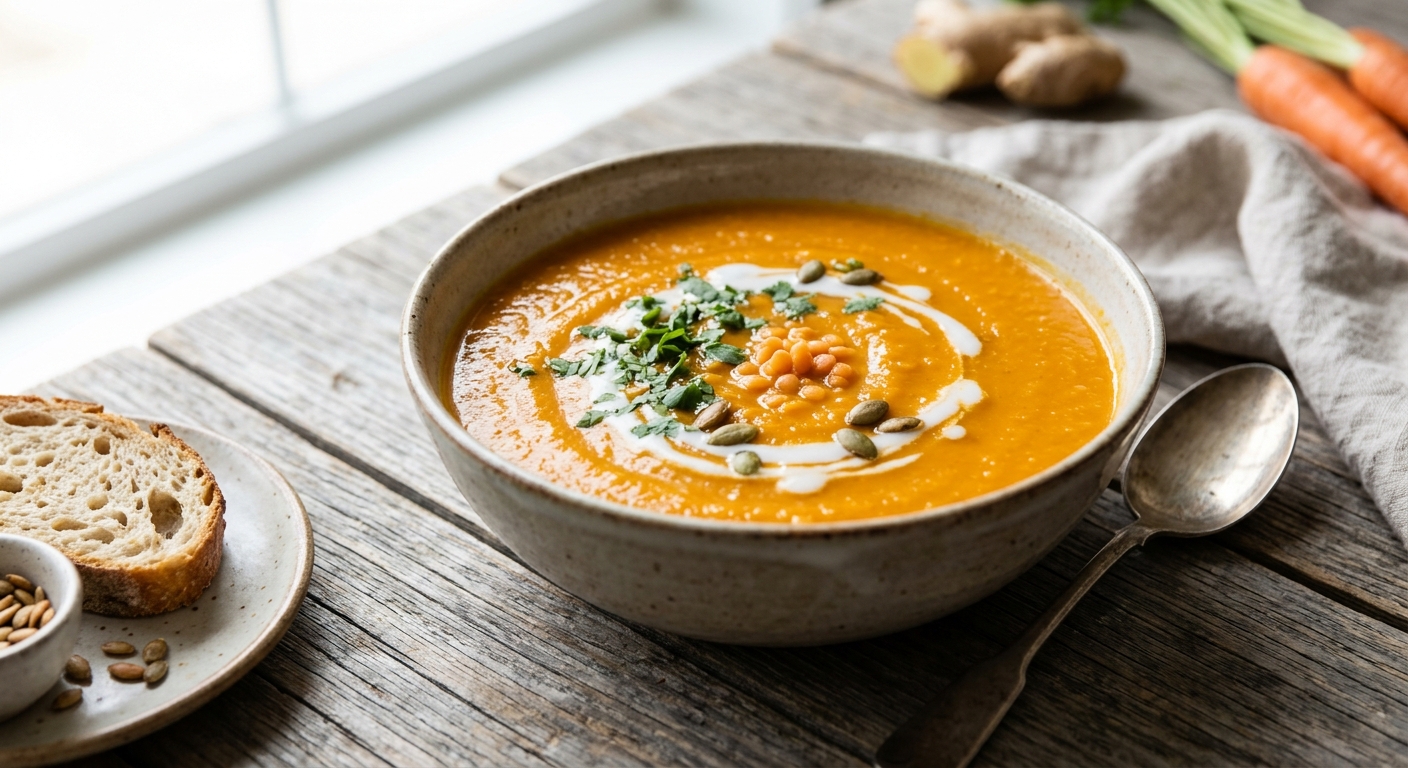
There are soups you make when you are hungry, and then there are soups you make when your body genuinely needs restoring. This Ginger Carrot Lentil Soup belongs firmly in the second category. Built on a foundation of red lentils and sweet carrots, sharpened with fresh ginger and brightened with turmeric, this bowl is not just warming on a cold evening. It is a carefully constructed anti-inflammatory intervention disguised as the most comforting thing you will eat all week. The vivid orange colour you see in the bowl is beta-carotene doing its job, and every spoonful delivers a measurable contribution toward your daily micronutrient targets.
Red lentils are the unsung hero of the plant-based kitchen. Unlike their green and brown cousins, they dissolve into a naturally creamy texture without any blending required, though a brief pass with an immersion blender elevates the soup to something genuinely restaurant-worthy. At roughly 230 calories per dry 100g and packed with 26g of protein, they contribute more iron per serving than most cuts of red meat on a gram-for-gram basis. Paired with carrots, which are among the richest dietary sources of beta-carotene on the planet, and with fresh ginger providing clinically studied gingerols and shogaols, this recipe earns its place at the top of any anti-inflammatory meal plan.
What sets this recipe apart on Calibrated Cuisine is that every ingredient has been chosen and measured so that a single serving clears meaningful thresholds across multiple micronutrients simultaneously. You are not just ticking an iron box or a vitamin A box. You are serving your body folate, potassium, magnesium, vitamin C, and a suite of polyphenols in a single bowl. Whether you make it on the stovetop on a weeknight, load the slow cooker before work, or have it on the table in under 30 minutes via the pressure cooker, the nutritional outcome is the same: calibrated, restorative, and genuinely delicious.
4
servings
Ingredients
- 200 gred lentils, rinsed and drained
- 500 gcarrots, peeled and roughly chopped (about 5 medium)
- 1 largeyellow onion, diced
- 4 clovesgarlic, minced
- 40 gfresh ginger, peeled and finely grated (about a 4cm knob)
- 2 tbspextra-virgin olive oil
- 1.5 tspground turmeric
- 1 tspground cumin
- 0.5 tspground coriander
- 0.25 tspcayenne pepper
- 1 can (400g)diced tomatoes, with juices
- 1200 mllow-sodium vegetable broth
- 30 mlfresh lemon juice (about 1 lemon)
- 15 gfresh cilantro, leaves and tender stems, roughly chopped
- —Colima Sea SaltMicroplastic Free Salt and freshly ground black pepper to taste
- —Plain coconut yogurt or a drizzle of extra-virgin olive oil, to serve (optional)
Instructions
Click on an item below to shop for the recommended items for this recipe on Amazon.
As an Amazon Associate, we earn from qualifying purchases.
- Heat the olive oil in a large Dutch oven or heavy-bottomed pot over medium heat. Once the oil shimmers, add the diced onion with a pinch of salt and cook, stirring occasionally, for 6 to 8 minutes until the onion is soft and translucent with lightly golden edges.
- Add the minced garlic and grated ginger to the pot. Stir constantly for 90 seconds, allowing the aromatics to bloom in the residual oil without burning. The mixture should smell intensely fragrant. Add the turmeric, cumin, coriander, and cayenne, and stir for a further 30 seconds to toast the spices directly in the oil.
- Add the chopped carrots and stir to coat them thoroughly in the spiced oil. Cook for 3 minutes over medium heat, letting the carrots begin to soften at the edges before adding any liquid.
- Pour in the rinsed red lentils, diced tomatoes with their juices, and the vegetable broth. Stir everything together, scraping any browned bits from the bottom of the pot. Bring to a vigorous boil over high heat, then reduce immediately to a gentle simmer. Partially cover the pot and cook for 20 to 22 minutes, stirring every 5 minutes, until the lentils have completely dissolved and the carrots are tender enough to crush easily against the side of the pot.
- Remove the pot from the heat. Use an immersion blender to blend the soup to your preferred texture, from a silky-smooth puree to a chunkier finish with some whole pieces of carrot remaining. Alternatively, carefully transfer half the soup to a blender, blend until smooth, and stir back into the pot.
- Stir in the fresh lemon juice and taste carefully for seasoning, adding salt and black pepper as needed. The lemon juice will brighten all the other flavours considerably. Ladle into warm bowls, top with fresh cilantro, and add a swirl of coconut yogurt or olive oil if desired. Serve immediately.
- In a small skillet, heat the olive oil over medium heat. Add the diced onion with a pinch of salt and cook for 5 minutes until softened. Add the garlic and ginger and stir for 60 seconds. Add the turmeric, cumin, coriander, and cayenne and stir for 30 seconds. This blooming step develops fat-soluble flavour compounds that do not develop as effectively in a low, wet cooking environment. Transfer the entire contents of the skillet to the slow cooker insert.
- Add the chopped carrots, rinsed red lentils, diced tomatoes with their juices, and vegetable broth directly to the slow cooker. Stir everything together to distribute the bloomed spice paste evenly throughout the liquid. Do not add the lemon juice or cilantro at this stage, as acid and fresh herbs added too early in slow cooking can become muted and bitter.
- Place the lid on the slow cooker and cook on Low for 7 to 8 hours, or on High for 3.5 to 4 hours. By the end of cooking, the lentils will have broken down almost entirely and the carrots should be completely tender. The broth will have reduced slightly and intensified in flavour.
- Turn off the slow cooker. Use an immersion blender to blend the soup directly in the insert to your preferred consistency, working carefully to avoid splashing the hot liquid. If you prefer a chunkier soup, simply mash some of the carrots against the side of the insert with the back of a large spoon.
- Stir in the fresh lemon juice and season generously with salt and black pepper. The soup will have a more concentrated flavour than the stovetop version, so add the lemon juice gradually and taste as you go. Serve topped with fresh cilantro and an optional swirl of coconut yogurt.
- Set your Instant Pot or electric pressure cooker to the Saute function on Normal heat. Add the olive oil and heat until it displays ‘Hot’. Add the diced onion and cook, stirring, for 4 minutes. Add the garlic and ginger and stir for 60 seconds. Add the turmeric, cumin, coriander, and cayenne and stir for 30 seconds to bloom the spices.
- Press Cancel to turn off the Saute function. Add the rinsed lentils, chopped carrots, diced tomatoes with their juices, and vegetable broth. Stir well and use a wooden spoon or silicone spatula to scrape up any browned bits stuck to the bottom of the insert, as these can trigger a burn warning during pressurisation. Ensure the liquid covers all solid ingredients.
- Secure the lid and set the pressure release valve to Sealing. Select Manual or Pressure Cook on High Pressure and set the timer for 10 minutes. The pot will take approximately 8 to 10 minutes to come up to pressure before the countdown begins.
- When the cook time ends, allow the pressure to release naturally for 10 minutes. After 10 minutes, carefully turn the valve to Venting to release any remaining steam. Open the lid away from you. The lentils will be completely dissolved and the carrots fully tender.
- Use an immersion blender to blend the soup to a smooth or semi-smooth consistency directly in the insert with the Instant Pot turned off and unplugged. Stir in the fresh lemon juice and season with salt and pepper. Serve immediately in warm bowls topped with fresh cilantro and an optional drizzle of olive oil.
- Preheat your oven to 200C (400F / Gas Mark 6). Arrange the chopped carrots and diced onion on a large rimmed baking sheet. Drizzle with the olive oil, sprinkle over the turmeric, cumin, coriander, cayenne, and a generous pinch of salt, then toss everything together until evenly coated. Spread in a single layer and roast for 25 to 30 minutes until the carrots are tender and caramelised at the edges and the onion is golden.
- In the final 5 minutes of roasting, scatter the minced garlic and grated ginger over the vegetables on the baking sheet and return to the oven. This brief roasting blooms the aromatics without burning them, adding a layer of flavour that stovetop sauteing cannot replicate.
- Carefully transfer all the roasted vegetables, garlic, and ginger to a large oven-safe Dutch oven with a lid. Add the rinsed lentils, diced tomatoes with their juices, and vegetable broth. Stir to combine, scraping any caramelised bits from the baking sheet into the pot using a splash of the broth.
- Cover the Dutch oven with its lid and place in the oven at the same 200C temperature. Bake for 35 to 40 minutes until the lentils are fully dissolved and have thickened the broth substantially. Check at the 30-minute mark and add a small splash of water or broth if the soup appears too thick.
- Remove from the oven and allow to rest, covered, for 5 minutes. Use an immersion blender to blend to your preferred consistency. Stir in the fresh lemon juice and season to taste with salt and black pepper. The roasted base will mean this version needs less salt than the others. Serve topped with fresh cilantro and a swirl of coconut yogurt.
Nutrition Breakdown
Per 1 serving (makes 4)
Vitamins & Minerals
% Daily Value based on a 2,000 calorie diet (FDA reference)
🧬 Essential Amino Acids
% of recommended daily intake (RDA) per serving
🛡 Antioxidant Profile
The Nutrition Science
The anti-inflammatory credentials of this soup rest on three distinct biochemical mechanisms working in parallel. First, fresh ginger contains a family of phenolic compounds called gingerols, which in their dried and heated form convert to the more potent shogaols. Both compounds have been demonstrated in peer-reviewed research to inhibit the enzyme cyclooxygenase-2 (COX-2), the same target as common non-steroidal anti-inflammatory drugs, though through gentler, food-dose mechanisms. A 40g serving of fresh ginger, as used in this recipe, provides a clinically meaningful dose consistent with amounts used in intervention studies showing reductions in serum C-reactive protein.
Second, the combination of turmeric and olive oil in this recipe is not accidental. Curcumin, the active polyphenol in turmeric, is famously poorly bioavailable when consumed in isolation, with absorption rates below 1% in some studies. However, curcumin is fat-soluble, and dissolving it in olive oil during the sauteing step increases its bioavailability significantly. The piperine naturally present in black pepper, added to taste at serving, can further enhance curcumin absorption by up to 2000% by inhibiting its rapid hepatic metabolism. This three-part delivery system, fat, heat, and piperine, is what separates a nutritionally calibrated anti-inflammatory recipe from simply adding turmeric to something for colour.
Third, the vitamin C from the fresh lemon juice plays a dual antioxidant and nutritional facilitation role. Red lentils provide a generous amount of non-haem iron, the plant-based form that is inherently less bioavailable than haem iron from animal sources. Ascorbic acid in the gut lumen chelates non-haem iron, reducing it from the ferric Fe3+ form to the more readily absorbed ferrous Fe2+ form, and can increase absorption by a factor of two to three. This is why the lemon juice is added at the end of cooking rather than during it: heat degrades ascorbic acid rapidly, and preserving its activity is essential for maximising the iron contribution of this soup.
Pro Tips
- Do not skip rinsing the red lentils thoroughly until the water runs clear. Rinsing removes surface starch that would otherwise make the soup gluey and the saponins that can cause digestive discomfort in sensitive individuals.
- Grate your ginger on a microplane rather than chopping it. Microplaned ginger integrates invisibly into the soup, delivering maximum surface area for flavour and bioactive compound release without fibrous ginger strings in the finished bowl.
- If you are making this ahead, the soup thickens considerably as it cools. Store it as a thick base and stir in additional vegetable broth when reheating to reach your preferred consistency. The flavour actually improves on day two as the spices continue to meld.

This soup is calling my name, especially with that iron content! I’m always excited to see lentils getting the spotlight since they’re such an underrated superfood, and red lentils in particular have such a creamy texture when blended. Have you ever experimented with adding a pinch of turmeric or black pepper to boost the bioavailability of that iron? I know ginger is already doing heavy anti-inflammatory lifting here, but I’ve found that combination really amplifies the functional benefits, plus it adds another layer of warmth.
What a lovely recipe! I’m actually planning to make this for my next community class, and I’m particularly excited about the iron bioavailability question Anna brought up, since I always teach that pairing plant-based iron with vitamin C sources makes such a difference in absorption. I’m curious whether you included citrus or tomato in the base, or if that’s something you’d recommend stirring in at the end? I used to make a similar lentil soup decades ago that was just… heavy, but I have a feeling the fresh ginger and that blending technique would transform it into something my students will actually be excited about.
This sounds wonderful, and I’m really intrigued by the iron bioavailability angle since red lentils can be tricky for those of us managing autoimmune conditions. Before I dive in, would you happen to know if this recipe includes any vitamin C rich ingredients to enhance iron absorption, or could I safely add something like fresh lemon juice without disrupting the flavor profile? I’m also curious whether the ginger is fresh or if you’ve tested the gingerol content since I’ve found that really matters for the anti-inflammatory benefit I’m chasing with my Hashimoto’s.