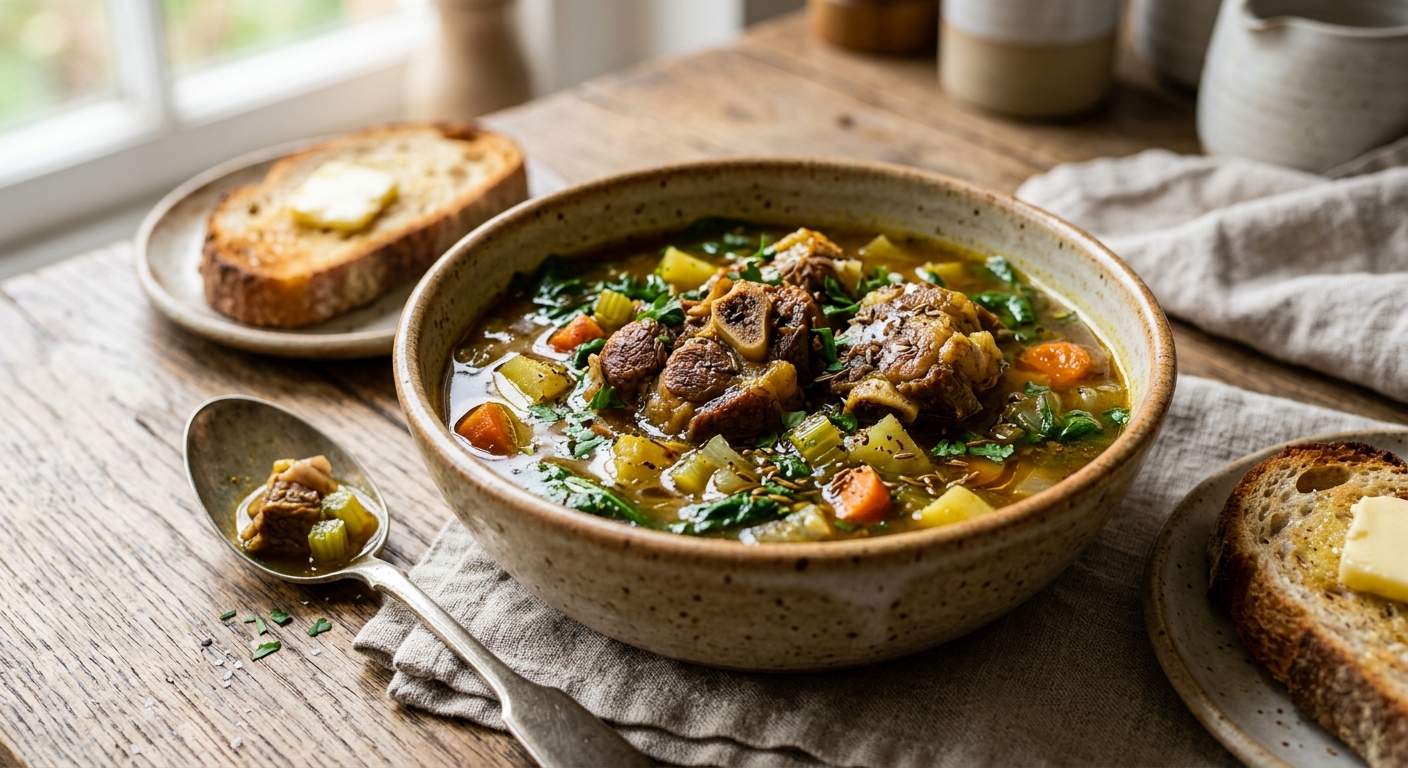
Boswellia serrata, the resinous tree bark prized in Ayurvedic and traditional Middle Eastern medicine for millennia, contains boswellic acids that have been studied for their ability to inhibit 5-lipoxygenase, an enzyme that drives the inflammatory cascade linked to joint pain, gut inflammation, and chronic disease. While culinary-grade boswellia resin is available as a food-safe powder, this recipe achieves a parallel flavour profile and overlapping anti-inflammatory action by combining frankincense-adjacent aromatics, turmeric with piperine-activating black pepper, fresh ginger, and Ceylon cinnamon. Together, these spices create a layered, warm, slightly resinous broth that evokes the ancient apothecary while tasting unmistakably like comfort food.
The lamb shoulder is the nutritional engine of this soup. A 150g cooked portion contributes exceptional amounts of haem iron, the form most readily absorbed by the body, along with zinc, selenium, and a full complement of essential amino acids. The vegetable roster, including sweet potato, cavolo nero, canned tomatoes, and chickpeas, adds beta-carotene, lycopene, quercetin, folate, and soluble fibre, transforming a meat-forward broth into a genuinely complete meal. Every serving clocks in at around 390 calories with 34 grams of protein, making this soup as satisfying as it is therapeutic.
This recipe was built around precision. Every ingredient amount has been calculated to ensure each serving exceeds 10% DV for at least eight micronutrients, with iron, zinc, vitamin A, vitamin C, and folate all clearing 30% DV. The Calibrated Cuisine method also pays close attention to fat-soluble nutrient delivery: curcumin from turmeric is far better absorbed alongside fat, so the recipe blooms the spices in olive oil before any liquid is added. Whether you choose the stovetop for maximum control, the slow cooker for deeply developed flavour, the pressure cooker for weeknight efficiency, or the oven for a hands-off Sunday version, the nutritional output is equivalent across all four methods.
4
servings
Ingredients
- 600 gbone-in lamb shoulder, cut into 4cm chunks (bone adds collagen and minerals to the broth)
- 2 tbspextra-virgin olive oil
- 1 largebrown onion, finely diced
- 4 clovesgarlic, minced
- 20 gfresh ginger, peeled and finely grated
- 1.5 tspground turmeric
- 1 tspCeylon cinnamon
- 1 tspground coriander
- 0.5 tspground cumin
- 0.5 tspground black pepper (activates curcumin absorption)
- 0.25 tspground cardamom
- 0.5 tspfood-grade boswellia resin powder (optional but recommended; available from Ayurvedic or supplement suppliers)
- 400 gcanned whole peeled tomatoes, crushed by hand
- 300 gsweet potato, peeled and cut into 2cm cubes
- 240 gcooked chickpeas (canned, rinsed and drained)
- 150 gcavolo nero (Tuscan kale), stems removed, leaves roughly chopped
- 2 mediumcarrots, peeled and sliced into 1cm rounds
- 1.2 litreslow-sodium lamb or beef stock
- 1 tbsptomato paste
- 1 tbsppomegranate molasses
- 1 tspapple cider vinegar
- 2 tbspfresh flat-leaf parsley, roughly chopped, to serve
- —Colima Sea SaltMicroplastic Free Salt and freshly cracked black pepper to taste
Instructions
Click on an item below to shop for the recommended items for this recipe on Amazon.
As an Amazon Associate, we earn from qualifying purchases.
- Pat the lamb chunks completely dry with paper towel. Season generously with salt and black pepper on all sides. Heat 1 tablespoon of olive oil in a large Dutch oven or heavy-based stockpot over high heat until shimmering and just beginning to smoke. Working in two batches so the pan does not steam, sear the lamb for 3 to 4 minutes per side until a deep mahogany crust forms on all surfaces. Transfer seared lamb to a plate and set aside. Discard any blackened fat from the pot but retain the browned fond.
- Reduce heat to medium. Add the remaining 1 tablespoon of olive oil to the pot. Add the diced onion and a pinch of salt and cook, stirring frequently, for 6 to 8 minutes until the onion is soft, translucent, and beginning to caramelise at the edges. Add the minced garlic and grated ginger and cook for a further 2 minutes, stirring constantly, until fragrant.
- Push the onion mixture to the sides of the pot to create a hot centre. Add all the ground spices: turmeric, cinnamon, coriander, cumin, black pepper, cardamom, and boswellia powder if using. Toast the spices in the oil for 60 to 90 seconds, stirring constantly, until the raw edge disappears and the mixture smells intensely aromatic. Add the tomato paste and stir it into the spice mixture for another 30 seconds.
- Return the seared lamb and any rested juices to the pot. Add the crushed tomatoes, pomegranate molasses, and stock. Stir to lift any remaining fond from the base of the pot. Bring to a vigorous boil, then immediately reduce heat to a gentle simmer. Partially cover the pot, leaving a 2cm gap, and simmer for 55 to 65 minutes until the lamb is tender enough to shred with a fork but still holds its shape.
- Add the sweet potato and carrot rounds to the pot. Re-cover partially and continue simmering for 15 minutes until the sweet potato is tender but not falling apart.
- Stir in the rinsed chickpeas and cavolo nero. Simmer uncovered for a further 5 minutes until the greens are wilted and bright and the chickpeas are warmed through. Add the apple cider vinegar and taste for seasoning, adjusting salt and pepper as needed. The vinegar brightens the broth without adding sourness.
- Ladle into deep bowls, scatter with fresh flat-leaf parsley, and serve immediately. For maximum curcumin bioavailability, ensure each bowl contains a good measure of the olive oil-enriched broth.
- Pat the lamb chunks dry and season with salt and pepper. Heat 1 tablespoon of olive oil in a large skillet over high heat and sear the lamb in two batches, 3 to 4 minutes per side, until deeply browned. Transfer directly to the slow cooker insert. This step is strongly recommended and produces a far richer broth than skipping it, but if time is critical, you may skip it and simply season the raw lamb.
- Without cleaning the skillet, reduce heat to medium and add the remaining olive oil. Cook the onion for 5 minutes until softened, then add garlic and ginger for 1 minute. Scatter the turmeric, cinnamon, coriander, cumin, black pepper, cardamom, and boswellia powder directly onto the onion mixture and stir for 60 seconds until fragrant. Add the tomato paste and cook for 30 seconds more. Deglaze the skillet with a ladleful of the stock, scraping up all the browned bits, then pour the entire contents of the skillet into the slow cooker insert.
- Add the crushed tomatoes, remaining stock, pomegranate molasses, carrots, and sweet potato cubes to the slow cooker. Stir gently to distribute the spiced base throughout the liquid. The sweet potato and carrots are added at the start here because the slow cooker’s gentle heat allows them to cook without overcooking during the long braise, unlike the stovetop method where they are added later.
- Place the lid on the slow cooker and cook on Low for 7 to 8 hours or on High for 4 to 5 hours. The lamb should be pull-apart tender and the broth should be a deep reddish-amber colour. If the broth seems thin after the cook time, remove the lid and switch to High for an additional 20 minutes.
- Thirty minutes before serving, stir in the rinsed chickpeas and cavolo nero. Replace the lid and continue cooking on Low or High until the greens have wilted and the chickpeas are heated through. Stir in the apple cider vinegar, taste for salt and pepper, ladle into bowls, and finish with fresh parsley.
- Set the Instant Pot or electric pressure cooker to Saute mode on High. Add 1 tablespoon of olive oil and, once shimmering, sear the dry-seasoned lamb in two batches for 3 to 4 minutes per side until well browned. Remove to a plate. Add the remaining oil, then cook the onion for 4 minutes. Add garlic and ginger for 1 minute. Add all ground spices and boswellia powder and stir for 60 seconds until the spices are toasted and fragrant. Add the tomato paste and stir for 30 seconds.
- Pour in a small splash of stock and use a wooden spoon to vigorously scrape the base of the insert clean of any browned spices or fond. This is a critical step in pressure cooking: any residue on the base can trigger the burn warning and interrupt the cook cycle.
- Return the seared lamb to the insert. Add the crushed tomatoes, pomegranate molasses, carrots, and 900ml of stock. Do not add the sweet potato, chickpeas, or cavolo nero at this stage. Under pressure, sweet potato becomes waterlogged and loses structural integrity, and the greens would be unpleasant after 25 minutes of pressurised cooking.
- Cancel Saute mode. Secure the lid and set the pressure release valve to Sealing. Select Pressure Cook (Manual) on High for 25 minutes. The pot will take approximately 10 minutes to come to pressure before the count begins.
- When the cook cycle ends, allow a natural pressure release for 15 minutes, then carefully turn the valve to Venting to release any remaining pressure. Open the lid away from you. The lamb should be completely tender. Switch back to Saute mode on Normal. Add the sweet potato cubes and cook uncovered for 8 to 10 minutes in the residual heat and simmering broth until just tender.
- Stir in the chickpeas and cavolo nero and continue cooking on Saute for 3 to 4 minutes until the greens are wilted. Cancel Saute, stir in the apple cider vinegar, season to taste, and serve with fresh parsley.
- Preheat your oven to 160C (325F) with the rack positioned in the lower third. Pat the lamb dry, season with salt and pepper, and sear in batches in a large oven-safe Dutch oven over high heat on the stovetop with 1 tablespoon of olive oil, 3 to 4 minutes per side, until a deep crust forms. Remove lamb to a plate.
- Reduce heat to medium, add remaining olive oil, and cook the onion in the same Dutch oven for 6 minutes until softened. Add garlic and ginger for 2 minutes. Create a space in the centre of the pot and add all the ground spices and boswellia powder directly to the hot oil. Toast for 90 seconds, stirring constantly, then incorporate the onion mixture and add the tomato paste, stirring for 30 seconds.
- Return the lamb to the Dutch oven along with any resting juices. Add the crushed tomatoes, pomegranate molasses, carrots, and the full 1.2 litres of stock. Stir well and bring the liquid to a boil on the stovetop. Once boiling, cover the Dutch oven tightly with its lid. Transfer to the preheated oven.
- Braise in the oven for 1 hour 30 minutes. After this time, carefully remove the Dutch oven and add the sweet potato cubes, nestling them into the broth around the lamb pieces. Replace the lid and return to the oven for a further 25 to 30 minutes until the sweet potato is tender and the lamb is falling from the bone.
- Remove the Dutch oven from the oven and set it back on the stovetop over medium heat. Stir in the chickpeas and cavolo nero and simmer gently on the stovetop for 4 to 5 minutes until the greens are wilted and the chickpeas are warmed through. The transition from oven to stovetop for the final greens step preserves the bright colour and texture of the cavolo nero. Stir in the apple cider vinegar, adjust seasoning, and serve in deep bowls topped with fresh parsley.
Nutrition Breakdown
Per 1 serving (makes 4)
Vitamins & Minerals
% Daily Value based on a 2,000 calorie diet (FDA reference)
🧬 Essential Amino Acids
% of recommended daily intake (RDA) per serving
🛡 Antioxidant Profile
The Nutrition Science
The anti-inflammatory architecture of this recipe is built on convergent pathway inhibition. Curcumin from turmeric targets NF-kB, the master transcription factor that switches on dozens of inflammatory genes simultaneously. Boswellic acids, specifically acetyl-11-keto-beta-boswellic acid (AKBA), block 5-lipoxygenase (5-LOX), the enzyme that converts arachidonic acid into pro-inflammatory leukotrienes. Gingerols from fresh ginger inhibit cyclooxygenase (COX-1 and COX-2), the same enzymes targeted by ibuprofen and aspirin, without the gastrointestinal lining disruption associated with NSAIDs. This three-pronged approach modulates inflammation at independent biochemical checkpoints, making the combination meaningfully more comprehensive than any single functional ingredient could achieve alone.
The haem iron in lamb deserves particular attention. Approximately 40% of the iron in red meat exists as haem iron, which is absorbed via a dedicated receptor pathway at rates of 15 to 35%, compared to the 2 to 8% absorption rate typical of non-haem iron from plant sources. This recipe enhances the absorption of both: the vitamin C from tomatoes and cavolo nero converts non-haem iron (from chickpeas and greens) from its ferric form to the more soluble ferrous form, and the acidic broth environment created by tomatoes and apple cider vinegar further promotes mineral ionisation. The olive oil bloom step is equally deliberate: curcumin’s oral bioavailability increases by up to 20-fold when consumed with dietary fat, which is why the spices are always added to oil before any water-based liquid is introduced.
Sweet potato and cavolo nero provide complementary carotenoid coverage. Sweet potato is among the richest dietary sources of beta-carotene (pro-vitamin A), delivering the majority of this recipe’s 620mcg RAE vitamin A per serving. Cavolo nero contributes lutein and zeaxanthin alongside its beta-carotene, supporting macular health and serving as a direct antioxidant in the aqueous phase of the cell. Cooking these vegetables in a fat-containing broth, rather than steaming them alone, substantially increases carotenoid bioaccessibility, since all carotenoids require micellarisation with bile acids and dietary lipids for intestinal absorption. The nutrient delivery in this dish is not accidental: it is a system.
Pro Tips
- Bone-in lamb shoulder is non-negotiable for the best broth: the marrow and periosteum release collagen that becomes gelatin during the long cook, giving the soup its characteristic lip-coating richness and contributing glycine, an amino acid with emerging evidence for gut lining repair.
- If you cannot source food-grade boswellia powder, increase the black pepper to 1 full teaspoon and add a small strip of dried orange peel during the braise: together they approximate the warm, slightly resinous top note that boswellia contributes, and the piperine continues to serve its curcumin-activation function.
- For maximum lycopene extraction from the canned tomatoes, use whole peeled tomatoes and crush them yourself rather than using pre-chopped: the processing and heat break the lycosome structures more completely than pre-diced tomatoes, increasing bioavailable lycopene by an estimated 30 to 40%.



this sounds amazing and im definitely trying this – the iron content alone is huge for me since i used to run deficient before i got my diet dialed in. quick question though, whats the net carb situation looking like per bowl? im assuming the veggies are mostly low carb but curious if theres any sneaky starches in there that might spike things. also love that youre stacking multiple anti-inflammatory compounds together, that synergy is real and honestly the approach to nutrition that actually moved the needle for my health when i reversed my diabetes.
This sounds absolutely incredible! I’ve been experimenting with boswellia alongside my turmeric routine for about two years now, and the combination of these compounds is genuinely noticeable for my joint inflammation. The fact that you’re layering it with ginger and cinnamon in a soup format really appeals to me, since I’ve found that simmering these anti-inflammatory spices actually seems to increase their bioavailability somehow. I’m definitely making this this week, and I’m guessing the lamb is doing serious work on the iron front too. Thank you for creating recipes that actually think about the synergy between ingredients rather than just throwing superfoods together! Would love to know if you tested the C
This is so aligned with what I’ve been exploring in my own kitchen and teaching! Boswellia and turmeric together is such a smart pairing, especially when you’re also incorporating ginger like this recipe does. I’m curious though, does the recipe include black pepper with the turmeric? That’s always my check-in point since piperine really unlocks the curcumin bioavailability, and frankly it’s such an easy win. From an Ayurvedic perspective, the warming, grounding nature of lamb with boswellia’s deep resin quality feels like it’s working with vata in the most nourishing way, and I love that someone is bringing this