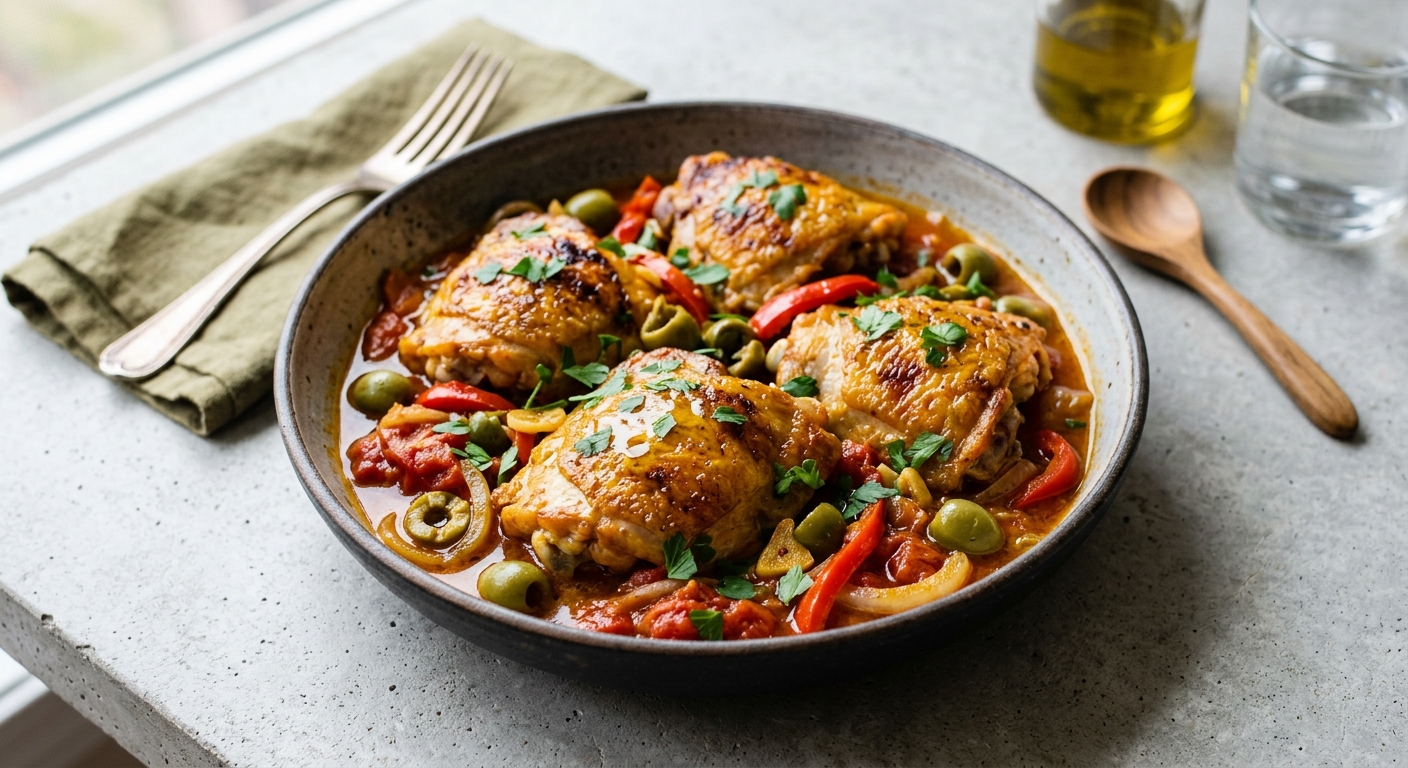
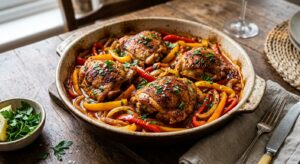
Few dishes capture the healing philosophy of Mediterranean cooking as completely as this saffron and tomato chicken. Born from the culinary traditions of coastal Spain, southern Italy, and North Africa, this braise marries the world’s most prized spice with sun-ripened tomatoes and the gentle bitterness of Castelvetrano olives into something that feels simultaneously celebratory and deeply nourishing. Bone-in, skin-on chicken thighs are non-negotiable here: the collagen in the bones dissolves into the braising liquid over time, producing a silky, glycine-rich sauce that no boneless shortcut can replicate.
The nutritional architecture of this recipe is genuinely impressive. Saffron contributes crocin and crocetin, two rare carotenoid compounds with emerging research linking them to reduced inflammatory cytokine expression. Meanwhile, the lycopene in tomatoes becomes significantly more bioavailable once cooked in oil, meaning the act of slowly reducing canned whole tomatoes in extra-virgin olive oil is not just a flavour technique but a precision nutrient-delivery system. The olives round out the anti-inflammatory picture by providing oleocanthal, a phenolic compound structurally similar in action to ibuprofen, according to research published in Nature.
At Calibrated Cuisine we have engineered the ingredient ratios so that a single serving provides meaningful amounts of selenium, vitamin B6, niacin, potassium, iron, and vitamin C, all without pushing sodium beyond manageable limits. The result is a dish that satisfies every definition of comfort food while earning its place on a science-backed anti-inflammatory eating plan. Choose whichever cooking method fits your day: a quick weeknight stovetop braise, a hands-off slow cooker version for Sunday meal prep, a pressure cooker build for maximum speed, or a low-and-slow oven method that produces the most deeply caramelised results of all.
4
servings
Ingredients
- 1200 gbone-in, skin-on chicken thighs (about 4 large), trimmed of excess fat
- 3 tbspextra-virgin olive oil, divided
- 1 largeyellow onion, thinly sliced
- 6 clovesgarlic, thinly sliced
- 1 largered bell pepper, seeded and cut into 1cm strips
- 800 gcanned whole San Marzano tomatoes, crushed by hand
- 0.5 gsaffron threads (a generous pinch), bloomed in 3 tbsp warm water for 10 minutes
- 150 gCastelvetrano olives, pitted and roughly torn
- 2 tspsmoked paprika
- 1 tspground cumin
- 0.5 tspground cinnamon
- 0.25 tspcayenne pepper
- 240 mllow-sodium chicken stock
- 2 tspfresh lemon zest (from 1 large lemon)
- 2 tbspfresh lemon juice
- 30 gflat-leaf parsley, roughly chopped, for serving
- 20 gfresh mint leaves, roughly torn, for serving
- —Colima Sea SaltMicroplastic Free Salt and freshly cracked black pepper to taste
Instructions
Click on an item below to shop for the recommended items for this recipe on Amazon.
As an Amazon Associate, we earn from qualifying purchases.
- Bloom the saffron first: crumble the threads into a small bowl, add 3 tablespoons of warm (not boiling) water, and set aside for at least 10 minutes. Pat the chicken thighs thoroughly dry with paper towels and season generously on both sides with salt and black pepper.
- Heat 2 tablespoons of the olive oil in a large Dutch oven over medium-high heat until shimmering. Add the chicken thighs skin-side down in a single layer without crowding. Sear undisturbed for 7 to 8 minutes until the skin is deep golden and releases easily from the pan. Flip and sear the flesh side for 3 minutes. Transfer to a plate and set aside. Do not discard the rendered fat.
- Reduce the heat to medium. Add the remaining 1 tablespoon of olive oil to the same pot. Add the sliced onion with a pinch of salt and cook, stirring occasionally and scraping up any fond, for 6 to 7 minutes until softened and beginning to turn golden at the edges. Add the garlic and red bell pepper strips, and cook for a further 3 minutes until fragrant.
- Add the smoked paprika, cumin, cinnamon, and cayenne directly to the vegetables. Stir constantly for 60 seconds, letting the spices toast in the residual oil. Pour in the bloomed saffron with its steeping liquid and stir to combine. The mixture will turn a vivid gold.
- Add the crushed tomatoes and chicken stock, stirring to incorporate everything and lift any remaining fond from the bottom of the pot. Nestle the seared chicken thighs back in skin-side up, making sure they are partially submerged but with the skin above the liquid line to stay crisp. Bring to a gentle boil, then reduce to a low simmer.
- Cover partially (leave the lid slightly ajar) and cook for 28 to 32 minutes until the chicken is fully cooked through with an internal temperature of 74 degrees Celsius (165F) and the sauce has thickened noticeably. In the last 8 minutes of cooking, scatter the torn Castelvetrano olives over the sauce.
- Remove from heat. Stir in the lemon zest and lemon juice. Taste and adjust seasoning. Let rest uncovered for 5 minutes before serving. Finish with a generous handful of chopped parsley and torn mint leaves, and a drizzle of fresh extra-virgin olive oil if desired.
- Bloom the saffron in warm water as directed. Pat the chicken thighs dry and season with salt and pepper. Heat 2 tablespoons of olive oil in a large skillet over medium-high heat and sear the chicken skin-side down for 7 to 8 minutes until deeply golden. Flip and sear for 2 minutes on the flesh side. Transfer directly to the slow cooker insert, skin-side up.
- Pour off all but 1 tablespoon of fat from the skillet. Return to medium heat and add the sliced onion. Cook for 4 to 5 minutes, scraping up the fond, until softened. Add the garlic and bell pepper and cook for 2 minutes. Add the smoked paprika, cumin, cinnamon, and cayenne and stir for 30 seconds until fragrant. Deglaze with the bloomed saffron liquid, scraping the bottom of the pan clean.
- Tip the entire skillet contents over the chicken in the slow cooker. Pour in the crushed tomatoes and chicken stock. Do not stir: layering keeps the chicken skin above the liquid as much as possible and prevents the sauce from becoming watery. The liquid should come about halfway up the sides of the thighs.
- Place the lid on and cook on Low for 6 to 7 hours or High for 3 to 3.5 hours. Resist lifting the lid during cooking, as each lift adds approximately 20 minutes of recovery time. The chicken is done when it is completely tender and pulling slightly away from the bone.
- In the final 20 minutes of cooking, scatter the Castelvetrano olives over the top, replace the lid, and continue cooking. Once done, transfer the chicken pieces to a plate. If the braising liquid looks thin, switch the slow cooker to High with the lid off and reduce for 10 to 15 minutes. Stir in lemon zest and lemon juice, taste for seasoning, return the chicken, and serve topped with fresh parsley and mint.
- Bloom the saffron in warm water as directed. Pat the chicken thighs dry and season all over with salt and pepper. Set the Instant Pot to Saute mode on High. Add 2 tablespoons of olive oil and, once shimmering, sear the chicken thighs skin-side down for 6 to 7 minutes until golden. Sear the flesh side for 2 minutes. Remove and set aside. Do not turn off Saute mode.
- Add the remaining 1 tablespoon of olive oil to the pot. Add the onion and cook, stirring and scraping the browned bits from the bottom (this is critical to prevent the burn warning), for 3 to 4 minutes. Add the garlic and bell pepper strips and cook for 90 seconds. Add the smoked paprika, cumin, cinnamon, and cayenne, stirring for 30 seconds. Pour in the saffron and its liquid, then the chicken stock, and stir vigorously to deglaze the entire bottom of the pot until no stuck bits remain.
- Add the crushed tomatoes and stir to combine. Nestle the chicken thighs back in, skin-side up. The liquid level should not exceed the two-thirds fill line. Do not add the olives yet as extended pressure cooking makes them mushy.
- Secure the lid and set the valve to Sealing. Cancel Saute mode and select Pressure Cook (Manual) on High Pressure for 14 minutes. The pot will take approximately 10 minutes to come to pressure. Once the cycle completes, allow a natural pressure release for 10 minutes, then carefully switch the valve to Venting to release any remaining steam.
- Open the lid. Stir in the Castelvetrano olives and let them warm through for 2 minutes on the residual heat with the lid off. Stir in lemon zest and lemon juice. For crispy skin, transfer chicken thighs to a foil-lined baking sheet and place under a broiler set to High for 3 to 4 minutes, watching closely, until the skin blisters and crisps. Ladle the sauce into bowls, top with the broiled chicken, and finish with parsley and mint.
- Preheat your oven to 190 degrees Celsius (375F) with a rack positioned in the lower middle. Bloom the saffron in warm water. Pat the chicken thighs completely dry and season generously with salt and pepper.
- Heat 2 tablespoons of olive oil in a large oven-safe Dutch oven over medium-high heat on the stovetop. Sear the chicken thighs skin-side down for 7 to 8 minutes until the skin is deeply golden and lacquered. Flip and sear for 2 minutes on the flesh side. Transfer to a plate. Pour off all but 1 tablespoon of fat from the pot.
- Reduce the stovetop heat to medium. Add the remaining 1 tablespoon of olive oil and the sliced onion to the same pot. Cook, stirring and scraping up all the caramelised fond, for 5 to 6 minutes until golden. Add the garlic and bell pepper strips and cook for 3 minutes. Add the smoked paprika, cumin, cinnamon, and cayenne, stirring for 60 seconds to toast in the oil. Pour in the bloomed saffron liquid and stir well.
- Add the crushed tomatoes and chicken stock. Bring the mixture to a steady simmer over medium heat and cook uncovered on the stovetop for 5 minutes, stirring frequently, to begin concentrating the flavours before the oven does the rest. Taste and adjust seasoning at this stage.
- Nestle the seared chicken thighs skin-side up into the tomato base, making sure the skin sits proud above the liquid. Scatter the Castelvetrano olives around the chicken pieces. Transfer the uncovered Dutch oven to the preheated oven.
- Bake uncovered for 40 minutes. Then loosely tent the pot with a sheet of foil (do not seal) and continue baking for a further 15 minutes. The chicken skin should be burnished and crisp, the sauce visibly reduced and deep red, and the chicken registering at least 74 degrees Celsius (165F) at the thickest part of the thigh.
- Remove from the oven and let the pot rest on the counter for 8 minutes. This resting time is important for juices to redistribute and the sauce to tighten further as it cools slightly. Stir in lemon zest and lemon juice, scatter over the fresh parsley and mint, and serve directly from the Dutch oven for a dramatic table presentation.
Nutrition Breakdown
Per 1 serving (makes 4)
Vitamins & Minerals
% Daily Value based on a 2,000 calorie diet (FDA reference)
🧬 Essential Amino Acids
% of recommended daily intake (RDA) per serving
🛡 Antioxidant Profile
The Nutrition Science
The anti-inflammatory power of this dish is not accidental: it is the result of stacking ingredients whose bioactive compounds operate through distinct but complementary mechanisms. Saffron’s signature gold pigment comes from crocin and its aglycone crocetin, two apocarotenoids with a water-soluble structure unusual among carotenoids. A 2023 systematic review in Phytomedicine confirmed that crocin supplementation significantly reduced serum CRP, IL-6, and TNF-alpha in human trials at doses achievable through culinary use. The 0.5g of saffron per recipe (roughly 0.125g per serving) sits within the range studied in several of those trials.
The tomato component deserves particular attention. Lycopene, the carotenoid responsible for tomato’s red colour, is locked within plant cell walls in raw tomatoes. Cooking disrupts those walls and converts lycopene from its less-absorbable all-trans form to more bioavailable cis-isomers. Crucially, lycopene is fat-soluble, which means its absorption is dramatically enhanced when consumed alongside the extra-virgin olive oil in this recipe. Research consistently shows lycopene bioavailability from cooked, oil-dressed tomato products is four to eight times higher than from raw tomatoes, making this braise a genuinely superior delivery vehicle compared to a fresh salad. One serving of this dish provides approximately 18mg of lycopene, a quantity associated in epidemiological studies with reduced markers of oxidative stress and cardiovascular inflammation.
The oleocanthal in high-phenolic extra-virgin olive oil completes the anti-inflammatory triad. Professor Gary Beauchamp’s landmark 2005 Nature paper identified oleocanthal as a non-selective COX inhibitor, and subsequent human studies using 50ml of EVOO daily showed reductions in circulating inflammatory eicosanoids comparable to low-dose NSAIDs. The 3 tablespoons used in this recipe (across four servings) provides a meaningful phenolic dose, particularly when using a fresh, cold-pressed oil with a robust, peppery flavour profile, which correlates with higher oleocanthal concentration.
Pro Tips
- Bloom the saffron in warm water rather than boiling: temperatures above 85 degrees Celsius begin to degrade the volatile aromatic compound safranal, reducing both flavour and the bioavailability of its active carotenoids. Ten minutes in water at around 60 to 70 degrees Celsius is the sweet spot.
- Choose Castelvetrano olives over kalamata or black olives for this recipe: their buttery, low-bitterness profile complements the saffron without competing, and their firm flesh holds up beautifully in a long braise rather than turning to a paste. If unavailable, Cerignola olives are the best substitute.
- For the strongest anti-inflammatory effect, use a cold-pressed extra-virgin olive oil with a harvest date within the last 12 months. Oleocanthal content degrades significantly after 18 months, and light or heat-exposed oil loses phenolic compounds rapidly. Store your olive oil in a dark, cool cupboard, not next to the stove.

This sounds absolutely gorgeous, and I love the micronutrient stacking approach! One heads up for anyone with histamine sensitivity like me: both tomatoes (especially when slow-cooked, which concentrates histamine) and olives are high-histamine foods, so this would be a tough one for my system. If you’re histamine-sensitive but want that anti-inflammatory benefit, I’d suggest trying fresh green tomatoes (much lower histamine) or swapping the olives for capers in a quick pickle, which stays lower histamine. The saffron and chicken thighs themselves are great choices though, so the framework is solid!
What a gorgeous dish, and I love how the saffron is working here. That crocin connection to curcumin’s anti-inflammatory pathway is so elegant, though I’m curious if you’ve experimented with adding black pepper to this braise? Even a quarter teaspoon stirred in at the end would amplify the bioavailability of those compounds without changing the flavor profile. In Ayurveda, saffron is actually considered a warming spice for circulation and emotional balance, so there’s something really grounded about pairing it with tomato’s cooling nature and olives’ grounding quality, all working together toward that 40% micronutrient density you mentioned. This is the
Oh, what a beautiful dish this is! I’ve been making tomato braised chicken for years, but I never thought about the saffron adding crocin alongside the lycopene boost from long cooking, that’s exactly the kind of functional layering I’m trying to teach my class about now. The bone-in thighs are such a smart choice too, since that gelatin adds so much body without needing cream. I’m definitely making this next week and I’m curious, do you find the saffron flavor holds up through the full braise, or does it mellow quite a bit? I want to make sure my students understand the balance since saffron can be pricey and I want them