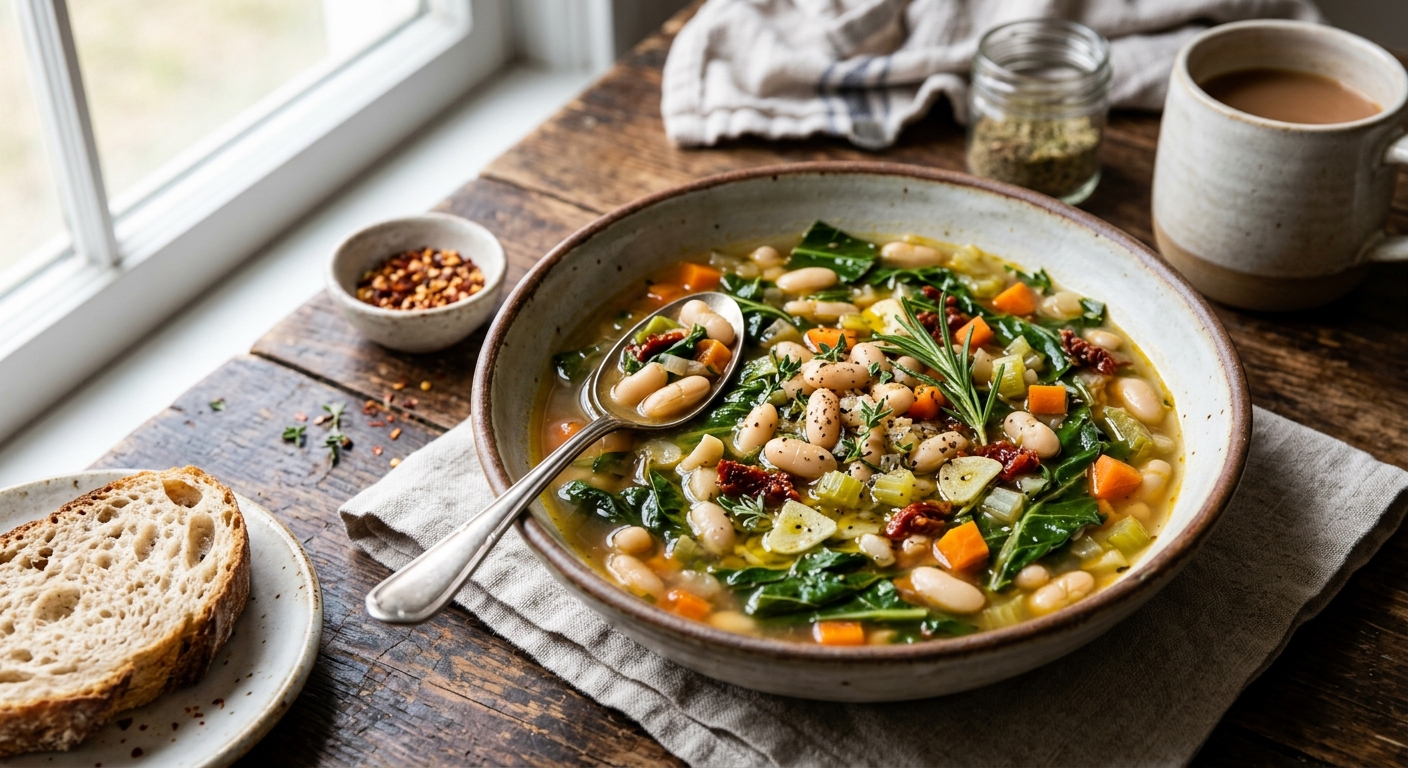
Most people reach for a glass of milk when they think about calcium, but collard greens have quietly been one of the most calcium-dense vegetables on the planet for centuries. A single 190g serving of cooked collard greens delivers roughly 266mg of calcium in a highly bioavailable form, with oxalate levels low enough that absorption rates rival those of dairy. Paired with cannellini beans, which bring an additional 130mg of calcium per cup alongside slow-digesting resistant starch and a complete spectrum of bone-supportive minerals, this soup becomes a genuinely functional meal for skeletal health.
What elevates this recipe beyond a simple health bowl is the layered cooking technique: a soffritto base of olive oil, onion, celery, and garlic builds deep umami before any liquid is added, sun-dried tomatoes and a parmesan rind (optional but transformative) dissolve into the broth over cooking time, and a finishing splash of lemon juice brightens every flavor simultaneously. The result is a soup that tastes like it has been simmering all afternoon even when made in under an hour on the stovetop, because every ingredient is doing deliberate, calibrated work.
On the Calibrated Cuisine bone and joint scale, this recipe is a standout. Calcium and phosphorus work in tandem here, while vitamin K1 from the collard greens activates osteocalcin, the protein that anchors calcium into bone matrix. Magnesium from both the beans and greens regulates parathyroid hormone to prevent calcium from being pulled out of bone. This is not a bowl that merely contains good nutrients; it is one where the nutrients interact in ways that modern bone metabolism research consistently endorses.
4
servings
Ingredients
- 400 gcollard greens, stems removed, leaves sliced into 1cm ribbons
- 800 gcanned cannellini beans (2 x 400g cans), drained and rinsed
- 1400 mllow-sodium vegetable broth
- 1 mediumyellow onion, finely diced
- 4 clovesgarlic, thinly sliced
- 3 stalkscelery, finely diced
- 2 mediumcarrots, peeled and diced into 1cm cubes
- 60 gsun-dried tomatoes (not oil-packed), roughly chopped
- 400 gcanned diced tomatoes with their juices
- 3 tbspextra-virgin olive oil
- 1 tspsmoked paprika
- 1 tspground cumin
- 0.5 tspred pepper flakes
- 1 pieceparmesan rind, about 6cm (optional, omit for fully vegan)
- 1 tbspfresh lemon juice
- 10 gfresh flat-leaf parsley, roughly chopped
- —Colima Sea SaltMicroplastic Free Salt and freshly ground black pepper to taste
Instructions
Click on an item below to shop for the recommended items for this recipe on Amazon.
As an Amazon Associate, we earn from qualifying purchases.
- Heat the olive oil in a large Dutch oven or heavy-bottomed pot over medium heat. Once shimmering, add the diced onion and celery with a generous pinch of salt. Cook, stirring occasionally, for 7 to 8 minutes until the vegetables are soft, translucent, and beginning to develop light golden edges.
- Add the sliced garlic, smoked paprika, ground cumin, and red pepper flakes directly to the soffritto. Stir constantly for 90 seconds until the garlic is fragrant and the spices are bloomed in the oil. Do not allow the garlic to brown. Add the diced carrots and stir to coat in the spiced oil for 2 minutes.
- Pour in the canned diced tomatoes and the sun-dried tomatoes. Use your spoon to scrape any fond from the bottom of the pot. Increase heat to medium-high and cook the tomato mixture for 4 to 5 minutes, stirring regularly, until it thickens slightly and the raw tomato smell is cooked off.
- Pour in the vegetable broth and nestle the parmesan rind (if using) into the liquid. Bring to a vigorous boil, then reduce heat to maintain a steady simmer. Add the drained cannellini beans and stir to combine. Simmer uncovered for 15 minutes, allowing the broth to concentrate slightly.
- Add the collard green ribbons in three batches, stirring each batch down into the liquid before adding the next. The volume will look large at first but the greens will wilt quickly. Once all greens are incorporated, continue simmering for 12 to 15 minutes until the collards are tender but retain a slight texture and their deep green color.
- Remove and discard the parmesan rind. Stir in the fresh lemon juice and taste for seasoning, adjusting salt and pepper as needed. Ladle into bowls and finish with chopped parsley and a drizzle of good olive oil.
- Perform the soffritto directly in the slow cooker insert if it has a saute function, or in a skillet on the stovetop. Heat the olive oil over medium heat, add onion, celery, and a pinch of salt, and cook for 7 minutes until soft. Add the garlic, smoked paprika, cumin, and red pepper flakes and cook for 90 seconds. Add carrots and stir for 2 minutes. If using a skillet, transfer the entire soffritto to the slow cooker insert now.
- Add the canned diced tomatoes, sun-dried tomatoes, cannellini beans, and vegetable broth to the slow cooker. Stir everything to combine, then nestle the parmesan rind (if using) into the liquid. Do not add the collard greens yet.
- Secure the lid and cook on Low for 6 hours or on High for 3 hours. During this long cook, the beans will begin to break down at the edges, naturally thickening the broth, and the sun-dried tomatoes will fully dissolve into the base, building body and umami.
- After the initial cook time, remove the lid and use the back of a large spoon to gently crush roughly one-quarter of the beans against the side of the insert. This step, not available in other methods, creates a naturally creamy texture without any blending or added thickeners.
- Add the collard green ribbons and stir them into the hot liquid. Replace the lid and cook for a further 45 minutes on Low or 25 minutes on High, until the greens are tender and silky but still bright green.
- Remove the parmesan rind. Stir in the lemon juice and taste for seasoning. Finish with fresh parsley. The soup will have a slightly thicker, more stew-like consistency than the stovetop version, which is ideal for serving over a small portion of cooked farro or crusty bread.
- Set the Instant Pot or electric pressure cooker to Saute mode on Normal heat. Add the olive oil and heat until shimmering. Add the onion, celery, and a pinch of salt and saute for 5 minutes, stirring frequently, until softened. Add the garlic, smoked paprika, cumin, and red pepper flakes and stir for 1 minute.
- Add the carrots, canned diced tomatoes, and sun-dried tomatoes. Stir and scrape the bottom of the insert thoroughly to ensure no fond is stuck, as any residue on the bottom can trigger a burn warning during pressurisation. Cook on Saute for 2 minutes.
- Cancel the Saute function. Add the vegetable broth and stir well, again scraping the bottom clean. Add the cannellini beans and nestle in the parmesan rind (if using). Add the collard green ribbons on top and gently press them into the liquid without stirring. Because the pressure environment will cook the greens rapidly and evenly, they can go in at the start unlike the slow cooker method.
- Secure the lid and set the pressure valve to Sealing. Cook on Manual High Pressure for 8 minutes. When the cook cycle ends, allow the pressure to release naturally for 10 minutes, then carefully turn the valve to Venting to release any remaining pressure.
- Open the lid away from you. Remove the parmesan rind. The collard greens will be completely tender and the broth will be richly flavored. If you prefer a thicker consistency, use an immersion blender to briefly pulse 3 to 4 times directly in the pot to partially blend without fully pureeing. Stir in the lemon juice, taste for seasoning, and finish with parsley.
- Preheat your oven to 160C (325F) with a rack in the lower-middle position. On the stovetop over medium heat, warm the olive oil in a large oven-safe Dutch oven. Add onion, celery, and a pinch of salt and cook for 8 minutes until deeply softened. Add garlic, smoked paprika, cumin, and red pepper flakes and cook for 2 minutes, stirring constantly.
- Add the carrots, canned diced tomatoes, and sun-dried tomatoes to the pot. Raise the heat to medium-high and cook, stirring, for 5 minutes until the tomato mixture reduces and begins to caramelise at the edges of the pot. This step is unique to the oven method: you want slightly more concentrated flavors in the base before the long oven braise, as the sealed environment will hold rather than evaporate moisture.
- Pour in the vegetable broth and stir to deglaze completely. Add the cannellini beans and nestle in the parmesan rind (if using). Add all the collard green ribbons and press them gently into the liquid. The greens do not need to be fully submerged at this point as the steam inside the sealed Dutch oven will wilt and cook them evenly from the start.
- Bring the pot to a low boil on the stovetop, then cover tightly with the Dutch oven lid and transfer to the preheated oven. Braise for 1 hour 15 minutes. At the 45-minute mark, remove the lid briefly, stir once, check that the liquid is barely simmering (adjust oven temperature by 10 degrees if needed), and replace the lid.
- After 1 hour 15 minutes, remove the pot from the oven using oven mitts. Remove the parmesan rind. The soup will have a beautifully silky broth with deeply tender collard greens. Stir in the lemon juice, taste carefully for salt and pepper, and allow the soup to rest with the lid off for 5 minutes before serving. Finish with parsley and a drizzle of olive oil.
Nutrition Breakdown
Per 1 serving (makes 4)
Vitamins & Minerals
% Daily Value based on a 2,000 calorie diet (FDA reference)
🧬 Essential Amino Acids
% of recommended daily intake (RDA) per serving
🛡 Antioxidant Profile
The Nutrition Science
Bone mineralization is governed by a network of nutrients that must be present simultaneously, and this soup is architected around that principle. Calcium is the structural mineral that makes up roughly 70% of bone mass, but dietary calcium is only useful if it can be absorbed and then correctly deposited. Collard greens belong to the Brassica family, which unlike spinach, contains very low concentrations of oxalic acid. Oxalates bind calcium in the gut and prevent absorption. Research published in the American Journal of Clinical Nutrition has measured the fractional absorption of calcium from collard greens at approximately 52%, compared to roughly 32% from whole milk, making these greens a genuinely superior calcium source by absorption efficiency.
Vitamin K1, present at an extraordinary 425% of the daily value per serving, activates osteocalcin via gamma-carboxylation. Undercarboxylated osteocalcin cannot bind calcium ions in bone matrix, regardless of how much calcium is consumed. This is why populations with high dairy intake but low green vegetable consumption do not always show expected bone density advantages: calcium without vitamin K2 or K1 conversion is inefficiently deposited. Cannellini beans contribute phosphorus, which combines with calcium in a roughly 2:1 ratio to form hydroxyapatite, the actual crystalline mineral that hardens bone tissue. The magnesium from both the beans and greens modulates parathyroid hormone, the signal that would otherwise instruct the kidneys to excrete calcium when blood levels are adequate.
The iron in this soup benefits significantly from the cooking method itself. Vitamin C from the collard greens and tomatoes is present in the same bowl as the non-heme iron from the beans, and the acidic tomato environment maintains the iron in its more absorbable ferrous (Fe2+) form. Studies consistently show that consuming 25mg or more of vitamin C alongside non-heme iron can increase absorption by a factor of two to four. At 47% of the daily vitamin C value per serving, this soup provides well above that threshold, making its 38% daily value iron figure considerably more bioavailable than the raw number suggests.
Pro Tips
- Do not skip removing the collard stems: stems are woody, cook unevenly, and their higher fiber concentration creates a noticeably bitter note if left in the soup. Stack the leaves, roll them into a tight cigar shape, and slice crosswise into 1cm ribbons in under two minutes.
- The parmesan rind is technically optional but functionally important for depth. It releases glutamates during cooking that add savory complexity without changing the nutritional profile meaningfully. If you want a fully vegan version, add 1 tablespoon of white miso paste stirred in at the end to replicate that umami dimension.
- This soup thickens considerably as it cools because the beans continue releasing starch. When reheating leftovers, add 60 to 100ml of water or broth per serving and stir over medium heat. The flavor actually improves on day two as the collard greens and beans exchange flavors fully with the broth.
Great calcium-focused recipe, but I’m curious about the protein punch here. Cannellini beans are solid, but are you hitting around 25-30g of protein per serving? At 62, I learned the hard way that I need roughly 30-35g per meal to reliably trigger muscle protein synthesis, and collard greens alone won’t get me there. What’s the actual protein count on this, and would you consider adding something like a poached egg or some hemp seeds to push the leucine content higher for us older folks trying to preserve muscle while we eat smart?
This is hitting the exact intersection I’ve been tracking obsessively during perimenopause, so thank you. I’ve noticed my body holds onto muscle way better when I’m getting solid protein with calcium-rich foods rather than treating them separately, and this soup does both without the dairy bloat I started getting around 48. The collard greens alone are such an underrated source of absorbable calcium plus that vitamin K that matters for bone density, not just bone building. Steve, I’m curious if you’re finding 30-35g per meal is helping stabilize your energy and hot flashes too, or is it purely a muscle retention thing for you?
Steve nailed it here, and I’d add that while cannellini beans bring a solid ~15g protein per cooked cup, the real win is their DIAAS score of around 0.75, meaning your body actually absorbs and utilizes most of that. But you’re right to push for 25-30g per serving if that’s your target, especially at 62, which is honestly smart planning. I’d suggest pairing this bowl with a quarter cup of hemp seeds (another 10g, complete amino acid profile) or finishing with a poached egg, which bumps you to ~28g while adding that leucine hit your muscles need post-workout. The collards are the nutritional