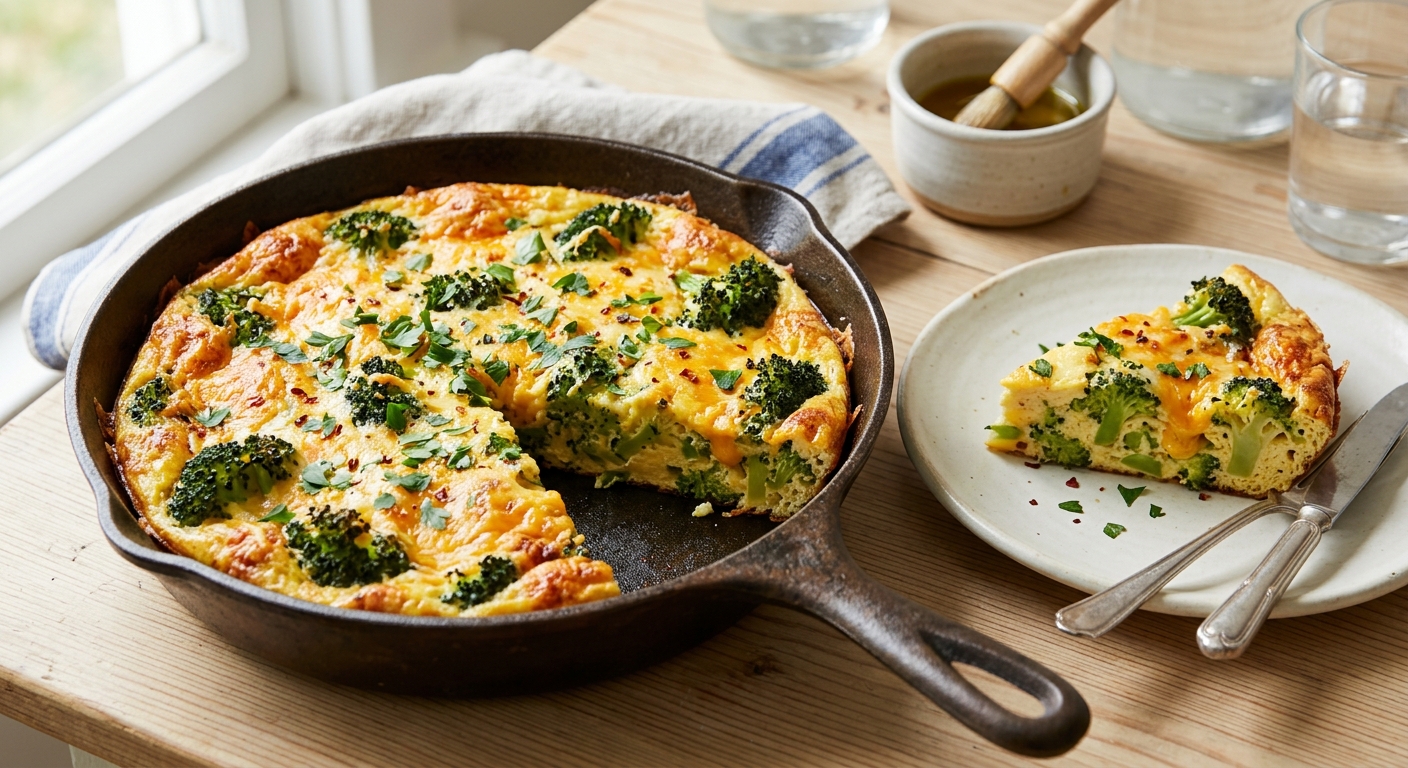
Most people chase calcium without thinking about the nutrient that unlocks it. Vitamin D is the key that opens the intestinal door, allowing calcium to pass from your digestive tract into your bloodstream and ultimately into your bones. This Cheddar and Broccoli Frittata is designed from the ground up around that biological partnership: eggs supply meaningful vitamin D alongside complete protein, sharp cheddar delivers a dense hit of highly bioavailable calcium and additional vitamin D, while broccoli contributes vitamin K2-precursor compounds and magnesium, two cofactors that direct calcium into bone tissue rather than soft tissue. The result is a single dish that works like a coordinated supplement protocol, except it also happens to taste extraordinary.
Technically, a frittata sits at the intersection of a Spanish tortilla and a baked egg custard. The stovetop method builds a lacy, golden crust before a short oven finish sets the top without overcooking the interior. The slow cooker version produces a surprisingly custardy, almost souffle-like texture with zero risk of a scorched bottom. The pressure cooker method steam-bakes the frittata in under 20 minutes, yielding a silky, uniform set that slices cleanly. The oven method treats the frittata more like a savory egg cake, baked in a cast iron skillet for a deeply caramelized base and a puffed, spoonable top. Each technique extracts something different from the same ingredients.
Sharp cheddar aged 12 months or more is deliberately specified here because the aging process concentrates calcium content while producing a more assertive flavor, meaning you get more nutritional impact from a smaller quantity of cheese. The broccoli is cut into small florets and briefly blanched before going into the egg mixture, which softens the cell walls just enough to release sulforaphane precursors without destroying the vitamin C that supports collagen synthesis in bone matrix. Every decision in this recipe has a reason.
4
servings
Ingredients
- 8 largeeggs, free-range (preferably vitamin D-enriched)
- 300 gbroccoli florets, cut into small bite-sized pieces
- 120 gsharp aged cheddar, grated (about 1 cup firmly packed)
- 60 mlwhole milk
- 1 mediumyellow onion, finely diced
- 3 clovesgarlic, minced
- 2 tbspextra-virgin olive oil
- 1 tspDijon mustard
- 0.5 tspsmoked paprika
- 0.25 tspfreshly grated nutmeg
- 1 tbspfresh chives, thinly sliced, for garnish
- —Colima Sea SaltMicroplastic Free Salt and freshly ground black pepper to taste
Instructions
Click on an item below to shop for the recommended items for this recipe on Amazon.
As an Amazon Associate, we earn from qualifying purchases.
- Position an oven rack 15 cm (6 inches) below the broiler element and preheat your broiler to high. Bring a medium saucepan of salted water to a boil. Blanch the broccoli florets for 90 seconds, then drain and transfer immediately to a bowl of ice water to stop cooking. Drain well and pat dry with a clean towel. Excess moisture is the enemy of a clean set.
- In a large bowl, whisk together the eggs, whole milk, Dijon mustard, smoked paprika, nutmeg, half of the grated cheddar, three-quarters of a teaspoon of salt, and a generous amount of black pepper. Whisk vigorously for 90 seconds until the mixture is slightly frothy and uniform in color. Set aside.
- Heat the olive oil in a 10-inch oven-safe skillet over medium heat. Once the oil shimmers, add the diced onion and a pinch of salt. Cook, stirring occasionally, for 5 to 6 minutes until the onion is soft and translucent. Add the minced garlic and cook for 1 minute more until fragrant. Distribute the blanched broccoli evenly across the pan and stir to combine with the onion and garlic.
- Reduce the heat to medium-low. Pour the egg mixture slowly and evenly over the vegetables. Use a silicone spatula to gently lift the edges of the egg as it begins to set, tilting the pan to allow uncooked egg to flow underneath. Do this around the entire perimeter of the pan 4 to 5 times over about 4 minutes. Stop lifting once the bottom third of the frittata is set but the center remains glossy and loose.
- Scatter the remaining cheddar evenly over the surface. Transfer the skillet to the oven under the broiler. Broil for 3 to 5 minutes, watching closely, until the top is set, golden in patches, and the cheese is bubbling. The center should have just a slight jiggle, like a set custard, when you shake the pan. Remove from the oven, run a spatula around the edges, and allow to rest in the pan for 3 minutes before slicing. Garnish with fresh chives and serve directly from the skillet.
- Line the base and lower sides of a 4 to 6-quart slow cooker insert with a single sheet of parchment paper, pressing it into the corners as best you can. Lightly grease any exposed ceramic above the parchment with a small amount of olive oil. This prevents sticking and allows you to lift the finished frittata out cleanly.
- Blanch the broccoli florets in boiling salted water for 90 seconds, drain, and pat completely dry. In a skillet over medium heat, warm 1 tablespoon of the olive oil and saute the diced onion for 5 minutes until soft. Add the garlic and cook for 1 minute. Remove from heat and allow to cool for 5 minutes so the hot vegetables do not begin cooking the eggs prematurely when combined.
- In a large bowl, whisk together the eggs, whole milk, Dijon mustard, smoked paprika, nutmeg, three-quarters of the cheddar, salt, and pepper until fully combined and slightly airy. Fold in the cooled onion, garlic, and broccoli. Pour the entire mixture into the prepared slow cooker insert. Scatter the remaining cheddar on top.
- Place a double layer of paper towels directly under the slow cooker lid before sealing it. This critical step absorbs condensation that would otherwise drip onto the egg surface, preventing a waterlogged, rubbery top layer. Cook on High for 2 to 2.5 hours, or on Low for 3.5 to 4 hours, until the center is fully set and a toothpick inserted in the middle comes out clean.
- Turn off the slow cooker and remove the lid. Allow the frittata to rest uncovered for 10 minutes to firm up. Lift it out using the parchment paper overhang, transfer to a cutting board, and slice into wedges. Garnish with fresh chives. The texture will be notably more moist and custardy than a skillet frittata, which many people prefer for meal prep and cold leftovers.
- Grease a 7-inch round cake pan or silicone mold with olive oil and line the bottom with a circle of parchment paper. Pour 250 ml (1 cup) of water into the Instant Pot insert and place the trivet with handles inside. Do not skip the water as it generates the steam required for pressure cooking.
- Because the pressure cooker method requires no preliminary sauteing step, gently steam-wilt the broccoli by placing it in a microwave-safe bowl with 2 tablespoons of water, covering loosely, and microwaving on high for 2 minutes. Drain and pat dry. Alternatively, blanch briefly in boiling water for 60 seconds. This step prevents the raw broccoli from releasing excess water into the egg mixture during pressure cooking.
- Whisk together the eggs, whole milk, Dijon mustard, smoked paprika, nutmeg, half the cheddar, the raw minced garlic (no sauteing necessary as pressure cooking mellows raw garlic beautifully), salt, and pepper in a large bowl. Fold in the softened broccoli and diced raw onion. Pour into the prepared pan. Scatter the remaining cheddar over the top and cover the pan tightly with aluminum foil, crimping the edges firmly. This prevents condensed steam from dripping onto the surface.
- Lower the covered pan onto the trivet using a foil sling (a folded strip of foil long enough to drape over the sides for easy removal). Secure the Instant Pot lid, set the valve to Sealing, and select Manual or Pressure Cook at High Pressure for 12 minutes. When the cook time ends, allow the pressure to release naturally for 10 minutes, then carefully switch the valve to Venting to release any remaining pressure.
- Remove the lid and carefully lift the pan out using the foil sling. Peel back the foil cover. The frittata should be fully set across the surface with no liquid pooling. If the center appears underdone, re-cover with foil, return to the pot, and cook on the Saute function with the lid off for 3 minutes. Allow to rest for 5 minutes before running a thin knife around the edge, inverting onto a plate, then re-inverting onto a cutting board so the cheese side faces up. Garnish with chives and serve.
- Preheat your oven to 190C (375F) with a rack positioned in the center. Blanch the broccoli florets in boiling salted water for 90 seconds, drain, and dry thoroughly on a clean kitchen towel. Spread on the towel and press gently to remove as much moisture as possible. Wet broccoli will steam rather than roast inside the frittata, creating soggy pockets.
- Heat a 10-inch cast iron skillet over medium heat on the stovetop. Add the olive oil, then the diced onion with a pinch of salt. Cook for 6 to 7 minutes, stirring occasionally, until the onion is soft and beginning to turn golden at the edges. Add the garlic and cook for 90 seconds until fragrant. Add the dried broccoli florets and toss to coat in the oil and aromatics. Spread into an even layer and cook undisturbed for 2 minutes to develop light caramelization on the florets. Remove the skillet from the heat and allow to cool for 4 minutes.
- While the vegetables cool, whisk together the eggs, whole milk, Dijon mustard, smoked paprika, nutmeg, half the cheddar, salt, and pepper in a large bowl until smooth and frothy. The cooling period for the vegetables is important: pouring eggs over a screaming-hot pan would scramble the base immediately and prevent an even bake.
- Pour the egg mixture evenly over the vegetable layer in the cast iron skillet. Use a spatula to gently redistribute any florets that shifted. Scatter the remaining cheddar across the top in an even layer. Transfer the skillet to the preheated oven.
- Bake uncovered for 22 to 28 minutes until the top is golden brown, fully puffed, and the center no longer jiggles when you shake the pan gently. The internal temperature at the center should read 74C (165F) on an instant-read thermometer. Remove from the oven and allow to rest in the skillet for 5 minutes, during which the frittata will settle and firm up slightly. Slice into wedges directly in the skillet and garnish generously with fresh chives. Serve warm or at room temperature.
Nutrition Breakdown
Per 1 serving (makes 4)
Vitamins & Minerals
% Daily Value based on a 2,000 calorie diet (FDA reference)
🧬 Essential Amino Acids
% of recommended daily intake (RDA) per serving
🛡 Antioxidant Profile
The Nutrition Science
The central mechanism at work in this dish is the vitamin D-dependent calcium absorption pathway. In the small intestine, the active form of vitamin D (calcitriol) binds to vitamin D receptors (VDR) on enterocyte cells and upregulates the expression of calbindin-D9k, a calcium-binding protein that physically shuttles calcium ions across the intestinal membrane. Without adequate vitamin D, passive calcium absorption drops to roughly 10 to 15 percent of dietary intake; with sufficient vitamin D, active transport can push that efficiency above 40 percent. Each serving of this frittata contributes approximately 3.8mcg of vitamin D, or 25 percent of the 15mcg daily value, from a combination of egg yolk vitamin D3 and the small amount present in aged cheddar.
Broccoli contributes to bone health through two additional and underappreciated pathways. First, it is one of the richest dietary sources of vitamin K1 (phylloquinone), providing approximately 95mcg per serving, or 79 percent of the daily value. Vitamin K1 is enzymatically converted in the liver and peripheral tissues to vitamin K2 (menaquinone), which activates osteocalcin, the protein that anchors calcium ions into the hydroxyapatite crystal lattice of bone matrix. Inadequately carboxylated osteocalcin due to vitamin K deficiency leaves calcium circulating in the blood, where it can paradoxically deposit in arterial walls rather than bones. Second, broccoli’s sulforaphane precursor glucoraphanin is converted by the enzyme myrosinase (released when cells are physically damaged during cutting) to sulforaphane, which activates the Nrf2 transcription factor and induces a broad antioxidant response that reduces the oxidative stress implicated in osteoclast overactivation.
The phosphorus content (approximately 380mg per serving, 30 percent DV) provided by eggs and cheddar is also nutritionally significant. Bone mineral is not pure calcium; it is hydroxyapatite, a calcium phosphate crystal with the formula Ca10(PO4)6(OH)2. Dietary phosphorus is required in the bone matrix at a calcium-to-phosphorus molar ratio of approximately 1.67 to 1, and a diet chronically low in phosphorus will produce hypomineralized, structurally weak bone regardless of calcium intake. This frittata provides both minerals in proportions that support healthy bone mineralization rather than creating an imbalance.
Pro Tips
- Dry the broccoli aggressively after blanching. Any residual surface water turns to steam during cooking, creating soggy pockets and diluting the egg mixture. A salad spinner followed by a firm press with a kitchen towel removes the most moisture in the least time.
- Grate the cheddar yourself from a block rather than buying pre-shredded cheese. Pre-shredded cheddar is coated in cellulose or potato starch to prevent clumping, which interferes with melting and gives the frittata a slightly grainy rather than creamy texture.
- For maximum vitamin D bioavailability, serve the frittata alongside a small amount of healthy fat if you are not using the full-fat cheddar and whole milk specified. Vitamin D is fat-soluble, and a co-ingested lipid significantly enhances its absorption in the upper small intestine. A drizzle of extra-virgin olive oil, a few slices of avocado, or a tablespoon of full-fat Greek yogurt on the side all accomplish this effectively.
okay wait, this is genius for post-WOD recovery too! eggs are such a complete protein and adding the broccoli for that anti-inflammatory boost plus the calcium… im seriously considering making this my saturday breakfast meal prep. how much protein are we looking at per serving? and does the calcium from the cheese get absorbed as efficiently as the vitamin d synergy you mentioned, or does the fat content in cheddar actually help with that absorption? ive been trying to dial in my micronutrient timing better between sessions and this feels like it could slot in perfectly before my afternoon strength block.
yesss okay so the protein content is gonna depend on your egg to broccoli ratio but youre looking at solid 15-20g per slice easily, which is legit for recovery! and heres the thing – the fat in that cheddar is actually working FOR you, not against. fat soluble vitamins like vitamin d need dietary fat for absorption, so the cheese is basically a co-factor making that whole calcium uptake thing work better. i meal prep something similar and i time it about 90 mins before afternoon training instead of right after because the carbs arent super high so it wont spike you pre-workout, but the complete amino acid profile keeps muscle protein synthesis humming. definitely dial
This is right up my alley! I’ve found that the combination of egg yolks, broccoli, and that sharp cheddar creates such a powerful anti-inflammatory base, and knowing the vitamin D is actually helping your body absorb the calcium makes me love this even more. I always add a generous amount of turmeric to my frittatas when I can sneak it in, and paired with the natural compounds in broccoli, I’ve noticed real improvements in my joint inflammation markers compared to weeks when I skip the cruciferous veggies. Thank you for highlighting this synergy so clearly, it’s exactly the kind of intentional nutrition that’s made such a difference in my RA management over the