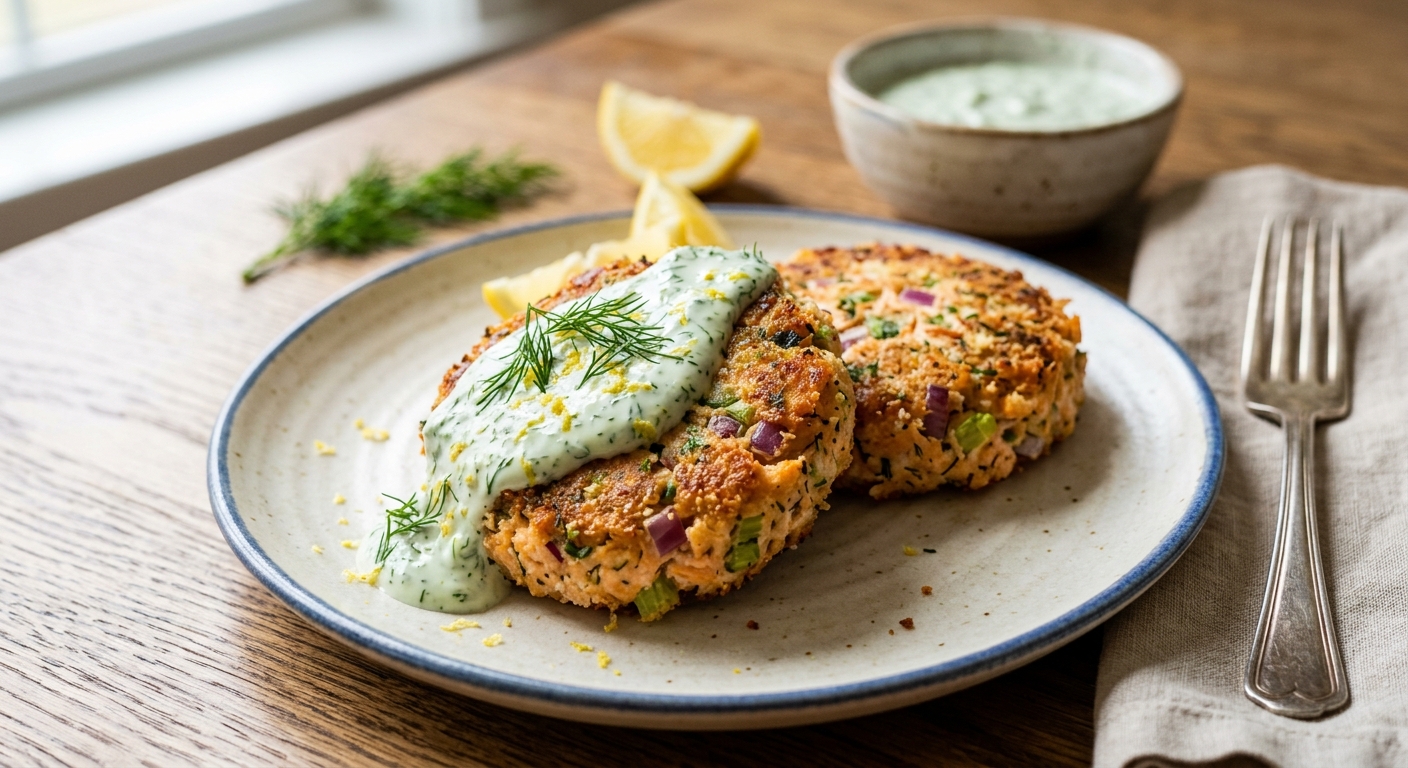
Canned salmon is one of the most underrated pantry staples in modern kitchens, and the secret weapon hiding inside every can is the soft, edible bones. When you mash those bones directly into your patty mixture, as this recipe instructs, you unlock a concentrated source of calcium that rivals a glass of milk, combined with the vitamin D naturally present in salmon to ensure your body actually absorbs it. This is not a workaround or a compromise: it is the most traditional and nutritionally intelligent way to use canned salmon, and generations of home cooks knew it long before nutrition science confirmed it.
The patties themselves are built for both flavor and function. Flaky pink salmon is blended with sauteed aromatics, a binding of egg and whole-wheat breadcrumbs for fiber, and a sharp hit of Dijon mustard and lemon zest that cuts through the richness beautifully. The accompanying dill Greek yogurt sauce doubles down on the calcium story, adding another 150mg per serving while providing probiotics that support gut health and, emerging research suggests, may indirectly support bone density through improved nutrient absorption. Fresh dill brings a bright, anise-adjacent freshness that is the classic pairing with salmon for excellent reason.
Bone and joint health is rarely about a single nutrient. This recipe takes a systems-level approach, combining calcium and vitamin D for absorption, omega-3 fatty acids to reduce inflammatory markers associated with bone loss, phosphorus to support bone mineral density, and magnesium to activate the enzymes involved in bone formation. Every component earns its place on the plate, and the result is a dish that tastes like a confident, well-seasoned diner classic while doing serious nutritional work behind the scenes.
4
servings
Ingredients
- 800 gcanned pink or red salmon (two 400g cans), drained, bones and skin retained
- 2 largeeggs, beaten
- 80 gwhole-wheat breadcrumbs, plus extra for coating
- 60 gyellow onion, finely diced
- 40 gcelery, finely diced
- 2 clovesgarlic, minced
- 2 tbspDijon mustard
- 1 tbspfresh lemon juice
- 1 tsplemon zest
- 2 tbspfresh flat-leaf parsley, finely chopped
- 1 tspsmoked paprika
- 3 tbspextra-virgin olive oil, divided
- 300 gfull-fat Greek yogurt
- 3 tbspfresh dill, finely chopped
- 1 tbspcapers, rinsed and roughly chopped
- 1 tsphoney
- —Colima Sea SaltMicroplastic Free Salt and black pepper to taste
Instructions
Click on an item below to shop for the recommended items for this recipe on Amazon.
As an Amazon Associate, we earn from qualifying purchases.
- Make the dill yogurt sauce first so the flavors meld while you cook. In a small bowl, combine the Greek yogurt, fresh dill, chopped capers, honey, remaining lemon juice, and a pinch of salt and pepper. Stir well, taste, and adjust seasoning. Cover and refrigerate until serving.
- Heat 1 tablespoon of olive oil in a small skillet over medium heat. Add the diced onion and celery and cook, stirring frequently, for 4 to 5 minutes until softened and translucent. Add the minced garlic and cook for another 60 seconds until fragrant. Remove from heat and allow to cool for 5 minutes.
- Open the salmon cans and drain thoroughly. Transfer the salmon to a large mixing bowl and use a fork to flake the flesh, mashing the soft bones completely into the mixture until no visible bone pieces remain. This step is non-negotiable for maximizing calcium content.
- Add the sauteed vegetables, beaten eggs, 80g breadcrumbs, Dijon mustard, lemon zest, parsley, smoked paprika, salt, and pepper to the salmon. Mix gently but thoroughly until a cohesive mixture forms. Divide into 8 equal portions and shape each into a patty roughly 1.5cm thick. Press both sides lightly into additional breadcrumbs for a crisper crust.
- Heat the remaining 2 tablespoons of olive oil in a large non-stick or cast-iron skillet over medium to medium-high heat until shimmering. Working in two batches to avoid crowding, cook the patties for 3 to 4 minutes per side until deeply golden and heated through. Transfer cooked patties to a wire rack rather than paper towels to keep the crust crisp. Serve immediately with the chilled dill yogurt sauce.
- Preheat your oven to 200C (400F) with a rack in the upper-middle position. Line a large rimmed baking sheet with parchment paper and brush generously with 1.5 tablespoons of olive oil. Preheating the pan in the oven for 5 minutes before adding the patties is optional but produces a significantly crisper bottom crust.
- Make the dill yogurt sauce by combining the Greek yogurt, fresh dill, chopped capers, honey, lemon juice, salt, and pepper in a small bowl. Cover and refrigerate.
- In a large bowl, combine the raw diced onion and celery (no pre-sauteeing is needed in the oven method, as the longer cooking time softens them sufficiently), minced garlic, drained and bone-mashed salmon, beaten eggs, 80g breadcrumbs, Dijon mustard, lemon zest, parsley, smoked paprika, salt, and pepper. Mix until evenly combined. The mixture will be slightly wetter than the stovetop version, which is correct.
- Shape the mixture into 8 patties approximately 1.5cm thick and coat both sides in a thin layer of breadcrumbs. Place them on the prepared baking sheet, spacing at least 2cm apart. Drizzle the remaining 1.5 tablespoons of olive oil evenly over the tops.
- Bake for 12 minutes, then carefully flip each patty with a thin spatula. Return to the oven and bake for a further 10 minutes until the surfaces are golden brown and slightly crisp. For extra browning, switch the oven to the broil setting for the final 2 minutes, watching closely. Allow to rest for 2 minutes before serving with the dill yogurt sauce.
- Make the dill yogurt sauce by combining the Greek yogurt, fresh dill, chopped capers, honey, lemon juice, salt, and pepper. Refrigerate, covered.
- In a large mixing bowl, combine the drained salmon with bones fully mashed, beaten eggs, breadcrumbs, raw finely diced onion and celery, minced garlic, Dijon mustard, lemon zest, parsley, smoked paprika, olive oil (use all 3 tablespoons directly in the mixture since there is no pan frying), salt, and pepper. Mix until well combined. The oil incorporated into the mixture adds richness and helps the patties hold moisture during the slow, moist cooking environment.
- Line the bottom of the slow cooker insert with a single sheet of parchment paper cut to size. Lightly spray or brush the parchment with a little olive oil. Shape the salmon mixture into 8 patties and arrange them in a single layer, or stack with a sheet of parchment between layers if your slow cooker is small.
- Place the lid on the slow cooker and cook on Low for 2 hours. The patties will be fully cooked through and set but pale in color. Do not cook on High, as the eggs can turn rubbery.
- If desired, transfer the patties to a foil-lined baking sheet and place under a preheated broiler on the highest setting for 3 to 4 minutes per side until golden. This step transforms the texture completely. Serve with the dill yogurt sauce.
- Make the dill yogurt sauce and refrigerate. Pour 240ml (1 cup) of water into the pressure cooker pot and place the trivet or steam rack inside.
- Combine all salmon patty ingredients (salmon with bones fully mashed, eggs, breadcrumbs, raw diced onion, celery, garlic, Dijon mustard, lemon zest, parsley, smoked paprika, all 3 tablespoons of olive oil incorporated directly, salt, and pepper) in a large mixing bowl. Stir thoroughly.
- Cut two pieces of parchment paper to fit the trivet. Shape the salmon mixture into 8 patties and place them on the parchment on the trivet, stacking in two layers with a parchment separator if needed. Leave a small gap between each patty so steam can circulate.
- Secure the lid and set the pressure valve to Sealing. Cook on High Pressure for 5 minutes. Once cooking is complete, allow a natural pressure release for 5 minutes, then carefully perform a quick release for any remaining pressure.
- Open the lid away from you and allow steam to escape. Use a wide spatula to carefully lift the patties off the trivet. For a golden finish, arrange patties on a foil-lined baking sheet and broil on high for 3 minutes per side. Serve with the chilled dill yogurt sauce.
Nutrition Breakdown
Per 1 serving (makes 4)
Vitamins & Minerals
% Daily Value based on a 2,000 calorie diet (FDA reference)
🧬 Essential Amino Acids
% of recommended daily intake (RDA) per serving
🛡 Antioxidant Profile
The Nutrition Science
The calcium in canned salmon bones is hydroxyapatite, the same crystalline mineral compound that forms human bone tissue, making it exceptionally well-matched to our skeletal needs. Unlike the calcium in plant foods such as spinach, which is partially bound by oxalates that reduce absorption, the calcium in fish bones carries no such inhibitors. Studies comparing fish bone calcium to dairy calcium have found bioavailability to be broadly equivalent, at approximately 30 to 32% absorption under normal physiological conditions. Critically, the vitamin D naturally present in salmon salmon is one of only a handful of dietary vitamin D sources upregulates the intestinal proteins that actively transport calcium into the bloodstream, meaning these two nutrients consumed together produce a synergistic effect that neither achieves alone.
Bone density is determined not just by calcium and vitamin D but by a network of nutrients acting in concert. Phosphorus, delivered here at 46% DV per serving, partners with calcium in an approximately 1:1 ratio to form hydroxyapatite crystals. Magnesium activates over 300 enzymatic reactions including several directly involved in osteoblast (bone-building cell) function. The omega-3 fatty acids EPA and DHA in salmon have been shown in multiple clinical trials to reduce levels of interleukin-6 and tumor necrosis factor-alpha, two inflammatory cytokines that activate osteoclasts, the cells responsible for bone resorption. Reducing chronic low-grade inflammation is therefore one of the most direct dietary strategies for slowing age-related bone loss.
The Greek yogurt in the dill sauce contributes an additional 150mg of calcium per serving alongside the probiotic strains Lactobacillus bulgaricus and Streptococcus thermophilus. A 2019 meta-analysis published in Osteoporosis International found a statistically significant association between regular yogurt consumption and higher total hip bone mineral density, independent of total calcium intake, suggesting the fermentation-derived bioactive compounds, including bioavailable peptides and specific short-chain fatty acids, may have direct osteogenic effects beyond what calcium content alone would predict. This recipe is therefore not merely a calcium delivery vehicle; it is a whole-food matrix designed to support skeletal health through multiple evidence-based mechanisms simultaneously.
Pro Tips
- Never discard the canned salmon bones. They are already fully softened by the canning process and mash completely invisibly into the patty mixture, contributing the majority of the recipe’s calcium without any detectable texture difference.
- For best patty cohesion, allow the formed patties to rest in the refrigerator for 15 to 30 minutes before cooking. Cold patties hold their shape significantly better in the pan and are less likely to crack or fall apart when flipped.
- Red sockeye salmon contains roughly 30% more astaxanthin and slightly more omega-3 fatty acids per gram than pink salmon, making it the nutritionally superior choice. Pink salmon is milder in flavor and less expensive; both are excellent and nutritionally strong options for this recipe.
Oh this is perfect for my IBS – I’ve found that the bone-in canned salmon actually helps my gut SO much better than fresh fillets, probably because of the gelatin and collagen content alongside all that bioavailable calcium. The Greek yogurt pairing is genius too, since I get both the probiotics from the yogurt AND the prebiotic-friendly fiber I can add with dill and other herbs – I’m definitely making this and tracking it against my usual salmon recipes to see how it compares on my inflammation markers! The heme iron point is interesting, but honestly my experience has been that when I include calcium-rich foods alongside iron sources, I feel less bloated afterward, so I’m curious
ooh this looks amazing but im curious about the iron story here – canned salmon has some heme iron which is great for absorption, but im wondering if the yogurt might interfere since dairy calcium can block iron uptake? ive been managing my ferritin levels pretty carefully and tend to either pair my iron rich foods with vitamin c boosters or keep the calcium for a separate meal, so im genuinely asking if that’s something you factored in or if the benefits of the bones/omega-3s just outweigh that concern for you!
Great catch on the iron/calcium interaction, Francesca. Honestly the effect here is minimal since you’re getting maybe 2-3mg of iron from the salmon while the calcium is doing most of the heavy lifting nutritionally, and that heme iron absorption is so efficient it still wins out even with dairy present. What I’ve found in practice is the real move is eating this with something acidic (lemon on the patties, vinegar in the yogurt sauce) which actually boosts both mineral absorption and keeps the flavors sharp instead of heavy.