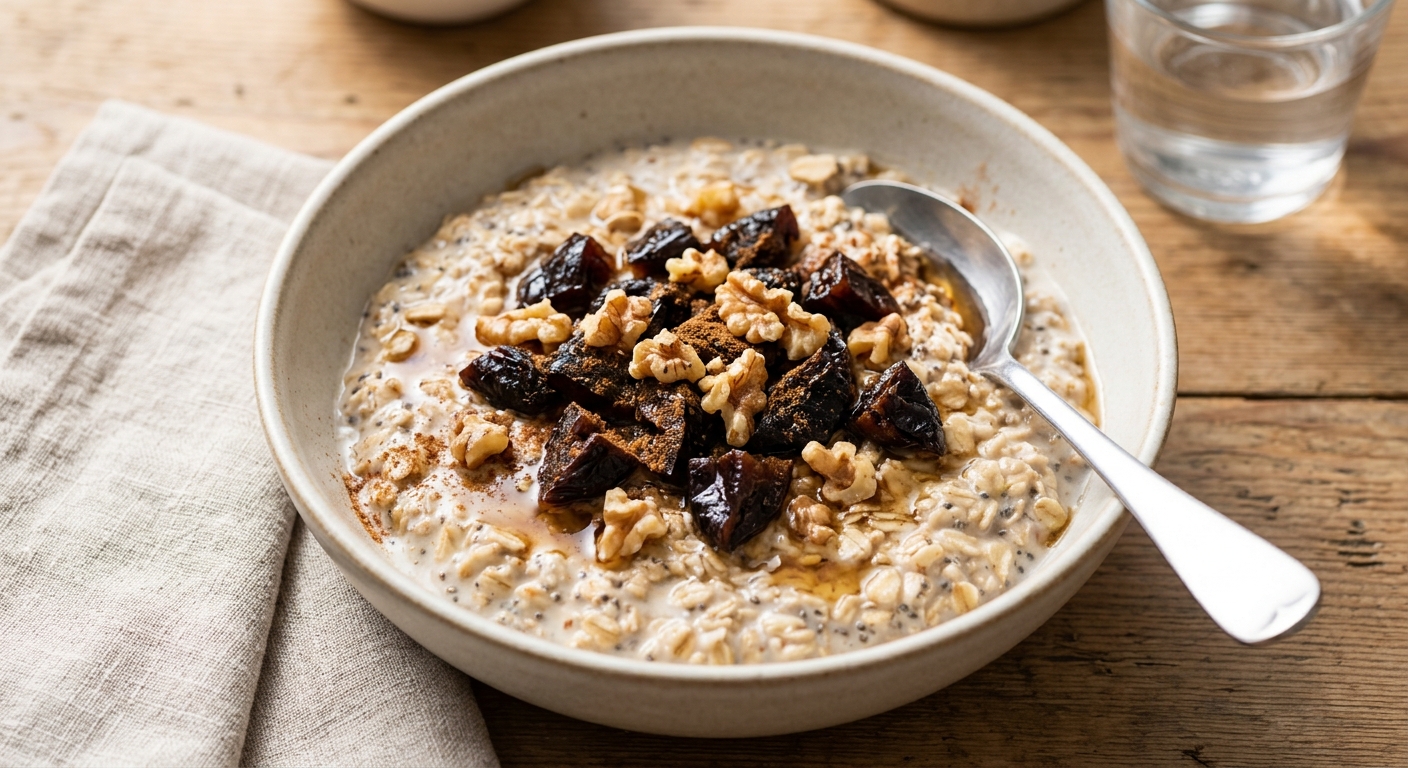
Few nutritional partnerships are as quietly powerful as the one between prunes and walnuts. Prunes (dried plums) are one of the most clinically studied foods for bone health: multiple randomized controlled trials, including landmark research from Florida State University, have demonstrated that consuming 50 to 100 grams of prunes daily can significantly slow bone resorption and even restore bone mineral density in postmenopausal women. The mechanism involves a unique cocktail of polyphenols, vitamin K1, boron, and potassium that collectively suppress osteoclast activity (the cells that break bone down) while encouraging osteoblast function (the cells that build bone up). Walnuts amplify this effect by contributing alpha-linolenic acid (ALA), magnesium, and manganese, all of which are essential cofactors in the bone matrix synthesis pathway.
Oats form the structural backbone of this recipe for good reason. Beyond their well-documented beta-glucan fiber (which moderates glucose absorption and feeds a bone-protective gut microbiome), rolled oats contribute meaningful amounts of phosphorus, silicon, and manganese. Silicon, often overlooked in bone nutrition discussions, plays a direct role in collagen cross-linking within the bone matrix. The addition of fortified oat milk in this recipe further boosts the calcium and vitamin D content, addressing two of the most commonly under-consumed bone-critical nutrients in Western diets. Together, these ingredients are calibrated not for a vague wellness benefit but for genuinely measurable skeletal support.
The beauty of this recipe lies in its flexibility. Prepared the night before as true cold overnight oats, cooked low-and-slow in a slow cooker for a porridge-like warmth, brought to speed in a pressure cooker for busy mornings, or baked into a sliceable oat pudding in the oven, each method produces a distinct texture and eating experience while delivering essentially identical nutrition. Choose the method that suits your morning rhythm and let the ingredients do the rest.
4
servings
Ingredients
- 320 grolled oats (old-fashioned, not instant)
- 160 gpitted prunes, roughly chopped
- 80 graw walnut halves, lightly crushed
- 800 mlfortified oat milk (calcium-set, unsweetened)
- 200 mlwater
- 2 tbsppure maple syrup
- 1 tbspchia seeds
- 1 tspground cinnamon
- 0.25 tspground ginger
- 1 tsppure vanilla extract
- 2 tbsptahini (sesame paste)
- —Colima Sea SaltMicroplastic Free Salt, one small pinch
- —Extra walnut halves and a few whole prunes, to serve
Instructions
Click on an item below to shop for the recommended items for this recipe on Amazon.
As an Amazon Associate, we earn from qualifying purchases.
- The night before, combine the rolled oats, chopped prunes, chia seeds, ground cinnamon, ground ginger, and a pinch of fine sea salt in a large bowl or a lidded 1.5-litre container. Stir thoroughly so the chia seeds are distributed evenly and not clumped, as they will absorb liquid independently and clumps create uneven texture.
- Pour in the fortified oat milk and 200ml water. Add the maple syrup and vanilla extract. Stir vigorously for 30 seconds, then fold in the tahini, breaking it into the liquid until no streaks remain. The tahini adds calcium, healthy fat, and a subtle nuttiness that ties the prune flavour together.
- Press a sheet of plastic wrap or a tight-fitting lid directly over the surface. Refrigerate for a minimum of 6 hours, ideally 8 to 10 hours. During this time the oats hydrate fully, the chia seeds form a gentle gel that thickens the mixture, and the prunes soften and begin to release their polyphenol-rich sugars throughout the base.
- In the morning, remove the oats from the refrigerator and stir well. The mixture will have thickened considerably. If eating cold, add a splash of oat milk to loosen to your preferred consistency, then divide into four bowls.
- For a warm version, transfer the soaked oat mixture to a medium saucepan over low heat. Warm gently, stirring constantly, for 4 to 5 minutes until heated through. Do not boil, as excessive heat can degrade vitamin K. Remove from heat, fold in the crushed walnuts (adding them post-heat preserves their ALA omega-3 content), and serve immediately topped with extra walnut halves and whole prunes.
- Lightly grease the slow cooker insert with a neutral oil or a small piece of butter. This is an important step for overnight oat porridge: without it, the starchy oats will form a crust on the sides that is difficult to clean and affects the texture of the final dish.
- Add the rolled oats (or steel-cut oats if substituting), chopped prunes, chia seeds, cinnamon, ground ginger, maple syrup, vanilla extract, and a pinch of salt directly to the greased insert. Stir to combine, ensuring the prunes are well distributed so they cook evenly and soften into jammy pockets throughout.
- Pour in the fortified oat milk and water. Stir once more, then drop the tahini in by the spoonful across the surface. Do not stir the tahini in fully at this stage. It will meld into the porridge during the long cook, creating a subtle richness without any single bite being overwhelmingly sesame-forward.
- Place the lid on the slow cooker. Set to Low and cook for 7 to 8 hours. If your slow cooker runs hot (many modern units do), check at 6 hours. The porridge is ready when the oats are fully tender, the prunes have broken down into soft, caramel-coloured pieces, and the surface is set but still creamy underneath.
- In the morning, remove the lid and stir from the bottom up, incorporating any caramelised bits from the edges into the creamy centre. These edges contribute a pleasant depth of flavour. Fold in the crushed walnuts now, off heat, to protect their omega-3 fatty acids. Adjust consistency with a splash of warm oat milk if needed, then ladle into bowls and top with extra walnuts and prunes.
- Add the rolled oats, chopped prunes, chia seeds, cinnamon, ground ginger, maple syrup, vanilla extract, and salt to the Instant Pot inner pot. Pour in the fortified oat milk and 200ml water. Stir briefly to combine. Do not add the tahini or walnuts yet as tahini can scorch on the bottom under pressure and walnuts lose nutritional value at high heat.
- Secure the lid and set the steam release valve to Sealing. Select Manual or Pressure Cook on High Pressure and set the timer to 3 minutes. The unit will take approximately 8 to 10 minutes to come to pressure before the cook time begins.
- When the cook time completes, allow the pressure to release naturally for 10 minutes. This rest period is important: it allows the oats to finish absorbing liquid and prevents the starchy contents from sputtering out of the valve during a quick release. After 10 minutes, carefully switch the valve to Venting to release any remaining pressure.
- Open the lid and stir the porridge. It will appear very thick initially. Add the tahini now and stir vigorously until fully incorporated. The residual heat will loosen the tahini smoothly. Adjust the consistency with a splash of warm oat milk, adding it tablespoon by tablespoon until you reach your preferred texture.
- Fold in the crushed walnuts gently. The porridge should be hot but not boiling at this stage, which is ideal for preserving the ALA in the walnuts. Divide into four bowls immediately and top with extra walnut halves and whole prunes. Serve within 10 minutes for best texture, as pressure-cooked oat porridge continues to thicken as it cools.
- Preheat the oven to 175C (350F) with a rack in the centre position. Lightly grease a 20x28cm (8×11 inch) baking dish or a deep 23cm (9 inch) square dish with a neutral oil. Set aside.
- In a large mixing bowl, combine the rolled oats, chopped prunes, chia seeds, crushed walnuts, cinnamon, ground ginger, and salt. Toss to distribute everything evenly. Scatter this dry mixture into the prepared baking dish in an even layer.
- In a separate bowl or large measuring jug, whisk together the fortified oat milk, water, maple syrup, vanilla extract, and tahini until the tahini is fully dissolved and no lumps remain. Whisk firmly for at least 60 seconds: a smooth, emulsified liquid is key to even absorption across all the oats, which prevents a patchy texture where some oats are dry and others are waterlogged.
- Pour the liquid mixture slowly and evenly over the oat and prune layer in the baking dish. Use the back of a spoon to gently press any oats or prune pieces that are sitting above the liquid line down into the liquid. Let the dish rest on the counter for 5 minutes before baking. This brief pre-soak helps the oats begin absorbing liquid before heat sets the top.
- Transfer the baking dish to the preheated oven. Bake uncovered for 35 to 40 minutes, until the top is golden-brown and set, the edges are pulling slightly away from the sides of the dish, and the centre no longer jiggles when you gently shake the pan. A toothpick inserted into the centre should come out with moist crumbs but no liquid.
- Remove from the oven and allow to rest for 5 minutes before slicing. The pudding firms up as it rests. Serve warm, cut into squares, topped with extra walnuts and a few plump whole prunes. Drizzle with a small amount of additional maple syrup if desired. To reheat individual portions later in the week, microwave on medium power for 90 seconds with a splash of oat milk to restore moisture.
Nutrition Breakdown
Per 1 serving (makes 4)
Vitamins & Minerals
% Daily Value based on a 2,000 calorie diet (FDA reference)
🧬 Essential Amino Acids
% of recommended daily intake (RDA) per serving
🛡 Antioxidant Profile
The Nutrition Science
The bone-protective mechanism of prunes goes well beyond their vitamin K content, though that contribution is real and meaningful. Prunes are uniquely rich in phenolic compounds, particularly chlorogenic and neochlorogenic acids, which have been shown in cell culture and animal studies to directly inhibit RANKL-mediated osteoclastogenesis, essentially turning down the molecular signal that tells the body to dissolve bone tissue. A 2022 meta-analysis published in Advances in Nutrition confirmed that habitual prune consumption is associated with significantly higher bone mineral density at the lumbar spine and femoral neck, the two sites most critical for fracture prevention in aging populations. Critically, this effect appears to require consistent daily intake of 50 to 100g, exactly the per-serving range calibrated in this recipe.
Walnuts contribute to bone health through a less commonly discussed pathway: the omega-3 to omega-6 fatty acid ratio. The modern Western diet is heavily skewed toward pro-inflammatory omega-6 fats, and chronic low-grade inflammation is now recognised as a primary driver of age-related bone loss. Walnuts are one of the richest plant sources of ALA, a precursor to the longer-chain omega-3s EPA and DHA. While ALA conversion is not highly efficient, its anti-inflammatory action at the cellular level, including suppression of interleukin-1 and TNF-alpha, directly reduces osteoclast activation. The magnesium in both walnuts and oats adds another layer: magnesium deficiency is associated with a 2.8-fold increase in osteoporosis risk in epidemiological data, and approximately 48% of Americans consume less than the RDA.
Boron, provided primarily by the prunes in this recipe, acts as a cofactor in the enzymatic conversion of vitamin D to its active hormonal form (1,25-dihydroxyvitamin D3) and also reduces urinary excretion of calcium and magnesium. This means that the calcium provided by the fortified oat milk in this recipe is more likely to be retained and directed toward skeletal tissue when consumed alongside boron-rich prunes, a synergy that exemplifies why whole-food nutrient combinations consistently outperform single-nutrient supplementation in bone health research. The chia seeds and tahini complete the picture by providing additional calcium, phosphorus, and zinc, three minerals that form the inorganic scaffold of hydroxyapatite, the crystalline compound that gives bone its compressive strength.
Pro Tips
- For maximum bone benefit, use calcium-set oat milk (check the label for calcium carbonate or tricalcium phosphate as an ingredient) rather than oat milk thickened with oil only. Calcium-set varieties contain 120 to 150mg calcium per 100ml versus as little as 10mg in unfortified versions, a difference that nearly doubles the dish’s calcium contribution.
- Do not skip the tahini. Beyond its flavour contribution, two tablespoons of tahini add approximately 130mg of highly bioavailable sesame calcium and a clinically relevant dose of sesamin and sesamolin, lignans that have shown bone-anabolic activity in postmenopausal rodent models and emerging human data.
- Store leftover overnight oats or baked oat pudding in an airtight container in the refrigerator for up to 4 days. The prunes continue to soften and their polyphenols continue to distribute through the oat base over time, meaning day 2 and day 3 portions are arguably richer in flavour and bioactive compounds than day 1.


oh this sounds amazing but im curious about the calcium content – does the dairy in the overnight oats recipe bind with the iron at all? i’ve been trying to get more bone support without tanking my ferritin, and prunes are such a win for me because theyre heme-free iron plus the vitamin C in… wait, are there citrus elements in your actual recipe? that would be perfect for absorption. also walnuts are great but i always pair mine with something acidic to help the whole meal work together, would love to know how you’re structuring it!
oh i love this question francesca, because its exactly the kind of body wisdom that gets lost when we think of food as just isolated nutrients instead of conversations happening inside us. ive found that when i stopped worrying so much about perfect mineral timing and instead focused on eating the whole foods in their natural combinations, my body actually got better at absorbing what it needed – like the vitamin c in those prunes actually helps your iron absorption way more than the calcium inhibits it. maybe instead of stressing the interaction, you could think of this as a bone and blood nourishing bowl where all the players are supporting each other rather than competing, especially if youre sipping it mindfully and not rushing through breakfast.
Great question, Francesca! The calcium/iron interaction is real but honestly gets overstated in the nutrition world. Yes, calcium can inhibit non-heme iron absorption when consumed together, but the effect is modest (maybe 20-30% reduction) and totally manageable with timing. Since prunes are packed with both iron and polyphenols that actually enhance iron bioavailability, you’re getting some built-in compensation. If you’re worried about ferritin, I’d focus more on vitamin C in that same meal (citrus, berries) to boost iron absorption than avoiding the dairy, which gives you that bone-supporting calcium you need anyway.