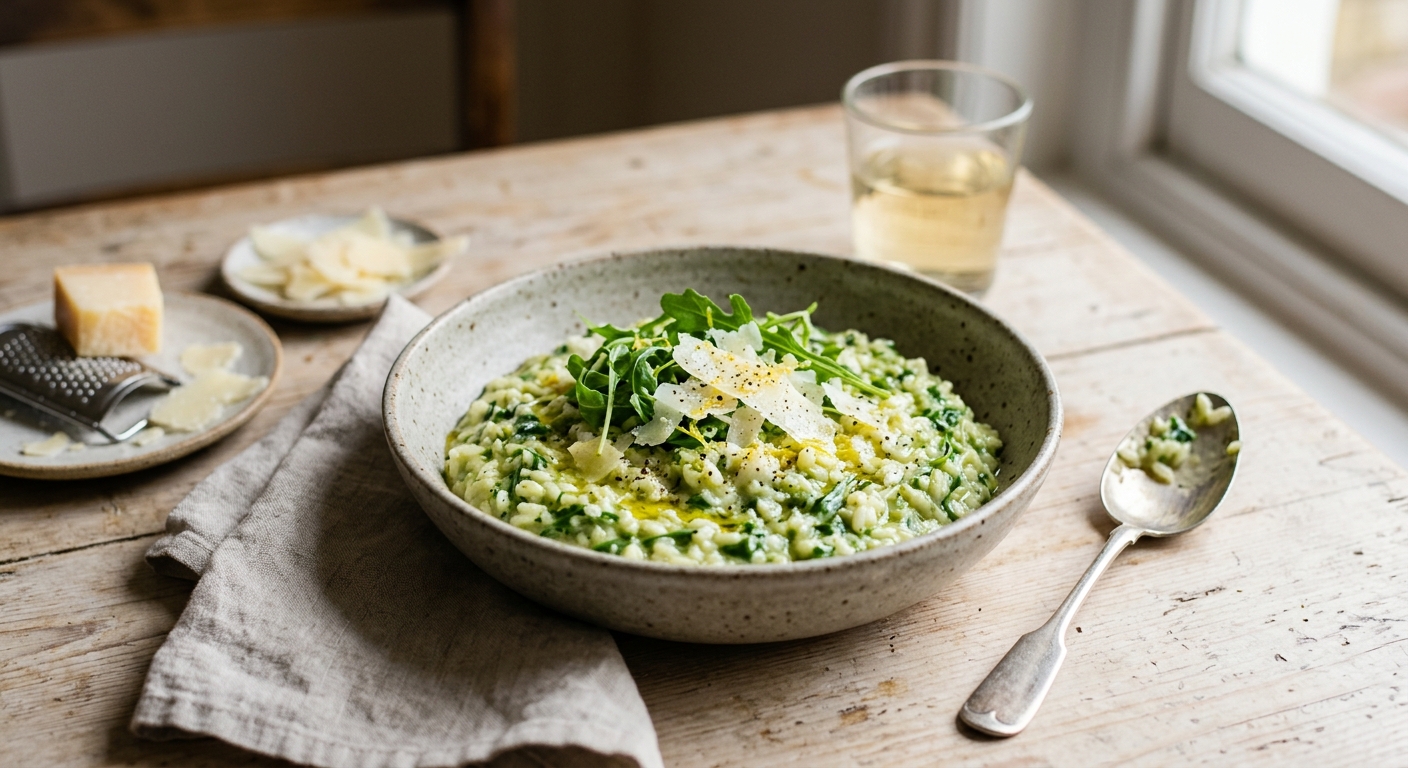
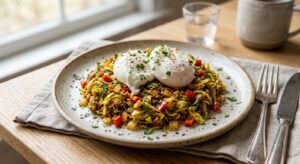
Risotto has a reputation for being fussy, but the nutritional payoff makes every stir worthwhile. This arugula and Parmesan version was developed specifically for the Bone and Joint category because it stacks two of the most underappreciated bone-health nutrients into a single, restaurant-worthy bowl. Arugula is one of the most concentrated leafy green sources of vitamin K1 in the culinary world, providing roughly 109 mcg per 100 g raw, and Parmesan delivers more calcium per gram than almost any other commonly used ingredient. Together, they do not just taste exceptional together, they function as a genuine nutritional system.
Vitamin K is the under-discussed partner of calcium and vitamin D in bone metabolism. Without adequate K1 and K2, the protein osteocalcin cannot be properly carboxylated, meaning calcium is deposited inefficiently into bone matrix. By pairing a vitamin K-rich green with a high-calcium cheese in the same meal, this recipe maximises the bioavailability of both nutrients. The fat from Parmesan and olive oil also improves the absorption of fat-soluble vitamin K, turning every bite into a precisely calibrated delivery mechanism.
Beyond bone health, this risotto brings meaningful amounts of folate from the arugula, manganese from the Arborio rice, and phosphorus from both the cheese and the rice. The technique here is classic northern Italian: a white wine deglaze, warm stock added ladle by ladle, and the arugula folded in at the very end so it wilts gently without losing its peppery brightness or surrendering its vitamin K to prolonged heat. Whether you are cooking this on the stovetop, setting it in a slow cooker, or finishing it in minutes under pressure, the result is a bowl that satisfies completely on every level.
4
servings
Ingredients
- 320 gArborio rice
- 180 gfresh arugula (rocket), washed and roughly chopped
- 100 gParmesan cheese, finely grated (plus extra shavings to serve)
- 1 mediumwhite onion, finely diced
- 3 clovesgarlic, minced
- 150 mldry white wine (such as Pinot Grigio or Sauvignon Blanc)
- 1.25 litreslow-sodium vegetable or chicken stock, kept warm
- 3 tbspextra-virgin olive oil
- 30 gunsalted butter
- 1 tbspfresh lemon juice
- 1 tsplemon zest
- —Colima Sea SaltMicroplastic Free Salt and freshly cracked black pepper to taste
- —Pinch of freshly grated nutmeg
Instructions
Click on an item below to shop for the recommended items for this recipe on Amazon.
As an Amazon Associate, we earn from qualifying purchases.
- Pour the stock into a separate medium saucepan and bring it to a gentle simmer over low heat. Keep it warm throughout the entire cooking process. Cold stock added to risotto will seize the starch and produce a gluey texture rather than the desired creamy wave.
- In a wide, heavy-bottomed Dutch oven or high-sided skillet, heat the olive oil over medium heat. Add the diced onion and a pinch of salt. Cook, stirring occasionally, for 6 to 7 minutes until the onion is completely translucent and beginning to turn pale gold at the edges. Add the minced garlic and cook for a further 90 seconds until fragrant.
- Add the Arborio rice to the pot. Toast it, stirring constantly with a wooden spoon, for 2 minutes. The grains should turn slightly translucent at the edges and smell faintly nutty. This step gelatinises the outer starch and is essential for achieving the correct final texture.
- Pour in the white wine and stir vigorously. The pan will hiss and steam. Cook, stirring, until all the wine has been absorbed and the raw alcohol smell has cooked off, about 2 minutes.
- Begin adding the warm stock one ladleful (approximately 120 ml) at a time. Stir continuously and allow each ladleful to be almost completely absorbed before adding the next. Maintain a steady medium-low heat so the liquid simmers rather than boils aggressively. This process will take 20 to 22 minutes and requires your attention throughout.
- After the 20-minute mark, taste the rice. It should be al dente: tender with a very slight, pleasant resistance at the centre. If it needs more time, add another ladleful of stock and continue. Remove the pot from heat when the rice is just done and the mixture still looks slightly loose, as it will tighten as it rests.
- Working quickly off the heat, fold in the chopped arugula in two batches, stirring gently so it wilts in the residual heat without overcooking. Add the butter, grated Parmesan, lemon juice, lemon zest, and nutmeg. Stir vigorously for 60 seconds to emulsify the butter and cheese into the starch, creating the classic all’onda (wave-like) consistency. Season with salt and pepper. Serve immediately in warmed bowls, topped with Parmesan shavings and an extra crack of black pepper.
- Before loading the slow cooker, complete the soffritto on the stovetop. Heat the olive oil in a skillet over medium heat, add the onion with a pinch of salt, and cook for 6 to 7 minutes until soft and golden. Add the garlic and cook for 90 seconds. Add the Arborio rice and toast, stirring, for 2 minutes. Deglaze with the white wine and stir until fully absorbed, about 2 minutes. This stovetop pre-step is non-negotiable for flavour development in slow cooker risotto.
- Transfer the toasted rice mixture to the slow cooker insert. Pour in 1 litre of the warm stock (reserve the remaining 250 ml). Stir to combine, scraping in any toasted bits from the skillet. Season lightly with salt, noting that Parmesan will add significant saltiness later.
- Cover and cook on High for 1 hour 45 minutes to 2 hours. Resist lifting the lid during the first 90 minutes, as heat loss significantly extends cooking time. At the 90-minute mark, lift the lid and stir well. The rice should be nearly tender. If it looks dry or the edges are catching, add the reserved warm stock in 60 ml increments.
- When the rice is just tender and the mixture is thick and creamy, switch the slow cooker to Warm. Quickly fold in the chopped arugula in two batches, pressing it gently beneath the surface of the hot rice and replacing the lid for 3 minutes to wilt it through steam.
- Remove the lid and stir in the butter, grated Parmesan, lemon juice, lemon zest, and nutmeg. The residual heat will melt everything together into a cohesive, creamy risotto. If it has tightened too much, stir in a small splash of the remaining warm stock to loosen it to a pourable, spoonable consistency. Taste, adjust seasoning, and serve immediately in warmed bowls with Parmesan shavings.
- Set the Instant Pot or electric pressure cooker to the Saute function on High. Heat the olive oil, then add the onion with a pinch of salt. Cook, stirring, for 5 to 6 minutes until softened. Add the garlic and cook for 60 seconds. Add the Arborio rice and stir for 90 seconds to toast the grains.
- Pour in the white wine and stir until fully absorbed and the alcohol smell has cooked off, about 2 minutes. This deglaze step is critical: any sugars caramelised on the pot bottom must be fully dissolved before pressure cooking to avoid a Burn warning.
- Pour in 900 ml of the warm stock (not the full 1.25 litres). Stir well to combine. The liquid level should be just enough to cover the rice by about 1 cm. Do not add the arugula, Parmesan, butter, or lemon at this stage.
- Secure the lid and set the pressure release valve to Sealing. Cook on High Pressure for 6 minutes. When the cycle completes, allow a Natural Pressure Release for 5 minutes, then carefully switch the valve to Venting to release any remaining pressure.
- Open the lid. The risotto will look slightly soupy at first. Immediately fold in the chopped arugula in two batches, stirring it in quickly so the residual heat wilts it within 60 to 90 seconds. Add the butter, grated Parmesan, lemon juice, lemon zest, and nutmeg. Stir vigorously and continuously for 90 seconds to develop the creamy emulsion. If needed, add warm stock in small splashes to achieve a flowing, spoonable texture. Season with salt and pepper and serve immediately with Parmesan shavings.
- Preheat your oven to 180C (350F) with a rack positioned in the centre. Place a Dutch oven or oven-safe casserole with a tight-fitting lid on the stovetop over medium heat. Add the olive oil, then the onion with a pinch of salt, and cook for 6 to 7 minutes until golden and soft. Add the garlic and cook for 90 seconds.
- Add the Arborio rice to the Dutch oven and stir constantly over medium heat for 2 minutes to toast the grains. Deglaze with the white wine, stirring until fully absorbed. The toasting and deglazing must happen on the stovetop; the oven cannot replicate this flavour development.
- Pour in 1.1 litres of hot stock (bring it to a boil just before adding, as the oven method requires the liquid to be hotter than the stovetop method to initiate even cooking). Season lightly with salt. Stir once to distribute the rice evenly across the bottom of the pot. Bring the mixture to a bare simmer on the stovetop, then immediately transfer the covered Dutch oven to the preheated oven.
- Bake, covered, for 40 to 45 minutes. Do not open the lid during the first 35 minutes. At the 40-minute mark, remove the pot from the oven and carefully lift the lid (steam will escape). The rice should be tender and have absorbed nearly all the liquid. If the top layer of rice looks dry, stir in the reserved warm stock in small amounts.
- Return the Dutch oven to the stovetop over very low heat. Working quickly, fold in the arugula in two batches, stirring gently until just wilted, about 2 minutes over low heat. This gentle stovetop finish gives better colour and texture to the arugula than the residual oven heat would. Add the butter, Parmesan, lemon juice, lemon zest, and nutmeg. Stir vigorously for 60 to 90 seconds to emulsify. Taste, season, and serve immediately in warmed bowls with Parmesan shavings and cracked black pepper.
Nutrition Breakdown
Per 1 serving (makes 4)
Vitamins & Minerals
% Daily Value based on a 2,000 calorie diet (FDA reference)
🧬 Essential Amino Acids
% of recommended daily intake (RDA) per serving
🛡 Antioxidant Profile
The Nutrition Science
The bone-health case for this dish rests on a well-established but under-appreciated biochemical axis. Vitamin K1 (phylloquinone) is the essential cofactor for gamma-glutamyl carboxylase, the enzyme that activates osteocalcin and matrix Gla protein (MGP). Osteocalcin anchors calcium ions to the hydroxyapatite crystal lattice that gives bone its compressive strength, while MGP actively prevents calcium from precipitating in arterial walls. Without sufficient vitamin K, both proteins remain undercarboxylated and functionally inactive, meaning dietary calcium circulates without being properly directed. Each serving of this risotto provides 144 mcg of K1, exceeding the adequate intake of 120 mcg for adult males and 90 mcg for adult females in a single meal.
Parmesan contributes approximately 385 mg of calcium per serving in a highly bioavailable form. The calcium in aged hard cheese is bound to phosphopeptides derived from casein, which resist precipitation in the alkaline intestinal environment and achieve absorption rates of 30 to 35%, meaningfully higher than calcium in many plant sources that are co-present with oxalates. The 310 mg of phosphorus per serving is equally important: calcium and phosphorus must be present in roughly a 2:1 ratio in bone mineral, and this dish delivers both in proportions very close to that physiological target. The olive oil and butter in the recipe are not merely culinary choices; the fat-soluble nature of vitamin K means that the co-presence of dietary fat in the same meal can increase K1 absorption by as much as two-fold compared with a fat-free meal.
Manganese, provided at 1.4 mg per serving (61% DV) primarily by the Arborio rice, plays a supporting but essential role in bone metabolism as a cofactor for manganese superoxide dismutase (MnSOD) and as a component of glycosyltransferase enzymes required to synthesise the proteoglycan matrix of cartilage. Folate from the arugula (88 mcg per serving) is relevant here because elevated homocysteine, a consequence of folate deficiency, has been independently associated with increased fracture risk and impaired collagen cross-linking. By providing meaningful folate alongside the primary bone-health nutrients, this dish addresses the full matrix of biochemical requirements for skeletal integrity rather than focusing on calcium alone.
Pro Tips
- Always add arugula off the heat or in the final 2 minutes of cooking. Prolonged high heat degrades both chlorophyll (turning it from bright green to dull olive) and vitamin K1, which is relatively heat-stable but loses bioactivity when exposed to extended high temperatures above 120C.
- Use a Parmesan that has been aged at least 24 months (look for Parmigiano-Reggiano DOP with the stamp). Longer aging concentrates both calcium content and glutamate crystals, meaning you use less to achieve the same depth of flavour and calcium dose.
- For a richer bone-health profile, substitute half the vegetable stock with homemade bone broth, which adds collagen precursors (glycine, proline, hydroxyproline) and additional phosphorus, directly complementing the vitamin K and calcium already in the dish.

okay so heres what im thinking – this could actually be a solid post-WOD meal if youre strategic with portion size? like the calcium and vitamin k combo is *chef’s kiss* for bone health and recovery, but id be curious about the protein content per serving since risotto is typically rice-heavy. are we talking like 10g protein or closer to 20g? because paired with maybe some grilled chicken or fish on the side, this becomes a legit anti-inflammatory recovery bowl. the carbs after intense training arent really the enemy anyway – its about refueling and supporting glycogen replenishment plus getting those micronutrients in. def love the focus on vitamin k1 for
This looks like such a thoughtful recipe, and I’m genuinely grateful for the vitamin K1 emphasis since that’s something I track carefully for myelin support. Kurt’s question about carb load is fair, especially with Arborio rice being so starchy, but I’m curious if you considered the glycemic impact alongside the micronutrient profile? I’ve found that risotto can spike my blood sugar in ways that trigger inflammation, so I’m wondering if you tested this with maybe a 50/50 rice to cauliflower rice blend, or if the fat and fiber from the arugula and Parmesan is enough to blunt the glucose response on its own.
this looks delicious and i love the micronutrient focus, but just curious – whats the net carb count on a typical serving? risotto is usually pretty heavy on the arborio rice so im wondering if thats something you account for in the recipe or if theres a lower carb alternative you’ve experimented with. the arugula and parmesan combo is fantastic for bone health tho, no argument there