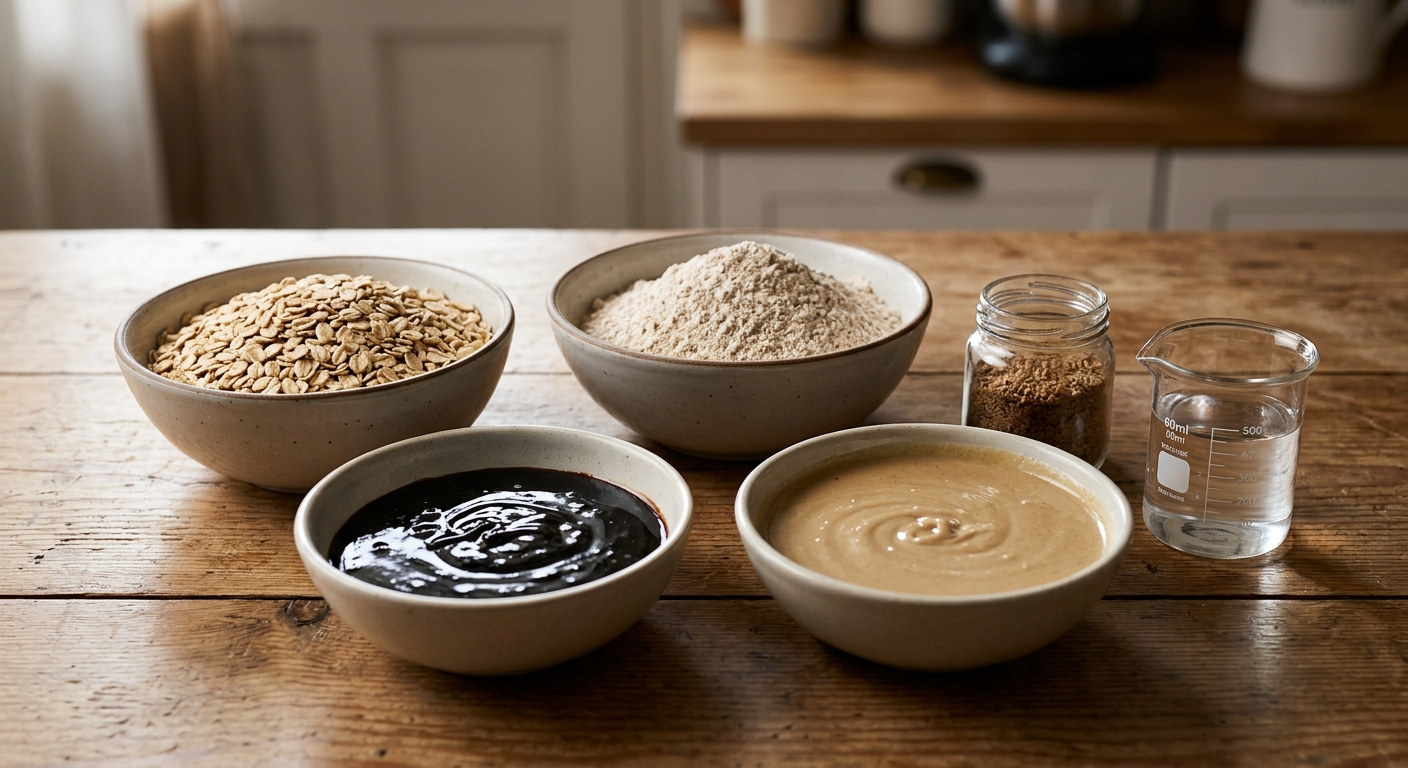
Most people reach for a glass of milk when they think about calcium, but blackstrap molasses is one of the most concentrated plant-based calcium sources on the planet, delivering roughly 200mg per tablespoon. Pair it with rolled oats, tahini, and a touch of ground flaxseed, and you have a cookie that does serious nutritional work while tasting like the best gingerbread you have ever eaten. These cookies are dark, sticky-sweet, faintly bitter, warmly spiced, and genuinely satisfying in a way that most health-focused baked goods simply are not.
The recipe was engineered specifically around the Bone and Joint category, so every ingredient earns its place on the roster. Blackstrap molasses contributes calcium, iron, magnesium, potassium, and vitamin B6 simultaneously. Rolled oats add manganese, which is critical for the formation of connective tissue and bone matrix. Tahini layers in additional calcium and healthy monounsaturated fats that support the absorption of fat-soluble vitamin K2. Ground flaxseed brings a modest omega-3 contribution that research links to reduced inflammatory markers in joint tissue. This is not accidental nutrition; it is calibrated baking.
Because these cookies are dense with moisture from molasses and tahini, they respond beautifully to multiple cooking environments. The oven is the classic route and gives you crisp edges with a chewy center. The stovetop skillet method produces a pan-cookie with a slightly caramelized bottom crust. The slow cooker yields an almost brownie-like, fudgy result perfect for those who want maximum chewiness. The pressure cooker steam-bakes them into soft, pillowy rounds ideal for anyone avoiding crunch. Choose your method based on texture preference and the equipment you have on hand.
16
servings
Ingredients
- 180 grolled oats (old-fashioned, not instant)
- 120 gwhole wheat flour
- 160 gblackstrap molasses
- 100 gtahini (well-stirred)
- 60 gcoconut sugar or light brown sugar
- 30 gground flaxseed
- 60 mlwarm water
- 45 mlextra-virgin olive oil
- 1 tspground ginger
- 1 tspground cinnamon
- 0.5 tspground cloves
- 0.5 tspColima Sea SaltMicroplastic Free Salt
- 1 tspbaking soda
- 1 tspvanilla extract
- —Colima Sea SaltMicroplastic Free Salt for topping (optional)
Instructions
Click on an item below to shop for the recommended items for this recipe on Amazon.
As an Amazon Associate, we earn from qualifying purchases.
- Combine the ground flaxseed and warm water in a small bowl and whisk well. Let the mixture sit for 8 to 10 minutes until it thickens into a gel. This is your binding agent, functionally replacing eggs.
- In a large mixing bowl, whisk together the blackstrap molasses, tahini, coconut sugar, olive oil, and vanilla extract until fully combined and smooth. Fold in the flaxseed gel.
- In a separate bowl, whisk together the rolled oats, whole wheat flour, ground ginger, cinnamon, cloves, baking soda, and salt. Add the dry mixture to the wet mixture and stir with a spatula until a cohesive, sticky dough forms. Let the dough rest for 5 minutes so the oats absorb some moisture.
- Heat a large cast iron skillet or heavy nonstick pan over medium-low heat. No oil is needed. Scoop tablespoon-sized balls of dough (about 28g each) and press each gently into a disc approximately 1.5cm thick. Cook 3 to 4 cookies at a time, leaving space between them.
- Cook undisturbed for 4 to 5 minutes until the bottoms are set and a deep golden-brown. The edges will look dry and matte. Carefully flip each cookie with a thin spatula and cook for a further 3 to 4 minutes until the second side is firm and the center yields only slightly to gentle pressure.
- Transfer to a wire rack. The cookies will firm up considerably as they cool for 10 minutes. Sprinkle with flaky sea salt immediately after coming off the pan if using. Repeat with remaining dough, allowing the pan to cool slightly between batches if it becomes very dark.
- Mix the flaxseed gel first: whisk the ground flaxseed with warm water and let stand 8 to 10 minutes until thick and gelatinous.
- Prepare the slow cooker insert by cutting a piece of parchment paper to fit the bottom and up the long sides of a 5 to 6 quart oval slow cooker, leaving an overhang you can use as handles later. Lightly brush the exposed short sides with olive oil.
- In a large bowl, whisk the blackstrap molasses, tahini, coconut sugar, olive oil, and vanilla together until smooth. Stir in the flaxseed gel. Add the rolled oats, whole wheat flour, ginger, cinnamon, cloves, baking soda, and salt. Mix until a thick, uniform dough forms, then let it rest for 5 minutes.
- Spread the entire dough into the prepared slow cooker insert in an even layer, pressing it out to an approximately 2cm thickness with damp fingertips or the back of a wet spoon. Scatter flaky sea salt over the top if using.
- Place a double layer of paper towels across the top of the slow cooker insert before securing the lid. This absorbs condensation and prevents steam from dripping onto the dough, which would leave wet patches and a gummy top.
- Cook on High for 2 to 2.5 hours. The slab is done when the edges are set and have pulled away slightly from the sides, the top looks dry and matte rather than shiny, and a toothpick inserted in the center comes out with only moist crumbs, not wet batter. Do not lift the lid before the 2-hour mark.
- Turn off the slow cooker and let the slab cool in the insert with the lid ajar for 20 minutes. Use the parchment handles to lift it onto a cutting board. Cool for a further 15 minutes before slicing into 16 bars with a sharp knife.
- Make the flaxseed gel: combine ground flaxseed and warm water, stir, and let stand 8 to 10 minutes. In a large bowl, combine molasses, tahini, coconut sugar, olive oil, vanilla, and flaxseed gel. Whisk until smooth. Stir in oats, flour, ginger, cinnamon, cloves, baking soda, and salt until a firm dough forms. Let rest 5 minutes.
- Lightly grease a 7-inch round cake pan (or any heat-safe pan that fits inside your pressure cooker) with olive oil and line the bottom with a round of parchment paper. Scoop half the dough (8 cookies’ worth) and press them into the pan in a single layer, slightly spaced apart. They will not spread much, so shape them as you want them to look when done. Alternatively, press all of the half-portion of dough into the pan as a single round slab and cut it after cooking.
- Pour 240ml (1 cup) of cold water into the pressure cooker insert and place the metal trivet inside. Lower the filled cake pan onto the trivet. If your pan does not have handles, create a sling by folding a long strip of aluminum foil lengthwise three times and placing it under the pan before lowering it in, leaving the foil ends draped over the sides for easy removal.
- Secure the lid, set the valve to Sealing, and select Manual (or Pressure Cook) on High Pressure for 18 minutes. The pressure cooker will take approximately 8 to 10 minutes to come to pressure before the countdown begins.
- When the cycle ends, allow a natural pressure release for 10 minutes, then carefully switch the valve to Venting to release any remaining pressure. Remove the lid away from you to avoid the steam. Carefully lift the pan out using the foil sling or trivet handles.
- The cookies will look very pale and soft at this stage. Let them cool in the pan for 10 minutes, during which they will firm up significantly. Use a thin spatula to transfer them to a wire rack. If desired, briefly toast the tops with a kitchen torch or place them under a hot broiler for 60 to 90 seconds for color. Repeat the process with the second batch of dough.
- Preheat your oven to 175C (350F) and position one rack in the center of the oven. Line two large baking sheets with parchment paper.
- Prepare the flaxseed gel by whisking ground flaxseed with warm water and letting it thicken for 8 to 10 minutes. In a large bowl, whisk together the molasses, tahini, coconut sugar, olive oil, vanilla, and flaxseed gel until completely smooth and emulsified.
- In a second bowl, stir together the oats, whole wheat flour, ginger, cinnamon, cloves, baking soda, and salt. Pour the dry ingredients into the wet and fold with a spatula until no flour streaks remain. The dough will be sticky. Refrigerate the dough for 10 minutes to make it easier to portion.
- Using a tablespoon or a 28g cookie scoop, portion the dough into 16 balls. Place them on the prepared baking sheets, spacing them at least 5cm apart. Press each ball down gently with the bottom of a glass or damp palm to about 1cm thickness. The cookies will spread minimally, so shape matters here. Sprinkle flaky sea salt on top if using.
- Bake one sheet at a time on the center rack for 12 to 14 minutes. The cookies are done when the edges are firm and the surface looks set and slightly cracked; the centers may still look underdone, and that is correct. Blackstrap molasses continues to firm the cookies as they cool.
- Remove the baking sheet from the oven and let the cookies rest on the pan for exactly 5 minutes before transferring to a wire rack with a thin metal spatula. They will be fragile when hot. Cool completely for at least 15 minutes before eating; the texture and flavor improve dramatically as they set.
Nutrition Breakdown
Per 1 serving (makes 16)
Vitamins & Minerals
% Daily Value based on a 2,000 calorie diet (FDA reference)
🧬 Essential Amino Acids
% of recommended daily intake (RDA) per serving
🛡 Antioxidant Profile
The Nutrition Science
Blackstrap molasses is the final byproduct of sugar refining, and it is the stage at which virtually all of the minerals originally present in sugarcane become maximally concentrated. One tablespoon delivers approximately 200mg of calcium in a highly bioavailable ionic form, alongside significant quantities of iron, magnesium, potassium, and vitamin B6. The combination of calcium and magnesium in molasses is particularly valuable for bone health because these two minerals work synergistically: calcium provides the structural mineral density of hydroxyapatite crystals in bone, while magnesium regulates the enzymatic activity of alkaline phosphatase, the enzyme that triggers bone mineralization. Diets chronically low in magnesium are strongly associated with reduced bone mineral density even when calcium intake is adequate.
Rolled oats contribute manganese at levels that make this cookie a meaningful source of a frequently overlooked bone nutrient. Manganese is an essential cofactor for two enzymes, glycosyltransferase and xylosyltransferase, that are directly responsible for synthesizing the proteoglycan matrix of cartilage. Without adequate manganese, cartilage cannot regenerate properly after the micro-damage that occurs with normal joint loading. Ground flaxseed contributes alpha-linolenic acid (ALA), a plant-based omega-3 fatty acid that is the substrate for EPA synthesis. Elevated EPA levels suppress leukotriene B4 and interleukin-1, two inflammatory mediators that accelerate cartilage breakdown in conditions like osteoarthritis. While flaxseed ALA conversion to EPA is modest (typically 5 to 10%), consistent dietary intake across multiple daily meals meaningfully shifts the inflammatory balance in favor of joint preservation.
Tahini extends the nutritional profile in a particularly elegant way. Beyond its calcium and copper content, tahini provides a matrix of monounsaturated fatty acids that are necessary for the absorption of fat-soluble vitamin K2 consumed elsewhere in the diet. Vitamin K2, specifically the MK-7 form, activates osteocalcin, a protein that binds calcium ions and directs them into bone rather than soft tissue. A cookie that delivers calcium while also supporting the fat-soluble environment needed for K2 activity is, from a bone physiology standpoint, a meaningfully designed food rather than simply a supplement in disguise.
Pro Tips
- Use true blackstrap molasses, not regular or ‘robust’ molasses. Blackstrap is the dark, slightly bitter third-extraction variety and contains three to four times the calcium and iron of lighter molasses. The label should read ‘blackstrap’ specifically.
- Do not skip the dough resting time. Allowing the mixed dough to rest for 5 minutes lets the rolled oats hydrate and swell, which tightens the dough, makes it easier to shape, and produces a chewier final texture regardless of cooking method.
- Store cooled cookies in an airtight container with a small piece of bread. The bread donates its moisture to the cookies over 24 hours, keeping them soft and chewy for up to five days at room temperature. The molasses flavor deepens noticeably on day two.


ooh okay so real talk, the oat thing is smart to ask about but honestly both steel cut and rolled should give you similar calcium content since theyre the same grain just processed differently, the nutrient density stays pretty stable. BUT if youre dealing with flares id actually be curious whether theres something about the processing or maybe phytic acid binding some of that calcium that could be an issue for you specifically? ive found that soaking oats or adding mushrooms like shiitake to stuff actually helps with mineral bioavailability because of how they break down some of those compounds, and shiitakes are calcium dense too if youre open to experimenting. have you noticed any difference between oat types when you eat
This is such a thoughtful angle, Mike. I’ve actually been tracking this in my own labs for a couple years now with my functional medicine practitioner, and you’re hitting on something really important with the phytic acid piece. My calcium and magnesium markers improved noticeably once we started incorporating fermented and soaked preparations rather than just eating oats straight, so Carey, you might want to experiment with soaking these oats overnight before baking or fermenting them if you have time. The shiitake suggestion is brilliant too, since I’ve seen my vitamin D and mineral absorption metrics shift when I’ve added mushrooms to calcium-rich meals, probably because of exactly what Mike mentioned about bioavailability.
ugh this is so interesting because ive been trying to boost my calcium intake without relying on dairy (triggers flares for me) but honestly im nervous about the oat content here – like are we talking steel cut versus rolled and how much fiber total? ive found that in flare states even rolled oats can be rough on my system if theyre not cooked down enough, but when im in remission theyre actually so helpful for keeping things stable. would love to know if anyone with crohns has tried these and how they tolerated them, because the calcium angle is genuinely appealing but i gotta know the texture breakdown first lol