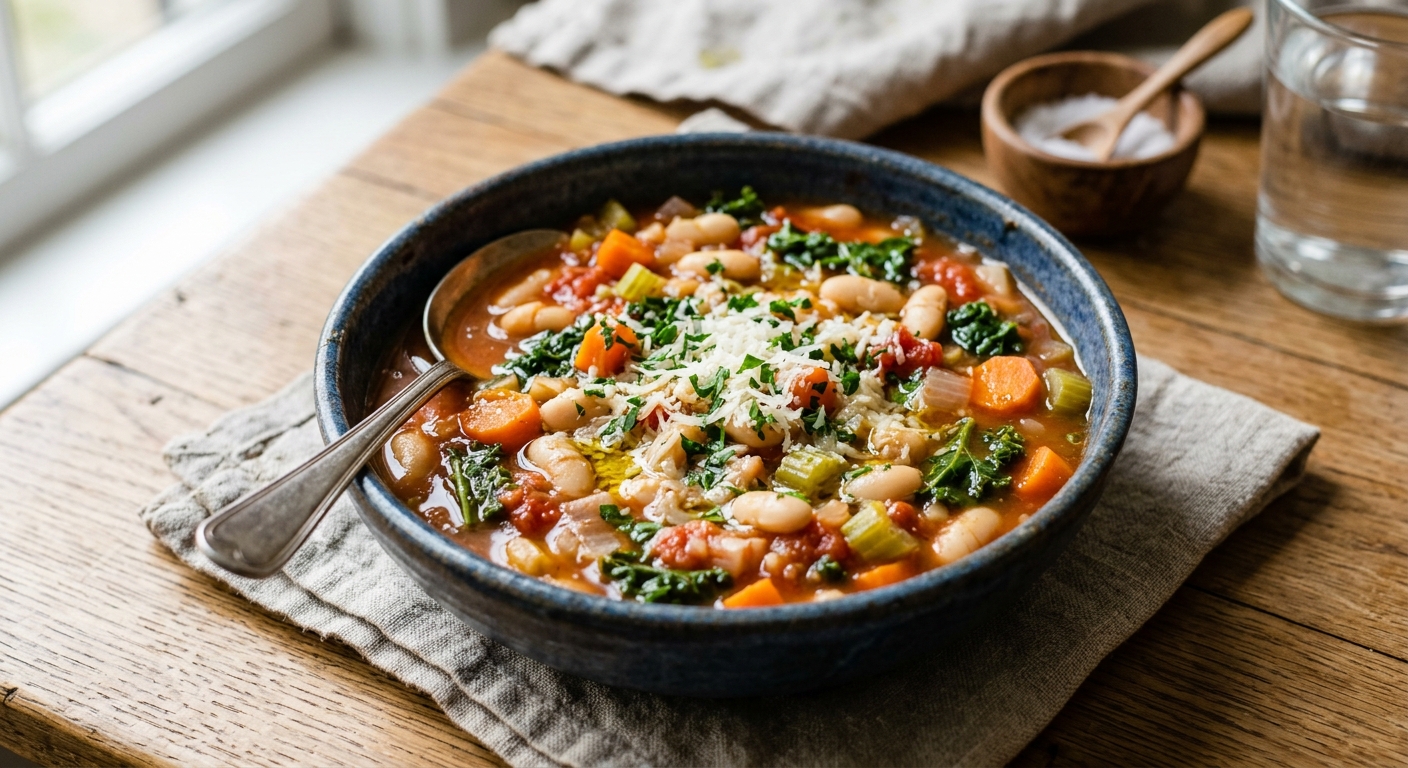
Minestrone is one of the oldest working-class dishes in Italy, born from the philosophy that nothing goes to waste and everything nourishing belongs in the pot. Our Calibrated Cuisine version takes that ancestral wisdom and sharpens it with modern nutritional science, assembling a precise roster of ingredients chosen not just for flavor but for their measurable impact on glycemic control. Cannellini beans anchor the recipe with a double payload of soluble fiber and resistant starch. Kale and zucchini add volume, micronutrients, and fermentable prebiotic fiber. Whole-grain ditalini slows carbohydrate absorption compared to refined pasta. Every ingredient earns its place.
What makes this soup extraordinary for metabolic health is the layering of fiber types. The soluble fiber in cannellini beans forms a viscous gel in the digestive tract that physically slows glucose absorption, reducing the speed at which blood sugar rises after eating. The resistant starch in cooked-and-cooled beans (or freshly cooked beans eaten warm) feeds beneficial gut bacteria, which in turn produce short-chain fatty acids like butyrate that improve insulin sensitivity at the cellular level. The insoluble fiber from kale and whole-grain pasta adds bulk that further moderates digestion. Together they create what researchers call the second-meal effect, where a high-fiber lunch measurably improves glycemic response at dinner.
From a culinary standpoint, this is a soup that rewards patience and layering. The soffritto of onion, celery, and carrot is sauteed until genuinely sweet and golden, building a savory backbone that no amount of seasoning can replicate if you rush it. Crushed tomatoes add acidity and lycopene. A Parmesan rind simmered in the broth contributes glutamates that deepen umami without spiking sodium beyond reasonable limits. This is food that tastes indulgent while actively working to keep your metabolism in balance.
4
servings
Ingredients
- 2 tbspextra-virgin olive oil
- 1 mediumyellow onion, finely diced
- 3 stalkscelery, finely diced
- 2 mediumcarrots, peeled and diced into 1cm pieces
- 4 clovesgarlic, minced
- 1 tbsptomato paste
- 400 gcanned crushed tomatoes
- 480 gcanned cannellini beans, drained and rinsed (about 2 cans)
- 240 gcanned borlotti (cranberry) beans, drained and rinsed (about 1 can)
- 1 mediumzucchini, halved lengthwise and sliced into half-moons (about 200g)
- 150 gTuscan kale (cavolo nero), ribs removed and leaves roughly chopped
- 120 gwhole-grain ditalini pasta (uncooked)
- 1200 mllow-sodium vegetable broth
- 1 pieceParmesan rind (approximately 5cm, optional but recommended)
- 1 tspdried oregano
- 1 tspdried thyme
- 1 sprigfresh rosemary
- 1 tbspred wine vinegar
- —Colima Sea SaltMicroplastic Free Salt and black pepper to taste
- —Fresh flat-leaf parsley, roughly chopped, to serve
- —Freshly grated Parmesan, to serve (optional)
Instructions
Click on an item below to shop for the recommended items for this recipe on Amazon.
As an Amazon Associate, we earn from qualifying purchases.
- Heat the olive oil in a large Dutch oven or heavy-bottomed pot over medium heat. Add the onion, celery, and carrot with a generous pinch of salt. Cook, stirring occasionally, for 8 to 10 minutes until the vegetables are fully softened, lightly golden, and fragrant. Do not rush this soffritto step; the caramelization here is the flavor foundation of the entire soup.
- Push the soffritto to the edges of the pot and add the garlic and tomato paste to the center. Stir the paste constantly for 90 seconds until it deepens to a brick-red color and smells slightly sweet and toasty. Incorporate the garlic and paste into the vegetables.
- Pour in the crushed tomatoes and stir well, scraping up any browned bits from the bottom of the pot. Add the dried oregano, dried thyme, and the fresh rosemary sprig. Cook for 3 minutes, stirring occasionally, to concentrate the tomato flavor.
- Add the vegetable broth, both varieties of drained beans, the Parmesan rind (if using), and a few grinds of black pepper. Increase heat to bring the soup to a lively boil, then reduce to a steady simmer. Partially cover and cook for 15 minutes to allow the flavors to meld and the beans to begin releasing their starch into the broth.
- Add the zucchini and the whole-grain ditalini to the simmering soup. Cook uncovered, stirring occasionally to prevent the pasta from sticking to the bottom, for 10 to 12 minutes until the pasta is just al dente and the zucchini is tender but not mushy.
- Stir in the kale and cook for a further 3 to 4 minutes until the leaves are wilted and tender. Remove the rosemary sprig and Parmesan rind. Stir in the red wine vinegar, which brightens all the flavors. Taste and adjust seasoning with salt and pepper.
- Ladle into warmed bowls and top with chopped fresh parsley and grated Parmesan if desired. The soup thickens considerably as it sits; add a splash of hot broth when reheating leftovers.
- Perform a quick pan soffritto for the best flavor: heat the olive oil in a skillet over medium-high heat and saute the onion, celery, carrot, and garlic together for 5 minutes until softened and just beginning to color. Add the tomato paste and stir for 1 minute. Transfer everything to the slow cooker insert. If you prefer a hands-off approach, you may skip this step and add the raw vegetables directly, but the finished soup will have a slightly thinner, less complex flavor.
- Add the crushed tomatoes, both varieties of drained beans, the vegetable broth, dried oregano, dried thyme, the rosemary sprig, and the Parmesan rind to the slow cooker. Stir briefly to combine. Add the zucchini and carrot pieces now as they need the full cook time. Season lightly with salt and pepper, keeping in mind the broth will concentrate slightly.
- Place the lid on and cook on Low for 7 to 8 hours or on High for 3.5 to 4 hours. The beans should be very creamy and the broth richly colored. After the main cook time, use the back of a large spoon or a potato masher to roughly crush about one-quarter of the beans directly in the pot. This technique thickens the broth naturally without any added starch.
- If your slow cooker has a High setting, increase heat to High. Stir in the whole-grain ditalini, cover, and cook for 20 to 25 minutes, checking at 20 minutes for al dente texture. Pasta continues to absorb liquid after cooking, so pull it slightly earlier than you think necessary.
- Stir in the chopped kale, replace the lid, and cook on High for a further 8 to 10 minutes until the kale is tender. Remove the rosemary sprig and Parmesan rind. Stir in the red wine vinegar and taste carefully, adjusting salt and pepper. Serve topped with fresh parsley and optional grated Parmesan.
- Set the Instant Pot or electric pressure cooker to Saute mode on Medium or Normal heat. Add the olive oil and heat until shimmering. Add the onion, celery, and carrot and saute, stirring frequently, for 5 to 6 minutes until softened. Add the garlic and tomato paste and stir constantly for 1 minute until the paste is caramelized. Press Cancel to turn off Saute mode.
- Add the crushed tomatoes and pour in approximately 120ml of the vegetable broth. Stir vigorously and use a wooden spoon or silicone spatula to scrape up all browned bits from the bottom of the insert. This deglazing step is critical in pressure cooking to prevent a burn warning.
- Add the remaining vegetable broth, both varieties of drained beans, the zucchini, dried oregano, dried thyme, rosemary sprig, Parmesan rind, and a few grinds of black pepper. Do not add the pasta or kale yet. Stir to combine. Lock the lid and set the pressure release valve to Sealing. Select High Pressure and set the timer for 8 minutes.
- Once cooking is complete, allow a natural pressure release for 10 minutes, then carefully switch the valve to Venting to release any remaining steam. Remove the lid. Remove the rosemary sprig and Parmesan rind. Use a large spoon to crush roughly one-quarter of the beans against the side of the pot to naturally thicken the broth.
- Set the pot back to Saute mode on High. Stir in the whole-grain ditalini and cook uncovered, stirring every 2 minutes, for 9 to 11 minutes until the pasta is just al dente. Stir in the chopped kale and cook for a further 2 to 3 minutes until wilted. Press Cancel. Stir in the red wine vinegar and season generously with salt and pepper. Serve immediately, topped with fresh parsley and optional Parmesan.
- Preheat your oven to 160 degrees Celsius (325 degrees Fahrenheit). Place a large oven-safe Dutch oven on the stovetop over medium heat. Add the olive oil and heat until shimmering. Add the onion, celery, and carrot with a pinch of salt and saute, stirring occasionally, for 8 to 10 minutes until deeply golden and very soft. Add the garlic and tomato paste and cook, stirring, for 2 minutes until caramelized and fragrant.
- Stir in the crushed tomatoes and cook for 3 minutes, scraping up any bits from the bottom of the pot. Add the vegetable broth, both varieties of drained beans, zucchini, dried oregano, dried thyme, rosemary sprig, and Parmesan rind. Season with salt and pepper and stir to combine. Bring the soup to a simmer on the stovetop.
- Once simmering, place the Dutch oven in the preheated oven with the lid slightly ajar (resting a wooden spoon across the rim works well to create a steam vent). Bake for 50 to 60 minutes. The soup will gently bubble, the beans will become supremely creamy, and a slightly darkened, concentrated ring of broth will form around the edges, which you stir back in for tremendous depth of flavor.
- Carefully remove the Dutch oven from the oven using heavy oven mitts and return it to the stovetop over medium heat. Remove the rosemary sprig and Parmesan rind. Crush approximately one-quarter of the beans with a spoon to thicken the broth. Stir in the whole-grain ditalini and cook over medium heat, stirring often, for 10 to 12 minutes until the pasta is just al dente.
- Stir in the chopped kale and cook for 3 to 4 minutes until completely wilted and tender. Remove from heat. Stir in the red wine vinegar and taste and adjust seasoning. Rest the soup for 5 minutes before serving to allow the flavors to settle. Serve in warmed bowls topped with fresh parsley and a generous grating of Parmesan.
Nutrition Breakdown
Per 1 serving (makes 4)
Vitamins & Minerals
% Daily Value based on a 2,000 calorie diet (FDA reference)
🧬 Essential Amino Acids
% of recommended daily intake (RDA) per serving
🛡 Antioxidant Profile
The Nutrition Science
The central mechanism through which this minestrone supports insulin control is its exceptionally high soluble fiber content, primarily from the beta-glucans and pectin-like compounds in cannellini and borlotti beans. When soluble fiber contacts water in the digestive tract, it forms a viscous gel that physically coats the intestinal wall, slowing the enzymatic breakdown of starches and the diffusion of glucose into the bloodstream. Clinical trials have consistently shown that diets providing 25 to 35g of fiber per day reduce fasting insulin levels and improve the HOMA-IR index, a standard measure of insulin resistance, by 10 to 20% over 12 weeks. One serving of this soup provides over 60% of the daily fiber target.
The resistant starch in cooked beans deserves particular attention. Unlike digestible starch, resistant starch passes intact through the small intestine and is fermented by Bifidobacterium and Lactobacillus species in the colon. This fermentation produces short-chain fatty acids, principally butyrate, propionate, and acetate. Butyrate is the preferred energy source for colonocytes and has been shown to upregulate the expression of GLP-1 and PYY, two gut hormones that enhance insulin secretion in response to meals and suppress appetite. Propionate travels to the liver and directly inhibits hepatic glucose production, offering a second line of glycemic defense that operates independently of insulin secretion entirely.
Kale contributes sulforaphane precursors (glucoraphanin) and the flavonoid kaempferol, both of which activate the Nrf2 pathway in liver and muscle cells. Nrf2 activation upregulates cellular antioxidant defenses and has been independently linked to improved insulin receptor sensitivity in animal models and early human trials. The olive oil in this recipe is not merely a cooking medium; its oleic acid and polyphenols (particularly oleocanthal) inhibit inflammatory signaling pathways that are mechanistically upstream of insulin resistance. The synergy between fiber, resistant starch, phytochemicals, and healthy fat in a single bowl makes this minestrone a genuine functional food, not just a nutritious one.
Pro Tips
- For maximum resistant starch and glycemic benefit, cook the soup up to a day ahead and refrigerate it overnight. Reheating does not fully reverse resistant starch formation, so next-day leftovers are metabolically superior to freshly made soup.
- The Parmesan rind is not optional if flavor is your priority. Keep a bag of rinds in your freezer whenever you finish a wedge of Parmesan. A single 5cm piece adds extraordinary body and umami depth with negligible sodium compared to what additional salt would require.
- If you are strictly managing sodium, use homemade or no-sodium-added vegetable broth and rinse your canned beans thoroughly under cold running water for 30 seconds. These two steps can reduce the sodium content of the finished soup by up to 35%.
What a wonderful question, Anna, and I’m so glad you brought up the pasta flexibility because that’s exactly the kind of thinking I encourage in my classes! I’ve made minestrone for decades, and I’ve found that the whole grains do add that lovely chewiness and extra fiber hit, but you’re absolutely right that the beans are doing most of the metabolic heavy lifting here. I’m planning to teach this exact recipe next month but I’m going to include a note about swapping in more vegetables (maybe some diced tomatoes or extra zucchini) if someone wants to reduce or skip the pasta entirely, since you get that same satisfying texture from the beans breaking down slightly. The beauty of minest
This looks amazing and I love the focus on resistant starch for insulin control, but I wanted to ask: does the whole-grain pasta stay in the final recipe, or would you say that’s flexible? I’ve found that legumes alone give me plenty of fiber support without the grains, and I’m curious if you’ve experimented with just increasing the bean ratio instead, especially for anyone managing autoimmune thyroid issues alongside blood sugar. Also, I don’t see tomatoes mentioned in the excerpt, which I’m relieved about since nightshades have been a tricky trigger for me. Would you be willing to share the full ingredient list so I can check for any other potential inflammatory additions? Thanks so much for this thought
This is exactly the kind of recipe I’ve been looking for, honestly. The resistant starch angle is what caught my attention, since I’ve noticed my inflammation markers respond really well when I’m consistent with cooled legumes and whole grains, but I’m curious about the vitamin D content here – are you fortifying the pasta, or would you suggest a side of leafy greens or fortified addition to round out the micronutrient profile? I’m managing MS and tend to layer my meals this way to hit specific targets without overthinking it. Thank you for breaking down the fiber mechanics so clearly, it genuinely helps me understand why something works for my body.