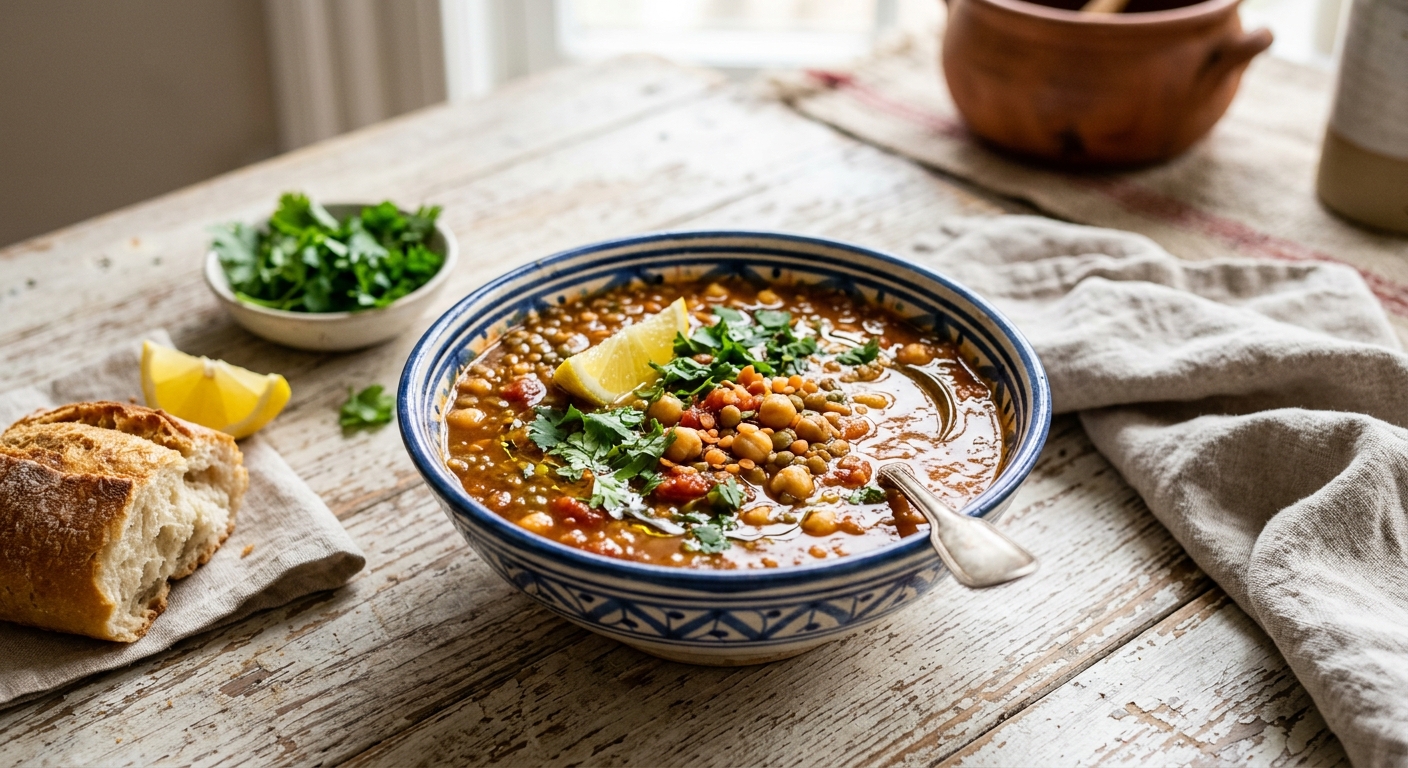
Harira is not merely a soup. It is a centuries-old nutritional masterpiece that Moroccan home cooks have been perfecting long before the word ‘bioavailability’ entered the scientific lexicon. The genius of this dish lies in its instinctive pairing of non-heme iron sources, specifically lentils and chickpeas, with vitamin C from fresh tomatoes, lemon juice, and parsley. That combination can increase iron absorption by up to three-fold, transforming a humble legume broth into one of the most effective iron-delivery vehicles in global cuisine.
Our calibrated version stays faithful to the soul of the dish while amplifying its micronutrient density. We use both red lentils, which break down into a silky, body-giving base, and brown or green lentils, which hold their shape and contribute textural contrast. Canned and fresh tomatoes together provide lycopene alongside vitamin C. Saffron contributes not just its unmistakable golden hue but also trace antioxidants including safranal and crocin. A finishing squeeze of lemon and a generous shower of fresh cilantro and parsley ensure the vitamin C content remains sky-high at the moment of serving, which matters because heat degrades ascorbic acid over time.
Each bowl of this recipe provides approximately 36% of your daily iron requirement, 52% of folate, and over 60% of vitamin C, alongside meaningful contributions of zinc, magnesium, and vitamin B6. It is a genuinely complete mineral matrix in a single course, and it tastes exactly as aromatic, warming, and deeply satisfying as any version you would find simmering on a clay pot stove in the medina of Fes.
4
servings
Ingredients
- 150 gred lentils, rinsed and drained
- 100 ggreen or brown lentils, rinsed and drained
- 240 gcanned chickpeas, drained and rinsed (one 400g can, half used)
- 400 gcanned crushed tomatoes
- 2 mediumripe tomatoes, finely diced (about 250g)
- 1 mediumyellow onion, finely diced
- 3 clovesgarlic, minced
- 2 stalkscelery with leaves, finely sliced
- 30 gfresh flat-leaf parsley, stems finely chopped, leaves reserved
- 30 gfresh cilantro, stems finely chopped, leaves reserved
- 2 tbspextra-virgin olive oil
- 1.5 tspground cumin
- 1 tspground turmeric
- 1 tspground cinnamon
- 0.5 tspground ginger
- 0.5 tspsweet paprika
- 0.25 tspcayenne pepper, or more to taste
- 0.25 tspsaffron threads, crumbled into 2 tbsp warm water
- 1.2 litreslow-sodium vegetable stock or water
- 2 tbsptomato paste
- 3 tbspfresh lemon juice (about 1 large lemon), plus wedges to serve
- 2 tbspall-purpose flour or chickpea flour, whisked into 4 tbsp cold water to form a slurry
- —Colima Sea SaltMicroplastic Free Salt and freshly ground black pepper to taste
- —Lemon wedges and extra fresh herbs to garnish
Instructions
Click on an item below to shop for the recommended items for this recipe on Amazon.
As an Amazon Associate, we earn from qualifying purchases.
- Bloom the aromatics: Heat the olive oil in a large Dutch oven or heavy-bottomed pot over medium heat. Add the diced onion and celery and cook, stirring occasionally, for 7 to 8 minutes until softened and lightly golden at the edges. Add the minced garlic and cook for a further 90 seconds until fragrant.
- Build the spice base: Add the cumin, turmeric, cinnamon, ginger, paprika, and cayenne directly to the onion mixture. Stir constantly for 60 seconds, letting the spices toast in the residual oil. Add the tomato paste and stir for another 60 seconds until it darkens slightly from bright red to a deeper brick colour.
- Add tomatoes and herb stems: Add both the crushed canned tomatoes and the fresh diced tomatoes along with the finely chopped parsley and cilantro stems. Stir well to deglaze any fond from the bottom of the pot. Simmer this tomato base for 5 minutes, stirring occasionally, until it thickens slightly.
- Add lentils and stock: Add the red lentils, green lentils, chickpeas, saffron with its soaking water, and the vegetable stock. Bring to a vigorous boil over high heat, then reduce to a steady simmer over medium-low. Cook uncovered for 30 to 35 minutes, stirring every 8 minutes, until the red lentils have completely dissolved into the broth and the green lentils are tender but not mushy.
- Thicken with flour slurry: Once the lentils are fully cooked, stir the flour-water slurry one more time to recombine, then pour it slowly into the simmering soup while stirring continuously. This is the traditional Moroccan tadouira technique that gives harira its characteristic velvety body. Simmer for a further 5 minutes, stirring frequently, until the soup is silky and slightly thickened.
- Finish and season: Remove the pot from heat. Stir in the fresh lemon juice, then fold in the reserved parsley and cilantro leaves. Taste and adjust salt, black pepper, and cayenne. The soup should taste bright, warmly spiced, and slightly tangy. Serve immediately in deep bowls with lemon wedges alongside.
- Layer the base without sauteing: Add the diced onion, celery, minced garlic, crushed tomatoes, fresh diced tomatoes, tomato paste, cumin, turmeric, cinnamon, ginger, paprika, cayenne, saffron with soaking water, olive oil, and all herb stems directly to the slow cooker insert. Stir to combine everything thoroughly. The slow cooker’s extended cooking time will mellow the raw aromatics without needing to pre-saute, though you may briefly saute onion and garlic first if you want a deeper, more caramelized flavour.
- Add legumes and stock: Add the rinsed red lentils, green lentils, chickpeas, and vegetable stock. Stir once more to distribute everything evenly. The liquid will look thin at this stage, which is correct since the red lentils will absorb stock and break down significantly over the long cook.
- Cook low and slow: Secure the lid and cook on Low for 7 to 8 hours or on High for 4 hours. Do not lift the lid during the first 3 hours on Low (or 2 hours on High), as this releases essential steam and extends the cooking time. By the final hour, the red lentils should have completely dissolved, the green lentils should be very tender, and the soup should have a deep, richly blended colour.
- Add the thickener: About 30 minutes before you are ready to serve, whisk together the flour slurry again and stir it into the slow cooker. Replace the lid and continue cooking on High for the remaining 30 minutes, stirring once at the 15-minute mark. This will tighten the broth into harira’s signature thick, velvety consistency. If you prefer a thinner soup, you may omit this step or use only half the slurry.
- Finish and serve: Turn off the slow cooker. Stir in the fresh lemon juice, reserved parsley leaves, and cilantro leaves. Taste and correct seasoning generously, as slow-cooked dishes often need a final lift of salt and acid. Ladle into deep bowls and serve with lemon wedges. The soup will thicken further as it cools, so thin with a small splash of warm water when reheating leftovers.
- Saute the aromatics on Saute mode: Select the Saute function on your Instant Pot and set to Normal heat. Add the olive oil and, once shimmering, add the diced onion and celery. Cook for 5 minutes, stirring frequently. Add the garlic and cook for 60 seconds. Add all dry spices and stir for 30 seconds, then add the tomato paste and stir for 60 seconds until darkened slightly.
- Add tomatoes and deglaze: Add the canned crushed tomatoes and fresh diced tomatoes. Stir vigorously to lift any browned spices from the bottom of the insert, as any stuck residue can trigger the burn warning during pressure cooking. Add the herb stems and saffron with its soaking water. Stir well and press Cancel to stop the Saute function.
- Pressure cook the legumes: Add the red lentils, green lentils, chickpeas, and vegetable stock. Stir to combine. Secure the lid and ensure the pressure release valve is set to Sealing. Select Pressure Cook (or Manual) on High Pressure for 14 minutes. The pot will take approximately 10 minutes to come to pressure before the countdown begins.
- Release pressure and check texture: Once the cook cycle completes, allow a natural pressure release for 10 minutes, then carefully switch the valve to Venting to release any remaining steam. Open the lid away from you. The red lentils should have dissolved completely and the green lentils should be very tender. If the green lentils still have resistance, reseal and pressure cook for an additional 3 minutes with a quick release.
- Thicken on Saute mode: Select the Saute function again on Normal heat. Whisk the flour slurry and stir it into the soup. Cook, stirring frequently, for 4 to 5 minutes until the soup thickens to harira’s characteristic body. Press Cancel, then stir in the fresh lemon juice and reserved herb leaves. Taste, adjust seasoning, and serve immediately with lemon wedges.
Nutrition Breakdown
Per 1 serving (makes 4)
Vitamins & Minerals
% Daily Value based on a 2,000 calorie diet (FDA reference)
🧬 Essential Amino Acids
% of recommended daily intake (RDA) per serving
🛡 Antioxidant Profile
The Nutrition Science
The most important nutritional interaction in this recipe is the iron-vitamin C synergy. Lentils and chickpeas contain non-heme iron, the plant-based form that the body absorbs at a baseline rate of only 2 to 8%, compared to 15 to 35% for heme iron from animal sources. However, vitamin C (ascorbic acid) present in the tomatoes, lemon juice, and fresh herbs chemically reduces ferric iron (Fe3+) to ferrous iron (Fe2+) directly in the digestive tract. Ferrous iron is the only form transportable across the intestinal mucosa via the DMT-1 transporter, so this reduction step can increase non-heme iron absorption by 200 to 300%. This is why the fresh lemon juice and herbs are added at the end of cooking rather than at the beginning: preserving their vitamin C content maximises this absorption-enhancing effect at the point of consumption.
The folate content deserves equal attention. A single serving provides over half the daily recommended intake of 400mcg, drawn primarily from the lentils and fresh parsley. Folate is essential for DNA synthesis and repair, red blood cell formation, and the methylation cycle that converts homocysteine to methionine. Critically, folate from food (naturally occurring as polyglutamate folates) has a bioavailability of approximately 50 to 85% depending on food matrix, with lentil folate sitting at the higher end of this range because the legume’s protein and fiber matrix slows digestion and allows more complete mucosal uptake.
The manganese content, at 70% of daily value per serving, is often overlooked but nutritionally significant. Manganese is a required cofactor for superoxide dismutase (MnSOD), the primary mitochondrial antioxidant enzyme. It also activates enzymes involved in gluconeogenesis and amino acid metabolism. Lentils are among the top dietary sources of manganese, and this recipe’s combination of two lentil varieties alongside chickpeas makes it an exceptional delivery vehicle. The copper content (53% DV) works synergistically with iron, as copper-dependent ceruloplasmin is required to oxidise iron back to its ferric form for loading onto transferrin for transport through the bloodstream, completing the iron metabolism circuit that this dish so elegantly initiates.
Pro Tips
- For maximum vitamin C retention and iron absorption benefit, add the lemon juice and fresh parsley and cilantro leaves only after the heat is turned off or just before serving. Vitamin C degrades rapidly above 70 degrees Celsius and in the presence of dissolved oxygen, so late addition preserves 70 to 80% more ascorbic acid than stirring it in at the start.
- Toast your whole spices in the dry pot for 60 seconds before adding oil if you want an even deeper flavour. Cumin seeds, coriander seeds, and a cinnamon stick all respond well to dry toasting; grind or crush them immediately before use for maximum volatile oil release.
- Harira thickens substantially as it cools because the dissolved red lentils continue to absorb liquid. Leftovers stored overnight will be almost paste-like; simply thin with warm vegetable stock or water by the ladle when reheating, and re-season with a fresh squeeze of lemon before serving.


This is such a thoughtful recipe for anyone managing iron levels, and I’m loving how the lemon juice is front and center here since vitamin C really does make a huge difference in how well we absorb the iron from those legumes. One thing I’d gently ask though: are there any goitrogenic vegetables in the traditional version, or is this version specifically modified to avoid them? I ask because raw cruciferous veggies can interfere with iodine absorption, and if someone’s adding this to their routine alongside thyroid support, it’s worth knowing what’s in the pot. The lentils themselves are a great selenium source too, which pairs beautifully with iron metabolism!
This is such a smart observation about the iron synergy, Sam! The saffron itself doesn’t contain meaningful melatonin, but I love that you’re thinking about evening nutrition since harira is traditionally a breaking-fast meal. From a pharmacist’s perspective, what’s brilliant here is that the ascorbic acid from tomatoes and lemon actually enhances non-heme iron absorption from the legumes by keeping it in a form your body can uptake more efficiently, especially important for plant-based iron. I’ve seen patients whose iron labs improved dramatically once they started pairing their legume dishes with citrus the same way this recipe does, rather than sipping coffee or tea with the meal which would inhibit
oh wow, the lentil + chickpea combo is genius for iron bioavailability, especially with that vitamin C from tomatoes and lemon hitting at the same time. quick question though – do you know if the saffron itself has any melatonin precursors or if its mainly there for flavor and those anti-inflammatory compounds? ive been experimenting with spiced broths as a pre-bed meal and my sleep tracker actually showed better deep sleep percentages after nights i had legume-heavy soups vs just plain protein, so im wondering if the magnesium density in harira could be playing a role too. definitely making this.