
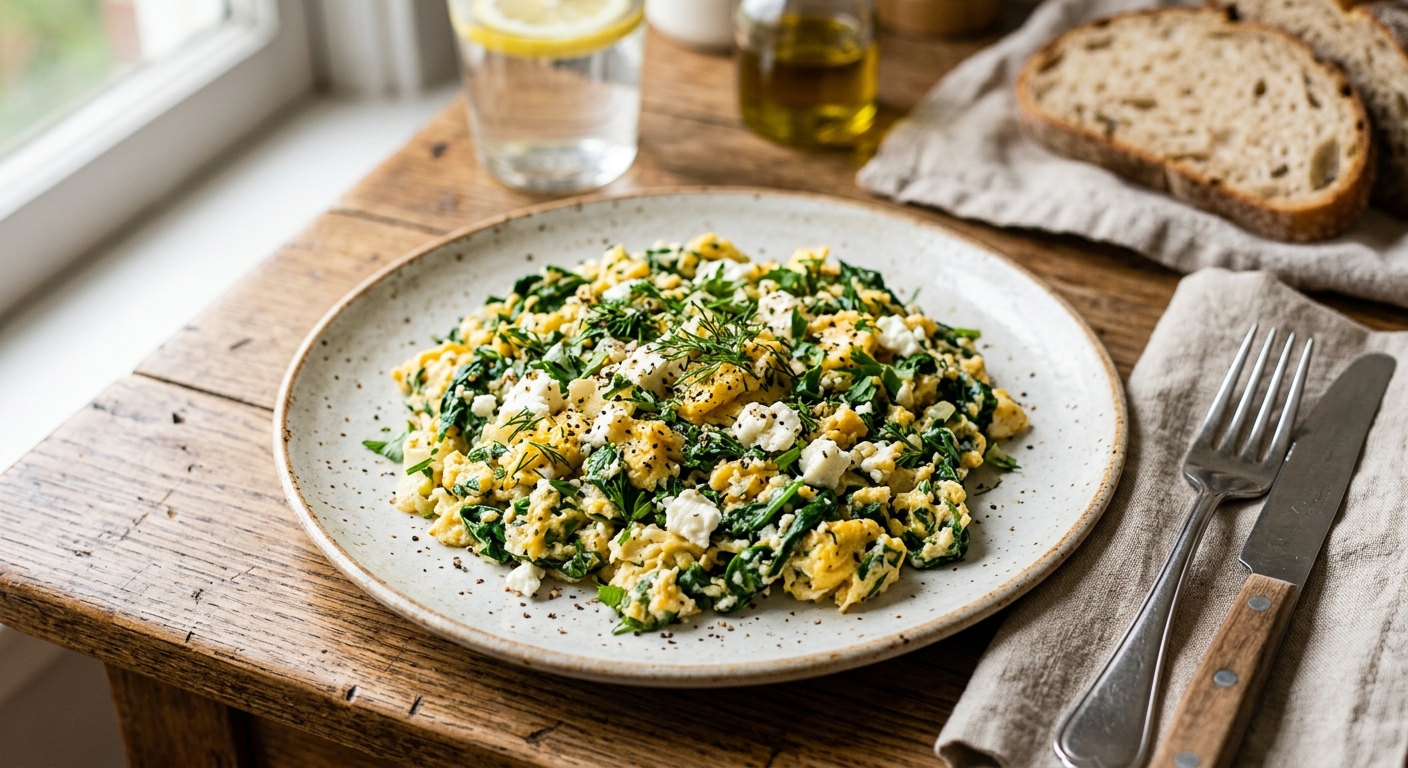
Spanakopita, the beloved Greek spinach and feta pie, has been a staple of Mediterranean cooking for centuries. We have taken everything that makes it extraordinary, the briny feta, the iron-rich spinach, the fragrant dill and nutmeg, and reimagined it as a fast, weeknight-friendly scramble that skips the phyllo pastry without sacrificing any of the nutritional or culinary magic. The result is a dish that is simultaneously comforting, vibrant, and precisely calibrated to support your skeletal health from multiple nutritional angles at once.
What sets this scramble apart from your average egg dish is the sheer density of bone-supporting nutrients packed into a single pan. Baby spinach contributes exceptional amounts of vitamin K1, the fat-soluble nutrient that activates osteocalcin, a protein that binds calcium directly into bone matrix. Full-fat feta cheese brings genuine bioavailable calcium alongside phosphorus, two minerals that work in tandem to maintain bone mineral density. And the eggs anchor the whole dish with high-quality complete protein, essential for collagen synthesis and ongoing bone tissue repair. Every ingredient earns its place on both flavor and functional grounds.
Whether you cook this on a weekday morning, batch it for meal prep in a slow cooker, or pressure cook it into a savory egg bake in under 20 minutes, the recipe adapts to your lifestyle without compromising on the nutrient profile. We have written each cooking method from the ground up with specific temperatures, techniques, and timing so that whether you are working with a cast iron skillet, a slow cooker, or an Instant Pot, you get perfect texture and maximum nutritional retention every time.
4
servings
Ingredients
- 8 largeeggs, beaten
- 280 gbaby spinach, washed and roughly chopped
- 180 gfull-fat feta cheese, crumbled
- 1 mediumyellow onion, finely diced (approx. 150g)
- 4 clovesgarlic, minced
- 3 tbspextra-virgin olive oil
- 3 tbspfresh dill, finely chopped (or 1 tbsp dried)
- 2 tbspfresh flat-leaf parsley, chopped
- 2 tbspfresh lemon juice
- 1 tsplemon zest
- 0.25 tspfreshly grated nutmeg
- 0.5 tspdried oregano
- 4 wholespring onions (scallions), thinly sliced
- —Colima Sea SaltMicroplastic Free Salt and freshly cracked black pepper to taste
- —Extra dill fronds and lemon wedges to serve
Instructions
Click on an item below to shop for the recommended items for this recipe on Amazon.
As an Amazon Associate, we earn from qualifying purchases.
- Beat the 8 eggs in a medium bowl with the lemon juice, lemon zest, nutmeg, oregano, a generous pinch of sea salt, and several cracks of black pepper. Whisk vigorously for 60 seconds until the mixture is pale, slightly frothy, and fully combined. Set aside.
- Heat 3 tablespoons of olive oil in a 12-inch cast iron skillet or heavy non-stick pan over medium heat. Once the oil shimmers, add the diced onion with a pinch of salt and cook, stirring occasionally, for 6 to 7 minutes until softened and translucent with light golden edges. Add the garlic and spring onions and cook for a further 90 seconds until fragrant.
- Add all the chopped spinach to the skillet in two or three batches, using tongs to fold it into the onion mixture. Cook for 2 to 3 minutes, turning frequently, until every leaf is wilted and the released liquid has evaporated almost completely from the pan. This step is critical: excess moisture will waterlog the eggs, so press the spinach against the pan with a spatula and tip off any pooled liquid.
- Reduce the heat to medium-low. Pour the seasoned egg mixture evenly over the spinach in the pan. Scatter two-thirds of the crumbled feta across the surface. Do not stir immediately. Allow the eggs to begin setting on the bottom and edges for about 60 to 90 seconds.
- Using a wide rubber or silicone spatula, gently fold the mixture from the edges toward the center in slow, deliberate strokes, turning large soft curds rather than scrambling aggressively. Continue folding every 20 to 30 seconds. Remove the pan from the heat when the eggs are just barely set and still look slightly underdone, as residual heat will finish cooking them to creamy perfection in about 30 seconds off the flame.
- Immediately scatter the remaining feta, fresh dill, and chopped parsley over the top. Serve directly from the pan alongside lemon wedges for squeezing. For best texture, serve within 2 minutes of plating.
- Prepare the spinach filling first on the stovetop: heat 2 tablespoons of olive oil in a skillet over medium heat and saute the diced onion for 5 minutes until softened. Add the garlic and spring onions, cook 1 minute, then add the spinach in batches, stirring until fully wilted and the excess moisture has evaporated, about 3 minutes. Season with salt, pepper, oregano, and nutmeg. Remove from heat and let the mixture cool for 10 minutes. This step prevents the hot filling from pre-cooking the eggs before they set evenly.
- Generously grease the entire interior of a 6-quart slow cooker insert with the remaining 1 tablespoon of olive oil, including the sides, using a paper towel or pastry brush. Line the base with a strip of parchment paper if desired for easy removal.
- In a large mixing bowl, whisk together the 8 eggs, lemon juice, lemon zest, and a generous pinch of salt and pepper for about 45 seconds until light and uniform. Fold in the cooled spinach mixture, the fresh dill, parsley, and two-thirds of the crumbled feta. Pour the entire mixture into the prepared slow cooker insert, spreading it evenly with a spatula.
- Scatter the remaining feta across the surface. Place a double layer of paper towels or a clean kitchen towel under the lid before sealing. This absorbs condensation dripping from the lid, which would otherwise make the surface watery and prevent it from setting cleanly.
- Cook on Low for 1 hour 45 minutes to 2 hours. The scramble is done when the center is just set and no longer jiggles when the insert is gently shaken. Avoid opening the lid in the first 90 minutes. Slice into wedges or scoop into portions directly from the insert, and garnish with fresh dill and lemon wedges before serving.
- Prepare the aromatic spinach base: select the Saute function on your Instant Pot or pressure cooker and heat 2 tablespoons of olive oil. Add the onion and cook, stirring, for 4 minutes until softened. Add the garlic and spring onions, stir for 60 seconds, then add the spinach in two batches, pressing it down and stirring until fully wilted, about 2 minutes. Add the nutmeg, oregano, salt, and pepper, stir to combine, then press Cancel to stop the Saute function. Transfer the spinach mixture to a bowl and allow it to cool for 8 minutes. Wipe the insert dry.
- In a large bowl, whisk together the eggs, lemon juice, lemon zest, dill, parsley, salt, and pepper until well combined. Fold in the cooled spinach mixture and two-thirds of the crumbled feta. Pour the mixture into a well-greased 7-inch springform pan or silicone mold. Scatter the remaining feta on top. Cover the pan tightly with aluminium foil, pressing it down around the edges to seal completely. This prevents condensation from dripping onto the egg surface during pressurised cooking.
- Pour 1 cup (240ml) of cold water into the Instant Pot insert. Lower the filled pan onto the trivet and carefully place it inside the pot, ensuring the foil seal is secure. Lock the lid and set the valve to the Sealing position.
- Select Pressure Cook on High for 8 minutes. Once the cycle completes, allow Natural Pressure Release for 5 minutes, then carefully switch the valve to Venting for a Quick Release of any remaining steam. Open the lid away from you.
- Using oven mitts, lift the trivet and pan out of the insert. Remove the foil carefully, avoiding the trapped steam. The eggs should be fully set with a slight gloss on the surface. Allow to rest for 3 minutes before releasing the springform clasp or unmoulding. Garnish with fresh dill fronds and serve with lemon wedges.
- Preheat your oven to 190C (375F) with a rack positioned in the center. Heat 3 tablespoons of olive oil in a 10-inch oven-safe cast iron skillet over medium heat on the stovetop. Add the diced onion with a pinch of salt and cook for 6 minutes, stirring occasionally, until golden and softened. Add the garlic and spring onions and cook for 90 seconds until fragrant.
- Add the spinach in two batches, using tongs to fold it into the aromatics until completely wilted, about 2 to 3 minutes. Tilt the pan and press the spinach firmly to expel as much moisture as possible, then carefully pour off any accumulated liquid. Season the spinach layer with oregano, nutmeg, salt, and pepper, then spread it evenly across the bottom of the skillet.
- In a bowl, whisk together the eggs, lemon juice, lemon zest, dill, and parsley with a pinch of salt and pepper until smooth and slightly aerated. Reduce the stovetop heat to low and pour the egg mixture directly over the spinach layer in the skillet. Scatter two-thirds of the crumbled feta evenly across the surface. Allow the eggs to cook undisturbed on the stovetop for 2 to 3 minutes until the very edges begin to set and turn opaque.
- Transfer the skillet to the preheated oven. Bake for 22 to 25 minutes until the eggs are fully set across the entire surface, the edges are pulling away from the pan slightly, and the top is lightly golden with small golden-brown spots where the feta caramelises. A knife inserted in the center should come out clean.
- Remove the skillet from the oven using heavy oven mitts and place it on a heatproof surface. Scatter the remaining crumbled feta across the hot surface so it softens slightly from residual heat. Rest for 3 to 4 minutes before slicing into wedges. The resting period allows the proteins to fully stabilise, making clean slices possible. Garnish with fresh dill fronds and serve with lemon wedges.
Nutrition Breakdown
Per 1 serving (makes 4)
Vitamins & Minerals
% Daily Value based on a 2,000 calorie diet (FDA reference)
🧬 Essential Amino Acids
% of recommended daily intake (RDA) per serving
🛡 Antioxidant Profile
The Nutrition Science
The bone-health story of this dish begins with vitamin K1, where spinach is one of the single most concentrated dietary sources on earth. At 346% DV per serving, the phylloquinone in cooked spinach directly carboxylates osteocalcin, the non-collagen protein secreted by osteoblasts that anchors calcium ions into the hydroxyapatite crystal lattice of cortical bone. Without sufficient vitamin K, osteocalcin remains in an undercarboxylated, inactive form, meaning calcium is absorbed from the gut but never efficiently deposited into bone tissue. The fat from olive oil and feta in this recipe is not incidental: vitamin K1 is fat-soluble, and studies show absorption increases two to threefold when consumed alongside dietary fat compared to a fat-free meal.
Feta cheese contributes a calcium and phosphorus ratio of approximately 1.3 to 1, which closely mirrors the natural mineral ratio found in bone itself (roughly 1.67 to 1 in hydroxyapatite). This makes feta a particularly efficient dairy source for bone mineralisation compared to cheeses with less favorable mineral ratios. The eggs amplify this effect through their phosphorus content and through the presence of vitamin D in the yolk, a hormone-like vitamin that upregulates the intestinal calcium transport protein TRPV6, dramatically increasing the fraction of dietary calcium that actually crosses the gut wall into circulation.
Folate, delivered here primarily by spinach and fortified by the egg yolks, plays a less commonly discussed but critical role in bone architecture. Elevated homocysteine, a metabolic byproduct that accumulates when folate and B12 intake is insufficient, directly inhibits collagen cross-linking in bone matrix and has been identified in prospective studies as an independent risk factor for fracture. With 52% DV of folate and 58% DV of vitamin B12 per serving, this scramble addresses both sides of the homocysteine methylation cycle simultaneously, supporting the collagen scaffold that gives bone its tensile flexibility and resistance to fracture under load.
Pro Tips
- Do not skip the moisture-expelling step after wilting the spinach. Spinach releases a remarkable volume of oxalic-acid-rich water when cooked, and if that liquid remains in the pan it will steam the eggs rather than allow them to set into creamy curds. Press firmly with a spatula, tilt the pan, and pour off every drop before adding your eggs.
- For superior calcium absorption, add a small squeeze of fresh lemon juice over each serving at the table. The vitamin C enhances non-heme iron uptake from the spinach, while the mild acidity creates a more favorable environment in the small intestine for calcium transport protein activity.
- If you are making this for bone health specifically, use full-fat feta rather than reduced-fat. The fat-soluble vitamins K1 and A in this dish require dietary fat for absorption, and the fat in full-fat feta contributes directly to that bioavailability. Greek or Bulgarian sheep’s milk feta tends to have a higher calcium density than cow’s milk varieties, so check labels and choose accordingly.


omg YES the spinach and feta combo is literally a micronutrient dream team, i get SO excited about dark leafy greens!! my kids actually demolished this when i made something similar, but i added even MORE spinach than the recipe called for and snuck in some crumbled feta at the end so they couldnt pick it out lol. the bone-building thing really resonates with me too since we’ve been so focused on calcium and vitamin K after our deficiency scare. gonna make this for breakfast tomorrow, thank you for putting the actual percentages in there, it makes it so much easier to plan the rest of our day around nutrient density!
ok this is genius and i love the sneaky feta move lol, thats some serious parent nutrition tactics right there! from an endurance perspective i’m always hunting for calcium and K2 rich foods since those micronutrients are huge for bone health when youre pounding the pavement on long runs, so the fact that spinach hits both plus folate is perfect. honestly wondering if this would work as a post race breakfast too since you need those carbs to replenish but the protein and electrolytes from the feta and eggs would be clutch for recovery – have you tried pairing it with like toast or some quick carbs to maximize the glycogen restock? either way definitely making this tomorrow
Love this, Diane! That instinct to pile on extra spinach is *chef’s kiss* because you’re not just boosting calcium and K2, you’re also increasing folate which so many of us are actually deficient in. It reminds me of how my own family would do something similar with collard greens and other dark leafies, stretching them out because we knew they were medicine in our kitchens. The fact that your kids are actually eating their greens with enthusiasm is honestly the biggest win here, so you’re clearly onto something!