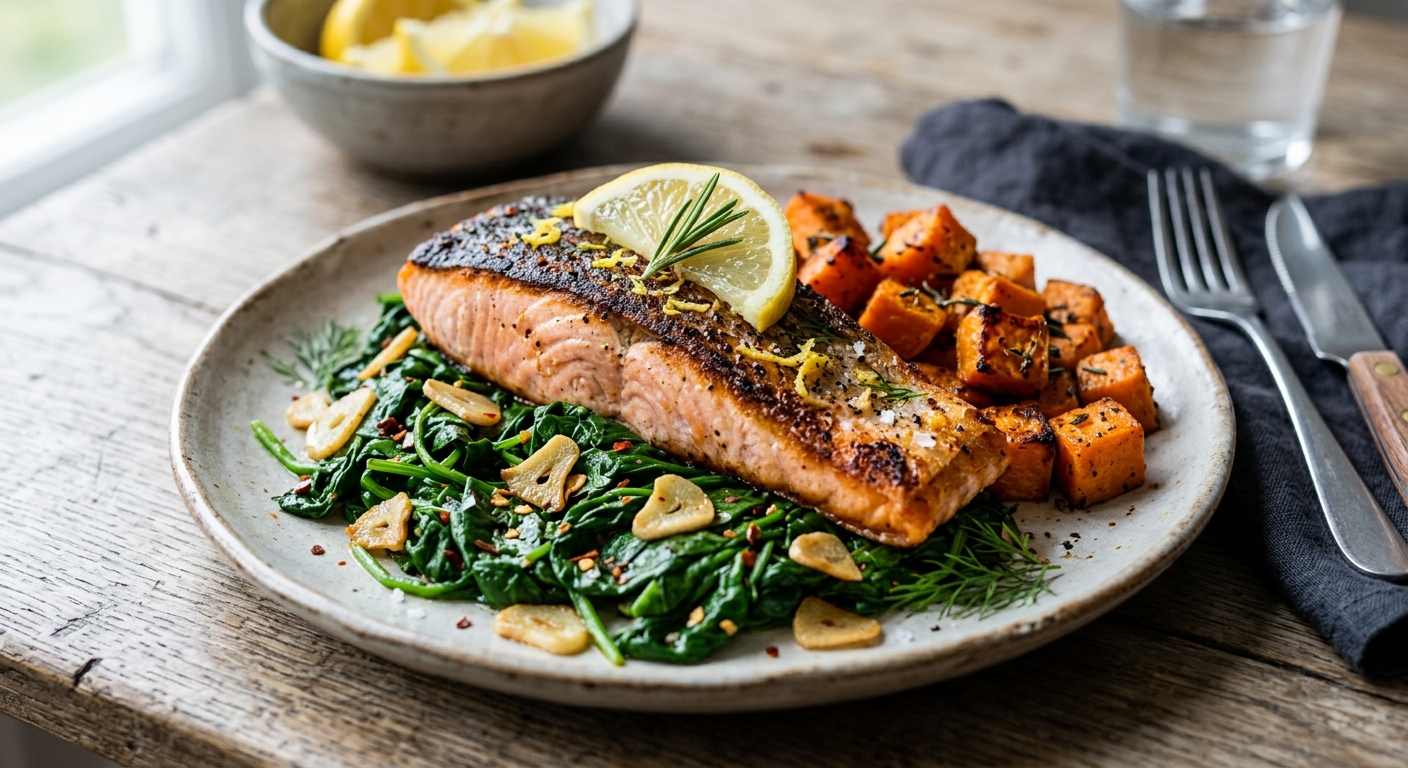
Few meals can claim to genuinely move the needle on your micronutrient status the way this plate does. Wild-caught salmon is one of nature’s most concentrated sources of long-chain omega-3 fatty acids (EPA and DHA), vitamin D, and vitamin B12, three nutrients that a significant portion of the population falls short on. Paired with roasted sweet potato for beta-carotene and complex carbohydrates, and a generous pile of garlicky wilted spinach for iron, folate, and vitamin K, this dish is essentially a multivitamin you actually want to eat.
What sets this recipe apart from standard salmon-and-vegetable combinations is the deliberate calibration of each component. The sweet potato is cut thick and roasted at high heat to concentrate its natural sugars and maximize carotenoid bioavailability, which is enhanced by the fat from the olive oil. The spinach is briefly wilted with sliced garlic rather than minced, so the garlic mellows to a sweet, nutty depth without turning harsh. The salmon is cooked to a precise internal temperature to preserve its delicate texture and prevent the denaturation of heat-sensitive omega-3s. Every step has a reason.
This recipe offers four distinct cooking methods so you can adapt it to your schedule and equipment without sacrificing results. The stovetop method delivers a classic golden sear. The oven method frees your hands and yields an evenly cooked, gently flaking fillet. The pressure cooker steams the salmon to silky perfection in minutes. And the slow cooker produces a confit-style result that is impossibly tender, perfect for batch cooking or hands-off evenings. Choose your method and let the nutrients do the work.
4
servings
Ingredients
- 680 gwild salmon fillets (4 x 170g portions, skin-on, pin bones removed)
- 600 gorange-fleshed sweet potatoes (about 2 medium), peeled and cut into 2cm cubes
- 280 gfresh baby spinach, washed
- 6 clovesgarlic, thinly sliced
- 3 tbspextra-virgin olive oil, divided
- 1 tbspfresh lemon juice
- 1 tspsmoked paprika
- 0.5 tspground cumin
- 0.25 tspcayenne pepper
- 2 tsplemon zest (from 1 large lemon)
- 1 tbspfresh dill, roughly chopped (or 1 tsp dried)
- —Colima Sea SaltMicroplastic Free Salt and freshly cracked black pepper to taste
- —Lemon wedges to serve
Instructions
Click on an item below to shop for the recommended items for this recipe on Amazon.
As an Amazon Associate, we earn from qualifying purchases.
- Pat the salmon fillets completely dry with paper towels and season generously on both sides with salt, black pepper, smoked paprika, cumin, and cayenne. Press the seasoning gently into the flesh and let the fish rest at room temperature for 10 minutes while you prepare the vegetables.
- Heat 1.5 tablespoons of olive oil in a large heavy-bottomed or cast-iron skillet over medium-high heat. Add the sweet potato cubes in a single layer without crowding. Season with a pinch of salt. Cook undisturbed for 5 to 6 minutes until the undersides are deeply golden. Flip and cook a further 5 minutes, then reduce heat to medium, add a splash of water (2 tablespoons), cover with a lid, and steam for 4 to 5 minutes until the potato is completely tender when pierced. Transfer to a warm bowl and cover loosely with foil.
- In the same skillet over medium heat, add 0.5 tablespoon of olive oil and the sliced garlic. Cook, stirring frequently, for 1 to 2 minutes until the garlic is just golden and fragrant. Add the baby spinach in two or three batches, tossing with tongs after each addition and allowing it to wilt before adding more. Season with salt and a squeeze of lemon juice. Cook for 2 minutes total until completely wilted but still bright green. Transfer to a plate and keep warm.
- Wipe the skillet clean and return it to high heat. Add the remaining 1 tablespoon olive oil and heat until shimmering and just beginning to smoke. Place the salmon fillets skin-side down. Press each fillet gently with a spatula for the first 30 seconds to prevent curling. Cook undisturbed for 4 to 5 minutes until the skin is crisp and the flesh is opaque two-thirds of the way up the fillet.
- Flip the salmon carefully and cook for a further 1 to 2 minutes until the internal temperature reads 52 to 54 degrees Celsius (125 to 130F) for medium, or 60C (140F) for fully cooked. Remove from heat and rest for 2 minutes. Plate the salmon over the spinach alongside the sweet potato, finish with lemon zest, fresh dill, and a lemon wedge, then serve immediately.
- Preheat your oven to 220C (200C fan, 425F, Gas Mark 7). Line a large rimmed baking sheet with parchment paper. In a bowl, toss the sweet potato cubes with 1.5 tablespoons of olive oil, smoked paprika, cumin, salt, and pepper until evenly coated. Spread in a single layer across two-thirds of the baking sheet, leaving space for the salmon.
- Roast the sweet potatoes on the upper-middle rack for 15 minutes, turning once halfway through, until the edges are starting to brown and caramelize.
- While the potatoes roast, place the salmon fillets on a plate. Combine 1 tablespoon olive oil, lemon zest, cayenne, salt, and pepper, and brush this mixture evenly over the flesh side of each fillet. After the potatoes have roasted for 15 minutes, push them to one side of the pan and nestle the salmon fillets skin-side down in the cleared space.
- Return the pan to the oven and roast for a further 10 to 14 minutes, depending on fillet thickness, until the salmon flesh is opaque and flakes easily with a fork (internal temperature 52 to 60C at the thickest point). The sweet potato edges should be deeply caramelized.
- While the salmon finishes roasting, heat the remaining 0.5 tablespoon olive oil in a skillet over medium heat. Add the sliced garlic and cook for 90 seconds until golden, then add the spinach and toss continuously for 2 minutes until wilted. Season with lemon juice, salt, and pepper. Plate the roasted sweet potato and garlicky spinach, lay the salmon fillet on top, scatter with fresh dill, and serve with lemon wedges.
- Lightly coat the inside of the slow cooker insert with 0.5 tablespoon of olive oil. Layer the sweet potato cubes across the base. Sprinkle with smoked paprika, cumin, a pinch of cayenne, salt, and pepper, then drizzle with 1 tablespoon of olive oil. Toss to coat. Pour 60ml (quarter cup) of water around the edges to create steam.
- In a small bowl, mix the remaining olive oil, lemon zest, salt, and a pinch of cayenne. Place the salmon fillets skin-side down directly on top of the sweet potato layer. Brush the flesh of each fillet with the seasoned oil mixture. Tuck the sliced garlic around the salmon and scatter the dill over the top.
- Place the lid on the slow cooker and cook on Low for 3 to 3.5 hours. Salmon is ready when the flesh is opaque throughout and flakes gently when tested with a fork. Avoid lifting the lid before the 3-hour mark, as this releases heat and extends cooking time. Do not cook on High, as salmon will overcook and dry out.
- About 5 minutes before serving, heat a skillet over medium heat with a small drizzle of olive oil. Add the sliced garlic and cook for 90 seconds, then add the baby spinach and toss until fully wilted, about 2 minutes. Season with lemon juice, salt, and pepper.
- Using a wide spatula, carefully lift each salmon fillet off the sweet potato bed (the skin may stick and release; this is fine). Spoon the sweet potatoes and any juices onto plates, top with the garlicky spinach, and lay the salmon on top. Finish with a squeeze of lemon and serve immediately.
- Pour 240ml (1 cup) of cold water into the inner pot of your pressure cooker. Add a pinch of salt and a few strips of lemon zest to the water to create a lightly aromatic steam. Place the trivet (steam rack) inside the pot. Arrange the sweet potato cubes in a steamer basket or directly on the trivet in an even layer. Season with smoked paprika, cumin, salt, pepper, and a drizzle of 1 tablespoon olive oil.
- Season the salmon fillets on both sides with salt, pepper, cayenne, and lemon zest. Lay the fillets skin-side down on top of the sweet potato layer. If your pot is small, overlap the thin tail ends slightly. Scatter half the sliced garlic over the salmon.
- Secure the lid and set the pressure release valve to Sealing. Cook on High Pressure for 3 minutes for medium-cooked salmon (slightly translucent at center) or 5 minutes for fully cooked. When the cycle ends, perform an immediate Quick Release by carefully turning the valve to Venting. Do not use Natural Release, as the residual heat will overcook the fish.
- Once the steam has fully released, open the lid away from you. Check that the sweet potato is tender (if not, use the Saute function for 2 to 3 minutes to finish). Carefully remove the salmon fillets with a wide spatula and the sweet potato with a slotted spoon. Tent loosely with foil while you prepare the spinach.
- Switch the Instant Pot to Saute mode on Medium. Add the remaining olive oil and sliced garlic directly to the inner pot and cook for 60 to 90 seconds until fragrant and golden. Add all the spinach at once and use tongs to toss continuously for 2 to 3 minutes until fully wilted. Add lemon juice and season to taste. Plate the sweet potato, pile the spinach alongside, rest the salmon on top, and finish with fresh dill and lemon wedges.
Nutrition Breakdown
Per 1 serving (makes 4)
🌿 Vitamins & Minerals
% Daily Value based on a 2,000 calorie diet (FDA reference)
🧬 Essential Amino Acids
% of recommended daily intake (RDA) per serving
🛡 Antioxidant Profile
The Nutrition Science
The omega-3 fatty acids EPA and DHA found in wild salmon are fundamentally different from the plant-based ALA found in flaxseed or walnuts. Only EPA and DHA directly reduce circulating triglycerides, lower systemic inflammation via prostaglandin modulation, and support neuronal membrane fluidity. A single 170g serving of wild sockeye or Atlantic salmon provides approximately 2,000 to 2,500mg of combined EPA and DHA, meeting or exceeding the 2,000mg threshold associated with measurable cardiovascular and cognitive benefits in clinical trials. Wild-caught varieties consistently deliver higher omega-3 levels than farmed alternatives due to their natural diet of krill and smaller fish.
The sweet potato and spinach in this recipe are not merely side dishes: they are strategic nutritional complements. Beta-carotene from sweet potato is a fat-soluble compound, meaning its absorption is dramatically enhanced by the presence of dietary fat. The olive oil in this recipe serves precisely this function. Research shows that consuming beta-carotene with as little as 3 to 5 grams of fat can increase carotenoid absorption from under 10% to over 60%. Meanwhile, the spinach contributes a substantial dose of vitamin K1 (phylloquinone), which works synergistically with the vitamin D from salmon to support calcium utilization in bone mineralization, a pairing that is rarely discussed but clinically meaningful.
Selenium, present at nearly 100% DV per serving from the salmon alone, functions as a cofactor for glutathione peroxidase, the body’s primary endogenous antioxidant enzyme. This is particularly relevant in the context of a high omega-3 meal: because polyunsaturated fats are inherently prone to lipid peroxidation, having adequate selenium ensures that the antioxidant system is upregulated to protect those very fatty acids from oxidative degradation both in the food and within the body after absorption. Astaxanthin, the carotenoid that gives wild salmon its distinctive color, provides additional lipid-phase antioxidant protection with a potency estimated to be 550 times greater than vitamin E for singlet oxygen quenching.
Pro Tips
- Always choose wild-caught salmon over farmed when possible: wild Pacific sockeye or coho reliably contains 20 to 40% more omega-3s per gram and significantly lower levels of PCB contaminants than most farmed Atlantic salmon.
- Do not skip drying the salmon fillets before cooking on the stovetop or in the oven. Moisture on the surface creates steam, which prevents the Maillard reaction and results in a pale, soft exterior instead of a deeply golden sear.
- Slicing garlic rather than mincing it is intentional: thicker slices release allicin more slowly during cooking, giving you a mellower, sweeter garlic flavor that complements the salmon rather than overpowering it. If you want more punch, add half the garlic raw after wilting the spinach.
- Cook your salmon to 52 to 54C (125 to 130F) internal temperature for medium doneness. At this temperature, the collagen in the flesh has gelled and the fish is moist and silky throughout. Cooking beyond 60C causes the proteins to contract sharply, squeezing out moisture and producing a dry, chalky texture.
- Store leftovers in an airtight container for up to 2 days. Reheat salmon gently in a covered skillet over low heat with a tablespoon of water to restore moisture, rather than microwaving, which unevenly overheats the delicate flesh.

This is exactly the kind of meal I’ve been building my PCOS management around, honestly! The omega-3s from wild salmon are game-changers for reducing inflammation and helping with insulin sensitivity, and I love that you paired it with sweet potato instead of regular white carbs – the fiber makes such a difference in how my body processes the meal. Have you noticed the vitamin D content matters for your readers managing hormonal stuff? I started tracking it after learning how deficiency can worsen androgen levels, and this recipe would be such a solid addition to my weekly rotation for keeping my DHEA-S in check without feeling restrictive.
The sear on that salmon is everything here, Rosa – you’re capturing those omega-3s intact because you’re not overcooking it, which so many home cooks miss. I’d just add that the sweet potato’s resistant starch actually enhances insulin stability even more when you let it cool slightly before eating, and pairing it with the fat from the salmon slows glucose absorption further. Simple plate, but the biochemistry is working overtime.
Love this breakdown, Chris! I’ve totally noticed the cooling trick with sweet potatoes, especially since I started tracking my CGM data more closely – letting it cool to room temp before eating genuinely flattens my spike compared to eating it warm right off the plate. The combination of that resistant starch plus the salmon fat is basically a glucose management dream, and I’d estimate this plate sits around 35-40 grams net carbs with an incredibly gentle glycemic load, which is exactly what keeps me stable for hours. This is the kind of “boring” whole food pairing that actually transforms blood sugar, so I’m here for all the biochemistry breakdowns!
oh man gabby youre speaking my language with the cgm tracking and net carb focus, thats exactly what changed everything for me too. the resistant starch angle is solid but id actually push back a tiny bit on that sweet potato serving size – even cooled, a medium one can creep closer to 50-55g total carbs depending on how much is on the plate, so net carbs might land a bit higher if youre strict about it. that said, paired with the salmon fat and protein like you said, the glycemic response should still stay way more stable than eating it solo. have you experimented with swapping half the sweet potato for cauliflower mash or regular spinach volume to
This is such a helpful carb breakdown, Kurt – I really appreciate you getting specific with those numbers since so many of us are tracking pretty carefully now. I’m curious if you’ve found the same stabilizing effect with the salmon’s fat when you do use cauliflower mash as a partial swap, because I’ve been experimenting with that ratio too for my Hashimoto’s management (the resistant starch helps my gut, but you’re right that portions matter a ton). Have you noticed any difference in how you feel between the 50/50 sweet potato/cauli split versus keeping it mostly sweet potato with the protein/fat anchor?
The fat from the salmon is doing real work here, Anna – it’s slowing gastric emptying and stabilizing that glucose response way more than people realize, so swapping even 50% of the potato for cauliflower actually might work against you if you’re relying on that satiety signal. That said, I’d keep the sweet potato as your primary starch and use cauliflower as volume, not replacement, especially for Hashimoto’s where you want those micronutrients (the betaine, choline, B6) intact. The resistant starch angle matters more when the potato cools, so meal prep and eating it at room temp or chilled would give you more of that benefit