
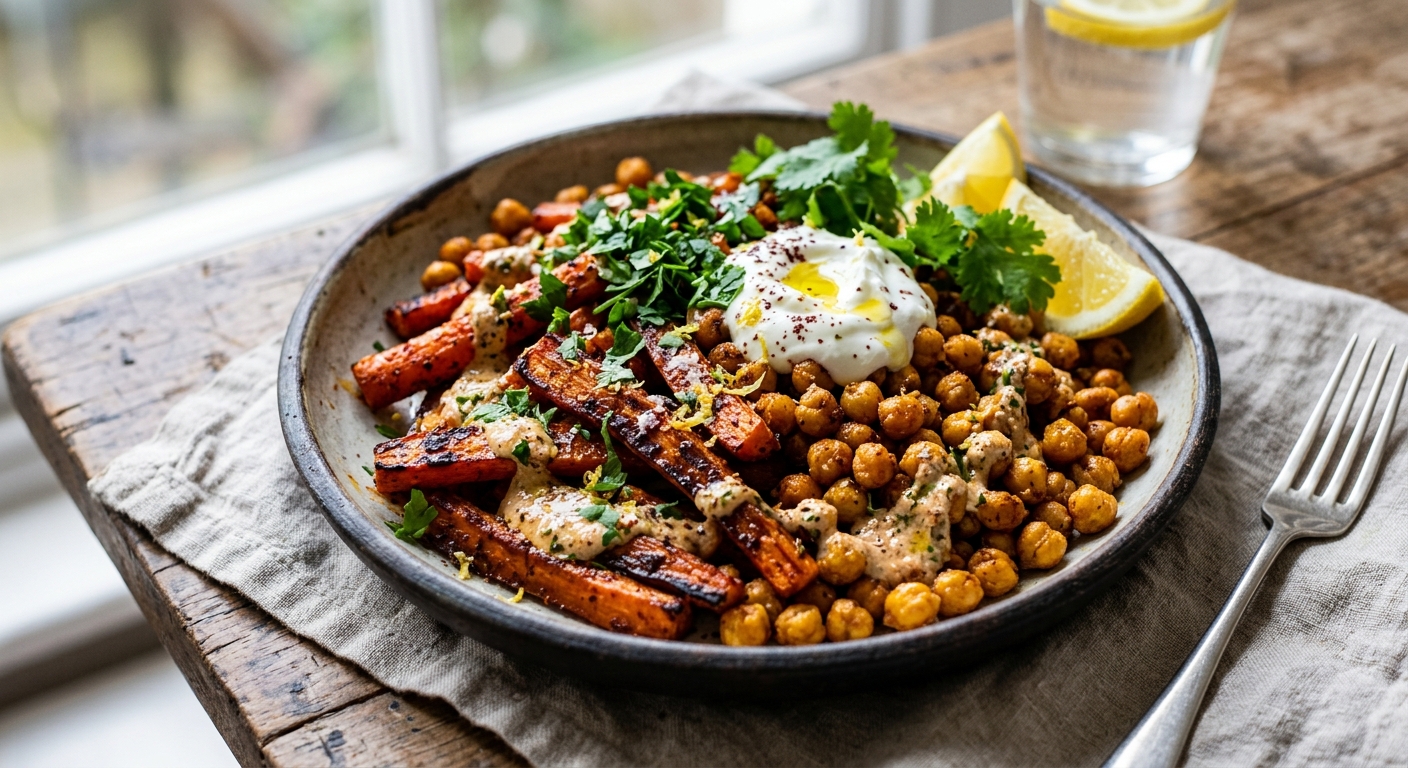
This is the salad that earns its place at the centre of the table. Deeply roasted carrots go soft and sweet at the edges, charred chickpeas provide crunch and satiety, and a bold harissa-lemon dressing pulls everything together with North African heat and brightness. It is the kind of dish that converts salad sceptics, because it eats more like a warm grain bowl than a side dish, yet requires no grains at all.
The nutritional architecture here is deliberate. Carrots are among the richest dietary sources of beta-carotene on earth, and roasting them in olive oil is not just a flavour decision, it is a science-backed strategy. Beta-carotene is a fat-soluble compound, meaning your body absorbs it dramatically better in the presence of dietary fat. The olive oil used in this recipe increases beta-carotene bioavailability by up to 6.5 times compared with eating raw carrots plain. Pair that with chickpeas delivering folate, iron, and all nine essential amino acids in significant quantities, and you have a single bowl that does genuine nutritional work.
Harissa, the Tunisian chilli paste, adds more than heat. It typically contains roasted red peppers and tomatoes, both of which contribute lycopene and capsaicin, compounds with well-documented anti-inflammatory properties. A spoonful of tahini in the dressing brings sesame lignans and additional calcium, while a handful of pumpkin seeds scattered over the top provides zinc and magnesium that many plant-forward eaters chronically under-consume. This recipe was built from the nutrient up, and it tastes like it was built from flavour down.
4
servings
Ingredients
- 700 gcarrots, peeled and cut into 4cm batons
- 480 gcooked chickpeas (two 400g tins, drained and rinsed, patted very dry)
- 3 tbspextra-virgin olive oil, divided
- 2 tbspharissa paste (rose harissa preferred)
- 1 tbsptahini
- 2 tbspfresh lemon juice
- 1 tspground cumin
- 1 tspsmoked paprika
- 0.5 tspground coriander
- 0.5 tspground cinnamon
- 1 tbsphoney or maple syrup
- 3 clovesgarlic, minced
- 120 gbaby spinach or rocket
- 30 gpumpkin seeds (pepitas), toasted
- 40 gpomegranate arils (optional but recommended)
- 20 gfresh flat-leaf parsley, roughly chopped
- 60 gthick Greek yogurt or dairy-free coconut yogurt, for serving
- —Colima Sea SaltMicroplastic Free Salt and freshly cracked black pepper to taste
Instructions
Click on an item below to shop for the recommended items for this recipe on Amazon.
As an Amazon Associate, we earn from qualifying purchases.
- Make the harissa dressing first so the flavours meld while you cook. In a small bowl, whisk together the harissa paste, tahini, lemon juice, honey, minced garlic, smoked paprika, ground coriander, ground cinnamon, and 1 tablespoon of the olive oil. Add 2 tablespoons of water to loosen to a pourable consistency. Season with salt and set aside.
- Dry the chickpeas thoroughly with a clean kitchen towel, pressing firmly. This step is non-negotiable for stovetop crispiness. Heat 1 tablespoon of olive oil in a large cast-iron or heavy-bottomed skillet over medium-high heat until shimmering. Add the chickpeas in a single layer, season generously with salt, and cook undisturbed for 4 to 5 minutes until the undersides are golden and blistered. Toss and continue cooking for another 8 to 10 minutes, shaking the pan every 2 minutes, until chickpeas are golden and have a crisp exterior. Transfer to a plate and sprinkle with the ground cumin while still hot.
- In the same wide saute pan (or a separate large pan), heat the remaining 1 tablespoon of olive oil over medium heat. Add the carrot batons in a single layer, season with salt and pepper, and cook undisturbed for 5 minutes until the undersides take on a golden-brown colour. Flip the carrots, then add 60ml of water to the pan and immediately cover with a lid. Steam-cook for 10 to 12 minutes over medium-low heat until the carrots are just tender when pierced with the tip of a knife.
- Remove the lid and increase heat to medium-high. Let any remaining water evaporate, then allow the carrots to caramelise in the dry pan for a further 3 to 4 minutes, turning occasionally, until golden patches develop on multiple sides. Drizzle 2 tablespoons of the harissa dressing over the carrots in the pan and toss to coat, cooking for 1 minute more until the dressing clings and slightly caramelises. Remove from heat.
- Arrange the baby spinach or rocket across a large serving platter. The residual heat from the carrots will gently wilt the greens when they are placed on top. Pile the dressed carrots over the greens, then scatter the crispy cumin chickpeas over everything. Drizzle the remaining harissa dressing generously over the salad. Top with dollops of Greek yogurt, pomegranate arils, toasted pumpkin seeds, and fresh parsley. Serve immediately while the carrots and chickpeas are still warm.
- In the insert of your slow cooker, combine the carrot batons and drained chickpeas. In a small bowl, whisk together the harissa paste, 2 tablespoons of olive oil, honey, minced garlic, ground cumin, smoked paprika, ground coriander, ground cinnamon, lemon juice, tahini, and 80ml of water until smooth. Pour the entire dressing over the carrots and chickpeas and toss thoroughly to coat every piece. Season generously with salt and pepper.
- Place the lid on the slow cooker. Cook on High for 3 to 4 hours or Low for 6 to 7 hours, until the carrots are completely tender and have absorbed the spiced harissa sauce. The mixture will look saucy at first but the carrots will absorb most of the liquid as they cook. Check at the 3-hour mark on High: the carrots should yield easily to a fork with no resistance but hold their shape.
- About 15 minutes before you are ready to serve, use a slotted spoon to scoop out approximately two-thirds of the chickpeas from the slow cooker. Pat them as dry as possible with kitchen paper. Heat 1 tablespoon of olive oil in a cast-iron skillet over high heat and fry those chickpeas for 6 to 8 minutes, tossing frequently, until golden and crispy. This textural contrast is essential to the finished dish. The remaining slow-cooked chickpeas stay in the pot, having absorbed all the harissa flavour.
- Taste the slow-cooked mixture and adjust seasoning. If the sauce is too thin, remove the lid and cook on High for a further 15 to 20 minutes to reduce. If it is too thick, stir in a splash of water or an extra squeeze of lemon juice.
- Spread the baby spinach or rocket across a serving platter. Spoon the warm slow-cooked carrot and chickpea mixture directly over the greens, letting the warm spiced juices wilt them naturally. Scatter the pan-crispy chickpeas over the top, then add dollops of Greek yogurt, pomegranate arils, toasted pumpkin seeds, and fresh parsley. Serve straight from the platter.
- Set your Instant Pot or electric pressure cooker to Saute mode on High. Add 1 tablespoon of olive oil and, once shimmering, add the minced garlic, ground cumin, smoked paprika, ground coriander, and cinnamon. Stir constantly for 60 to 90 seconds until the spices bloom and become intensely fragrant. This dry-toasting of spices in oil at the start is a step unique to this method and builds a flavour base you cannot achieve in the slow cooker.
- Add the carrot batons and drained chickpeas directly to the pot. Pour in 120ml of water and add the harissa paste and honey. Stir everything to combine, scraping up any spiced bits from the bottom of the pot to prevent a burn warning. Season with salt and pepper. Cancel Saute mode.
- Secure the lid, set the pressure valve to Sealing, and cook on High Pressure for 4 minutes. When the cycle completes, perform a Quick Release immediately by carefully switching the valve to Venting. Do not use Natural Release, as the carrots will overcook and become mushy. Open the lid once the float valve drops.
- Switch back to Saute mode on High. Add the tahini and lemon juice directly to the pot, stirring to incorporate them into the cooking liquid, forming a glossy sauce. Cook uncovered on Saute for 4 to 6 minutes, stirring occasionally, until most of the liquid reduces and the sauce clings to the carrots and chickpeas. During this time, the chickpeas will get slightly golden where they contact the hot base of the pot. Taste and adjust seasoning.
- Drizzle the remaining 1 tablespoon of olive oil over the mixture, stir once, then cancel Saute mode. Let the mixture rest in the pot for 2 minutes. Arrange the greens on a serving platter, pile the harissa carrot and chickpea mixture on top while still steaming hot, and finish with Greek yogurt, pumpkin seeds, pomegranate arils, and fresh parsley.
- Preheat your oven to 220C (425F) with two oven racks positioned in the upper-middle and lower-middle positions. Line two large rimmed baking sheets with parchment paper. Ensure both sheets are hot before adding ingredients by placing them in the oven during preheating.
- In a large bowl, toss the carrot batons with 1.5 tablespoons of olive oil, the ground cumin, smoked paprika, ground coriander, ground cinnamon, half the minced garlic, salt, and pepper until every baton is evenly coated. In a separate bowl, toss the thoroughly dried chickpeas with the remaining 1.5 tablespoons of olive oil, remaining garlic, a generous pinch of salt, and a pinch of smoked paprika. Keeping them separate is essential: they have different moisture contents and will cook at different rates.
- Carefully remove the hot baking sheets from the oven. Spread the seasoned carrots in a single layer on one sheet, ensuring they are not touching. Spread the chickpeas in a single layer on the second sheet. Slide both sheets back into the oven, placing the carrots on the lower rack and the chickpeas on the upper rack. Roast for 20 minutes without opening the oven.
- After 20 minutes, flip the carrots with a spatula and shake the chickpea tray. Swap the trays between racks. Continue roasting for another 15 to 20 minutes until the carrots have caramelised, golden-brown edges and the chickpeas are deep golden and crunchy. The chickpeas will continue to crisp as they cool, so do not over-roast them.
- While the carrots and chickpeas finish roasting, whisk together the harissa paste, tahini, lemon juice, honey, and 2 tablespoons of water to make the dressing. As soon as the carrots come out of the oven and are still hot, drizzle half the dressing directly onto the carrot sheet pan and toss to coat. This allows the residual heat to bloom the harissa into the carrots.
- Spread the greens across a large platter. Pile the dressed roasted carrots over the greens, then cascade the crispy roasted chickpeas across the top. Drizzle the remaining dressing over everything. Add spoonfuls of Greek yogurt, scatter pomegranate arils, pumpkin seeds, and parsley, and serve immediately while still warm from the oven.
Nutrition Breakdown
Per 1 serving (makes 4)
Vitamins & Minerals
% Daily Value based on a 2,000 calorie diet (FDA reference)
🧬 Essential Amino Acids
% of recommended daily intake (RDA) per serving
🛡 Antioxidant Profile
The Nutrition Science
The central nutritional story of this dish is fat-soluble vitamin bioavailability. Beta-carotene, the pigment responsible for the vivid orange colour of carrots, is classified as a carotenoid and is only meaningfully absorbed by the body in the presence of dietary fat. A landmark 2004 study published in the American Journal of Clinical Nutrition demonstrated that adding fat to a carotenoid-rich meal increased absorption by 4 to 6.5 times compared with a fat-free preparation. The 3 tablespoons of olive oil in this recipe are therefore not optional from a nutritional standpoint. Roasting intensifies the effect further: heat disrupts the cell wall matrix of the carrot, releasing beta-carotene from the chromoplasts where it is stored and making it accessible to digestive enzymes.
Chickpeas bring a complementary nutritional profile that addresses several common deficiencies in plant-forward diets. A 120g serving of cooked chickpeas provides approximately 6mg of non-haem iron, but non-haem iron from plant foods has low intrinsic bioavailability compared with haem iron from meat. The vitamin C delivered by the harissa (which contains roasted red peppers) and fresh lemon juice in this recipe acts as a chelating agent, binding iron ions and keeping them in the reduced ferrous form that intestinal cells can actively absorb. This dietary pairing can increase non-haem iron absorption by as much as 300%, making the combination far more than coincidental.
Harissa paste deserves recognition as a functional ingredient, not merely a condiment. Traditional harissa is built on dried chillies, caraway, coriander, and garlic, each of which contains bioactive compounds with demonstrated health effects. Capsaicin from the chillies activates TRPV1 receptors, a mechanism associated with increased thermogenesis and reduced inflammatory signalling via NF-kB pathway inhibition. Garlic’s allicin precursor compounds support cardiovascular health through mild ACE-inhibitory action. Pumpkin seeds, added as a finishing garnish, provide one of the most bioavailable plant sources of zinc (approximately 2.5mg per 30g), a mineral critical for immune function, wound healing, and the enzymatic conversion of beta-carotene to active Vitamin A in the liver.
Pro Tips
- Dry your chickpeas obsessively before cooking. Moisture is the enemy of crispiness in every method except the slow cooker. Roll them in a clean towel and press firmly, then leave them exposed to air for 10 minutes before cooking.
- Rose harissa (which contains rose petals alongside chilli) is significantly less fiery than standard harissa and adds a floral depth that pairs beautifully with the sweetness of roasted carrots. If you use standard harissa, start with 1 tablespoon and taste before adding more.
- This salad holds well for up to 3 days in the refrigerator, but store the crispy chickpeas separately in an open container at room temperature. Refrigerating chickpeas causes them to re-absorb moisture and lose their crunch. Reheat the carrot mixture gently and add the chickpeas cold or at room temperature.
Love that you’re asking about the cooking method, Tammy! This actually matters a lot for vitamin A absorption since it’s fat-soluble, so wilting those greens in a bit of olive oil (which it looks like the harissa vinaigrette provides) is honestly ideal. The combination of roasted carrots plus the oil in the dressing means you’re getting really good bioavailability of all that beta-carotene, and the chickpeas add both protein and a bit more fat to maximize absorption. I’d probably do a quick saute of the greens rather than steaming to make sure they get coated in that good harissa oil.
This is exactly the kind of detail I’ve been tracking in my own labs over the past two years, so I’m really glad Priya brought up the fat-soluble absorption piece. My practitioner emphasized that beta-carotene conversion is hugely variable between individuals, and cooking with fat really does move the needle on bioavailability. I’m curious whether you’re sourcing the carrots organically, since I’ve noticed my inflammation markers stay lower when I’m more intentional about pesticide exposure, and the carotenoid density seems to vary pretty significantly by growing conditions. Have you tested the actual vitamin A content, or is that estimate based on USDA database assumptions?
This looks amazing, and I love that you’re highlighting the vitamin A content! I do have one quick question though, since I’m always thinking about this stuff: are those greens raw or wilted, and if wilted, what cooking method are you using? I ask because if there are any cruciferous greens in the mix, gentle wilting in a pan actually reduces the goitrogenic compounds way better than eating them raw, which is something I wish I’d known years ago when I was first diagnosed with hypothyroidism. The roasted carrots and chickpeas sound like they’d provide great selenium and zinc to support thyroid function too, so this is honestly a really thoughtful bowl for thyroid health