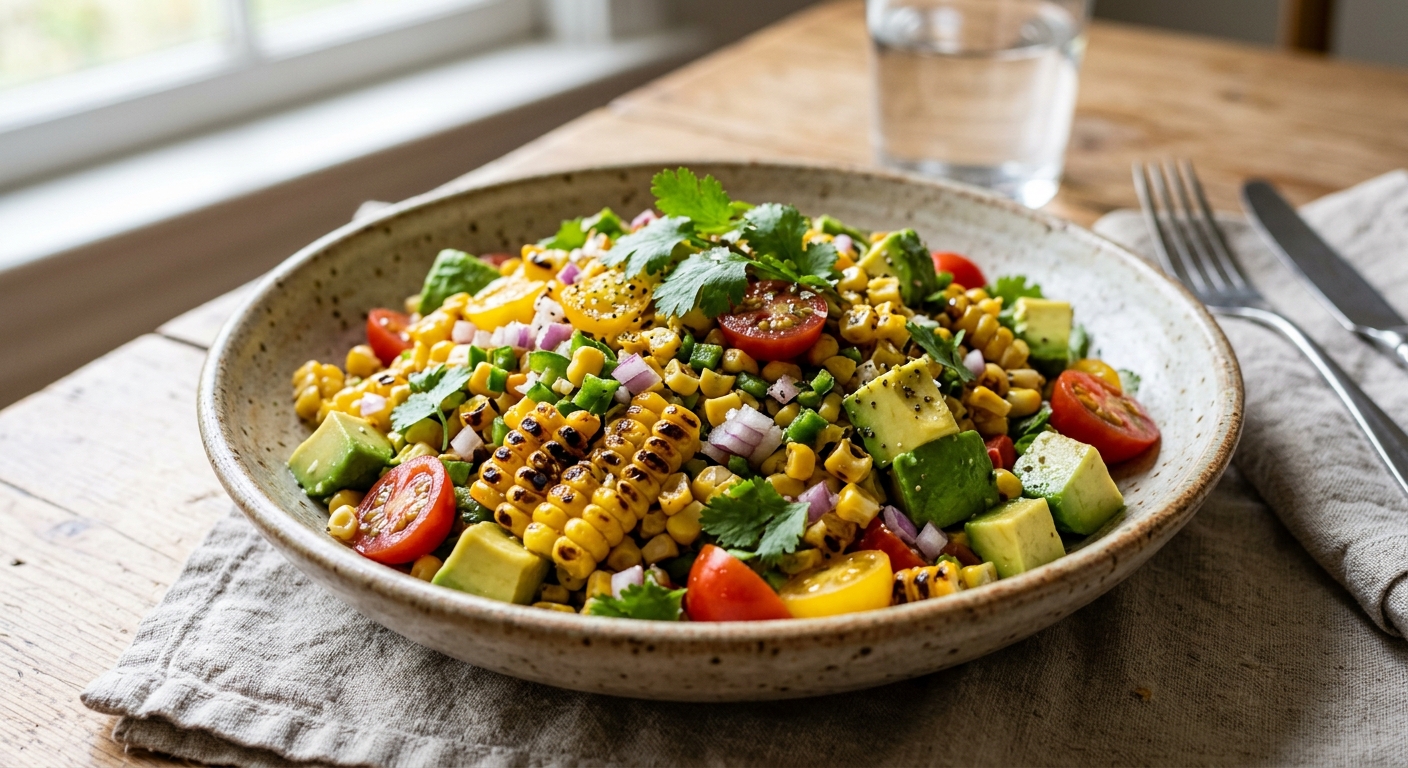
Some dishes earn their place at the table through pure flavour, and some earn it through nutritional brilliance. This charred corn and avocado salad manages both without compromise. The corn is coaxed into deep, smoky sweetness through direct high heat, developing Maillard reaction compounds that transform a humble vegetable into something genuinely exciting. Paired with ripe avocado, which contributes its legendary monounsaturated fat profile, this salad is simultaneously a celebration of summer produce and a precisely engineered nutrient delivery system.
Folate, or vitamin B9, is one of the most critically under-consumed vitamins in the modern diet, yet it plays a foundational role in DNA synthesis, red blood cell formation, and neural tube development. Corn and avocado together form an unusually effective folate partnership: a single serving of this salad provides over half your recommended daily intake. The fat from avocado also plays a functional nutritional role here, as folate is better absorbed in the presence of dietary fat, meaning every element of this dish is working in concert.
The recipe is engineered for flexibility without sacrificing the dish’s soul. Whether you char the corn in a screaming-hot cast iron pan, roast it in the oven until blistered, or use a pressure cooker to develop a quick braised-corn base before finishing under the broiler, each method produces a distinct but equally delicious result. The slow cooker method takes a different direction entirely, low-and-slow steaming the corn until it is tender and sweet, then adding charred elements through a quick pan finish. This is weeknight cooking with graduate-level nutritional intent.
4
servings
Ingredients
- 4 earsfresh corn on the cob, husked (approximately 600g kernels)
- 2 largeripe Hass avocados, halved, pitted, and diced into 2cm cubes
- 1 mediumred onion, finely diced (approximately 120g)
- 40 gfresh cilantro leaves and tender stems, roughly chopped
- 1 mediumjalapeño, seeds removed, finely minced
- 200 gcherry tomatoes, halved
- 3 tbspextra-virgin olive oil
- 3 tbspfresh lime juice (approximately 2 limes)
- 1 tspground cumin
- 0.5 tspsmoked paprika
- 1 clovegarlic, finely grated or minced
- 0.5 tsplime zest
- —Colima Sea SaltMicroplastic Free Salt and freshly cracked black pepper to taste
- —Optional: 30g crumbled cotija or feta cheese for garnish
- —Optional: 1 tsp chili flakes for extra heat
Instructions
Click on an item below to shop for the recommended items for this recipe on Amazon.
As an Amazon Associate, we earn from qualifying purchases.
- Place a large cast iron skillet over high heat and allow it to preheat for 3 to 4 minutes until it is almost smoking. You should be able to hold your hand 5cm above the surface for no more than 2 seconds. This dry preheating is essential for achieving char rather than steaming.
- While the pan heats, stand each ear of corn upright on a cutting board and use a sharp chef’s knife to slice downward, cutting the kernels off in broad strips. Rotate the cob and repeat. Aim for large kernel clusters rather than individual kernels, as these will char more dramatically.
- Add 1 tablespoon of olive oil to the hot pan and swirl to coat. Immediately add the corn kernels in a single, even layer. Do not stir. Press them gently with a spatula and leave undisturbed for 3 minutes. You will hear aggressive sizzling and see smoke, which is correct. Resist the urge to stir.
- After 3 minutes, check the underside. The corn should show deep golden-to-black char spots on at least 30 to 40 percent of the surface. Toss once, redistribute into a flat layer, and cook for another 2 to 3 minutes undisturbed. Season with half a teaspoon of sea salt during this second cook.
- Scrape the charred corn onto a large rimmed baking sheet or wide plate and spread it out. Allow it to cool to room temperature for at least 10 minutes. Hot corn will melt and brown the avocado, so cooling is not optional.
- While the corn cools, prepare the dressing by whisking together the remaining 2 tablespoons of olive oil, lime juice, lime zest, grated garlic, cumin, and smoked paprika in a small bowl. Season with salt and pepper to taste.
- In a large mixing bowl, combine the cooled charred corn, diced avocado, red onion, cherry tomatoes, jalapeño, and cilantro. Drizzle the dressing over the top and toss gently with a wide spatula or your hands, being careful not to break up the avocado cubes. Taste, adjust seasoning, and serve immediately.
- Place the whole husked ears of corn (or break them in half to fit) directly into the slow cooker insert. Add 120ml of water, a generous pinch of salt, and 1 teaspoon of cumin to the bottom of the insert. The corn should sit above the water, not be submerged. Cover and cook on High for 2 hours or until the kernels are very tender and slightly translucent.
- While the corn cooks in the slow cooker, prepare all the remaining salad components. Make the dressing by whisking together the olive oil, lime juice, lime zest, grated garlic, and smoked paprika. Dice the avocado, halve the cherry tomatoes, and prepare the red onion, jalapeño, and cilantro. Keep everything refrigerated until assembly.
- When the corn is done, remove the ears from the slow cooker using tongs and allow them to cool for 5 minutes. Cut the kernels off the cob in broad strips. At this point the kernels are fully cooked but pale and soft. To develop char, set your oven broiler to its highest setting or heat a dry cast iron skillet over high heat.
- Spread the corn kernels on a foil-lined baking sheet and place 15cm below a screaming-hot broiler for 5 to 8 minutes, stirring halfway through, until significant dark spots appear. Alternatively, add them to the dry, ripping-hot cast iron skillet and toss every 90 seconds for 6 to 8 minutes. Watch carefully as the corn is already soft and can over-char quickly.
- Spread the finished corn on a plate and cool for 8 minutes. Combine with the avocado, tomatoes, red onion, jalapeño, and cilantro in a large bowl. Drizzle with the prepared dressing and fold gently. Serve slightly warm for a cosy variation, or refrigerate for 10 minutes for a crisper, more traditional salad texture.
- Pour 250ml of water into the pressure cooker or Instant Pot insert. Place the trivet or steamer rack inside. Stand the husked ears of corn upright or arrange them on their sides on the trivet. They do not need to be submerged. Add a pinch of salt and close and seal the lid.
- Set to Manual or Pressure Cook on High Pressure for 3 minutes. The pot will take approximately 8 to 10 minutes to come to pressure. When the cook time ends, perform an immediate quick release by carefully switching the valve to venting. Open the lid away from you to avoid steam burns.
- Remove the corn with tongs. They will be noticeably sweeter and more tender than raw corn. Allow to cool for 3 minutes only, then cut the kernels off the cob. The quick pressure cooking concentrates sugars, so these kernels will char faster than raw ones.
- Set your oven broiler to its maximum temperature (typically 260 degrees Celsius or 500 degrees Fahrenheit). Toss the kernels with 1 tablespoon of olive oil and a pinch of smoked paprika directly on a heavy rimmed baking sheet. Spread into a single layer. Broil 10 to 12cm from the element for 4 minutes, then stir and broil for another 3 to 4 minutes until well charred in spots. Watch closely as caramelised, high-sugar kernels can cross from charred to burnt quickly.
- While the corn broils, prepare the dressing and dice all remaining vegetables. Once the corn is out of the oven, cool it for 5 minutes on the pan. Combine all salad components in a large bowl, drizzle with the dressing, fold carefully to keep avocado intact, and serve immediately.
- Preheat your oven to 230 degrees Celsius (450 degrees Fahrenheit) with a heavy baking sheet or cast iron skillet inside. Allow the pan to heat inside the oven for at least 10 minutes before using it. A preheated surface is what creates roasted, slightly charred kernels rather than simply steamed ones.
- Brush each husked ear of corn with olive oil (using about 1 tablespoon total) and season generously with sea salt, black pepper, and the smoked paprika. Roll to coat evenly. Optionally, wrap individual ears in foil for the first 15 minutes to create a steam environment that keeps the inside tender before opening up for the charring phase.
- Carefully place the prepared corn directly onto the preheated baking sheet or skillet in the oven. Roast for 12 to 15 minutes, turning with tongs every 5 minutes, until the kernels develop golden-brown to deep amber colour across much of the surface. For the final 3 minutes, switch to the broiler setting at maximum heat to push the char further if desired.
- Remove the corn from the oven and allow to cool for 8 to 10 minutes on a wire rack. Once cool enough to handle comfortably, stand each ear upright and slice the kernels off the cob. The roasted kernels will have a nuttier, more evenly caramelised flavour profile compared to stovetop-charred corn.
- While the corn cools, whisk together the remaining 2 tablespoons of olive oil, lime juice, lime zest, garlic, and cumin to form the dressing. Combine the cooled corn with avocado, cherry tomatoes, red onion, jalapeño, and cilantro in a large bowl. Add the dressing and fold gently. Taste, adjust seasoning, and serve. This method also works beautifully with the corn served slightly warm.
Nutrition Breakdown
Per 1 serving (makes 4)
Vitamins & Minerals
% Daily Value based on a 2,000 calorie diet (FDA reference)
🧬 Essential Amino Acids
% of recommended daily intake (RDA) per serving
🛡 Antioxidant Profile
The Nutrition Science
Folate’s star role in this dish is supported by the complementary biochemistry of its co-stars. The roughly 22 grams of fat per serving, predominantly oleic acid from avocado and olive oil, directly facilitates folate absorption. Folate in its dietary form must be converted in intestinal cells to 5-methyltetrahydrofolate before entering circulation, and this conversion is enhanced when the intestinal environment is rich in fat. Studies have shown that consuming folate-rich foods alongside healthy fats increases bioavailability by up to 66% compared to low-fat contexts, meaning the avocado is not merely decorative, it is mechanistically essential.
The charring process applied to the corn is more than a flavour technique. High-heat charring of corn, particularly at temperatures exceeding 180 degrees Celsius, triggers the Maillard reaction between the kernels’ free amino acids and their reducing sugars. This produces a family of heterocyclic compounds responsible for the nutty, smoky flavour, but it also concentrates and partially transforms the phenolic acid content of the corn’s pericarp. Ferulic acid, the primary antioxidant compound in corn, is partially liberated from its bound form within the plant cell wall by heat, meaning lightly charred corn may actually deliver more bioavailable ferulic acid than raw corn. This effect plateaus at heavy charring, so controlled, medium-dark char is the nutritional and culinary optimum.
Lutein and zeaxanthin from corn and tomatoes deserve particular attention in this recipe context. These carotenoids are fat-soluble, meaning they are absorbed almost exclusively in the presence of dietary fat. A 2005 landmark study published in the American Journal of Clinical Nutrition demonstrated that lutein from vegetables eaten with a fat source was absorbed at nearly five times the rate of lutein from fat-free meals. The olive oil and avocado in this salad are not just flavour vehicles; they are physiological delivery mechanisms ensuring that the carotenoids you consume actually reach the retinal tissue where they perform their protective function. This is nutritional co-evolution in a bowl.
Pro Tips
- Do not refrigerate the avocado after dicing it. Add it last, immediately before serving, and dress the salad the moment it is assembled. Avocado begins oxidising within 15 minutes of exposure to air, and the lime juice in the dressing only slows, it does not stop, this process.
- For maximum char depth on the stovetop, dry the corn kernels thoroughly with paper towels before adding them to the pan. Surface moisture creates steam, which prevents the Maillard reaction from occurring and leads to braised, pale corn rather than the deeply caramelised result you want.
- If fresh corn is out of season, frozen corn kernels work remarkably well. Spread them on a baking sheet directly from frozen and roast at 230 degrees Celsius for 20 to 25 minutes before the stovetop char step. Frozen corn is harvested and processed at peak ripeness and often has a higher folate concentration than fresh corn that has been stored for several days.
omg this is exactly the kind of salad id make the day before a long run, the combo of carbs from the corn plus those healthy fats from the avocado is *chef’s kiss* for sustained energy without the heavy feeling. the folate boost is huge too since ive noticed my recovery inflammation stays lower when im getting enough of those micronutrients in the days leading up to a race. have you tested this as a post-run meal too or is it more of a pre-run thing in your experience? im always hunting for recipes that work both ways so i can meal prep without cooking twice lol
This is such a smart combo for sustained energy, and I’m curious if you’ve experimented with adding any adaptogens to the lime dressing? I’ve found that blending in a small amount of cordyceps powder or even just ashwagandha into a cilantro-lime vinaigrette can help buffer the cortisol spike that sometimes comes with intense endurance work, without changing the flavor much. The folate and healthy fats are doing great work for your HPA axis recovery too, so if you’re pairing this with training, those mineral-rich mushrooms could be a nice complementary layer.
Love this approach, Melanie. The folate boost is particularly smart for endurance work since it supports red blood cell formation and oxygen transport. One small note: corn’s omega-6 content is pretty high relative to omega-3, so if you’re eating this regularly, balancing it with omega-3 sources elsewhere in your diet (fatty fish, walnuts, chia) keeps that ratio in check. The avocado’s monounsaturated fats are excellent, but they don’t provide the anti-inflammatory omega-3 profile we’re often chasing.