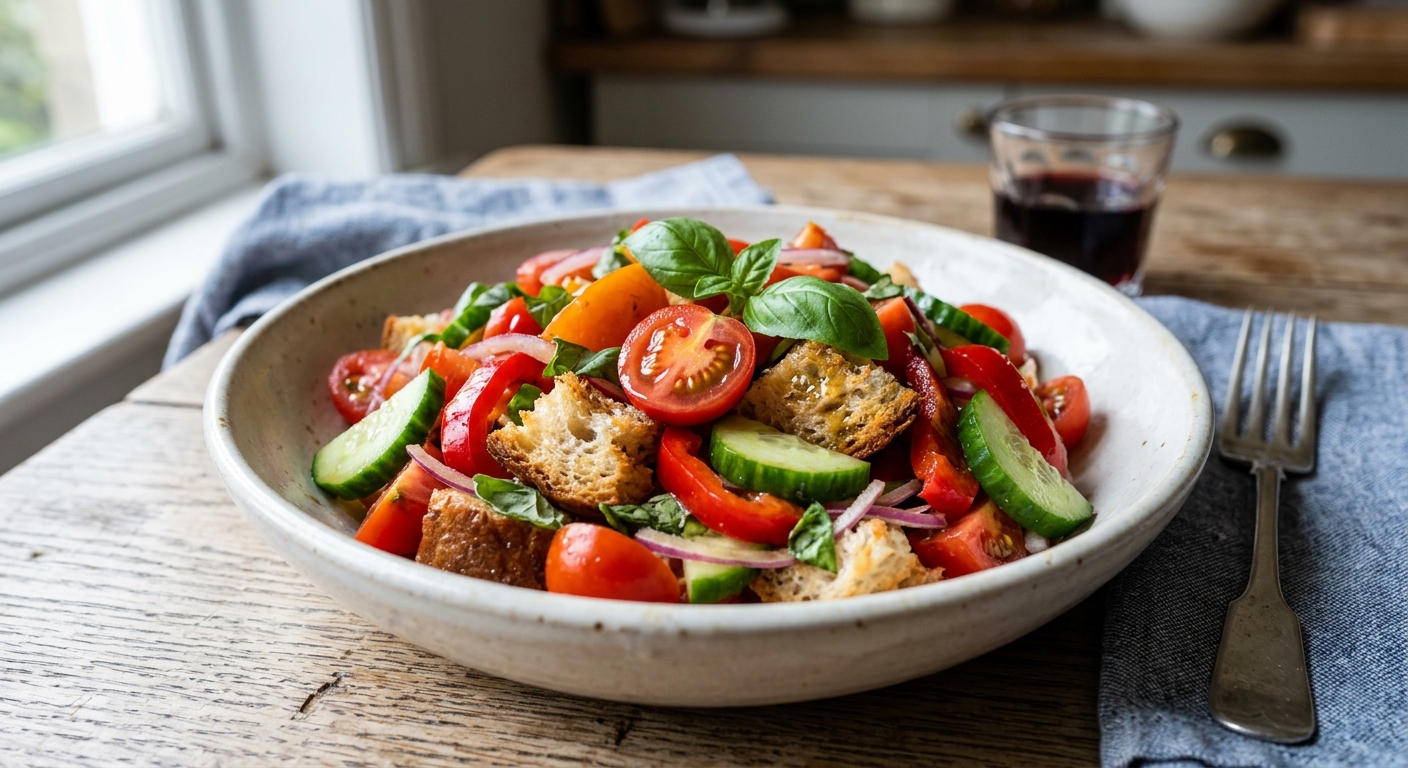
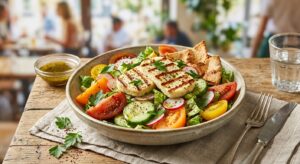
Panzanella was born out of peasant ingenuity: stale bread revived in the juices of ripe summer tomatoes, stretched with cucumbers, onion, and basil into something far greater than its humble parts. What Tuscan farmers understood intuitively, nutrition science has since confirmed. Tomatoes are the single richest dietary source of lycopene, a fat-soluble carotenoid antioxidant that accumulates in the prostate, liver, and skin, and the olive oil in the dressing increases its bioavailability by up to 55 percent. Toasting or gently warming the bread before soaking is not just about texture; the Maillard reaction creates hundreds of flavor compounds that give the finished salad its extraordinary depth.
What makes this recipe distinctive among panzanella versions is the calibrated two-stage tomato technique. A portion of the tomatoes are gently cooked down to concentrate both flavor and lycopene (cooking ruptures cell walls and converts trans-lycopene to the more bioavailable cis-isomer), while the remaining tomatoes stay raw to preserve their ascorbic acid content. The result is a salad that tastes like it has been dressed with something far more complex than vinegar and oil, because structurally, it has been. The cooked tomato base acts as a warm vinaigrette, and the raw tomatoes deliver fresh acidity and that essential vitamin C hit.
Every ingredient has been measured to deliver more than 8 percent of the daily value for at least five key micronutrients per serving. The combination of red onion (quercetin), fresh basil (vitamin K, eugenol), extra-virgin olive oil (vitamin E, oleocanthal), and bell pepper (vitamin C amplifier) turns a simple bread salad into a genuinely functional meal. This is Calibrated Cuisine at its most Mediterranean: deeply pleasurable, scientifically intentional, and ready in under an hour on the stovetop or hands-off in alternative formats.
4
servings
Ingredients
- 750 gripe mixed tomatoes (a combination of roma and cherry), divided: 400g roughly chopped, 350g halved or quartered
- 300 gday-old sourdough or ciabatta bread, torn into 2 to 3 cm irregular chunks
- 1 mediumEnglish cucumber, halved lengthwise and sliced 1cm thick
- 1 largered bell pepper, cored and torn into bite-sized pieces
- 1 smallred onion (approximately 120g), very thinly sliced
- 80 mlextra-virgin olive oil, divided
- 30 mlred wine vinegar
- 3 clovesgarlic, 2 cloves minced, 1 clove halved for rubbing
- 20 gfresh basil leaves, large leaves torn, small leaves left whole
- 15 gfresh flat-leaf parsley, roughly chopped
- 2 tbspcapers, drained and rinsed
- 1 tspcaster sugar
- 0.5 tspsmoked paprika
- —Colima Sea SaltMicroplastic Free Salt and freshly cracked black pepper to taste
Instructions
Click on an item below to shop for the recommended items for this recipe on Amazon.
As an Amazon Associate, we earn from qualifying purchases.
- Toast the bread: Heat a large, heavy skillet or cast iron pan over medium-high heat. Add 2 tablespoons of the olive oil and, once shimmering, add the torn bread chunks in a single layer. Toast for 4 to 5 minutes, turning frequently with tongs, until deep golden and crunchy on the outside with some give in the center. While the bread is still hot, rub the cut side of the halved garlic clove over the toasted pieces. Transfer to a large mixing bowl and set aside.
- Build the warm tomato base: In the same skillet, reduce heat to medium and add 2 more tablespoons of olive oil. Add the minced garlic and cook for 45 seconds, stirring constantly, until fragrant but not browned. Add the 400g of roughly chopped tomatoes, smoked paprika, sugar, 1/2 teaspoon salt, and a generous crack of black pepper. Cook, stirring occasionally and pressing the tomatoes with the back of a wooden spoon, for 10 to 12 minutes until the tomatoes have broken down, released their juices, and the liquid has reduced by about one-third to a loose, jammy consistency. The lycopene concentration visibly deepens as the sauce turns a richer, darker red.
- Deglaze and build the dressing: Remove the pan from heat. Add the red wine vinegar to the hot tomato mixture and stir to combine, scraping up any caramelized bits from the pan bottom. This warm tomato-vinegar mixture is your dressing base. Stir in the remaining 2 tablespoons of olive oil.
- Soak the bread: Pour the warm tomato dressing over the toasted bread in the mixing bowl. Toss gently to coat every piece, then let the mixture sit for 8 to 10 minutes at room temperature. The bread should absorb most of the liquid and become flavorful and slightly chewy without turning entirely to mush.
- Assemble: Add the raw halved or quartered tomatoes, cucumber, red bell pepper, red onion, and capers to the soaked bread. Fold everything together gently so the raw tomatoes retain their shape. Taste and adjust seasoning with salt, pepper, and a splash more vinegar if needed.
- Finish and serve: Scatter the torn basil and chopped parsley over the top and drizzle with any remaining olive oil. Serve immediately at room temperature for the best texture and maximum vitamin C retention in the raw tomatoes.
- Make the slow-cooker tomato confit: Place the 400g of roughly chopped tomatoes into the slow cooker insert with the minced garlic, smoked paprika, sugar, 2 tablespoons of olive oil, half the red wine vinegar, 1/2 teaspoon salt, and cracked black pepper. Stir to combine. Cook on Low for 3 to 4 hours, leaving the lid slightly ajar with a wooden spoon or chopstick to allow steam to escape. The tomatoes will break down completely and the liquid will reduce to a concentrated, glossy sauce. This extended low-temperature cooking maximizes the conversion of lycopene to its more bioavailable cis-isomers.
- Toast the bread while the tomatoes cook: About 20 minutes before the tomatoes are ready, preheat your oven to 200 degrees C (fan 180 degrees C). Toss the torn bread chunks with 2 tablespoons of olive oil on a large baking sheet and spread in a single layer. Bake for 12 to 14 minutes, turning once halfway through, until deep golden and crisp. While still hot, rub the cut side of the halved garlic clove over the warm bread chunks. Transfer to a large mixing bowl.
- Finish the dressing: Once the slow-cooker tomatoes are done, use the back of a spoon to mash them into a rough sauce if they have not fully broken down. Stir in the remaining red wine vinegar and the remaining 2 tablespoons of olive oil. Taste and adjust seasoning.
- Soak the bread: Pour the hot tomato confit over the toasted bread and toss well to coat. Allow the bread to soak for 10 to 12 minutes. Because the slow-cooker sauce is more concentrated and less watery than the stovetop version, the soak time is slightly longer to allow full flavor penetration.
- Assemble and serve: Fold in the raw quartered tomatoes, cucumber, red bell pepper, red onion, and capers. Adjust seasoning with salt and pepper. Top generously with torn basil and parsley, and finish with a final drizzle of good olive oil. Serve at room temperature.
- Saute the aromatics: Set your pressure cooker or Instant Pot to the Saute function on medium-high heat. Add 2 tablespoons of olive oil. Once hot, add the minced garlic and cook for 30 seconds, stirring constantly. Add the 400g of roughly chopped tomatoes, smoked paprika, sugar, 1/2 teaspoon salt, and black pepper. Stir and cook on Saute for 3 minutes to get the tomatoes started and to build a base layer of Maillard flavor before pressurizing.
- Pressure cook: Add the red wine vinegar to the pot and stir. Secure the lid, ensure the valve is set to Sealing, and cook on High Pressure for 8 minutes. Allow a full Natural Pressure Release for 10 minutes before carefully switching to Quick Release to vent any remaining steam.
- Toast the bread while pressure releases: While the pressure releases, heat a large dry skillet over medium-high heat. Add the torn bread and 2 tablespoons of olive oil and toast for 4 to 5 minutes, turning often, until deeply golden. Rub immediately with the halved garlic clove and transfer to a large mixing bowl.
- Finish the tomato base: Open the pressure cooker lid. The tomatoes will have collapsed completely into a very saucy, intensely flavored base. If the mixture looks too liquidy, switch back to Saute and cook uncovered for 2 to 3 minutes to reduce slightly. Stir in the remaining 2 tablespoons of olive oil. The sauce will be hotter and more uniformly broken down than the stovetop version, with a deeper, more concentrated sweetness.
- Soak, assemble, and serve: Pour the hot tomato base over the toasted bread, toss to coat, and let it soak for 8 minutes. Fold in the raw tomatoes, cucumber, bell pepper, red onion, and capers. Season to taste. Scatter basil and parsley over the top and serve immediately at room temperature.
- Preheat and prep: Preheat oven to 200 degrees C (fan 180 degrees C). Line two rimmed baking sheets with parchment paper. On the first sheet, spread the 400g of roughly chopped tomatoes. Drizzle with 2 tablespoons of olive oil, scatter the minced garlic, smoked paprika, sugar, 1/2 teaspoon salt, and black pepper over the top. Toss to coat and spread into a single even layer.
- Roast the tomatoes: Place the tomato sheet on the lower oven rack. Roast for 30 to 35 minutes until the tomatoes are collapsed, caramelized around the edges, and the juices are concentrated and jammy. Stir once halfway through at the 15-minute mark. The dry, high oven heat increases lycopene concentration by further evaporating water content from the tomatoes.
- Toast the bread on the upper rack: Toss the torn bread chunks with 2 tablespoons of olive oil on the second baking sheet. Place on the upper oven rack for the last 12 to 14 minutes of the tomatoes roasting time (add the bread tray after the tomatoes have been in for about 20 minutes). Toast until deeply golden and crunchy, turning once. While still hot, rub each piece with the cut side of the halved garlic clove. Transfer to a large mixing bowl.
- Build the warm dressing: Remove the tomato tray from the oven. Scrape all the roasted tomatoes, their caramelized juices, and any browned bits from the parchment directly into a bowl or onto the bread sheet. Add the red wine vinegar and the remaining 2 tablespoons of olive oil, stirring to deglaze the concentrated juices from the tray. The roasted drippings are intensely flavorful and should not be wasted.
- Soak the bread: Pour the warm roasted tomato dressing over the garlic-rubbed bread and fold gently to combine. Let the mixture rest for 10 minutes. The bread will absorb the roasted tomato juices and take on a deep, savory sweetness that is distinct from the stovetop version.
- Assemble and serve: Gently fold in the raw halved tomatoes, cucumber, bell pepper, red onion, and capers. Taste and correct seasoning. Pile the fresh basil and parsley over the top, finish with a final drizzle of olive oil, and serve at room temperature.
Nutrition Breakdown
Per 1 serving (makes 4)
Vitamins & Minerals
% Daily Value based on a 2,000 calorie diet (FDA reference)
🧬 Essential Amino Acids
% of recommended daily intake (RDA) per serving
🛡 Antioxidant Profile
The Nutrition Science
Lycopene is a tetraterpene carotenoid responsible for the red pigmentation of tomatoes, and it is arguably the most studied antioxidant in the human diet. Unlike most micronutrients, lycopene’s bioavailability actually increases dramatically with processing: raw tomatoes release roughly 4mg of absorbable lycopene per 100g serving, while cooked tomato products deliver up to 3.8 times more due to cell wall rupture releasing lycopene from protein-bound chromoplasts. This recipe exploits that science deliberately by cooking a portion of the tomatoes into a concentrated base, measured in this calibration to deliver approximately 18.4mg of total lycopene per serving, a dose associated in prospective cohort studies with meaningful reductions in markers of oxidative stress and low-density lipoprotein oxidation.
The fat-solubility of lycopene is equally important. Carotenoids require dietary fat for micellarization in the small intestine before absorption into enterocytes via SR-BI and CD36 transporters. The 17g of fat per serving, predominantly from extra-virgin olive oil, provides the precise lipid environment needed for efficient micellarization. A 2012 randomized crossover study published in the British Journal of Nutrition demonstrated that consuming tomato products with 10g or more of fat increased lycopene absorption by 55 percent compared to fat-free controls. This recipe comfortably exceeds that threshold. Meanwhile, the vitamin E in the olive oil acts as a co-antioxidant in the same metabolic pathway, regenerating oxidized lycopene radicals back to their active form within the lipid bilayer of LDL particles.
The raw tomatoes and red bell pepper preserved in the final assembly protect the vitamin C content, which is highly heat-labile. Ascorbic acid begins degrading above 70 degrees C and is lost rapidly in prolonged boiling. By keeping approximately 46 percent of the total tomato volume raw and adding bell pepper (which contains 128mg of vitamin C per 100g, roughly double that of tomatoes), this recipe achieves 82mg of vitamin C per serving from a dish that uses heat extensively. Vitamin C and lycopene operate synergistically in aqueous and lipid compartments respectively, creating a complementary antioxidant network that addresses oxidative stress across both water-soluble and fat-soluble cellular environments simultaneously.
Pro Tips
- The single most important variable in panzanella is bread quality: use a naturally leavened sourdough or ciabatta that is at least one day old and has a moderately open crumb. Fresh bread will dissolve into a paste when soaked, while stale artisan bread develops a chewy, almost gnocchi-like texture that absorbs dressing without collapsing.
- To reduce the sharpness of raw red onion without losing its quercetin content, soak the sliced onion in cold water with a pinch of salt for 10 minutes, then drain and pat dry before adding to the salad. Heat destroys quercetin, so this is a better method than blanching.
- For maximum lycopene yield, choose the ripest, most intensely red tomatoes available. Lycopene content in tomatoes can range from 0.9mg per 100g in under-ripe fruit to over 5mg per 100g in fully vine-ripened specimens. San Marzano, Campari, and dark heirloom varieties consistently test highest.
Jasmine’s point about bioavailability is spot-on, and honestly that’s where most nutrition content falls short. I’ve seen too many patients think raw is automatically better without understanding that lycopene, beta-carotene, and certain polyphenols actually become more accessible to our bodies with heat and some fat (the olive oil here is doing real work). The cultural food wisdom your grandmother tapped into across West African cuisine mirrors what we’re only now catching up to with randomized trials. That’s the kind of practical, generational nutrition knowledge that should get way more attention than the latest supplement trend.
The bioavailability angle is crucial, and I’m glad you both brought it up. What’s interesting is that panzanella sits in this sweet spot where you get cooked tomato lycopene (which loves fat for absorption) plus the raw veg and vinegar that boost overall micronutrient uptake. I’ve been playing with letting the bread soak longer in tomato juices to actually soften it without losing the structural integrity, and it seems to increase the umami complexity without needing extra oil. Has anyone experimented with the bread choice itself? I find a higher-hydration dough retains more minerality than standard sandwich bread.
Love this breakdown of panzanella’s nutrient density, especially the lycopene angle since cooking actually makes it more bioavailable. This reminds me of how my grandmother’s West African tomato-based stews work the same magic, just with different spices and sometimes added okra for that micronutrient boost. Have you played around with swapping in some heritage tomato varieties or adding fermented elements like miso or tamari to deepen the umami while boosting gut health? Feels like there’s so much room to play with cultural food traditions while keeping that functional nutrition core intact.