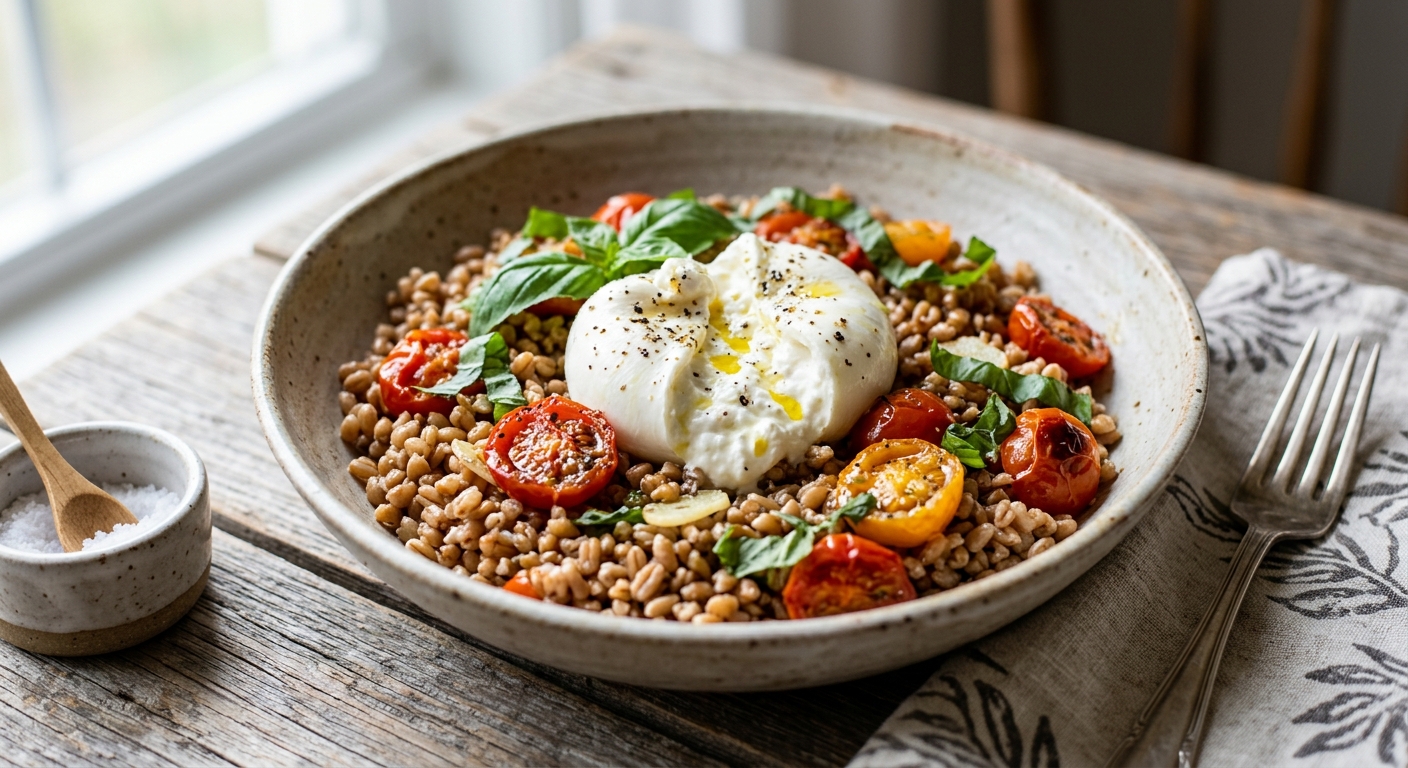
There are bowls that fill you up, and then there are bowls that genuinely build you up. This Spelt and Roasted Tomato Bowl with Burrata belongs firmly in the second category. Whole spelt, one of the most nutritionally complete ancient grains available, forms a chewy, golden base that is rich in thiamine (B1), niacin (B3), and pantothenic acid (B5). Layered on top: slow-roasted cherry tomatoes that concentrate their natural sugars and lycopene while contributing meaningful amounts of folate and B6, finished with cloud-soft burrata that adds riboflavin (B2) and a luxurious creaminess that makes every forkful feel indulgent.
What makes this dish remarkable from a nutritional standpoint is the synergy between its components. The B vitamins found here do not work in isolation, they form an interlocking team. Thiamine, riboflavin, niacin, and pantothenic acid all participate in the citric acid cycle, the cellular engine that converts the carbohydrates and fats in this very meal into usable energy. Folate and B6 work downstream, supporting amino acid metabolism and the synthesis of neurotransmitters like serotonin and dopamine. Eating this bowl is not just delicious. It is metabolically coherent.
From a culinary standpoint, the technique is the story. Whole spelt requires more water and time than pearled spelt, but rewards patience with a satisfying chew and a deeper, slightly malty flavour that pearled grains simply cannot replicate. The tomatoes are roasted at a relatively low temperature to coax out sweetness without destroying the heat-sensitive folate content. The burrata is never cooked; it is torn and placed on the warm bowl at the very last moment so it softens gently without losing its delicate milky core. This is precision cooking in service of both flavour and nutrition.
4
servings
Ingredients
- 320 gwhole-grain spelt berries, rinsed and soaked overnight in cold water
- 600 gcherry tomatoes, halved
- 2 ballsfresh burrata (approximately 125g each)
- 4 tbspextra-virgin olive oil, divided
- 6 clovesgarlic, thinly sliced
- 1 tspdried oregano
- 1 tspcaster sugar
- 30 gfresh basil leaves, torn
- 2 tbspfresh lemon juice
- 1 tsplemon zest
- 2 tbsptoasted pine nuts
- 1 tbspnutritional yeast (optional, boosts B12 and B2)
- 60 gbaby rocket (arugula)
- —Colima Sea SaltMicroplastic Free Salt and freshly cracked black pepper to taste
- —Colima Sea SaltMicroplastic Free Salt for finishing
Instructions
Click on an item below to shop for the recommended items for this recipe on Amazon.
As an Amazon Associate, we earn from qualifying purchases.
- Drain the soaked spelt and transfer it to a large saucepan. Cover with fresh cold water by at least 5cm (about 1 litre total). Bring to a vigorous boil over high heat, then reduce to a steady simmer. Cook uncovered for 50 to 60 minutes, skimming any foam from the surface in the first 10 minutes, until the grains are tender but still have a pronounced chew. Drain through a fine-mesh sieve, season lightly with salt while hot, and spread on a tray to cool slightly.
- While the spelt cooks, prepare the stovetop-roasted tomatoes. Heat 2 tablespoons of olive oil in a large, heavy-bottomed skillet (preferably cast iron) over medium-high heat until shimmering. Add the cherry tomatoes cut-side down in a single layer, working in two batches if necessary to avoid crowding. Do not stir. Cook undisturbed for 4 to 5 minutes until the tomatoes develop deep, caramelised char marks on their cut faces. Add the sliced garlic, oregano, and caster sugar, toss gently, and cook for a further 2 minutes until the garlic is fragrant and golden at the edges. Remove from heat and deglaze the pan with 1 tablespoon of lemon juice, scraping up the sticky, flavour-packed fond from the bottom of the skillet.
- Make the lemon-basil dressing directly in the warm skillet off the heat. Add the remaining 2 tablespoons of olive oil, the remaining tablespoon of lemon juice, the lemon zest, half the torn basil, the nutritional yeast if using, and a generous pinch of salt and pepper. Stir to combine, allowing the residual heat to gently wilt the basil and bloom the flavours together.
- Add the drained, still-warm spelt to the skillet with the tomatoes and dressing. Fold together gently using a wide spatula, ensuring the grains are evenly coated. Taste and adjust seasoning. The mixture should be glossy, fragrant, and slightly saucy from the collapsed tomato juices.
- Divide the baby rocket among four shallow bowls and spoon the warm spelt and tomato mixture on top. Tear each burrata ball in half and nestle one half into each bowl, allowing the creamy interior to spill slightly over the grains. Scatter over the toasted pine nuts, the remaining fresh basil, and a few flakes of sea salt. Serve immediately while the burrata is still gently warmed by the bowl.
- No soaking required. Place the dry rinsed spelt berries directly into the slow cooker insert. Add the cherry tomatoes (halved), sliced garlic, dried oregano, caster sugar, 2 tablespoons of olive oil, 1 teaspoon of salt, and 750ml of water or light vegetable stock. Stir once to combine, making sure the spelt is fully submerged. The tomatoes will sit on top initially and gradually collapse into the liquid as cooking progresses.
- Place the lid securely on the slow cooker. Cook on High for 4 to 5 hours or on Low for 7 to 8 hours. Resist the urge to lift the lid during the first 3 hours on High or 6 hours on Low, as each peek adds 15 to 20 minutes of recovery time. The dish is ready when the spelt is fully tender and the tomatoes have dissolved into a deep red, jammy sauce with no visible standing liquid remaining.
- Once cooking is complete, remove the lid and stir the lemon juice, lemon zest, remaining 2 tablespoons of olive oil, and nutritional yeast if using directly into the slow cooker insert. The residual heat will be sufficient to emulsify the oil into the tomato juices. Taste carefully and adjust with salt, pepper, and additional lemon juice as needed. Fold in half the torn basil and allow to rest uncovered for 10 minutes so excess steam escapes and the mixture thickens slightly.
- Spoon the warm spelt and tomato mixture over beds of baby rocket in four shallow bowls. The heat from the grains will gently wilt the rocket, which is desirable here. Tear each burrata ball in half and place one half on each bowl. Finish with toasted pine nuts, the remaining fresh basil, a drizzle of your best olive oil, and flaky sea salt. Serve within 10 minutes of assembling as the burrata will continue to warm and soften.
- Select the Saute function on your Instant Pot or electric pressure cooker and set to High. Once the display reads Hot, add 2 tablespoons of olive oil. Add the cherry tomatoes cut-side down in a single layer (work in two batches if your pot is smaller than 6 litres). Cook without stirring for 3 to 4 minutes until the tomatoes develop colour on their cut faces and begin to release their juices. Add the sliced garlic and oregano and stir for 60 seconds. Add the caster sugar and stir for a further 30 seconds until lightly caramelised. Press Cancel to turn off the Saute function.
- Add the dry rinsed spelt berries to the pot with the tomato mixture. Pour in 700ml of cold water, scraping the bottom of the pot thoroughly with a wooden spoon or silicone spatula to deglaze any fond stuck to the base. This is critical: any residue left on the bottom of the pot can trigger the Burn warning during pressurisation. Add 1 teaspoon of salt and stir once.
- Secure the lid and set the pressure valve to Sealing. Cook on Manual High Pressure for 25 minutes. When the cycle completes, allow the pressure to release naturally for 15 minutes (do not touch the valve), then carefully quick-release any remaining pressure by moving the valve to Venting. Open the lid away from you to avoid the steam.
- The mixture inside should be thick and deeply fragrant, with the tomatoes fully collapsed into the spelt. If any excess liquid remains, select Saute on Low and stir for 2 to 3 minutes until absorbed. Stir in the remaining 2 tablespoons of olive oil, lemon juice, lemon zest, and nutritional yeast if using. Fold in half the torn basil. Taste and correct seasoning generously, as pressure-cooked grains often need a final salt adjustment.
- Serve immediately: divide baby rocket among four bowls, top with the spelt mixture straight from the pot while still steaming hot. Tear the burrata over the top and scatter with pine nuts, remaining basil, and flaky sea salt. The contrast of the hot, savoury grains against the cold, creamy burrata is at its best in the first few minutes after assembly.
- Preheat the oven to 200 degrees Celsius (180 fan, 400F, Gas 6). Drain the soaked spelt and transfer it to a deep, lidded casserole dish or Dutch oven. Add 900ml of hot water or light vegetable stock, 1 teaspoon of salt, and 1 tablespoon of olive oil. Bring to a simmer on the stovetop over medium heat, then transfer to the oven with the lid on. Bake for 55 to 65 minutes until the spelt is tender and has absorbed most of the liquid. Check at 50 minutes: if it looks dry, add a splash of hot water. Remove from the oven and let it sit covered for 10 minutes to steam-finish.
- While the spelt is in its final 30 minutes of baking, prepare the roasting tray for the tomatoes. Increase the oven temperature to 220 degrees Celsius (200 fan, 425F, Gas 7). Line a large rimmed baking sheet with parchment paper. Spread the halved cherry tomatoes cut-side up in a single layer. Scatter the sliced garlic evenly over the tomatoes. Drizzle generously with 2 tablespoons of olive oil, then sprinkle with oregano, caster sugar, salt, and black pepper. Do not crowd the pan: use two trays if necessary. Crowding steams rather than roasts.
- Roast the tomatoes at 220C for 25 to 30 minutes until they are blistered, collapsed, and caramelised at their edges with dark jammy spots forming around the garlic. The edges of the parchment may colour slightly, which is normal. Remove from the oven and immediately drizzle 1 tablespoon of lemon juice over the hot tomatoes, using a spatula to scrape up the intensely flavoured juices and caramelised bits from the tray.
- Combine the roasted spelt and roasted tomatoes in a large wide serving bowl. Add the remaining tablespoon of lemon juice, the lemon zest, remaining tablespoon of olive oil, nutritional yeast if using, and a generous seasoning of salt and pepper. Fold together and taste. The dressing here needs to be bolder than in other methods because oven roasting drives off more moisture, concentrating the flavours but also concentrating the need for brightness.
- Lay the baby rocket as a base in four shallow bowls or arrange in the large communal bowl for family-style serving. Spoon the warm spelt and tomato mixture on top. Tear the burrata and drape over the grains. Finish with toasted pine nuts, all the remaining fresh basil, a final drizzle of extra-virgin olive oil, flaky sea salt, and an extra crack of black pepper. This version photographs beautifully and the deep colour contrast between the charred tomatoes, ivory burrata, and green basil makes for a stunning presentation.
Nutrition Breakdown
Per 1 serving (makes 4)
Vitamins & Minerals
% Daily Value based on a 2,000 calorie diet (FDA reference)
🧬 Essential Amino Acids
% of recommended daily intake (RDA) per serving
🛡 Antioxidant Profile
The Nutrition Science
Whole-grain spelt is nutritionally distinct from modern wheat in ways that matter. As a hulled grain, spelt retains its bran and germ through milling, which is where the majority of B vitamins are concentrated. Thiamine (B1), for example, is found almost exclusively in the outer bran layers of cereal grains and is lost almost entirely in refined white flour. A single serving of whole spelt in this recipe contributes roughly 0.4mg of thiamine, representing over a third of the adult daily requirement. Thiamine is the coenzyme for pyruvate dehydrogenase, the enzyme complex that gates entry of carbohydrate-derived carbon into the citric acid cycle. Without adequate B1, cellular energy metabolism stalls at this critical chokepoint.
The roasting of cherry tomatoes is a deliberate nutritional strategy, not just a culinary one. Lycopene, the red carotenoid that gives tomatoes their colour, is fat-soluble and has very low bioavailability in raw tomatoes because it is tightly bound within the cell matrix. Heat disrupts the cell walls, and the presence of olive oil dramatically increases micellar solubilisation in the gut, raising lycopene absorption by up to 400% compared to raw tomatoes eaten without fat. Each serving of this dish delivers nearly 10mg of bioavailable lycopene, a clinically meaningful dose associated in prospective studies with reduced risk of prostate cancer and cardiovascular events. Folate in the tomatoes is partially heat-labile, which is why the roasting temperature is capped at 220C and kept brief: enough to maximise lycopene release while preserving the majority of the folate content.
Burrata provides more than indulgence. Fresh cow’s milk cheese is a reliable source of riboflavin (B2), a vitamin that is often underrepresented in plant-forward diets. Riboflavin is the precursor to both FAD and FMN, coenzymes that carry electrons through the mitochondrial electron transport chain. It also plays a specific role in recycling glutathione, the body’s primary endogenous antioxidant, from its oxidised form back to its active reduced state. By placing burrata on the warm bowl rather than cooking it, this recipe preserves the full riboflavin content, which can degrade under prolonged or direct heat. The calcium from the burrata additionally contributes to the overall mineral density of the dish, complementing the magnesium and phosphorus in the spelt for a package that supports both energy metabolism and bone mineralisation.
Pro Tips
- Always soak whole spelt berries overnight for stovetop and oven methods: this reduces phytic acid content by up to 40%, significantly improving the absorption of zinc, iron, and magnesium already present in the grain.
- Remove the burrata from the refrigerator 20 minutes before serving so it comes to room temperature. Cold burrata placed on a warm bowl will feel rubbery and will not release its creamy interior the way room-temperature burrata does.
- If you cannot find whole spelt berries, pearled spelt works in all four methods but reduce cook times by approximately one third and expect slightly lower fibre and B-vitamin content due to partial bran removal.
- Toasting the pine nuts in a dry skillet over medium heat for 3 to 4 minutes until golden is non-negotiable: raw pine nuts taste bland here, whereas toasted ones contribute buttery depth and additional vitamin E from their released oils.
okay this is exactly what i needed to see rn because i literally just bombed a focus session yesterday and realized i’d been living on coffee and toast all week, and like… my folate was probably in the floor. the b-complex stuff is SO underrated for cognitive function – folate especially for methylation cycles that feed into neurotransmitter synthesis, and b6 for the conversion of tryptophan to serotonin which obviously tanks your ability to consolidate anything when its low. im definitely making this for my next study block because whole grain spelt has that slower glucose release which keeps glutamate from spiking and crashing my working memory. plus burrata adds the choline which syn
Oh Sophia, I love how you connected the folate to methylation and neurotransmitter synthesis – that’s the piece so many people miss when they’re just chasing energy! Quick thing though from my own thyroid journey: I’d just double check how often you’re eating spelt since it does contain goitrogens that can interfere with iodine absorption, especially if your folate and B6 are running low (they’re needed for proper thyroid conversion too). The good news is roasting and cooking spelt reduces the goitrogenic compounds significantly, and pairing it with the burrata’s choline plus some selenium-rich foods on the side makes a huge difference. Have you thought about
hey Sophia, totally get that energy crash – i used to live on stuff like that too and my brain was honestly foggy all the time. one thing id check though is how much that spelt is spiking your blood sugar, because even whole grains can tank focus pretty quick if youre not pairing them right with fat and protein. when i switched to lower carb options i noticed my afternoon crashes basically disappeared and my concentration got way sharper. thats awesome youre thinking about the folate angle though, definitely important for energy and mental clarity