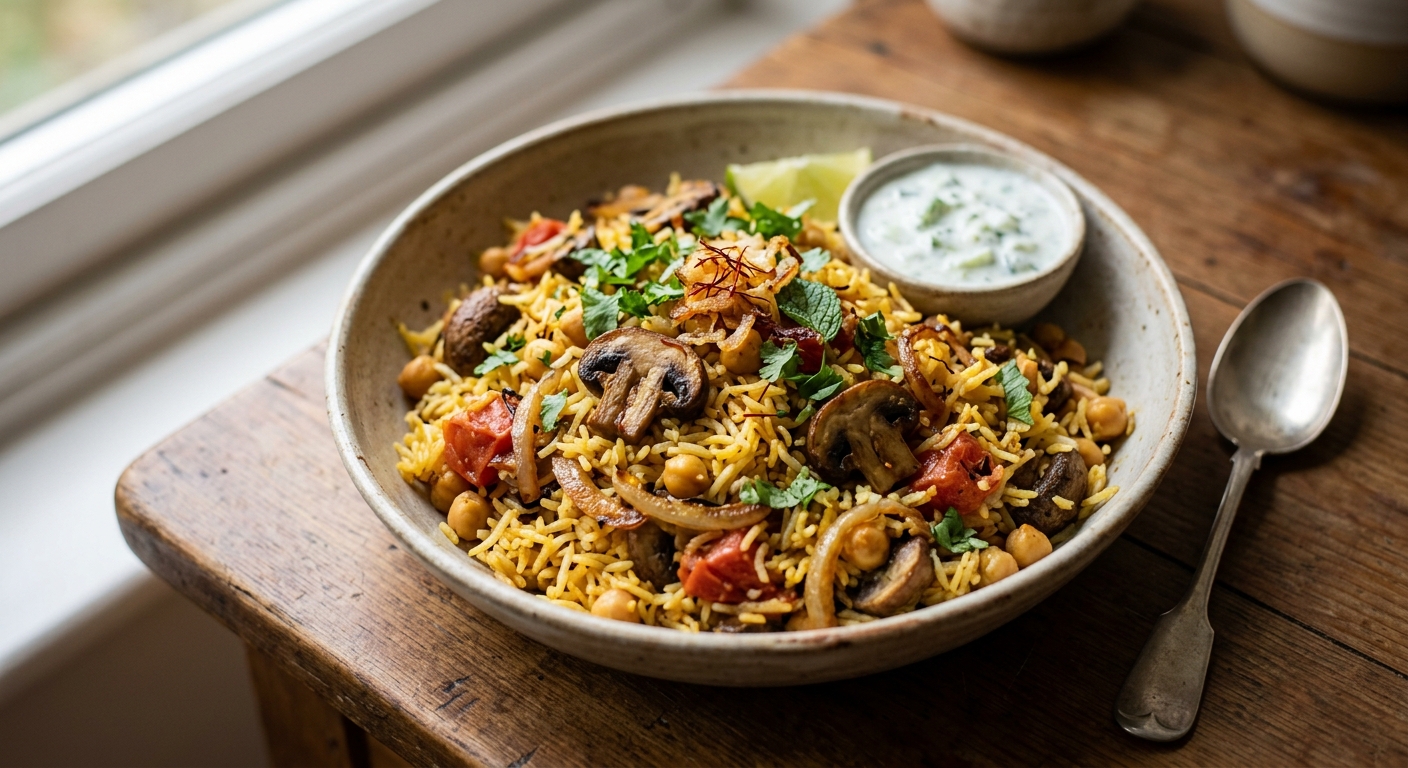
Biryani is one of the most magnificent achievements in the history of rice cookery, and this plant-based version earns its place at that table. Layers of golden saffron basmati, plump spiced chickpeas, and deeply browned cremini mushrooms are built with the same classical technique used in the great Mughal kitchens: the dum method, where steam is trapped and the ingredients cook into one another rather than simply sitting side by side. The result is a dish where every grain of rice carries flavour and every bite delivers satisfying substance.
From a nutritional standpoint, this biryani is a masterclass in plant-based synergy. Chickpeas bring both protein and non-haem iron, while the tomatoes and lemon in the spice base provide vitamin C to dramatically improve that iron’s bioavailability. Cremini mushrooms are one of the only non-fortified plant foods that provide meaningful vitamin D2 and a significant hit of selenium. Together, they fill gaps that are genuinely difficult to address in a plant-based diet, including zinc, copper, and the full suite of B-vitamins except B12. Caramelised onions woven throughout the rice add quercetin and a natural sweetness that balances the warming spice profile.
This recipe is designed with precision: every ingredient earns its place both culinarily and nutritionally. The spice blend is not decorative, it is functional. Cumin seeds contribute iron, turmeric provides curcumin, cinnamon contributes manganese, and black pepper carries piperine, which enhances the absorption of curcumin by up to 2000 percent. This is cooking where science and pleasure move in exactly the same direction.
4
servings
Ingredients
- 300 gbasmati rice, rinsed until water runs clear and soaked 20 minutes
- 400 gcanned chickpeas, drained and rinsed (or 200g dried, cooked)
- 400 gcremini (chestnut) mushrooms, quartered
- 2 largeyellow onions, thinly sliced
- 3 tbspextra-virgin olive oil or Avocado Oil100% Pure Avocado Oil
- 4 clovesgarlic, minced
- 20 gfresh ginger, finely grated
- 2 mediumripe tomatoes, finely chopped (about 250g)
- 120 gplain full-fat yogurt (dairy or coconut-based for vegan)
- 1 tspcumin seeds
- 1 tspground coriander
- 1 tspground cumin
- 0.75 tspground turmeric
- 1 tspKashmiri chili powder (or mild paprika)
- 0.5 tspgaram masala
- 0.5 tspground cinnamon
- 4 wholegreen cardamom pods, lightly crushed
- 2 wholebay leaves
- 0.25 tspblack peppercorns, lightly crushed
- 0.5 gsaffron strands, bloomed in 3 tbsp warm water for 10 minutes
- 2 tbspfresh lemon juice
- 30 gfresh cilantro (coriander), roughly chopped
- 30 gfresh mint leaves, roughly chopped
- 550 mlvegetable stock or water
- —Colima Sea SaltMicroplastic Free Salt and freshly ground black pepper to taste
Instructions
Click on an item below to shop for the recommended items for this recipe on Amazon.
As an Amazon Associate, we earn from qualifying purchases.
- Caramelise the onions: heat 2 tablespoons of oil in a wide, heavy-bottomed pot or Dutch oven over medium-high heat. Add the sliced onions with a pinch of salt and cook, stirring frequently, for 18 to 22 minutes until deep golden brown and jammy. Do not rush this step; the colour and sweetness of the onions form the backbone of the biryani’s flavour. Remove two-thirds of the caramelised onions and set aside for layering.
- Build the masala: reduce heat to medium. Add the remaining 1 tablespoon of oil to the pot. Add cumin seeds, cardamom pods, bay leaves, and crushed black peppercorns; sizzle for 30 seconds until fragrant. Add garlic and ginger and cook for 90 seconds, stirring constantly. Add chopped tomatoes, ground coriander, ground cumin, turmeric, Kashmiri chili powder, and cinnamon. Cook for 6 to 8 minutes, pressing the tomatoes with the back of a spoon, until the masala darkens and oil separates from the edges.
- Add the chickpeas and mushrooms: add the quartered mushrooms and cook for 4 minutes until they release their liquid and begin to brown. Stir in the drained chickpeas, yogurt, lemon juice, half the cilantro, and half the mint. Season generously with salt. Cook for 3 minutes until the sauce is thick and coats the chickpeas. Spread the mixture into an even layer in the pot. Remove and reserve 2 tablespoons of the bloomed saffron water; add the remainder to the chickpea layer.
- Par-cook the rice: in a separate large saucepan, bring 1.5 litres of well-salted water to a boil. Drain the soaked basmati and add it to the boiling water. Cook for exactly 5 minutes; the rice should be 70 percent cooked with a firm white core still visible in each grain. Drain immediately through a sieve.
- Layer and dum-cook: spoon the par-cooked rice in an even layer over the chickpea masala. Scatter the reserved caramelised onions over the rice. Drizzle the reserved 2 tablespoons of saffron water in a thin stream over the surface to create golden streaks. Scatter the remaining cilantro and mint on top. Cover the pot tightly (sealing with foil if needed) and cook over the lowest possible heat for 20 minutes. Remove from heat and rest, still covered, for 10 minutes before serving.
- Serve by using a wide spoon to scoop through all layers so each portion contains both saffron rice and the spiced chickpea-mushroom base. Discard bay leaves and cardamom pods before serving.
- Sauté on the stovetop first (this step cannot be skipped for flavour): heat 2 tablespoons of oil in a large skillet over medium-high heat. Add the sliced onions with a pinch of salt and cook for 15 to 18 minutes until golden brown. Scoop out and reserve half the onions for layering. Push the remaining onions to the side, add the cumin seeds, cardamom, bay leaves, and peppercorns and toast for 30 seconds. Add garlic and ginger; cook 90 seconds. Add tomatoes and all the ground spices. Cook for 5 to 6 minutes until the masala is deep and fragrant. Add mushrooms, cook 3 minutes. Stir in chickpeas, yogurt, lemon juice, half the herbs, and generous salt. Cook 2 minutes. Transfer everything to the slow cooker insert.
- Prepare a flavoured stock: combine the 550ml vegetable stock with the full saffron water (including the bloomed strands) and 0.5 teaspoon of salt. Stir to combine. This saffron stock will both cook the rice and distribute its colour evenly throughout the biryani, compensating for the slow cooker’s inability to create distinct steamed layers.
- Add the rice: scatter the rinsed and drained (but not soaked) basmati rice directly over the chickpea-mushroom layer in an even, unbroken layer. Do not stir. Pour the saffron stock gently over the rice by tilting a spoon against the pot wall so the stock distributes without disturbing the layers. The stock should just cover the rice.
- Cook and finish: place a layer of two sheets of paper towel under the slow cooker lid before securing it; this absorbs condensation and prevents it from dripping back onto the rice, which would make it mushy. Cook on High for 2.5 to 3 hours or on Low for 5 to 6 hours, until the rice is fully cooked and has absorbed the liquid.
- Rest and serve: once cooked, remove the lid and paper towels. Scatter the reserved caramelised onions and remaining cilantro and mint over the surface. Replace the lid and rest for 10 minutes off the heat. Serve by scooping through all layers to combine rice and the chickpea-mushroom base in each portion, discarding bay leaves and cardamom pods.
- Sauté using the Saute function: press Saute on High. Add 2 tablespoons of oil to the inner pot. Once shimmering, add the sliced onions with a pinch of salt. Cook, stirring frequently, for 12 to 15 minutes until golden and caramelised. The Instant Pot runs slightly cooler than a stovetop skillet, so allow the full time. Remove and reserve half the onions.
- Build the masala in the pot: add the remaining 1 tablespoon of oil. Add cumin seeds, cardamom pods, bay leaves, and crushed peppercorns; toast 30 seconds. Add garlic and ginger; cook 90 seconds. Add tomatoes, ground coriander, ground cumin, turmeric, Kashmiri chili powder, garam masala, and cinnamon. Cook 4 to 5 minutes, stirring frequently, until the masala is thick and the oil separates. Press Cancel to stop the Saute function.
- Add chickpeas, mushrooms, and yogurt: stir in the mushrooms, chickpeas, yogurt, lemon juice, half the cilantro, half the mint, and generous salt. Stir to combine. Use a silicone spatula to deglaze the bottom of the pot thoroughly, scraping up any browned bits; this is critical to prevent a Burn notice. Spread the masala into an even, flat layer.
- Layer the rice precisely: combine the drained soaked basmati with the full saffron water (including strands), 400ml of the vegetable stock, and 0.75 teaspoon of salt. Gently pour this mixture over the masala layer. Do not stir. The liquid-to-rice ratio in the pressure cooker is deliberately lower than stovetop because the sealed environment retains all moisture. Scatter the reserved caramelised onions over the rice.
- Pressure cook and release: secure the lid and set the valve to Sealing. Cook on Manual High Pressure for 6 minutes. When the timer ends, allow a Natural Pressure Release for 10 minutes, then carefully switch the valve to Venting to release any remaining pressure. Open the lid away from you. The rice should be perfectly cooked with golden saffron streaks. Scatter remaining cilantro and mint over the top, replace the lid, and rest for 5 minutes before serving.
- Preheat your oven to 180C (350F / Gas Mark 4). Place the oven rack in the lower third of the oven. Caramelise the onions on the stovetop: heat 2 tablespoons of oil in a large oven-safe Dutch oven over medium-high heat. Add the sliced onions with a pinch of salt and cook for 18 to 22 minutes, stirring regularly, until they are deeply golden and caramelised. Transfer two-thirds of the onions to a bowl and set aside.
- Build the masala in the Dutch oven: keep the pot on the stovetop over medium heat. Add 1 tablespoon of oil. Add cumin seeds, cardamom, bay leaves, and peppercorns; sizzle 30 seconds. Add garlic and ginger; cook 90 seconds. Add tomatoes and all ground spices. Cook for 8 minutes over medium heat until the masala is very dark and fragrant and oil pools at the edges. The longer stovetop cook time at this stage is intentional because the oven’s indirect heat will not develop the masala further.
- Finish the masala layer: add mushrooms and cook 4 minutes until browned and their moisture has evaporated. Stir in chickpeas, yogurt, lemon juice, half the cilantro, and half the mint. Season generously with salt. Cook 3 minutes, then remove the pot from the heat. Drizzle half the saffron water over the masala layer. The masala should be thick and moist but not watery.
- Par-cook the rice and layer: bring a large pot of well-salted water to a boil. Drain and add the soaked basmati; par-cook for exactly 5 to 6 minutes until 70 percent cooked with a white core visible. Drain. Gently spoon the par-cooked rice over the masala in the Dutch oven in an even layer without pressing down. Scatter the reserved caramelised onions over the rice. Drizzle the remaining saffron water in thin streams over the surface to create the characteristic golden-and-white pattern. Scatter remaining cilantro and mint on top.
- Bake and rest: seal the Dutch oven tightly with its lid (or use the foil method described above). Place in the preheated oven and bake for 35 minutes. The sealed environment allows the trapped steam to gently finish cooking the rice while it absorbs all the aromas from the spiced masala below. Remove from the oven and rest, still sealed, for 15 minutes. This resting period is as important as the cooking time; it allows steam to redistribute and the rice to firm up. Open the lid at the table for a dramatic aromatic reveal, then serve by scooping through all layers.
Nutrition Breakdown
Per 1 serving (makes 4)
Vitamins & Minerals
% Daily Value based on a 2,000 calorie diet (FDA reference)
🧬 Essential Amino Acids
% of recommended daily intake (RDA) per serving
🛡 Antioxidant Profile
The Nutrition Science
The pairing of chickpeas and cremini mushrooms in this biryani is nutritionally strategic rather than accidental. Chickpeas are one of the most mineral-dense legumes available, providing substantial non-haem iron (around 3mg per 100g cooked), folate critical for DNA synthesis and red blood cell production, and a protein that is notably high in lysine, an amino acid that is the primary limiting factor in most cereal-based diets. The basmati rice in this dish is complemented precisely by the chickpeas’ lysine richness, together providing a full essential amino acid profile across a single meal without any animal protein.
Cremini mushrooms contribute nutrients that are genuinely rare in plant foods. They are one of the only non-animal, non-fortified dietary sources of vitamin D2 (ergocalciferol), particularly when the mushrooms have been exposed to UV light during growing. They provide ergothioneine, a sulphur-containing antioxidant that humans cannot synthesise and must obtain from dietary sources, and they are among the best plant-based sources of selenium, a trace mineral essential for thyroid hormone synthesis and glutathione peroxidase activity. The 22mcg of selenium per serving from this dish represents 40 percent of the daily value.
The spice blend in this biryani functions as a bioavailability stack. Turmeric’s curcumin has repeatedly demonstrated anti-inflammatory and antioxidant properties in clinical research, but it is poorly absorbed on its own. The black pepper in this recipe contributes piperine, which inhibits the hepatic and intestinal glucuronidation of curcumin and has been shown to increase curcumin bioavailability by up to 2000 percent in human studies. The lemon juice and tomato provide ascorbic acid, which reduces non-haem iron from the ferric (Fe3+) form to the more absorbable ferrous (Fe2+) form, potentially doubling the amount of iron absorbed from the chickpeas and spices. These are not coincidental combinations; they are the accumulated wisdom of a culinary tradition that intuited the science long before it was measured.
Pro Tips
- Bloom the saffron in warm (not boiling) water for at least 10 minutes; gentle heat releases the crocin compounds that give saffron its colour and the safranal that gives it its aroma. Boiling water degrades both.
- Do not skip soaking the basmati rice for at least 20 minutes before stovetop or oven methods. Soaking hydrates the outer starch layer, allowing the grains to cook longer before breaking, which is what gives biryani rice its characteristic length and separation.
- For maximum iron absorption, avoid drinking tea or coffee within 1 hour of eating this meal. The tannins in both beverages bind non-haem iron and can reduce absorption by 60 to 70 percent. The built-in vitamin C from tomatoes and lemon is already working to help you; do not counteract it.



wait hold up, the umami mushroom angle is great but im more interested in whether this is gonna help me sleep lol. chickpeas have decent tryptophan content and saffron might have some melatonin precursor action, plus the magnesium from those minerals you mentioned… im genuinely wondering if this becomes a legit pre bed meal or if the spices keep you wired? might have to run my own experiment and check my sleep tracker data because a carb heavy meal like this before bed could actually work pretty well for tryptophan absorption if timed right
Solid instinct on the tryptophan/carb timing angle, that’s exactly how it works. The real question is spice load and individual tolerance, though – warming spices like cumin and coriander are actually pretty benign for sleep, but if you’re heavy-handed with black pepper or chili you might catch unwanted stimulation. I’d cook it earlier in the evening, let digestion get ahead, then eat maybe 2-3 hours pre-bed so the carbs can facilitate tryptophan crossing the blood-brain barrier without your GI system still firing. That said, the cremini umami plus saffron’s mild nervine properties could genuinely support sleep quality if
oh this is RIGHT up my alley! chickpeas plus mushrooms is such a smart combo for that complete amino acid profile, especially post-wod when youre trying to hit protein without animal products. the umami from the cremini mushrooms is gonna help with that savory satisfaction too so youll actually feel recovered, not just stuffed. plus all those minerals layered in with the saffron and basmati… thats gonna help with inflammation management between sessions. definitely trying this as a meal prep option!