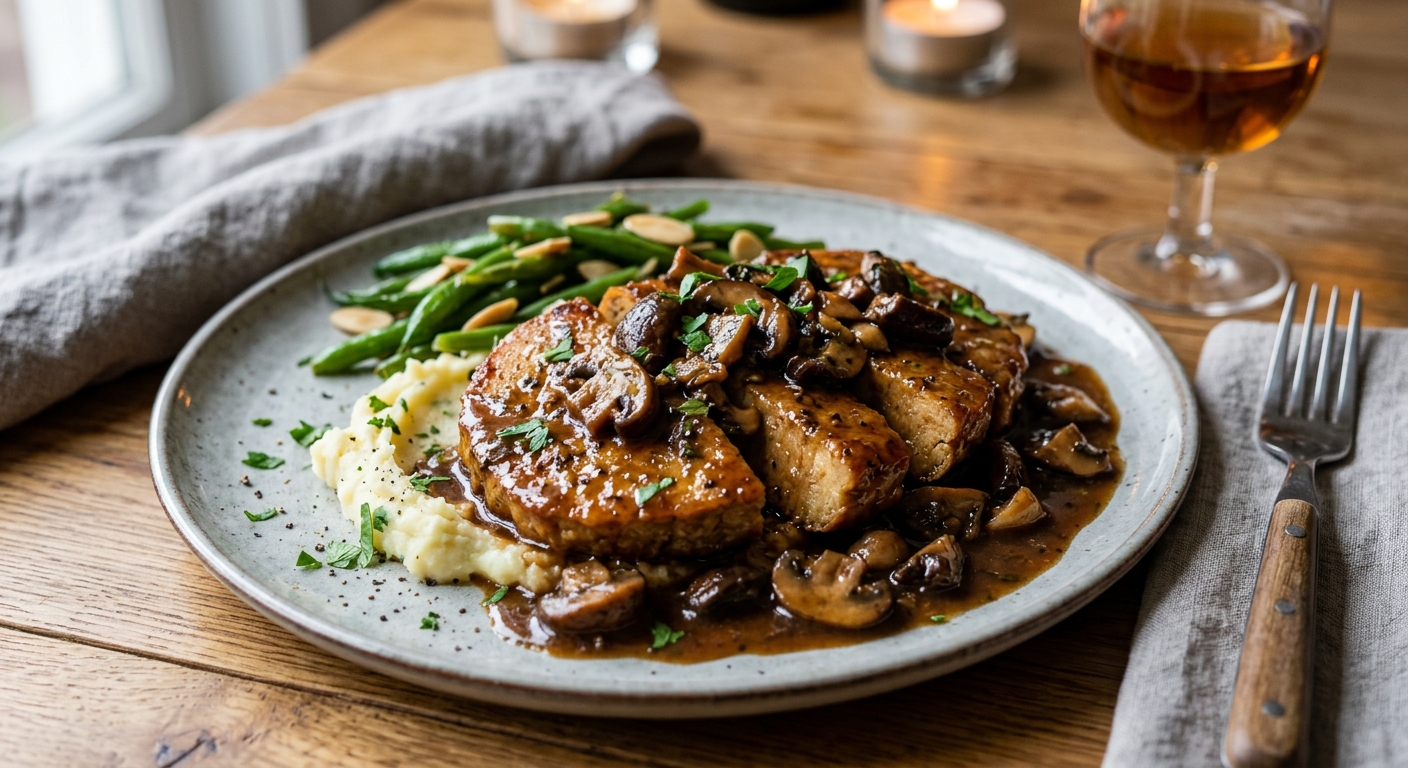
Chicken Marsala is one of those Italian-American classics that feels simultaneously luxurious and weeknight-approachable, and the good news is that seitan steps into that role with astonishing fidelity. Seitan, made from vital wheat gluten, has a dense, meaty chew that holds its own against a bold Marsala reduction far better than tofu or tempeh ever could. When pounded thin and seared hard in a screaming-hot pan, the exterior develops a deeply savory crust that practically begs to be draped in glossy, wine-dark sauce.
The mushroom combination here is not an afterthought. Cremini mushrooms bring earthy depth and a generous dose of selenium and riboflavin, while shiitake mushrooms contribute eritadenine (a bioactive compound linked to healthy cholesterol metabolism) alongside lentinan, a beta-glucan polysaccharide with well-documented immune-modulating properties. Together they form a nutritional and flavor backbone that elevates this dish well beyond a simple protein vehicle. The Marsala wine itself, a fortified Sicilian wine with bittersweet notes of dried fruit and caramel, reduces into a sauce that is simultaneously acidic, sweet, and deeply umami.
From a macronutrient standpoint, seitan is genuinely extraordinary: at roughly 25 grams of protein per 100 grams, it outpaces chicken breast gram for gram on protein density. While it is not a complete protein in the strict sense (wheat gluten is low in lysine), pairing this dish with a legume-based side, such as white bean mash or a simple lentil salad, closes that gap entirely. With over 40% of your daily iron needs, substantial B12 (from the nutritional yeast in the seitan dredge), and a glycemic load kept deliberately moderate through the use of a light arrowroot thickener rather than a heavy roux, this is precision nutrition that tastes like a celebration.
4
servings
Ingredients
- 600 gseitan, sliced into 1cm-thick cutlets (store-bought or homemade)
- 250 gcremini mushrooms, thickly sliced
- 150 gshiitake mushrooms, stems removed and caps sliced
- 180 mldry Marsala wine
- 240 mllow-sodium vegetable broth
- 3 tbspextra-virgin olive oil, divided
- 1 tbspvegan butter or unsalted butter
- 4 clovesgarlic, minced
- 1 mediumshallot, finely diced
- 2 tbspnutritional yeast
- 3 tbspall-purpose flour, for dredging
- 1 tsparrowroot powder or cornstarch
- 1 tbspsoy sauce or tamari (for depth)
- 1 tspfresh thyme leaves, plus extra sprigs for garnish
- 1 tspsmoked paprika
- 2 tbspflat-leaf parsley, finely chopped
- —Colima Sea SaltMicroplastic Free Salt and freshly cracked black pepper to taste
Instructions
Click on an item below to shop for the recommended items for this recipe on Amazon.
As an Amazon Associate, we earn from qualifying purchases.
- Combine the flour, nutritional yeast, smoked paprika, a generous pinch of salt, and several cracks of black pepper on a wide plate. Press each seitan cutlet firmly into the mixture, coating both sides thoroughly, then shake off any excess. The nutritional yeast in the dredge adds umami and helps the crust brown deeper.
- Heat 2 tablespoons of olive oil in a large, heavy-bottomed skillet over medium-high heat until the oil shimmers and just begins to smoke at the edges. Working in two batches to avoid crowding, sear the dredged seitan cutlets for 3 to 4 minutes per side without moving them, until a deep golden-brown crust forms. Transfer to a plate, tent loosely with foil, and set aside.
- Reduce the heat to medium and add the remaining 1 tablespoon of olive oil to the same pan. Add the shallot and cook, stirring frequently, for 2 minutes until softened and translucent. Add the garlic and cook for a further 30 seconds until fragrant. Do not allow the garlic to brown.
- Increase the heat back to medium-high and add all the mushrooms in a single, even layer. Resist stirring for the first 2 minutes to allow moisture to evaporate and a golden sear to develop. Then toss and continue cooking for 3 to 4 minutes until the mushrooms are reduced, deeply caramelised, and any liquid has fully evaporated from the pan.
- Pour in the Marsala wine and use a wooden spoon or heat-proof spatula to vigorously scrape up all the browned bits from the pan bottom. These bits are pure concentrated flavor. Let the Marsala bubble and reduce by half, about 3 minutes.
- Add the vegetable broth, soy sauce, and fresh thyme. Whisk the arrowroot powder with 1 tablespoon of cold water in a small bowl to make a slurry, then pour it into the simmering sauce while stirring constantly. Cook for 2 minutes until the sauce thickens enough to coat the back of a spoon.
- Return the seared seitan cutlets to the pan, nestling them into the sauce. Reduce the heat to low, add the vegan butter, and gently swirl the pan to emulsify the butter into the sauce for a glossy finish. Simmer for 3 to 4 minutes to heat the seitan through and allow it to absorb the sauce flavors. Taste and adjust seasoning. Garnish with fresh parsley and thyme sprigs before serving.
- Season the seitan cutlets on both sides with salt, pepper, and smoked paprika only (no flour dredge). Heat 2 tablespoons of olive oil in a skillet over high heat and sear the cutlets for 2 minutes per side just to develop surface color. Transfer directly to the slow cooker insert.
- In the same skillet over medium heat, add the remaining olive oil. Saute the shallot for 2 minutes until softened, then add the garlic and cook for 30 seconds. Add the cremini and shiitake mushrooms and cook, stirring occasionally, for 4 to 5 minutes until they release their moisture and begin to color. Transfer the entire contents of the skillet to the slow cooker on top of the seitan.
- In a measuring jug, combine the Marsala wine, vegetable broth, soy sauce, nutritional yeast, and fresh thyme. Pour this liquid over the seitan and mushrooms in the slow cooker. The liquid should come just halfway up the seitan cutlets. Place the lid on securely.
- Cook on Low for 3 hours. The slow, gentle heat allows the seitan to absorb the Marsala sauce deeply without becoming rubbery. After 3 hours, carefully lift a cutlet; it should be very tender and deeply colored throughout.
- Thirty minutes before serving, whisk the arrowroot powder with 2 tablespoons of cold water. Remove the lid, increase the slow cooker to High, stir in the arrowroot slurry, and cook uncovered for 20 to 25 minutes, stirring occasionally, until the sauce reduces and thickens. Stir in the vegan butter until melted and the sauce is glossy. Taste and adjust seasoning, then garnish with parsley and fresh thyme.
- Set the Instant Pot or electric pressure cooker to Saute mode on High. Add 2 tablespoons of olive oil and sear the seasoned seitan cutlets (no flour dredge; just salt, pepper, and smoked paprika) for 2 minutes per side until browned. Remove and set aside on a plate.
- Without cleaning the pot, add the remaining olive oil and saute the shallot for 2 minutes. Add the garlic and cook for 30 seconds. Add all the mushrooms and cook for 3 to 4 minutes, stirring occasionally, until softened and lightly browned. The mushrooms do not need to be fully caramelised at this stage.
- Pour in the Marsala wine and stir to deglaze, scraping up any browned bits from the bottom of the pot. This step is critical for pressure cooking: any stuck bits can trigger a burn warning. Let the wine simmer for 1 minute, then add the vegetable broth, soy sauce, nutritional yeast, and thyme. Return the seared seitan cutlets to the pot, pressing them into the liquid.
- Secure the lid and set the pressure release valve to Sealing. Cook on Manual High Pressure for 8 minutes. When the cycle is complete, allow a 5-minute natural pressure release, then carefully switch the valve to Venting to release any remaining steam.
- Open the lid and transfer the seitan to a plate. Switch the pot back to Saute mode on High. Whisk the arrowroot with 1 tablespoon of cold water, then stir the slurry into the simmering sauce. Cook for 3 to 5 minutes, stirring frequently, until the sauce reduces to a glossy, spoon-coating consistency. Stir in the vegan butter, return the seitan to the pot, and spoon the sauce over the cutlets for 1 to 2 minutes before serving. Garnish with parsley and fresh thyme.
- Preheat your oven to 190C (375F). Combine the flour, nutritional yeast, smoked paprika, salt, and pepper on a plate and dredge the seitan cutlets as described in the stovetop method, shaking off excess flour.
- Heat 2 tablespoons of olive oil in a large oven-safe skillet (cast iron or stainless steel) over medium-high heat on the stovetop. Sear the dredged seitan cutlets for 2 to 3 minutes per side until golden. You are building a crust, not cooking them through. Remove to a plate.
- In the same oven-safe skillet over medium heat, add the remaining olive oil and saute the shallot for 2 minutes. Add the garlic and cook 30 seconds. Add the mushrooms and cook for 4 to 5 minutes until caramelised. Pour in the Marsala wine, scraping the pan bottom thoroughly, and let it reduce by one-third, about 2 minutes.
- Add the vegetable broth, soy sauce, nutritional yeast, and thyme to the skillet. Stir to combine, then whisk in the arrowroot slurry and bring the sauce to a gentle simmer. Nestle the seared seitan cutlets back into the skillet in a single layer, spooning sauce over the top. The sauce should come about halfway up the sides of the cutlets.
- Transfer the uncovered skillet to the preheated oven and bake for 20 to 25 minutes. Baste the seitan with the pan sauce halfway through cooking. The sauce will reduce and concentrate considerably, and the exposed tops of the seitan will develop a slightly firmer, lightly crisped edge. Remove from the oven, stir in the vegan butter until melted, taste for seasoning, and garnish generously with parsley and fresh thyme before bringing the skillet straight to the table.
Nutrition Breakdown
Per 1 serving (makes 4)
Vitamins & Minerals
% Daily Value based on a 2,000 calorie diet (FDA reference)
🧬 Essential Amino Acids
% of recommended daily intake (RDA) per serving
🛡 Antioxidant Profile
The Nutrition Science
Seitan’s extraordinary protein density comes from vital wheat gluten, the elastic network of glutenin and gliadin proteins that remains after starch is washed from wheat flour. At approximately 75 grams of protein per 100 grams dry weight, it is among the highest-protein whole foods on the planet. The primary nutritional caveat is a relative deficit in lysine, the limiting essential amino acid in most grains. However, this is easily addressed by pairing the dish with any legume source, since legumes are lysine-rich and themselves low in methionine, which wheat provides in abundance. This complementary relationship is the foundational logic behind traditional plant-based cuisine worldwide.
The mushroom medley in this recipe is a nutritional force multiplier. Cremini and shiitake mushrooms are among the few non-animal sources of ergothioneine, a histidine-derived thiol antioxidant that humans have evolved a dedicated transporter protein (OCTN1) to absorb, strongly suggesting it plays a privileged physiological role. Shiitake mushrooms also contain lentinan, a triple-helix beta-1,3-glucan that has been studied extensively as an immunomodulatory agent, and eritadenine, a compound that inhibits an enzyme involved in phosphatidylcholine metabolism, with favorable effects on circulating LDL cholesterol observed in animal and early human studies. The selenium content from the mushrooms, providing over 50% of the daily value per serving, is critical for the synthesis of selenoproteins including glutathione peroxidase and thioredoxin reductase, two master regulators of cellular redox balance.
The choice of arrowroot powder over a traditional butter-and-flour roux as the thickening agent is deliberate and nutritionally significant. Arrowroot starch thickens at a lower temperature than cornstarch, produces a cleaner, more translucent sauce, and contributes negligible additional glycemic load compared to a roux-thickened sauce. The result is a glossy Marsala sauce with all the textural satisfaction of a classical French preparation, but with a glycemic load kept firmly in the moderate range even accounting for the residual sugars in the Marsala wine, which contributes approximately 5 grams of sugar per serving after reduction.
Pro Tips
- For homemade seitan that holds up beautifully in this recipe, combine 200g vital wheat gluten with 2 tablespoons nutritional yeast, 1 teaspoon garlic powder, and 160ml cold vegetable broth; knead for 3 minutes, form into a log, and simmer in seasoned broth for 45 minutes before slicing into cutlets.
- The single most important technique for a great Marsala sauce is fully evaporating all mushroom liquid before adding the wine. If you rush this step, the sauce will be watery and the mushrooms will taste steamed rather than savory. Listen for the sizzling to intensify once the moisture is gone.
- Dry Marsala is essential here; sweet Marsala will make the sauce cloying and unbalanced. Look for a bottle labeled ‘Marsala Secco’ or ‘Fine Dry’. A good bottle costs less than most cooking wines and dramatically elevates the final result.
Great recipe, and I appreciate you calling out the 38g per serving detail. Quick question though: how’s that protein distributed across the day if someone’s eating this for dinner? I’ve been digging into the leucine threshold research (around 2.5-3g per meal for us older folks to trigger muscle protein synthesis), and seitan’s got decent leucine content, but I’m curious if you’ve thought about pairing this with a leucine-rich breakfast and lunch to hit that sweet spot across the day. At 62, I learned the hard way that one big protein hit doesn’t cut it like it did at 30, so I’m always wondering how recipes fit into someone’s total daily protein strategy.
This is such a beautiful recipe choice! I love that you’re highlighting how seitan plus mushrooms create this nutrient synergy, especially for those hard-to-get minerals like zinc. I actually recommend this exact pairing to clients because the vitamin C in the Marsala sauce helps with iron absorption from both the seitan and mushrooms, which is a detail people often overlook. The complete protein aspect of seitan is such an underrated advantage for plant-based eating – it has all nine amino acids, so unlike some plant combos, you’re getting everything in one ingredient.
This sounds fantastic, and I’m curious about your sourcing on those mushrooms, especially the shiitake. Were you able to source them for their medicinal compounds, or just for flavor and texture? I’ve found that when I use shiitake specifically grown for beta-glucan and polysaccharide content, they genuinely help with my stress response in ways my HPA axis biomarkers reflect. The umami depth in this dish would pair beautifully with that kind of intentional sourcing, and the combination of seitan’s amino acid profile with mushroom-derived adaptogens makes this feel like more than just a high-protein meal. Would love to know more about your ingredient philosophy here.