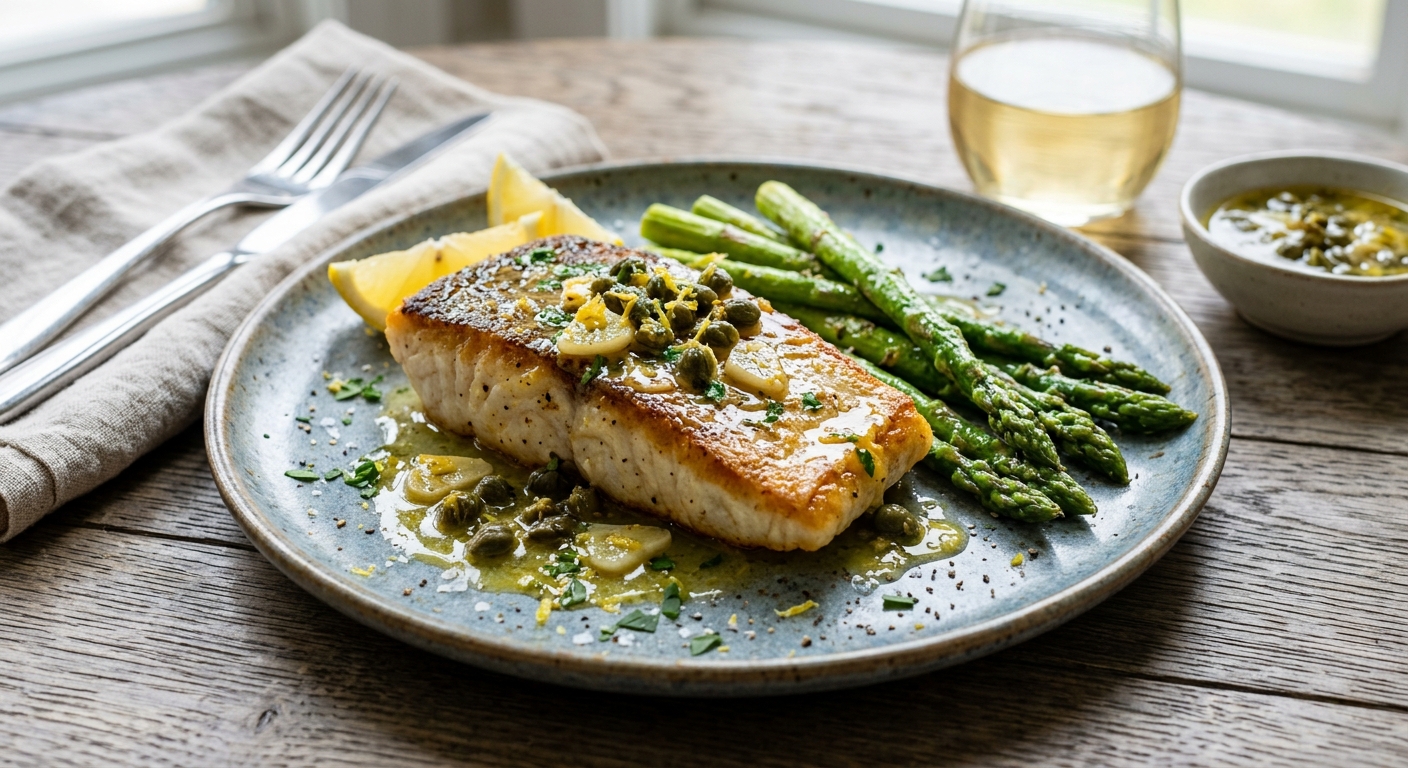
Halibut is one of the ocean’s most nutritionally dense white fish, yet it remains criminally underused in home kitchens. A single 180g fillet packs a complete amino acid profile, virtually zero saturated fat, and a concentration of selenium that rivals Brazil nuts gram-for-gram. Paired with asparagus, one of the plant kingdom’s premier sources of folate and prebiotic inulin, this dish is less a recipe and more a precisely engineered nutritional event dressed up in a bistro apron.
The lemon caper sauce is where technique and nutrition converge. Capers are not mere garnish: they are among the highest known dietary sources of quercetin and rutin, two flavonoids with clinically studied anti-inflammatory properties. The acid in fresh lemon juice also preserves heat-sensitive vitamin C while simultaneously denaturing the light proteins in the pan fond to create a silky, emulsified sauce without cream or excessive butter. A single tablespoon of high-quality extra-virgin olive oil added off-heat provides oleocanthal, olive oil’s signature phenolic compound.
What makes this recipe genuinely special on Calibrated Cuisine is the commitment to method integrity. Pan-searing delivers the Maillard crust that concentrates flavour compounds and produces pyrazines with their own antioxidant activity. The oven method gently finishes thick fillets without overcooking the delicate interior. Even the slow cooker and pressure cooker versions are re-engineered, not retrofitted, so that every technique produces a result worth eating, not just a result worth photographing.
4
servings
Ingredients
- 720 ghalibut fillets, skin-on, cut into 4 equal portions (about 180g each)
- 480 gfresh asparagus, woody ends snapped off
- 3 tbspextra-virgin olive oil, divided
- 2 tbspunsalted butter
- 3 clovesgarlic, thinly sliced
- 3 tbspcapers, rinsed and roughly chopped
- 2 wholelemons, 1 zested and juiced (about 3 tbsp juice), 1 cut into wedges for serving
- 120 mldry white wine (such as Pinot Grigio or Sauvignon Blanc)
- 60 mllow-sodium fish stock or vegetable stock
- 2 tbspfresh flat-leaf parsley, finely chopped
- 1 tspfresh thyme leaves
- 1 tspsmoked paprika
- 0.5 tspcrushed red pepper flakes
- —Colima Sea SaltMicroplastic Free Salt and freshly cracked black pepper to taste
Instructions
Click on an item below to shop for the recommended items for this recipe on Amazon.
As an Amazon Associate, we earn from qualifying purchases.
- Remove the halibut from the refrigerator 20 minutes before cooking to bring it to room temperature. Pat each fillet thoroughly dry on all sides with paper towels, this is the single most important step for achieving a proper sear. Season generously with fine sea salt, black pepper, and smoked paprika on both sides.
- Heat a large cast iron or stainless steel skillet over medium-high heat for at least 2 minutes until the pan is fully and evenly hot. Add 2 tablespoons of olive oil and swirl to coat. The oil should shimmer and begin to smoke lightly at the edges. Carefully lay the halibut fillets skin-side down in the pan, pressing each fillet gently with a spatula for the first 10 seconds to prevent curling.
- Sear the fillets skin-side down without moving them for 4 to 5 minutes, until the skin is deep golden and releases from the pan cleanly. Flip each fillet and add 1 tablespoon of butter to the pan. Cook flesh-side down for 2 to 3 minutes, basting continuously with the foaming butter. The halibut is done when it flakes easily at the thickest point and an instant-read thermometer reads 57 to 60 degrees C (135 to 140 F). Transfer to a warm plate and tent loosely with foil.
- In the same skillet, reduce heat to medium and add the remaining 1 tablespoon of olive oil. Add the sliced garlic and cook, stirring, for 45 seconds until fragrant and just beginning to turn golden. Add the asparagus spears in a single layer, season with salt and pepper, and toss to coat. Cook for 3 to 4 minutes, turning occasionally, until bright green and tender-crisp with slight char at the tips. Transfer asparagus to the serving plates.
- With the skillet still over medium heat, add the white wine and scrape up any browned bits from the bottom of the pan with a wooden spoon. Let it reduce for 1 minute, then add the fish stock, lemon juice, lemon zest, capers, thyme, and red pepper flakes. Simmer for 2 minutes until the sauce reduces slightly and coats the back of a spoon. Remove from heat, swirl in the remaining tablespoon of butter and the chopped parsley. Taste and adjust seasoning. Spoon the sauce generously over the halibut and asparagus and serve immediately with lemon wedges.
- Preheat your oven to 220 degrees C (425 F) with two racks positioned in the upper-middle and lower-middle positions. Line a large rimmed baking sheet with parchment for the asparagus. Pat the halibut fillets completely dry with paper towels and season on both sides with salt, black pepper, and smoked paprika. Let them rest at room temperature while the oven preheats.
- Toss the asparagus on the prepared baking sheet with 1.5 tablespoons of olive oil, a pinch of salt, black pepper, and the red pepper flakes. Arrange in a single layer. Place on the lower-middle rack and roast for 10 to 12 minutes until tender and slightly caramelised at the tips. Do not crowd the spears or they will steam rather than roast.
- Meanwhile, heat an oven-safe skillet (cast iron or stainless steel) over high heat until smoking. Add the remaining 1.5 tablespoons of olive oil. Sear the halibut fillets skin-side down for 2 minutes to establish a crust, then flip once. Transfer the entire skillet to the upper-middle oven rack and roast for 6 to 10 minutes depending on thickness, until the internal temperature reaches 57 to 60 degrees C (135 to 140 F). This dual sear-roast method prevents the common problem of overcooked edges with a raw centre.
- While the fish is in the oven, build the lemon caper sauce in a small saucepan over medium heat. Add 1 tablespoon of butter and the sliced garlic, cook for 1 minute. Pour in the white wine and simmer for 1 minute, then add the fish stock, lemon juice, lemon zest, capers, and thyme. Simmer for 3 to 4 minutes until slightly reduced. Remove from heat and stir in the parsley and season to taste.
- Remove the halibut from the oven and rest for 2 minutes in the pan. Arrange the roasted asparagus on warmed plates, place a halibut fillet over each portion, and spoon the lemon caper sauce generously over the top. Serve with lemon wedges immediately.
- In the slow cooker insert, combine the white wine, fish stock, lemon juice, lemon zest, sliced garlic, capers, thyme, red pepper flakes, and 1 tablespoon of olive oil. Stir briefly to combine. This aromatic braising liquid will gently poach the halibut and develop into the finished sauce.
- Pat the halibut fillets dry and season with salt, black pepper, and smoked paprika on both sides. Place the fillets in a single layer directly in the braising liquid, skin-side down. Spoon some of the liquid over the top of each fillet. Cover and cook on Low for 1 hour to 1 hour 20 minutes. Begin checking at the 1-hour mark: the fish is done when it is opaque throughout and flakes with gentle pressure. Because slow cooker temperatures vary, do not rely on time alone.
- At the 1-hour mark, lay the asparagus spears around the halibut fillets in the slow cooker, pushing them gently into the liquid. Drizzle with the remaining olive oil and season lightly with salt. Replace the lid and cook for a further 20 to 25 minutes until the asparagus is tender-crisp.
- Using a wide fish spatula, carefully transfer the halibut fillets and asparagus to warmed serving plates. The fish will be more fragile than a seared fillet, handle it gently to keep it intact.
- Ladle the cooking liquid into a small saucepan over medium-high heat. Bring to a rapid simmer and reduce for 4 to 5 minutes until it concentrates to a light sauce consistency. Remove from heat, swirl in 2 tablespoons of cold butter in small pieces for body, and stir in the chopped parsley. Pour the finished sauce over the plated halibut and asparagus and serve with lemon wedges.
- Set your Instant Pot or electric pressure cooker to Saute on Normal heat. Add 2 tablespoons of olive oil. Once shimmering, add the sliced garlic, thyme, and red pepper flakes. Saute for 1 minute, stirring constantly, until the garlic is fragrant. Pour in the white wine and let it bubble for 1 minute to cook off the alcohol. Add the fish stock, lemon juice, lemon zest, and capers. Stir to combine, then press Cancel to end the Saute cycle.
- Pat the halibut fillets dry and season generously with salt, black pepper, and smoked paprika on both sides. Place a steamer rack or trivet inside the pressure cooker insert above the sauce. Arrange the halibut fillets on the rack in a single layer, skin-side down. If your cooker is too small for all four fillets flat, arrange two and rest the other two slightly overlapping at the edges, rotating after cooking.
- Scatter the asparagus spears over and around the halibut on the rack. Drizzle with the remaining tablespoon of olive oil and a pinch of salt. Secure the lid, set the valve to Sealing, and cook on Manual High Pressure for 3 minutes. As soon as the cycle is complete, perform an immediate Quick Release by carefully turning the valve to Venting. Do not use Natural Release or the residual heat will overcook the fish.
- Open the lid, and carefully transfer the asparagus and halibut fillets to warmed serving plates using a wide spatula. The fish will be fully opaque and flake easily. Remove the trivet from the insert.
- Press Saute on High. Bring the remaining sauce in the insert to a vigorous simmer and reduce for 3 to 4 minutes until it lightly coats a spoon. Press Cancel, then swirl in 2 tablespoons of butter in small pieces and stir in the chopped parsley. The sauce will emulsify slightly as the butter melts. Taste, adjust seasoning, and spoon over the plated fish and asparagus. Serve with lemon wedges.
Nutrition Breakdown
Per 1 serving (makes 4)
Vitamins & Minerals
% Daily Value based on a 2,000 calorie diet (FDA reference)
🧬 Essential Amino Acids
% of recommended daily intake (RDA) per serving
🛡 Antioxidant Profile
The Nutrition Science
Halibut’s extraordinary selenium content deserves its own discussion. Selenium is incorporated into at least 25 human selenoproteins, the most studied of which are the glutathione peroxidases (GPx1 through GPx4). These enzymes are the body’s primary enzymatic defence against lipid peroxidation, the process by which free radicals degrade cell membrane fatty acids and initiate a chain reaction of oxidative damage. A single 180g halibut fillet provides over 95 micrograms of selenium, predominantly in the highly bioavailable form of selenomethionine, which research shows is absorbed at roughly 90% efficiency compared to selenite’s 50 to 60%.
Vitamin D from halibut operates through a distinct biological pathway that most people consume inadequately. Unlike the vitamin D produced by sun exposure, which must be converted first in the liver and then in the kidneys, dietary vitamin D3 from fish enters the same conversion pathway but provides a more consistent baseline, particularly in winter months or for individuals with darker skin tones or limited sun exposure. Vitamin D’s role extends well beyond calcium metabolism: adequate serum 25-hydroxyvitamin D is associated with improved insulin sensitivity, reduced risk of several cancers, and regulation of over 200 genes involved in immune function. The asparagus in this recipe adds a synergistic contribution of vitamin K, which works in concert with vitamin D to direct calcium toward bone matrix rather than arterial walls.
The lemon caper sauce is not merely flavour chemistry, it is functional nutrition. Capers (Capparis spinosa) contain up to 332mg of quercetin and 250mg of rutin per 100g dry weight, making them among the densest dietary sources of these flavonoids measured in controlled studies. Both compounds inhibit xanthine oxidase, an enzyme involved in uric acid production and a significant generator of reactive oxygen species. The lemon juice provides not only vitamin C but also d-limonene from the zest, a monoterpene that has demonstrated upregulation of detoxification enzymes in phase II liver metabolism in human studies. This makes the sauce a genuinely therapeutic component of the dish rather than an afterthought.
Pro Tips
- The single biggest mistake when cooking halibut is not drying the fillets thoroughly. Moisture on the surface creates steam, which prevents browning. Use paper towels and press firmly, then let the seasoned fillets air-dry on a wire rack for 5 minutes before they hit the pan.
- Halibut has almost no fat and overcooks rapidly. Pull the fish from heat when an instant-read thermometer reads 57 degrees C (135 F) and allow carryover cooking to bring it to the safe 60 degrees C (140 F). Fish cooked to 65 degrees C or above becomes dry and mealy regardless of method.
- For the sauce, using cold butter added off-heat and swirled (not stirred vigorously) is the technique that creates a glossy, emulsified finish. Hot butter breaks the emulsion and produces a greasy sauce. If your sauce breaks, a squeeze of cold lemon juice and a gentle swirl will often rescue it.
- Buy the best capers your budget allows and always rinse them. Salt-packed capers, rinsed and soaked for 10 minutes, have a more complex flavour than brined jarred capers and contain significantly less sodium, preserving the dish’s heart-healthy profile.
- Asparagus thickness matters for timing. Choose spears of uniform thickness (medium, about pencil-width) for even cooking. Very thin spears will overcook before the halibut is done in the slow cooker and pressure cooker methods; add them in the final few minutes only.

This is exactly the kind of recipe I’ve been searching for, thank you so much for putting this together. The B12 and D combination is particularly relevant for me since MS affects nutrient absorption, and halibut’s bioavailable forms are something my neurologist actually flagged as worth prioritizing. I’m curious about Pete’s selenium point too, since I’ve read conflicting things about optimal intake levels versus toxicity thresholds – do you have thoughts on portion frequency with a dish this selenium-dense, especially for people managing autoimmune conditions?
Nadia, what a thoughtful question and I’m really glad your neurologist is digging into bioavailability with you because that’s the piece so many people miss, especially with absorption challenges. The selenium thing is real, and honestly I’ve started thinking about it similarly to how I track my magnesium on HRT (too much and I notice it, too little and my symptoms flare), so maybe once or twice a week with this particular recipe keeps you in that sweet spot without stressing about cumulative intake? I’d definitely check with your neuro or a nutritionist who gets autoimmune stuff since mineral interactions get complicated there, but I love that you’re asking these questions instead of just assuming one nutrient
This is such a beautiful reminder of how seafood carries those dense micronutrients we often overlook! I’m curious about Pete’s point on the selenium nuance since that’s such an important mineral for thyroid health and immune function. Also love that you’re highlighting halibut’s vitamin D content, because so many folks don’t realize fatty fish are one of the few whole food sources we can actually rely on, especially for those of us with limited sun exposure. I’ve been incorporating more white fish into my practice lately after realizing how many clients were deficient in both B12 and D, and a meal this nutrient-dense feels celebratory rather than clinical.
Oh this is such a great observation about the whole food vitamin D angle, especially since so many people are stuck supplementing when they could be getting bioavailable D3 from halibut like this! I’m actually diving deep into selenium bioavailability for my thesis right now (focusing on how different mineral cofactors affect phytonutrient absorption), and it’s making me realize how interconnected these micronutrients really are, like you can’t optimize thyroid selenium status without adequate magnesium for cofactor binding. What’s been fascinating in my research is that while halibut delivers that incredible D and B12, I’ve been wondering if pairing it with the asparagus here does some heavy
Love this take on halibut as a nutrient delivery vehicle – the micronutrient profile is genuinely impressive and often gets overshadowed by the “fish is just protein” narrative. One small nuance though: while the selenium content is real, I’d be curious if you’re hitting that 130% figure with skin-on or skin-off preparation, since the bioaccumulation patterns differ slightly. The capers are doing some heavy lifting here too – people don’t realize they’re actually a solid source of quercetin and other phenolic compounds that work synergistically with those minerals for absorption. Have you noticed any differences in how this dish sits with your readers compared to white fish recipes without the selenium-rich
Oh Pete, I’m SO glad you brought up the skin consideration because that’s exactly the kind of bioavailability detail I’m wrestling with in my thesis right now! The selenoprotein distribution in fish skin is actually fascinating, and you’re totally right that it changes the mineral profile considerably. I also love that you called out the capers because honestly most people sleep on how those phenolic compounds, especially the quercetin you mentioned, enhance mineral absorption through chelation effects. Have you noticed whether your readers report better satiety or micronutrient absorption markers when they include those kinds of polyphenol-rich condiments, or is that something you’re still observing anecdotally?