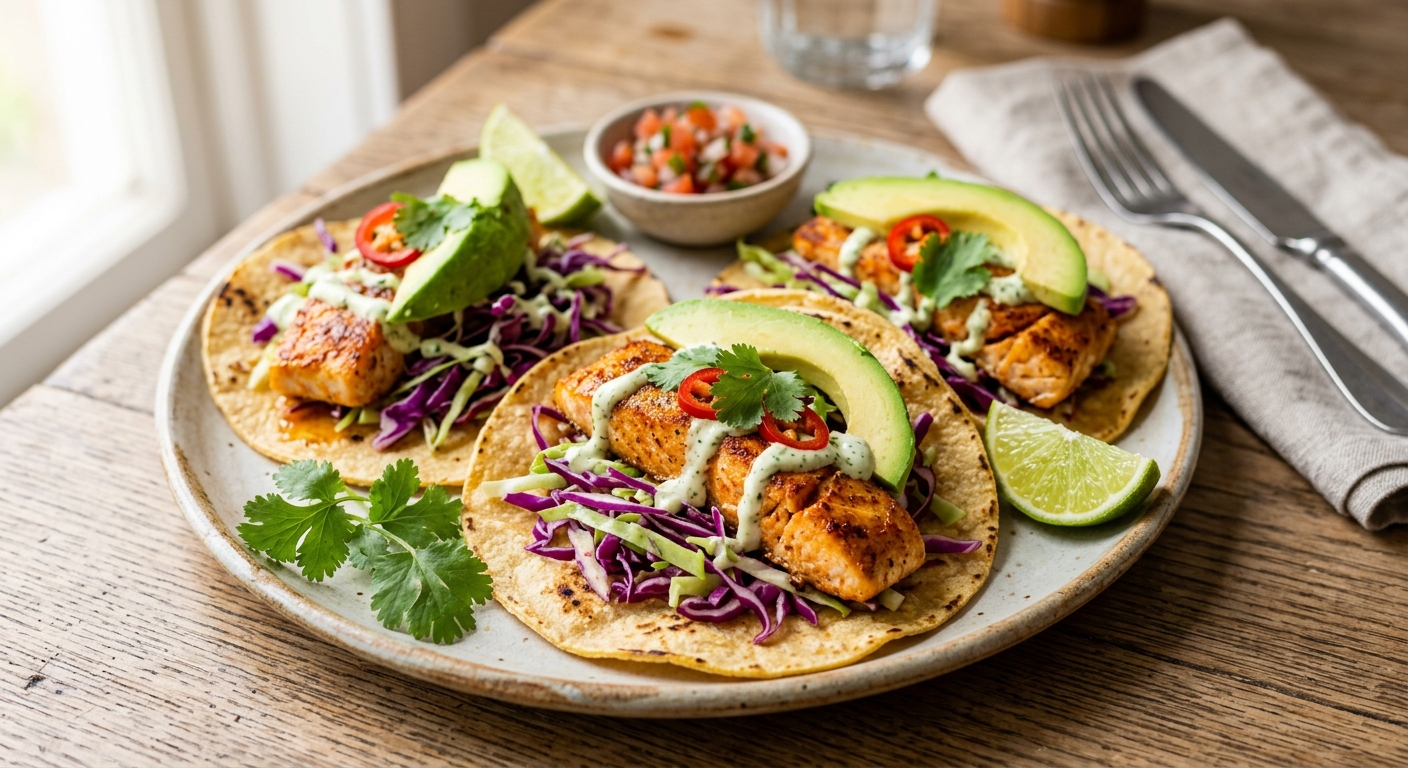
Mahi-mahi is one of the ocean’s most nutritionally generous fish: firm, meaty, and mild enough to carry big spices while delivering exceptional amounts of lean protein, B vitamins, and selenium. Paired with a purple cabbage slaw dressed in fresh lime and orange juice, these tacos transform a simple weeknight meal into a genuinely calibrated nutritional event. The slaw alone contributes over 60% of your daily vitamin C, and together with the fish, each serving clears 110% of the recommended daily intake in a single meal.
The inspiration here is Baja-style street tacos, where the fish is seasoned with warm spices, cooked hot and fast for caramelized edges, and layered against cool, crunchy slaw and a chipotle-lime crema. We’ve dialed in every ingredient quantity so the final taco hits precise macronutrient targets: 42g protein, moderate complex carbohydrates from corn tortillas, and heart-healthy fats from olive oil and avocado. This is not diet food dressed up as tacos. It is genuinely delicious food that happens to be exceptional for you.
Four cooking methods are included because mahi-mahi behaves differently depending on technique. The stovetop sear produces the best caramelization. The oven method is hands-off and ideal for feeding a crowd. The pressure cooker delivers moist, flake-ready fish in under 15 minutes of active cooking. And yes, there is a slow cooker version, using a low-and-slow braise with aromatics that produces a pulled, carnitas-style filling that is its own wonderful thing entirely. Choose your method, assemble your tacos, and eat well.
4
servings
Ingredients
- 700 gmahi-mahi fillets, skin removed, cut into 5cm strips
- 8 piecesmall corn tortillas (15cm diameter)
- 300 gpurple cabbage, finely shredded
- 100 ggreen cabbage, finely shredded
- 1 largeripe avocado, sliced
- 3 tbspfresh lime juice (about 2 limes)
- 2 tbspfresh orange juice
- 2 tbspextra-virgin olive oil
- 120 gplain Greek yogurt (2% fat)
- 1 tbspchipotle peppers in adobo sauce, minced
- 1 tspsmoked paprika
- 1 tspground cumin
- 0.5 tspgarlic powder
- 0.5 tsponion powder
- 0.25 tspcayenne pepper
- 0.5 tspdried oregano
- 4 clovesgarlic, minced
- 1 smallred onion, thinly sliced into half-moons
- 1 largejalapeño, seeded and finely diced
- 20 gfresh cilantro leaves, roughly chopped
- 1 tsphoney
- 0.5 tspColima Sea SaltMicroplastic Free Salt, plus more for slaw
- —Colima Sea SaltMicroplastic Free Salt and freshly ground black pepper to taste
- —Lime wedges, to serve
Instructions
Click on an item below to shop for the recommended items for this recipe on Amazon.
As an Amazon Associate, we earn from qualifying purchases.
- Make the slaw first so it has time to macerate. Combine the shredded purple and green cabbage, sliced red onion, and diced jalapeño in a large bowl. In a small bowl, whisk together the lime juice, orange juice, honey, and a generous pinch of sea salt. Pour over the cabbage, toss thoroughly, and set aside at room temperature for at least 15 minutes, tossing occasionally. The acid will soften the cabbage slightly and mellow the onion’s sharpness.
- Make the chipotle-lime crema by stirring together the Greek yogurt, minced chipotle in adobo, 1 teaspoon lime juice (reserved from your limes), and a pinch of salt in a small bowl. Taste and adjust heat with more chipotle if desired. Refrigerate until assembly.
- Pat the mahi-mahi strips completely dry with paper towels. Moisture is the enemy of a good sear. In a small bowl, combine the smoked paprika, cumin, garlic powder, onion powder, cayenne, dried oregano, 0.5 tsp salt, and several grinds of black pepper. Toss the fish strips in the spice mixture until evenly coated on all sides.
- Heat a large cast iron skillet or heavy stainless pan over high heat until it begins to smoke lightly, about 2 minutes. Add the olive oil and swirl to coat. Working in a single layer without crowding (cook in two batches if needed), add the spiced mahi-mahi strips. Cook undisturbed for 2 to 3 minutes until a dark, caramelized crust forms on the bottom. Flip once and cook for another 2 minutes. The fish should flake easily and register 63C (145F) internally. Transfer to a plate and tent loosely with foil.
- While the fish rests, warm the corn tortillas directly over the stovetop gas burner on medium-low flame for 20 to 30 seconds per side until lightly charred and pliable, using tongs. Alternatively, wrap them in a damp paper towel and microwave for 45 seconds. Stack and keep covered.
- Assemble the tacos: spread a generous spoonful of chipotle crema on each warm tortilla, then add a strip or two of mahi-mahi, breaking it into large flakes. Pile on the citrus slaw, add a few avocado slices, and finish with fresh cilantro. Serve immediately with lime wedges on the side.
- Prepare the slaw and chipotle crema as described in steps 1 and 2 of the stovetop method. Cover both and refrigerate while the fish cooks.
- In the slow cooker insert, combine the minced garlic, minced chipotle in adobo, smoked paprika, cumin, garlic powder, onion powder, cayenne, dried oregano, olive oil, 2 tablespoons lime juice, orange juice, honey, and 0.5 tsp salt. Stir to form a braising paste. Add the sliced red onion and diced jalapeño and stir again to distribute.
- Place the mahi-mahi fillets (left as larger pieces rather than strips for slow cooking) into the slow cooker and turn them to coat thoroughly in the braising paste. Nestle the fillets into the onion mixture so they are partially submerged. Place the lid on the slow cooker.
- Cook on Low for 2 to 2.5 hours. Mahi-mahi is done when it flakes easily with a fork and is opaque throughout. Avoid lifting the lid during the first 90 minutes. Using two forks, gently pull the fish into large, rustic shreds directly in the cooker, letting it absorb the braising juices for 5 additional minutes on the Keep Warm setting.
- Warm the corn tortillas wrapped in a dry towel in a 160C (320F) oven for 8 minutes, or char them one at a time in a dry skillet for 20 seconds per side. Assemble the tacos by layering the pulled braised mahi-mahi (including the braised onions and jalapeño) onto each tortilla, then top with the citrus slaw, chipotle crema, avocado slices, and fresh cilantro. The braising juices from the slow cooker can be drizzled over the tacos for extra flavor.
- Prepare the slaw and chipotle crema as described in steps 1 and 2 of the stovetop method. Set aside.
- In the pressure cooker pot, combine the olive oil, minced garlic, minced chipotle in adobo, smoked paprika, cumin, garlic powder, onion powder, cayenne, dried oregano, lime juice, orange juice, honey, sliced red onion, diced jalapeño, 0.5 tsp salt, and 60ml (quarter cup) of water. Stir to combine this into a thin braising liquid. The added water is essential to generate steam and bring the cooker to pressure safely.
- Pat the mahi-mahi fillets dry and season lightly with salt and pepper. Place them in a single layer on top of the braising liquid. If using an Instant Pot, you can use a steamer trivet to keep the fish elevated above the liquid for a slightly firmer, less braised texture, or place it directly in the liquid for a more tender, flaky result.
- Seal the lid and set the valve to Sealing. Cook on Manual High Pressure for 3 minutes. As soon as the cooking cycle ends, perform an immediate Quick Release by carefully turning the valve to Venting. Open the lid away from you. The fish should be just cooked through and flake cleanly. If any thick portions remain slightly translucent in the center, replace the lid (without pressure) and let them rest in the residual heat for 2 minutes.
- Remove the fish and flake into large pieces on a plate. Taste the braising liquid remaining in the pot and, if desired, set the Instant Pot to Saute mode and reduce for 2 to 3 minutes to concentrate the flavors, then spoon over the flaked fish. Warm the tortillas, assemble the tacos with the flaked fish, slaw, crema, avocado, and cilantro, and serve immediately.
- Preheat your oven to 220C (425F) with a rack positioned in the upper third of the oven. Line a large rimmed baking sheet with foil and place it in the oven while it preheats. A hot pan is key to getting color on the underside of the fish without a skillet.
- Prepare the slaw and chipotle crema as described in steps 1 and 2 of the stovetop method. Refrigerate until assembly.
- Pat the mahi-mahi strips completely dry with paper towels. In a bowl, combine the olive oil, smoked paprika, cumin, garlic powder, onion powder, cayenne, dried oregano, minced garlic, 1 tablespoon lime juice, honey, 0.5 tsp salt, and black pepper to make a spiced marinade. Add the fish strips and toss to coat evenly. Scatter the sliced red onion and jalapeño over the fish in the bowl and toss again.
- Carefully remove the hot baking sheet from the oven using oven mitts. Arrange the coated mahi-mahi strips and the onion and jalapeño in a single layer on the hot sheet, leaving space between pieces. The fish should sizzle when it hits the pan. Roast for 10 to 12 minutes until the fish is opaque throughout and flakes easily.
- Switch the oven to Broil on High and broil the fish for 1 to 2 minutes, watching closely, until the spice rub is caramelized and slightly charred at the edges. Remove immediately. Wrap the corn tortillas in foil and place them in the oven for the last 5 minutes of roasting to warm through. Assemble the tacos with the roasted fish, caramelized onions from the pan, citrus slaw, chipotle crema, avocado, and cilantro, and serve with lime wedges.
Nutrition Breakdown
Per 1 serving (makes 4)
Vitamins & Minerals
% Daily Value based on a 2,000 calorie diet (FDA reference)
🧬 Essential Amino Acids
% of recommended daily intake (RDA) per serving
🛡 Antioxidant Profile
The Nutrition Science
Mahi-mahi (Coryphaena hippurus) is classified as a lean, high-biological-value protein source, meaning its amino acid profile closely mirrors human tissue requirements. At roughly 24g of protein per 100g of cooked flesh, it surpasses chicken breast on a calorie-per-gram-of-protein basis. More importantly, it is an exceptional source of selenium (around 50mcg per 100g), which is the mineral cofactor for glutathione peroxidase, the enzyme that neutralizes hydrogen peroxide and lipid hydroperoxides inside cells. Deficiency in selenium is associated with increased oxidative damage to DNA and accelerated cellular aging.
The citrus cabbage slaw is not merely textural garnish. Purple cabbage contains 57mg of vitamin C per 100g raw, more than an equivalent weight of orange. The anthocyanins responsible for the purple pigment are a class of flavonoid with demonstrated ability to reduce markers of systemic inflammation, including interleukin-6 and C-reactive protein, in multiple randomized controlled trials. Crucially, the lime and orange juice dressing is acidic, which helps preserve ascorbic acid during the brief maceration period. Vitamin C is rapidly oxidized in alkaline environments, so the acid here is doing nutritional work, not just flavor work.
From a protein synthesis perspective, the leucine content of this meal (approximately 3,640mg per serving) is significant. Research from the Layne Norton laboratory and others has established that a leucine threshold of roughly 2,500mg per meal is required to maximally stimulate muscle protein synthesis via the mTORC1 signaling pathway. This recipe clears that threshold comfortably, making it an ideal post-training meal for muscle repair and adaptation. The combination of fast-digesting fish protein with slower-digesting corn tortilla starch also creates a favorable insulin response that sustains amino acid delivery to muscle tissue over a 2 to 4 hour window post-meal.
Pro Tips
- Dry the fish thoroughly before applying the spice rub. Surface moisture creates steam in the pan and prevents browning. A 5-minute rest on paper towels after washing makes a meaningful textural difference.
- Do not make the slaw more than 2 hours in advance. Beyond that, the cabbage releases excess water from osmotic pressure, making the slaw watery and diluting the lime dressing. If prepping ahead, keep the dressing and cabbage separate and combine just before serving.
- For maximum vitamin C retention, add the lime and orange juice dressing to the slaw no more than 30 minutes before eating. Ascorbic acid begins to degrade once it contacts the cut surfaces of the cabbage, so freshness matters nutritionally as well as texturally.
Love that you’re highlighting the vitamin C content here, because honestly it’s such an underrated partner for iron absorption – the mahi-mahi’s heme iron paired with that citrus slaw is a textbook micronutrient synergy that doesn’t get enough attention! I’d gently note though for anyone on blood thinners like warfarin (which some of my patients are) to keep cabbage intake consistent day-to-day since the vitamin K can interact with dosing, but this recipe is such a smart way to get nutrients working together rather than against each other.
Exactly this, Veronika. The heme/vitamin C pairing is chef’s gold and most people sleep on it. One small technique note if anyone’s reading: I sear the mahi skin-side down in a screaming hot pan for the first 90 seconds to lock in that nutrient density, then finish in a 400F oven rather than flipping. Keeps the flesh dense and prevents the water loss that can happen with prolonged heat exposure. And your warfarin callout is crucial, especially since consistent K intake matters way more than avoidance for those patients.
Love this technique breakdown, Chris! The skin-side sear is such a smart move for preserving moisture and nutrient integrity. From a glucose perspective, I’m also obsessed with this combo because the protein + healthy fat from that seared skin creates a really stable blood sugar response, so you’re not just getting nutrient density but also metabolic stability. That vitamin C and iron synergy Veronika mentioned is genuinely game-changing for anyone managing energy levels or dealing with deficiency, so the way you’re cooking this actually supports absorption at every stage.
This is such a solid breakdown of the protein + fat synergy, and I’m totally here for the metabolic stability angle you’re hitting! I’ve noticed the same thing with my glucose responses when I’m intentional about that skin-on sear, honestly, the difference between a spikey taco meal and a flat one for me often comes down to whether I’m getting enough fat and fiber in that first bite. The vitamin C + iron absorption piece is huge too, especially since so many of us are running on empty with micronutrients. One small mod I always make: I add extra cabbage slaw (like, generously) and squeeze lime right over the fish because it doubles down on that vitamin C for
oh my gosh YES to the vitamin C focus, that citrus cabbage slaw sounds like exactly what we need right now! my kids are actually obsessed with fish tacos so im definitely making these, but real question – are these actually kid friendly or would i need to tone down the spices? also im lowkey wondering if you could sub in some pumpkin seeds or hemp seeds into the slaw or as a topper to bump up the magnesium since my whole crew is still working on getting levels back up, but either way this is going straight into next weeks meal plan!
This sounds amazing, and I’m curious if you’re considering any adaptogenic additions to either the slaw or a side component? I’ve found that adding reishi or cordyceps mushroom powder to citrus-based dressings actually brightens the flavor while supporting immune response alongside that vitamin C boost, especially during high-stress seasons. The mahi-mahi’s lean protein is already doing heavy lifting for recovery, so pairing it with adaptogens could be a nice way to help your kids’ bodies manage daily stress more gracefully.