
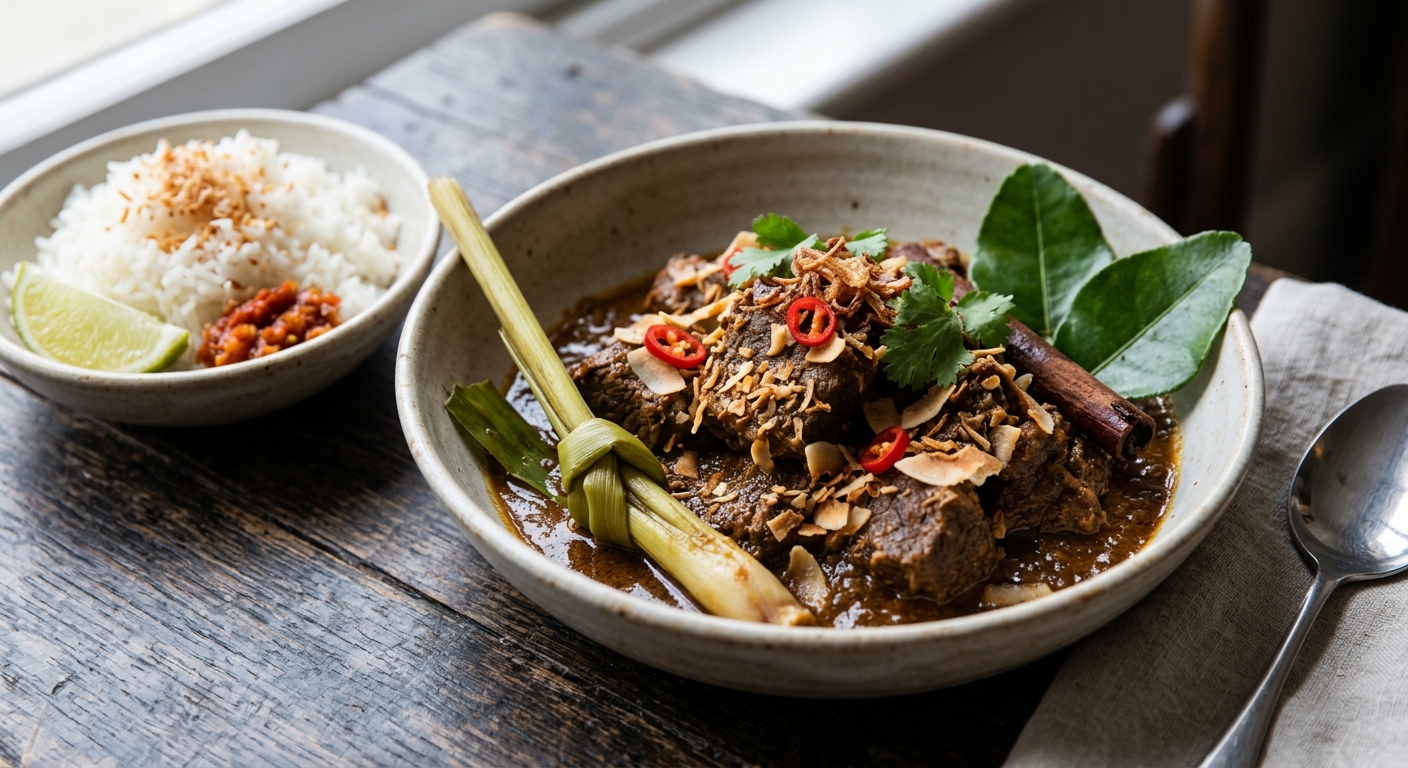
Beef rendang is one of the great slow-cooked masterpieces of Southeast Asian cuisine, originating in the Minangkabau highlands of West Sumatra and adopted with fierce pride across Malaysia and Indonesia. Unlike a conventional braise, rendang begins wet and ends almost completely dry: the coconut milk gradually reduces, the spice paste caramelises directly onto the beef, and the natural oils from the coconut cream re-fry the meat in its own fragrant coating. The result is a dish of breathtaking complexity where every cube of beef carries layers of galangal heat, citrusy lemongrass, earthy turmeric, and a deep, almost smoky sweetness from the toasted kerisik (grated coconut).
From a nutritional standpoint, beef rendang is one of the most mineral-dense meals you can build around a single protein. Grass-fed beef chuck is exceptional in bioavailable heme iron and zinc, two minerals that are chronically under-consumed in modern diets. The long, low cook time does not diminish these minerals; unlike some vitamins, zinc and iron are heat-stable, meaning every milligram present in the raw beef remains fully available on your plate. The generous fat content from coconut milk, while predominantly saturated, is rich in medium-chain triglycerides (MCTs) that are metabolised rapidly for energy rather than stored, and the lauric acid component has been studied for its antimicrobial properties.
The spice matrix here is not just flavour architecture: turmeric contributes curcumin, one of the most researched anti-inflammatory polyphenols on earth; galangal provides galangin and other flavonoids; and chillies deliver a significant dose of vitamin C that actually aids non-heme iron absorption from the spice paste itself. This is nutritional synergy written in a wok.
4
servings
Ingredients
- 900 gbeef chuck, cut into 5cm cubes
- 400 mlfull-fat coconut milk
- 200 mlcoconut cream
- 60 gdesiccated coconut (unsweetened), dry-toasted to golden brown
- 3 stalkslemongrass, bruised and tied in a knot
- 5 wholekaffir lime leaves, torn
- 2 wholeturmeric leaves (or 1 tsp ground turmeric as substitute), torn
- 1 cinnamon stickCeylon cinnamon, approximately 8cm
- 3 wholestar anise
- 4 wholecardamom pods, lightly crushed
- 2 tbspcoconut oil or Avocado Oil100% Pure Avocado Oil
- 1 tbsppalm sugar or soft dark brown sugar
- 1.5 tspColima Sea SaltMicroplastic Free Salt, plus more to taste
- 6 wholeshallots, peeled and roughly chopped
- 5 clovesgarlic, peeled
- 30 gfresh galangal (or ginger), peeled and roughly sliced
- 20 gfresh ginger, peeled and roughly sliced
- 15 gfresh turmeric (or 1.5 tsp ground turmeric)
- 4 wholedried Kashmiri chillies, soaked in hot water for 10 minutes and drained
- 2 wholefresh long red chillies, roughly chopped
- 1 tspground coriander
- 0.5 tspground cumin
- —Steamed jasmine rice, to serve
- —Fresh red chilli slices and kaffir lime leaf chiffonade, to garnish
Instructions
Click on an item below to shop for the recommended items for this recipe on Amazon.
As an Amazon Associate, we earn from qualifying purchases.
- Make the rempah (spice paste): place the shallots, garlic, galangal, ginger, fresh turmeric, drained Kashmiri chillies, fresh red chillies, ground coriander, and ground cumin into a food processor or high-powered blender. Add 3 tablespoons of water and blend to a very fine, smooth paste, scraping down the sides as needed. The paste should have no visible fibrous chunks.
- Toast the kerisik: heat a dry heavy-bottomed skillet over medium heat and add the desiccated coconut. Stir constantly for 4 to 5 minutes until deep golden and fragrant. Immediately transfer to a mortar and pestle or blender and grind to a rough, oily paste. Set aside. This step is non-negotiable for authentic depth of flavour.
- Heat the coconut oil in a large, heavy Dutch oven over medium heat. Add the rempah paste and fry, stirring frequently, for 8 to 12 minutes until it turns from pale orange to a deep rust-red, the raw smell is gone, and the paste pulls away from the sides of the pot. This process of cooking out the paste is called tumis and it is foundational to rendang flavour.
- Add the cinnamon stick, star anise, and cardamom pods and stir for 1 minute to bloom in the paste. Add the beef chuck cubes and stir thoroughly to coat every piece in the rempah. Cook for 3 to 4 minutes, turning the beef, until the outside is sealed and beginning to colour.
- Pour in the coconut milk and coconut cream. Add the lemongrass knots, torn kaffir lime leaves, turmeric leaves, palm sugar, and salt. Stir well and bring to a vigorous boil, then reduce the heat to medium-low to maintain a lively, bubbling simmer (not a rolling boil). Cook uncovered for 1 hour, stirring every 15 minutes.
- After 1 hour, the liquid will have reduced by about half and the mixture will be thicker and richer in colour. Continue cooking over low heat, now stirring every 5 to 10 minutes, for a further 45 minutes to 1 hour. The coconut oil will begin to separate and the sauce will visibly darken from beige-orange to deep mahogany brown.
- Add the ground kerisik paste and stir in thoroughly. The mixture will tighten rapidly. Continue cooking and stirring for a final 20 to 30 minutes until the liquid is almost entirely gone, the beef is coated in a dark, sticky, nearly-dry spice crust, and the oil fries the beef rather than steams it. The beef should sizzle audibly when you stir. Taste and adjust salt. Remove the lemongrass, cinnamon, star anise, cardamom pods, and any large lime leaf pieces before serving.
- Prepare the rempah and toast the kerisik exactly as in steps 1 and 2 of the stovetop method. These foundational steps cannot be skipped or transferred to the slow cooker; they require dry and high heat that only a skillet can provide.
- Heat the coconut oil in a skillet over medium heat and fry the rempah paste for 8 to 12 minutes, stirring constantly, until it is deep rust-red, the oil separates from the paste, and the raw smell has completely cooked out. Add the cinnamon, star anise, and cardamom, stir for 1 minute, then transfer the entire spice paste mixture to the slow cooker insert.
- In the same skillet, increase heat to medium-high and sear the beef chuck cubes in two batches for 2 to 3 minutes per side until deep brown on at least two faces. Do not crowd the pan. Transfer the seared beef to the slow cooker. Deglazing is optional: add a splash of coconut milk to the hot pan, scrape up the fond, and pour it into the slow cooker for added flavour.
- Add the coconut milk, coconut cream, lemongrass knots, kaffir lime leaves, turmeric leaves, palm sugar, salt, and ground kerisik paste directly to the slow cooker. Stir gently to combine everything, ensuring the beef is submerged in the liquid. Cook on Low for 8 hours or on High for 4 to 5 hours. Do not lift the lid during cooking, as each peek adds 15 to 20 minutes of cooking time.
- At the end of cooking, the beef will be extremely tender. If you want a drier, more traditional finish: ladle the beef and sauce into a wide saucepan, discard the lemongrass, cinnamon, star anise, and cardamom, and boil vigorously over high heat for 20 to 30 minutes, stirring constantly during the final 10 minutes as the sauce reduces to a dark, clinging coating. If you prefer a saucy rendang, simply remove the whole spices, taste for salt, and serve directly from the slow cooker.
- Prepare the rempah and toast the kerisik as described in steps 1 and 2 of the stovetop method. Set the Instant Pot to Saute mode on High. Once hot, add the coconut oil.
- Add the rempah paste to the hot insert and fry, stirring constantly, for 8 to 10 minutes in Saute mode until deeply coloured, fragrant, and the raw smell is gone. The stainless insert gets very hot; keep stirring to prevent scorching. Add the cinnamon stick, star anise, and cardamom pods and stir for 1 minute to bloom.
- Add the beef chuck cubes directly into the paste and stir to coat. Cook for 2 minutes in Saute mode, turning the beef once. Pour in only the coconut milk (reserve the coconut cream for after pressure cooking). Add the lemongrass knots, kaffir lime leaves, turmeric leaves, palm sugar, and salt. Stir well and scrape any paste from the bottom of the insert to avoid a burn warning.
- Cancel Saute mode. Secure the lid and set the steam release valve to Sealing. Cook on Manual (Pressure Cook) at High Pressure for 45 minutes. Allow a full natural pressure release for 15 minutes, then carefully quick-release any remaining pressure.
- Remove the lid. The beef will be tender but the mixture will be quite liquid. Discard the lemongrass, whole spices, and large leaf pieces. Set the Instant Pot back to Saute mode on High, or transfer everything to a wide saucepan on the stovetop. Add the reserved coconut cream and the kerisik paste, and reduce vigorously for 20 to 30 minutes, stirring frequently and then constantly in the final 10 minutes, until the sauce is dark, thick, and clings to the beef. The dry-down phase is essential for authentic rendang character.
- Preheat your oven to 160C (325F) with the rack in the lower-middle position. Prepare the rempah paste and toast the kerisik exactly as in steps 1 and 2 of the stovetop method. These stovetop steps are essential and cannot be done in the oven.
- Heat the coconut oil in a wide, heavy Dutch oven with an oven-safe lid (such as a Le Creuset) over medium heat on the stovetop. Fry the rempah paste for 8 to 12 minutes, stirring frequently, until deep rust-red and aromatic. Add the whole spices and bloom for 1 minute. Sear the beef in the paste for 3 to 4 minutes, turning to coat.
- Pour in the coconut milk and coconut cream. Add the lemongrass, kaffir lime leaves, turmeric leaves, palm sugar, salt, and kerisik paste. Stir to combine and bring to a simmer on the stovetop. Cover the Dutch oven with its lid and transfer to the preheated oven.
- Braise in the covered oven at 160C for 2 hours, checking once at the 1-hour mark to ensure the liquid is gently bubbling (not boiling hard). If it is boiling aggressively, reduce oven temperature to 150C. After 2 hours the beef will be tender and the liquid significantly reduced.
- Remove the lid and increase the oven temperature to 200C (400F). Return the uncovered Dutch oven to the oven for 30 to 40 minutes, stirring every 10 minutes, until the sauce reduces to a thick, dark coating and the tops of the beef cubes develop a slightly caramelised, roasted character. Watch closely during this stage. Remove from the oven, discard the whole spices and lemongrass, taste for salt, and rest for 5 minutes before serving.
Nutrition Breakdown
Per 1 serving (makes 4)
Vitamins & Minerals
% Daily Value based on a 2,000 calorie diet (FDA reference)
🧬 Essential Amino Acids
% of recommended daily intake (RDA) per serving
🛡 Antioxidant Profile
The Nutrition Science
The extraordinary zinc content of beef rendang stems from the biology of muscle tissue itself. Zinc is stored predominantly in fast-twitch muscle fibres, and cuts like chuck, which are dense with slow-twitch and connective tissue, still carry between 8 and 12mg of zinc per 200g of raw beef. Unlike many minerals, zinc bioavailability from red meat is exceptionally high at 40 to 50%, compared to just 10 to 20% from plant sources, because heme-bound proteins in beef carry zinc through intestinal absorption pathways that bypass the inhibitory effects of phytic acid. A single serving of this rendang provides over 100% of the daily value for zinc, covering wound healing, immune T-cell regulation, testosterone synthesis, and the activity of over 300 enzymatic reactions in one meal.
The interaction between the spice matrix and iron absorption is one of the most elegant nutritional synergies in this dish. The chillies, galangal, and fresh turmeric contribute meaningful amounts of vitamin C (ascorbic acid) to the rempah paste, even after cooking. Ascorbic acid reduces ferric iron (Fe3+) to the more soluble ferrous form (Fe2+), dramatically increasing non-heme iron absorption from the spices themselves and from any plant-based sides. Simultaneously, the 6.8mg of heme iron from the beef is absorbed directly via the HCP1 receptor at rates of 20 to 30%, meaning this dish alone can address a clinically significant portion of the 8mg daily requirement for men and 18mg for premenopausal women.
Curcumin from the fresh and ground turmeric deserves special mention for its interaction with meat-based cooking. Research published in the Journal of Agricultural and Food Chemistry has demonstrated that curcumin reduces the formation of heterocyclic amines (HCAs) when meat is cooked at high temperatures. While rendang’s moist early cooking phase minimises HCA formation anyway, the turmeric provides an additional protective buffer during the final high-heat dry-down. The fat-soluble nature of curcumin also means that the coconut cream in this dish significantly enhances its bioavailability compared to water-based dishes, as curcumin requires a lipid vehicle for proper intestinal absorption.
Pro Tips
- Cut the beef chuck into uniform 5cm cubes and do not trim too much fat: the intramuscular fat from chuck dissolves into the sauce during the long cook, creating body and richness that lean cuts cannot replicate.
- The single most important flavour decision is how long you fry the rempah (spice paste) before adding liquid. Under-fried rempah produces a raw, harsh, one-dimensional heat. Properly tumis-ed rempah, fried for a full 10 to 12 minutes until it smells sweet and nutty rather than sharp, is the foundation of authentic rendang depth.
- Kerisik (ground toasted coconut) is not optional for authentic flavour and texture. The process of dry-toasting desiccated coconut and then grinding it releases its oils into a coarse paste that acts simultaneously as a flavour intensifier, a natural thickener, and the vehicle by which the spice paste adheres to the beef during the dry-down phase.




This is really hitting on something I’ve been curious about for recovery nutrition – that zinc and iron density is solid, but I’m wondering about the bioavailability angle here. The coconut milk fat is great for absorption, but does the turmeric and other polyphenols in rendang create any binding issues with mineral uptake? I’ve been experimenting with pairing high-mineral dishes with vitamin C sources post-ride to optimize iron absorption, and I’m curious if you’ve looked into whether this needs any strategic pairing or if the rendang stands alone as a complete recovery meal. The slow cooking should maximize nutrient availability though, which is honestly ideal for someone like me who needs to dial in micronutrient
Really solid question on the bioavailability piece. You’re right that polyphenols can chelate minerals, but the slow cooking actually works in your favor here – long heat exposure breaks down some of those binding compounds and increases free mineral availability. I’ve been tracking this with my CGM and seeing how different dishes affect my ferritin levels, and honestly the rendang performs well on its own, though I’d still add a vitamin C source post-ride just to be safe. Studies show pairing heme iron with ascorbic acid can increase absorption by up to 3x, so maybe a simple lime wedge or even some sauerkraut on the side to hedge your bets, especially post-workout
This is exactly right on the bioavailability mechanics, and I appreciate you mentioning the slow-cook advantage, which a lot of people miss. The extended gentle heat does genuinely help liberate minerals from binding compounds. One thing I’d add from a clinical standpoint: the coconut milk fat in rendang is actually doing heavy lifting here too, since fat-soluble absorption improves with lipids present, and you’re getting both heme and non-heme iron in beef, so the vitamin C pairing strategy is solid. I’ve seen ferritin responses shift noticeably when patients pair iron-rich meals with fresh citrus or fermented sides, so your post-ride lime wedge instinct tracks
omg YES this is exactly what im talking about!!! my kids actually ASK for beef now instead of their usual chicken nugget phase, and knowing theyre getting that much zinc in one meal makes me feel like im actually doing something right for their immune systems. do you have any tips for making it less spicy for younger palates? i usually cut back the chilis and add a little extra coconut milk but im wondering if theres a way to keep all the flavor complexity without the heat since my 7yo is still working up to spicier foods
honestly this is clutch – getting kids to eat zinc-dense foods without fighting them is like half the battle. your instinct with extra coconut milk is solid, keeps the fat content up which helps mineral absorption anyway. id also suggest pulling back on the raw chilis but keeping the turmeric and lemongrass doses the same, thats where most of the flavor complexity actually lives. you could toast those spices a bit longer too before adding liquid, brings out depth without heat. my approach with clients who have picky eaters is basically let the rendang simmer longer so everything gets super tender and the spice mellows naturally – kids connect with texture way more than we think
This looks absolutely wonderful, and I’m thrilled to see such a zinc-rich recipe that actually tastes like comfort food! I’ve found that the turmeric and other warm spices in rendang are such a gift for my joints, especially when paired with that beautiful slow-cooked beef. I’m definitely making this soon, though I might add a splash of extra virgin olive oil at the end since that’s become my secret weapon for managing inflammation. Thank you for breaking down the micronutrient density, it’s so helpful to know exactly what I’m getting in each spoonful!