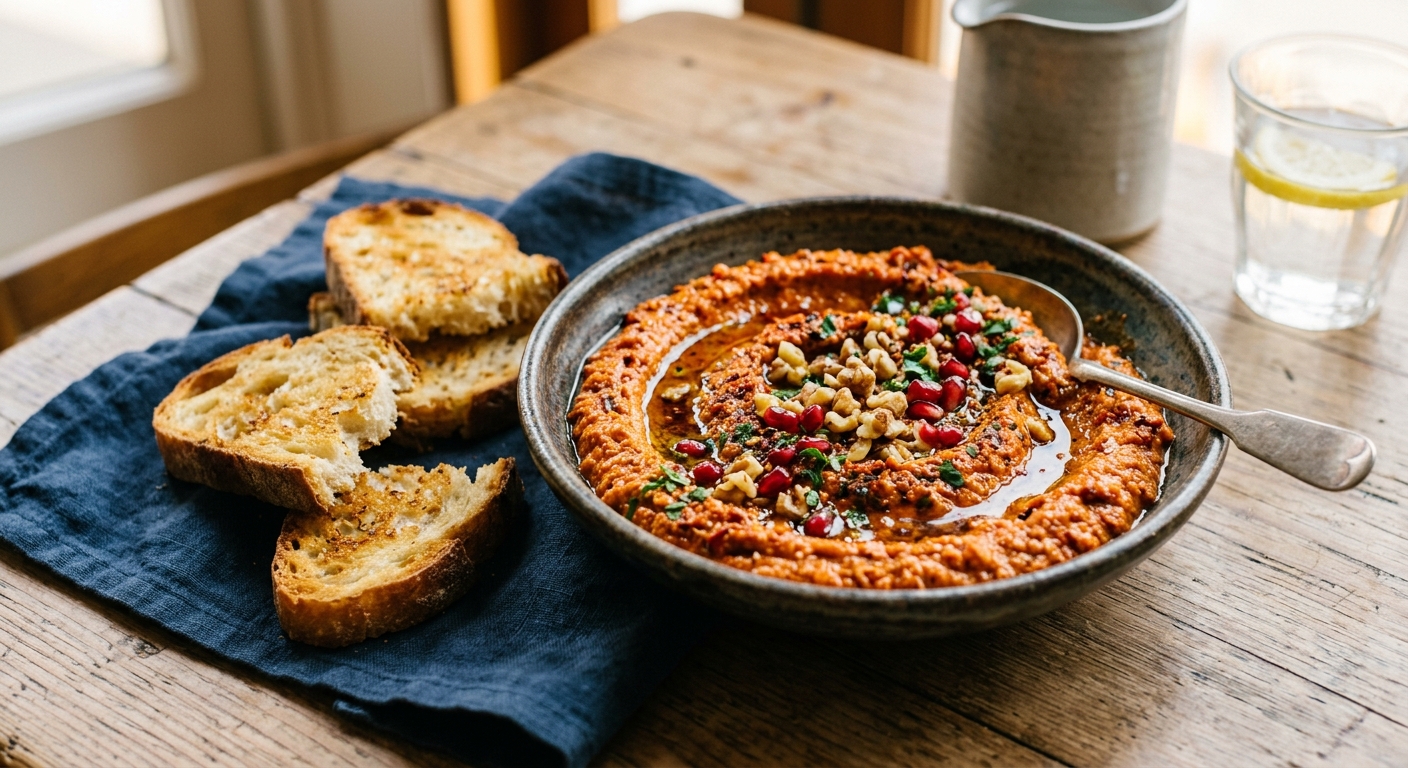
Muhammara originates from Aleppo, Syria, where it has been served as a meze staple for centuries. The name derives from the Arabic word for ‘reddened,’ a nod to the vivid crimson colour that comes from slow-roasted red peppers and the prized Aleppo pepper flakes that give the dip its gentle, fruity heat. Unlike hummus, which is built on protein and starch, muhammara is fundamentally a walnut-and-pepper emulsion, meaning its caloric density comes primarily from the exceptionally healthy fat profile of walnuts rather than from carbohydrates.
From a nutritional standpoint, this recipe is engineered around two powerhouse ingredients: walnuts and red bell peppers. Walnuts are the only tree nut with a significant concentration of alpha-linolenic acid (ALA), the plant-based omega-3 fatty acid that the body can partially convert to EPA and DHA. A single 28g serving of walnuts delivers approximately 2.5g of ALA, which meets and exceeds the adequate intake recommendation for most adults. Red bell peppers, particularly when roasted to concentrate their sugars and nutrients, are one of the richest food sources of vitamin C and beta-carotene on the planet, with a single large pepper providing more than 150% of the daily value for vitamin C.
What elevates this recipe beyond a simple puree is the layering of technique. Whether you roast the peppers directly over a gas flame, blister them under a high broiler, or soften them slowly in a low oven, each method draws out different flavour compounds and produces a subtly different texture. The pomegranate molasses adds tartness and a hit of polyphenols, the toasted breadcrumbs provide body and a slightly lower glycemic profile than straight starch, and a finishing drizzle of olive oil contributes oleocanthal, an anti-inflammatory compound chemically similar in action to ibuprofen. This is a dip with serious nutritional credentials and even more serious flavour.
6
servings
Ingredients
- 4 largered bell peppers (approximately 700g total)
- 120 graw walnut halves
- 40 gday-old sourdough or white bread, crusts removed and torn
- 3 tbspextra-virgin olive oil, plus more for finishing
- 2 tbsppomegranate molasses
- 1 tbspfreshly squeezed lemon juice
- 2 tspAleppo pepper flakes (or 1 tsp smoked paprika plus 0.5 tsp mild chilli flakes)
- 1 tspground cumin
- 2 clovesgarlic, peeled
- 0.5 tspColima Sea SaltMicroplastic Free Salt, plus more to taste
- —Freshly ground black pepper to taste
- —Fresh flat-leaf parsley, walnut halves, and Aleppo pepper for garnish
Instructions
Click on an item below to shop for the recommended items for this recipe on Amazon.
As an Amazon Associate, we earn from qualifying purchases.
- Set four gas burners to high. Using long-handled tongs, place one red bell pepper directly on each burner grate over the open flame. Char the peppers, turning every 2 to 3 minutes, until the skin is completely blackened and blistered on all sides and the flesh feels soft when pressed, about 10 to 12 minutes total. The peppers should be deeply charred, not just lightly blistered.
- Transfer the charred peppers immediately to a large bowl and cover tightly with plastic wrap or a plate. Let them steam for 15 minutes. This steam loosens the blackened skin from the flesh without cooking away the smoky compounds. While the peppers steam, place a dry skillet over medium heat and toast the walnuts, shaking the pan frequently, until they are fragrant and lightly golden, about 4 to 5 minutes. Transfer to a plate to cool.
- In the same dry skillet over medium heat, toast the torn bread pieces until crisp and golden on both sides, about 3 minutes. Add 1 tablespoon of the olive oil to the pan, add the garlic cloves, and cook for 1 to 2 minutes until the garlic is lightly golden and fragrant. Remove from heat.
- Uncover the peppers and peel away the charred skin using your fingers or a paper towel. Do not rinse under water as this washes away the smoky flavour compounds. Remove and discard the stems and seeds. Tear the roasted flesh roughly and let any excess liquid drain in a colander for 5 minutes.
- Add the toasted walnuts and toasted bread to a food processor and pulse 8 to 10 times until the mixture resembles coarse breadcrumbs. Add the roasted pepper flesh, sauteed garlic, pomegranate molasses, lemon juice, Aleppo pepper flakes, cumin, salt, and the remaining 2 tablespoons of olive oil. Process for 30 to 45 seconds, scraping down the sides once, until you have a slightly textured paste. Muhammara should not be completely smooth. Taste and adjust salt, lemon juice, or Aleppo pepper as needed. Serve in a shallow bowl, drizzled with olive oil and garnished with fresh parsley, walnut halves, and a pinch of Aleppo pepper.
- Position an oven rack 10 to 12cm beneath the broiler element and preheat the broiler to its highest setting. Line a heavy rimmed baking sheet with aluminium foil. Halve the red bell peppers lengthways, remove the stems and seeds, and press each half flat with your palm. Arrange the pepper halves skin-side up in a single layer on the prepared baking sheet. Drizzle with 1 tablespoon of the olive oil and season lightly with salt.
- Spread the raw walnut halves on a separate small baking sheet and place it on a lower oven rack. Slide both baking sheets into the oven. Broil the peppers for 15 to 18 minutes, watching closely after 12 minutes, until the skins are deeply blistered and charred in places and the flesh is completely tender and collapsing. The walnuts will be lightly toasted after 6 to 8 minutes; remove them from the oven at that point and set aside to cool.
- Transfer the broiled pepper halves immediately to a large bowl, cover tightly with plastic wrap, and let steam for 15 minutes. Meanwhile, reduce the oven temperature to 180C (350F). Scatter the torn bread pieces on the empty foil-lined baking sheet, drizzle with a little olive oil, and bake for 6 to 8 minutes until crisp and golden. Wrap the garlic cloves in a small piece of foil with a drizzle of olive oil and roast alongside the bread for the same time.
- Peel the cooled peppers, discarding the charred skins. The flesh should be silky and deeply sweet. Squeeze the roasted garlic from the foil packet. Drain the peeled peppers in a colander for 5 minutes to remove excess liquid, which would otherwise make the dip watery.
- Place the toasted walnuts and baked bread in a food processor and pulse 8 to 10 times to a coarse crumb texture. Add the roasted peppers, roasted garlic, pomegranate molasses, lemon juice, Aleppo pepper flakes, cumin, salt, and the remaining 2 tablespoons of olive oil. Pulse and then process for 30 to 45 seconds into a textured, rustic paste. Taste carefully, as oven-roasted peppers are sweeter than flame-charred ones, so you may want a touch more lemon juice or Aleppo pepper to balance. Serve garnished with olive oil, parsley, and walnut halves.
- Cut the red bell peppers into quarters, remove stems and seeds, and place them directly in the slow cooker insert. Add the whole peeled garlic cloves, 1 teaspoon of smoked paprika (used in addition to or in place of Aleppo pepper for smoke compensation), the ground cumin, 1 tablespoon of olive oil, and 0.5 teaspoon of salt. Add 2 tablespoons of water to help create steam. Stir briefly to coat the peppers, then spread them into as even a layer as possible. Cook on High for 4 hours or Low for 7 hours, until the peppers are completely collapsed, jammy, and very tender.
- About 20 minutes before the peppers finish cooking, toast the walnuts in a dry skillet over medium heat, shaking frequently, until fragrant and golden, about 4 to 5 minutes. In the same pan, toast the torn bread pieces with a drizzle of olive oil until crisp and golden. Set both aside to cool. The toasting step is essential for this method because the slow cooker cannot develop the Maillard reaction flavours that roasting provides.
- When the peppers are done, carefully tilt the insert and use a spoon to remove and discard as much accumulated liquid as possible. This is more critical in the slow cooker method because the sealed environment retains moisture. Transfer the jammy pepper mixture to a colander and let it drain for 10 minutes.
- Add the toasted walnuts and bread to a food processor and pulse to a coarse crumb. Add the drained slow-cooked peppers and garlic, pomegranate molasses, lemon juice, Aleppo pepper or chilli flakes, the remaining 2 tablespoons of olive oil, and an optional 2 to 3 drops of liquid smoke if you want to replicate the flame-roasted character. Process in short pulses to a textured paste.
- Taste the muhammara carefully. Slow-cooked peppers are intensely sweet, so this version will likely need a more assertive balance of acid and heat. Add lemon juice in small increments, adjust salt, and increase Aleppo pepper or smoked paprika to taste. Transfer to a serving bowl, rest for at least 10 minutes for flavours to meld, then finish with olive oil, parsley, walnut halves, and Aleppo pepper.
- Quarter the red bell peppers, remove stems and seeds, and add them to the Instant Pot inner pot along with the whole peeled garlic cloves, 2 tablespoons of water, 1 teaspoon of smoked paprika, 0.5 teaspoon of cumin, and 0.5 teaspoon of salt. Secure the lid and set the pressure release valve to Sealing. Cook on Manual High Pressure for 5 minutes.
- While the peppers cook, toast the walnuts in a dry skillet over medium heat until fragrant and golden, about 4 to 5 minutes. In the same skillet, toast the torn bread pieces with a drizzle of olive oil until crisp and golden on both sides, about 3 minutes. Set both aside to cool completely. Toasting must happen separately since the pressure cooker environment prevents any browning.
- When the pressure cook cycle ends, perform a quick pressure release by carefully switching the valve to Venting. Open the lid and switch the Instant Pot to Saute mode on High. Cook the peppers and their liquid for 4 to 5 minutes, stirring occasionally, until most of the released moisture has evaporated and the pepper mixture looks thick and jammy rather than watery. This concentration step is unique to the pressure cooker method and significantly improves the final dip texture. Cancel the Saute function and let the mixture cool for 10 minutes.
- Transfer the concentrated pepper and garlic mixture to a food processor. Add the toasted walnuts and bread and pulse 6 to 8 times to a coarse mixture. Add the pomegranate molasses, lemon juice, Aleppo pepper flakes, the remaining 0.5 teaspoon of cumin, and the 3 tablespoons of olive oil. Process for 30 to 40 seconds into a cohesive but textured paste, scraping down the sides once.
- Taste and season. Pressure-cooked peppers retain a bright, fresh flavour with deep sweetness, so the balance of pomegranate molasses tartness and Aleppo heat should be checked carefully. Adjust salt and lemon juice as needed. Serve in a wide shallow bowl, finished with a generous drizzle of olive oil, a sprinkle of Aleppo pepper, fresh parsley leaves, and a few walnut halves for visual contrast.
Nutrition Breakdown
Per 1 serving (makes 6)
Vitamins & Minerals
% Daily Value based on a 2,000 calorie diet (FDA reference)
🧬 Essential Amino Acids
% of recommended daily intake (RDA) per serving
🛡 Antioxidant Profile
The Nutrition Science
The anti-inflammatory power of muhammara operates through at least four distinct biochemical mechanisms, which is what separates it from dips that are merely nutritious. Walnuts are the central player: their ALA content (approximately 2.5g per 20g portion of walnuts used in this recipe per serving) is converted by the body to EPA and DHA at a rate of roughly 5 to 15% for EPA and under 5% for DHA. While this conversion is modest, regular dietary ALA intake is associated with reduced circulating CRP and IL-6, two primary inflammatory biomarkers, independent of conversion. The walnut polyphenols, particularly pedunculagin and its hydrolysis product urolithin A (produced by gut bacteria), have been shown in randomised controlled trials to reduce LDL oxidation and endothelial inflammation.
Red bell peppers contribute a synergistic antioxidant payload. Capsanthin, the primary red carotenoid in bell peppers, has a singlet oxygen quenching capacity approximately 1.5 to 2 times greater than beta-carotene and is fat-soluble, meaning it is best absorbed alongside the olive oil and walnut fat in this recipe. This is a classic example of food synergy: the fat in walnuts and olive oil directly enhances the bioavailability of the pepper’s fat-soluble antioxidants. Roasting the peppers also increases the bioaccessibility of these carotenoids by breaking down the cell wall matrix that otherwise limits absorption.
Pomegranate molasses adds a concentrated source of punicalagins and ellagic acid, polyphenols associated with inhibition of the NF-kB transcription factor, a master regulator of inflammatory gene expression. The finishing olive oil contributes oleocanthal, which has been quantified to provide roughly 10% of the anti-inflammatory effect per dose of ibuprofen at typical culinary use levels. Cumulative daily exposure from olive oil consumption is considered one of the mechanisms behind the Mediterranean diet’s documented reduction in cardiovascular inflammatory risk. Together, these compounds make muhammara a genuinely functional food, not merely a food that contains nutrients.
Pro Tips
- Do not rinse flame-charred peppers under water. The smoky volatile compounds responsible for depth of flavour are water-soluble and will wash away. Use dry hands or a paper towel to rub away the skin instead.
- Toast the walnuts every time, regardless of cooking method. Raw walnuts contain tannins concentrated near the skin that create bitterness in raw applications. A 4 to 5 minute dry toast drives off these compounds and develops nutty Maillard flavours that make the dip taste far more complex.
- Rest the finished muhammara for at least 20 minutes before serving. Like all emulsified dips, the flavours continue to integrate and the texture firms slightly as the bread absorbs residual moisture. Muhammara made a day ahead and refrigerated overnight is noticeably superior to freshly made.
This is such a smart point about the charring, Chris! I’m actually researching polyphenol bioavailability in my thesis and the heat application absolutely matters for extraction, especially with those carotenoids in red peppers. I’ve been curious about whether the roasting process affects the walnut’s ALA omega-3 stability since heat can sometimes be tricky with polyunsaturated fats, but it sounds like you’re finding the flavor compounds more than make up for any potential oxidation concerns. Have you noticed a difference in how the dip sits in the fridge after a day or two?
The roasting technique here is everything – I’ve found that charring the peppers hard enough to blister the skin (not just soften them) concentrates the lycopene and creates those polyphenols you can actually taste. One thing I’d add: if someone’s doing the walnuts, toasting them separate at 325F for exactly 8-10 minutes before blending keeps that ALA intact instead of letting the friction heat from the processor degrade it. The pomegranate molasses is the secret weapon though, that tartness lets you use way less added oil while keeping the umami profile rich, which I’ve been leaning into hard for clients watching their omega-6 balance.
oh this is gold – the walnut temp control especially, ive been wondering if my processor was just obliterating everything and 325 for 8-10 min sounds way more intentional than my chaotic approach lol. also love that you mention the pomegranate molasses reducing oil need, bc ive noticed red peppers are already a vitamin C powerhouse when theyre charred like that, which actually helps with iron absorption if anyone’s eating this with something iron-rich (im always thinking about pairing now since my ferritin started creeping up). the umami focus without extra oil is smart – do you find the polyphenols stay more stable when youre not heating everything together at