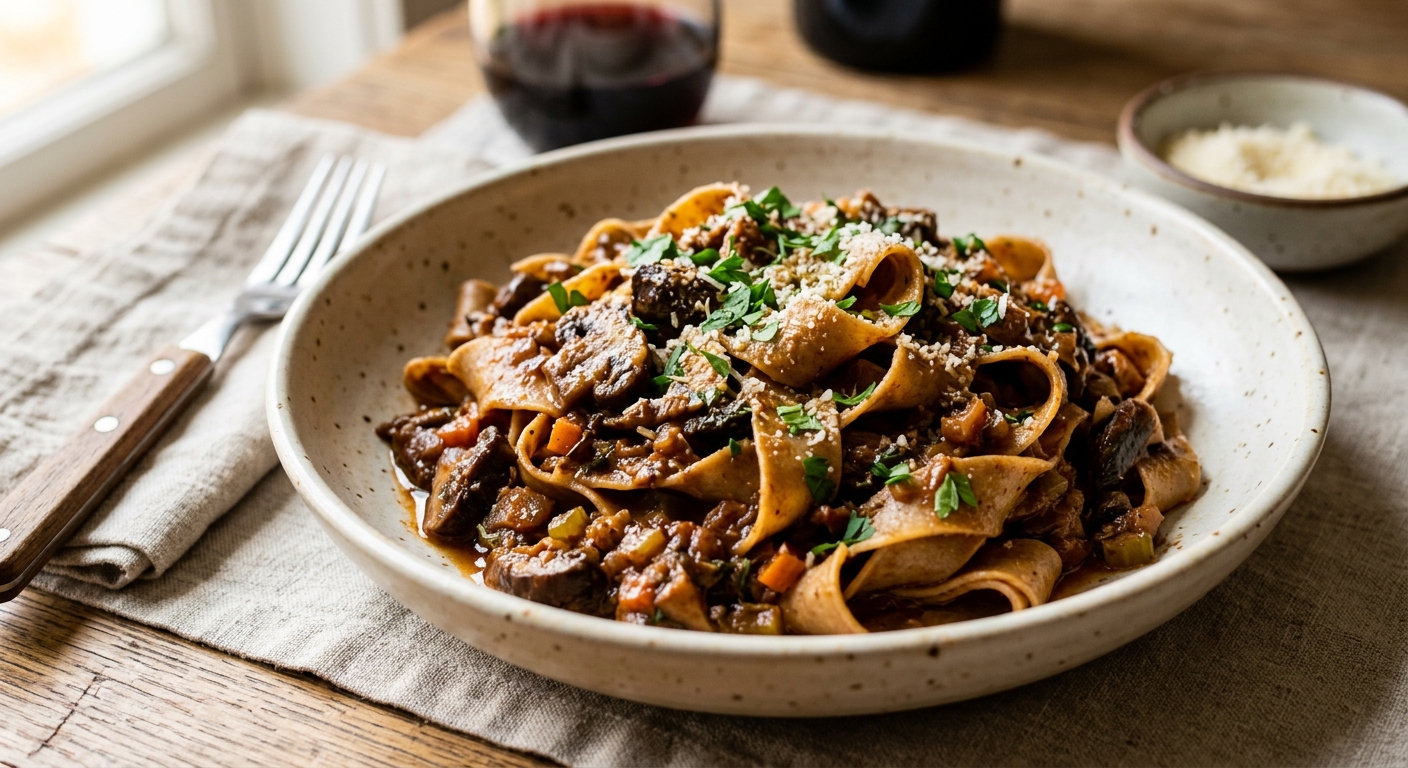
There is a particular kind of satisfaction that comes from a bowl of wide, chewy pasta ribbons coated in a ragu so deeply flavored it could pass for a meat-based Sunday sauce. That is precisely what this whole wheat pappardelle with mushroom ragu delivers, and it does so while functioning as one of the most intelligently constructed B-vitamin meals you can put on a weeknight table. The combination of cremini, shiitake, and porcini mushrooms is not accidental: each variety contributes a different spectrum of B vitamins, umami compounds, and bioactive polyphenols that work together in ways a single-mushroom sauce simply cannot match.
Whole wheat pappardelle is the unsung hero of the pasta world. Its coarse, fibrous texture gives the wide noodles a satisfying chew and a nutty backbone that standard semolina pasta lacks entirely. More importantly, the intact bran and germ layers in whole wheat flour supply beta-glucan fiber, magnesium, manganese, and a meaningful hit of thiamine and niacin that refined pasta strips away during milling. When you pair whole grain pasta with a mushroom ragu built on a soffritto of onion, celery, carrot, and garlic, you create a dish where every component is contributing something quantifiable to your nutritional day.
At Calibrated Cuisine, we ran this recipe through three cooking methods and found genuinely different flavor profiles in each. The stovetop version gives you the most control and produces the brightest, most complex ragu. The slow cooker version develops an almost braise-like depth from hours of low heat, with mushrooms that melt into silky ribbons of concentrated flavor. The pressure cooker version is a weeknight miracle: full depth in under 30 minutes. We also tested an oven-braised version that produces an extraordinary, slightly caramelized top layer and an incredibly concentrated sauce. All four are worth knowing.
4
servings
Ingredients
- 320 gwhole wheat pappardelle
- 300 gcremini mushrooms, stems trimmed, roughly chopped
- 200 gfresh shiitake mushrooms, stems removed, caps sliced
- 20 gdried porcini mushrooms
- 240 mlhot water, for soaking porcini
- 1 mediumyellow onion, finely diced
- 2 stalkscelery, finely diced
- 1 mediumcarrot, peeled and finely diced
- 4 clovesgarlic, minced
- 2 tbsptomato paste
- 400 gcanned whole San Marzano tomatoes, crushed by hand
- 120 mldry red wine (such as Chianti or Barbera)
- 3 tbspextra-virgin olive oil
- 1 tspfresh thyme leaves (or 0.5 tsp dried)
- 1 sprigfresh rosemary
- 2 tbspflat-leaf parsley, finely chopped, for serving
- 30 gParmigiano-Reggiano, finely grated, for serving
- —Colima Sea SaltMicroplastic Free Salt and freshly cracked black pepper to taste
Instructions
Click on an item below to shop for the recommended items for this recipe on Amazon.
As an Amazon Associate, we earn from qualifying purchases.
- Place the dried porcini in a small bowl and pour 240ml of just-boiled water over them. Let steep for 20 minutes until fully rehydrated and fragrant. Lift the porcini out with a slotted spoon, squeeze gently, and roughly chop. Reserve the soaking liquid, pouring it carefully through a fine-mesh sieve lined with a paper towel to remove any grit. Set both aside.
- Heat 3 tablespoons of olive oil in a wide, heavy-bottomed Dutch oven or large saute pan over medium heat. Add the diced onion, celery, and carrot with a generous pinch of salt. Cook, stirring occasionally, for 8 to 10 minutes until the vegetables are completely softened and beginning to turn golden at the edges. Add the minced garlic and cook for a further 90 seconds until fragrant.
- Increase the heat to medium-high and add all the mushrooms, including the rehydrated porcini, in one large addition. Resist the urge to stir immediately. Let the mushrooms sit undisturbed for 3 to 4 minutes so they develop a deep brown sear on one side before tossing. Continue cooking for another 6 to 8 minutes, stirring every couple of minutes, until all mushrooms have released their liquid, that liquid has fully evaporated, and the mushrooms are deeply browned and beginning to stick slightly to the pan.
- Push the mushrooms to the sides of the pan and add the tomato paste directly to the center. Let the tomato paste cook undisturbed for 90 seconds, then stir to combine with the mushrooms and cook for another minute. Pour in the red wine and scrape up any browned bits from the bottom of the pan. Let the wine reduce by half, about 3 minutes.
- Pour in the reserved porcini soaking liquid, the crushed San Marzano tomatoes, thyme leaves, and the rosemary sprig. Stir well, season with salt and pepper, and bring to a gentle simmer. Reduce heat to low, partially cover, and cook for 25 to 30 minutes, stirring occasionally, until the ragu is thick, glossy, and deeply flavored. Remove the rosemary sprig. Taste and adjust seasoning.
- While the ragu finishes, bring a large pot of heavily salted water to a rolling boil. Cook the whole wheat pappardelle for 1 minute less than the package’s al dente recommendation, typically 7 to 8 minutes. Before draining, scoop out about 240ml of starchy pasta water. Drain the pasta and add it directly to the ragu over medium heat with a splash of pasta water. Toss vigorously for 60 to 90 seconds until the sauce clings to every ribbon and the pasta finishes cooking. Add more pasta water as needed for a silky consistency.
- Divide among warm bowls and finish with chopped parsley and freshly grated Parmigiano-Reggiano. Serve immediately.
- Soak the dried porcini in 240ml of just-boiled water for 20 minutes. Remove them, squeeze well, and roughly chop. Carefully strain the soaking liquid through a paper-towel-lined sieve to remove grit. Set the chopped porcini and strained liquid aside.
- Heat 2 tablespoons of olive oil in a large skillet over medium-high heat. Working in two batches to avoid crowding, spread the cremini and shiitake mushrooms in a single layer and cook without stirring for 3 to 4 minutes per batch until deeply browned on one side. Transfer the seared mushrooms to the slow cooker insert. This browning step is not optional: it builds the Maillard-reaction compounds that give the slow cooker ragu its savory complexity, compensating for the lack of high-heat reduction during the long cook.
- In the same skillet, reduce heat to medium and add the remaining tablespoon of olive oil. Add the onion, celery, carrot, and a pinch of salt. Cook for 6 minutes until softened. Add the garlic and tomato paste and stir for 2 minutes until the paste darkens slightly. Pour in the red wine and scrape up any browned bits. Let reduce for 2 minutes, then pour this entire soffritto mixture over the mushrooms in the slow cooker.
- Add the chopped porcini, the strained porcini soaking liquid, the crushed San Marzano tomatoes, thyme, and the rosemary sprig to the slow cooker. Season generously with salt and pepper. Stir everything together, cover, and cook on Low for 6 to 8 hours or on High for 3 to 4 hours. The ragu is ready when it is thick, deep mahogany in color, and the mushrooms have melted into the sauce.
- About 15 minutes before serving, remove the rosemary sprig and use the back of a spoon to break down any large mushroom pieces if desired. Taste and correct the seasoning. Bring a large pot of heavily salted water to a boil, cook the whole wheat pappardelle until al dente, and reserve 240ml of pasta water before draining. Spoon the hot ragu generously over the drained pasta in a warm serving bowl or individual bowls, loosening with a little pasta water if needed. Finish with parsley and Parmigiano-Reggiano.
- Soak the dried porcini in 240ml of just-boiled water for 15 minutes while you prep the other ingredients. Remove them, chop roughly, and strain the soaking liquid through a paper-towel-lined sieve. Set both aside. Note that the pressure cooker’s sealed environment will preserve this soaking liquid’s full flavor, so none of its depth is wasted.
- Set your Instant Pot or electric pressure cooker to the Saute function on High. Add 3 tablespoons of olive oil and, once shimmering, add the onion, celery, and carrot. Saute for 5 minutes, stirring frequently, until softened. Add the garlic, tomato paste, thyme, and rosemary sprig. Stir and cook for 90 seconds until the tomato paste caramelizes slightly against the hot pot.
- Add all the mushrooms, including the chopped porcini, to the pot. Stir to combine and let them cook in the residual heat and oil for 2 minutes. Pour in the red wine and use a wooden spoon to scrape any browned bits from the bottom of the pot, as these bits will trigger a burn warning if left. Let the wine reduce for 2 minutes. Pour in the strained porcini soaking liquid and the crushed San Marzano tomatoes. Season well with salt and pepper and stir to combine.
- Cancel the Saute function. Secure the lid and set the pressure release valve to Sealing. Cook on Manual High Pressure for 15 minutes. When the cooking cycle ends, allow a natural pressure release for 10 minutes, then carefully switch the valve to Venting to release any remaining pressure.
- Open the lid, remove the rosemary sprig, and set the pot back to Saute on Medium. Stir the ragu and let it simmer uncovered for 5 to 8 minutes, stirring often, to reduce and concentrate the sauce to a thick, glossy consistency. Taste and adjust seasoning. Meanwhile, cook the whole wheat pappardelle in a large pot of heavily salted boiling water until al dente. Reserve 240ml of pasta water, drain, and toss the pasta directly with the ragu, using pasta water as needed to achieve a silky coating. Serve topped with parsley and Parmigiano-Reggiano.
- Preheat your oven to 160C (325F). Soak the dried porcini in 240ml of just-boiled water for 20 minutes. Remove, chop roughly, and strain the soaking liquid carefully through a paper-towel-lined sieve. Set aside. The oven’s ambient, surrounding heat makes the long porcini steep and strained liquid particularly impactful here, as the sauce will reduce slowly and concentrate without scorching.
- On the stovetop over medium-high heat, heat 3 tablespoons of olive oil in an oven-safe Dutch oven. Add the cremini and shiitake mushrooms in a single crowded layer and cook without stirring for 4 minutes to achieve a strong sear. Stir once and sear for another 3 minutes. This initial high-heat browning is critical for the oven method because the sealed, moderate oven temperature will not generate additional browning once the lid goes on.
- Push mushrooms to one side. Over medium heat, add the onion, celery, and carrot to the cleared side. Cook for 5 minutes until softened, then combine with the mushrooms. Add the garlic and cook for 90 seconds. Add the chopped porcini. Push everything aside again and add the tomato paste directly to the pan surface. Let it cook undisturbed for 2 minutes until it darkens from bright red to a deep brick color, then stir into the vegetables.
- Pour in the red wine and scrape up all browned bits from the bottom of the Dutch oven. Let the wine reduce by half over medium heat, about 3 minutes. Add the strained porcini soaking liquid, the crushed San Marzano tomatoes, thyme, and the rosemary sprig. Season generously with salt and pepper. Stir well, bring to a gentle simmer on the stovetop, then cover tightly with the lid.
- Transfer the Dutch oven to the preheated oven and braise for 1 hour to 1 hour 15 minutes. After 45 minutes, remove the lid and check the sauce: if it looks watery, leave the lid off for the remaining time to encourage reduction and allow the top layer of mushrooms to caramelize slightly. The ragu is done when it is thick, dark, and intensely aromatic.
- Remove from the oven and discard the rosemary sprig. Taste and adjust seasoning. Cook the whole wheat pappardelle in a large pot of heavily salted boiling water until al dente. Reserve 240ml of pasta water before draining. Return the Dutch oven to low stovetop heat and add the drained pasta directly to the ragu, tossing vigorously with a splash of pasta water until the sauce coats every ribbon. Serve immediately in warm bowls, topped with parsley and Parmigiano-Reggiano.
Nutrition Breakdown
Per 1 serving (makes 4)
Vitamins & Minerals
% Daily Value based on a 2,000 calorie diet (FDA reference)
🧬 Essential Amino Acids
% of recommended daily intake (RDA) per serving
🛡 Antioxidant Profile
The Nutrition Science
The B-vitamin density of this dish comes from a deliberate layering of complementary sources. Mushrooms, particularly shiitake and cremini, are among the few non-animal foods that contain meaningful amounts of riboflavin (B2), niacin (B3), and pantothenic acid (B5). Shiitake mushrooms are also one of the only plant sources of vitamin B12 analogues, though these are not bioavailable in the same way as animal-derived B12. Critically, whole wheat pasta contributes thiamine, niacin, folate, and B6 from the intact aleurone layer of the wheat grain, nutrients that are removed during the refining of white pasta and only partially restored through fortification. Eating the whole grain means accessing these vitamins in their natural food matrix, alongside the fiber and mineral co-factors that influence how they are absorbed.
The fiber story in this dish is equally compelling. The 11 grams per serving comes from two distinct types: the insoluble cellulose and hemicellulose in the whole wheat bran, and the soluble beta-glucan polysaccharides in the mushrooms. Insoluble fiber accelerates gastrointestinal transit and feeds a broad range of beneficial gut bacteria, while mushroom beta-glucans have been shown in clinical trials to specifically stimulate the proliferation of Bifidobacterium and Lactobacillus species. The combination creates a meaningful prebiotic effect that a dish made with refined pasta and a single mushroom variety simply cannot replicate.
Ergothioneine deserves a special mention. This rare sulfur-containing amino acid antioxidant is synthesized almost exclusively by fungi and certain bacteria, and humans have evolved a dedicated transporter protein (OCTN1) to absorb and concentrate it in tissues that face high oxidative stress, including the liver, kidney, bone marrow, and lens of the eye. A single serving of this ragu, built on three mushroom varieties, provides a clinically meaningful dose. Epidemiological data from the National Health and Nutrition Examination Survey suggest that higher dietary ergothioneine intake is associated with reduced all-cause mortality, making the mushroom-heavy architecture of this recipe a genuinely strategic nutritional choice.
Pro Tips
- Do not skip drying your fresh mushrooms before cooking: wipe them with a damp paper towel rather than rinsing under water. Wet mushrooms steam instead of sear, and a proper sear is the single most important step for building ragu depth.
- Save and freeze leftover ragu without the pasta. Mushroom ragu freezes exceptionally well for up to 3 months and can be tossed with freshly cooked pasta, spooned over polenta, or stirred into a grain bowl on a busy weeknight.
- To boost the B12 content of this dish for a fully plant-based version, omit the Parmigiano-Reggiano and stir in 2 tablespoons of nutritional yeast per serving at the end of cooking. Nutritional yeast provides approximately 2.4mcg of B12 per tablespoon, meeting 100 percent of the daily value.
ok so im super interested in this one because whole wheat pasta usually triggers me pretty bad during flares, but ive found that cooking it just past al dente actually makes it softer and easier to digest for some reason? my GI said it’s probably the starch breakdown. during remission i can totally do this, but id love to know if you have any experience with folks who need to modify the pasta itself, like maybe a white whole wheat blend or even just regular pasta with the mushroom nutrition as the star? also curious about how long youre cooking the mushrooms down because fat soluble stuff aside, the actual breakdown of the cell walls matters for my stomach
This looks so nourishing, and I love that you’re highlighting the B vitamins from the mushrooms themselves rather than just the pasta. Quick question though, since I’m always thinking about absorption: are you cooking the mushrooms long and low like this ragu suggests, or is there a quick saute option? I’ve found that the longer cooking really breaks down the cell walls and makes those nutrients more bioavailable, plus it concentrates the umami, which is just a bonus. Also curious if you’ve thought about pairing this with a squeeze of lemon or something acidic to help with iron absorption from the whole wheat, since that’s something I always look for in my own meals now.
ooh tammy youre asking all the right questions, the long slow cook is definitely the move here for both bioavailability and that deep umami flavor, though i’ve definitely done quick sautes on weeknights when im short on time and tbh the nutrients are still solid just less concentrated. and YES on the lemon, i actually always finish mine with a squeeze or even fresh parsley because that acid + vitamin c combo really does help with iron uptake from the whole grain, plus it brightens the earthiness of the mushrooms so much. been experimenting with adding it as a post run meal since the whole wheat digests better than refined pasta for me and the b vitamins help with recovery, definitely worth