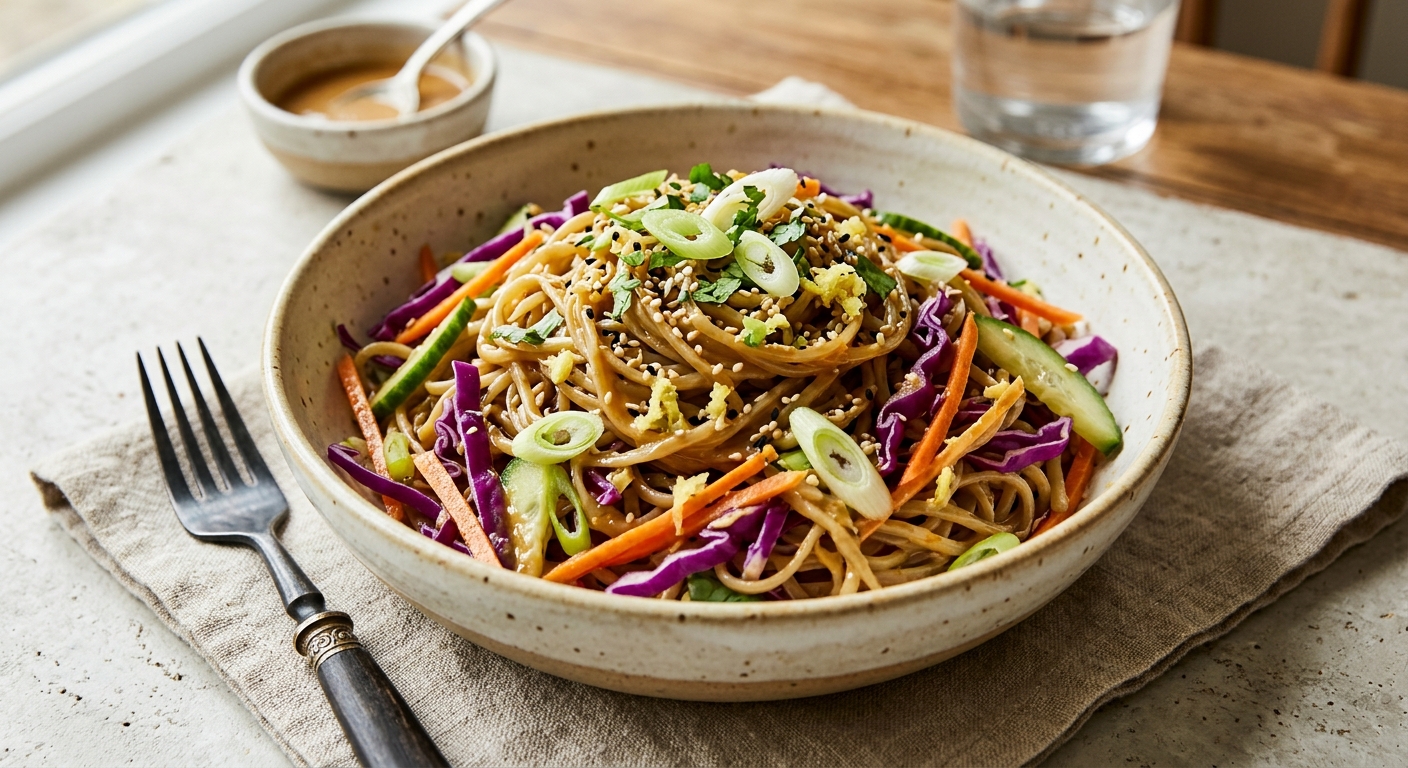
Kelp noodles occupy a fascinating intersection of ancient sea wisdom and modern nutritional science. Harvested from brown algae (Macrocystis pyrifera and related species), these translucent, glass-like strands are virtually calorie-free yet carry one of the most concentrated mineral payloads found in any whole food. Unlike spirulina powders or iodine supplements, kelp noodles deliver their nutrients in a food matrix that also supplies fucoidan, a sulfated polysaccharide with emerging evidence for metabolic and immune support. Paired with a sesame ginger dressing built on tahini, tamari, rice vinegar, and fresh ginger, this dish transforms a humble sea vegetable into something genuinely crave-worthy.
The sesame ginger dressing is the culinary engine here. Tahini contributes creaminess and a noteworthy dose of calcium and copper, while fresh ginger root adds gingerols, the bioactive compounds responsible for ginger’s anti-inflammatory and thermogenic reputation. Shredded purple cabbage and matchstick carrots add crunch, beta-carotene, and anthocyanins, turning what might have been a one-note mineral delivery system into a vibrant, texturally layered bowl. Toasted sesame seeds and sliced scallions finish the dish with aromatic lift and additional lignans from the sesame.
This recipe is calibrated so that a single serving provides at least 300mcg of iodine, meeting the full RDI for most adults, while keeping sodium in check through the careful use of low-sodium tamari and rice vinegar rather than high-sodium soy sauces. Whether you are supporting thyroid function, seeking a low-calorie mineral-dense meal, or simply curious about sea vegetables, this bowl delivers on every front without asking you to tolerate anything that tastes like the bottom of a tide pool.
4
servings
Ingredients
- 340 gkelp noodles (one standard bag), rinsed under cold water
- 2 tspbaking soda (for softening kelp noodles)
- 200 gpurple cabbage, finely shredded
- 2 mediumcarrots, cut into thin matchsticks (about 160g)
- 4 stalksscallions, thinly sliced on the bias
- 1 mediumcucumber, halved lengthwise and thinly sliced (about 180g)
- 30 gfresh ginger root, peeled and finely grated
- 3 clovesgarlic, minced
- 80 gtahini (sesame paste), well stirred
- 3 tbsplow-sodium tamari or coconut aminos
- 3 tbspunseasoned rice vinegar
- 1 tbsptoasted sesame oil
- 1 tbsppure maple syrup or honey
- 1 tspred chili flakes or gochugaru, or more to taste
- 2 tbsptoasted sesame seeds (white or mixed)
- 2 tbspextra-virgin olive oil or Avocado Oil100% Pure Avocado Oil (for stovetop and oven methods)
- 15 gfresh cilantro leaves, roughly torn
- 60 mlwarm water (for dressing consistency)
- —Colima Sea SaltMicroplastic Free Salt and white pepper to taste
Instructions
Click on an item below to shop for the recommended items for this recipe on Amazon.
As an Amazon Associate, we earn from qualifying purchases.
- Place the rinsed kelp noodles in a large bowl. Fill with warm water, add the baking soda, and stir briefly. Let soak for 15 minutes, gently massaging the noodles every 5 minutes. The baking soda raises the pH and breaks down the sodium alginate in the noodles, transforming them from crunchy to silky. Drain and rinse thoroughly under cold water, then use kitchen scissors to cut the noodle mass into roughly 15cm lengths for easier tossing.
- While the noodles soak, prepare the sesame ginger dressing. In a medium bowl, whisk together the tahini, tamari, rice vinegar, toasted sesame oil, maple syrup, grated ginger, minced garlic, and red chili flakes. Add warm water one tablespoon at a time, whisking until the dressing is smooth, glossy, and pourable but still thick enough to coat a spoon. Taste and adjust with a pinch of sea salt or an extra splash of rice vinegar if needed.
- Heat olive oil in a large skillet or wok over medium heat. Add the shredded cabbage and carrot matchsticks and stir-fry for 2 to 3 minutes until they begin to soften slightly at the edges while retaining most of their crunch. You are looking for just enough heat to take the raw edge off without wilting them fully.
- Add the drained kelp noodles directly to the skillet. Pour approximately two-thirds of the sesame ginger dressing over the noodles and vegetables. Toss everything continuously with tongs over medium-low heat for 2 minutes until the noodles are warmed through and well coated. The dressing will thicken as it heats, so add a splash of warm water if it tightens too much.
- Remove from heat. Add the sliced cucumber, most of the scallions, and the cilantro leaves, tossing gently so the cucumber stays cool and crisp against the warm noodles. Divide among four bowls, drizzle with the remaining dressing, and finish with toasted sesame seeds and the reserved scallion greens. Serve immediately.
- Do not soak the kelp noodles yet. Instead, combine the shredded cabbage, carrot matchsticks, grated ginger, and minced garlic directly in the slow cooker insert. In a separate bowl, whisk together the tahini, tamari, rice vinegar, toasted sesame oil, maple syrup, chili flakes, and 60ml warm water until smooth. Pour this dressing over the vegetables and stir to coat evenly.
- Cover and cook on Low for 1 hour 45 minutes. The cabbage will become tender and silky, absorbing the sesame and ginger flavors deeply in a way stovetop methods cannot replicate. Check at the halfway point and stir once; if the dressing looks too thick or dry against the walls of the insert, add 2 to 3 tablespoons of warm water.
- About 20 minutes before serving, prepare the kelp noodles. Place the rinsed noodles in a large bowl, cover with warm water, add the baking soda, and soak for 15 minutes, massaging periodically. Drain, rinse well, and cut into 15cm lengths with kitchen scissors.
- Add the softened kelp noodles to the slow cooker insert and fold them gently into the braised vegetable mixture. Replace the lid and cook on Low for a final 15 minutes, just enough to warm the noodles through and let them absorb the surrounding juices without losing their texture.
- Turn off the slow cooker. Fold in the sliced cucumber and cilantro leaves. The residual heat is sufficient to take the chill off the cucumber without cooking it. Divide into bowls, scatter toasted sesame seeds and scallions over the top, and finish with a small drizzle of toasted sesame oil for aroma.
- Set the Instant Pot or pressure cooker to the Saute function on medium heat. Add the olive oil and, once shimmering, add the minced garlic and grated ginger. Saute for 90 seconds, stirring constantly, until fragrant and just beginning to turn golden. This step builds aromatic depth that slow cooking alone cannot develop in the short cook window.
- Add the shredded cabbage and carrot matchsticks to the pot and stir to coat in the aromatics. Pour in the tamari, rice vinegar, maple syrup, and chili flakes, then add 80ml of water. Stir well. The liquid is necessary to reach safe pressure and will form the braising base that the dressing will be built on.
- Secure the lid, set the valve to Sealing, and pressure cook on High for 3 minutes. While the pot comes to pressure and cooks, prepare the kelp noodles: rinse them, place in a bowl with warm water and baking soda, and soak for 10 to 12 minutes, massaging to soften. Drain, rinse, and cut to length.
- When the cook time ends, perform a quick pressure release by carefully switching the valve to Venting. Open the lid and stir the vegetables. Whisk the tahini and toasted sesame oil into the liquid in the pot directly, creating a rich sauce. Set the Instant Pot to Saute on Low and add the kelp noodles, folding them into the sauced vegetables for 2 minutes until just warmed through.
- Switch off the Saute function. Fold in the sliced cucumber and cilantro. Serve immediately in warmed bowls, topped with toasted sesame seeds and scallions. The pressure-cooked version will have a noticeably more concentrated, deeply savory sauce compared to the other methods.
- Preheat the oven to 200C (400F) with a large rimmed baking sheet inside, allowing it to heat for at least 10 minutes. A hot baking sheet creates immediate searing contact, encouraging caramelization on the vegetables rather than steaming. Meanwhile, prepare the kelp noodles: soak in warm water with baking soda for 15 minutes, drain, rinse, and cut to length.
- In a large bowl, toss the shredded cabbage and carrot matchsticks with the olive oil, half the tamari, minced garlic, and a pinch of sea salt. Spread in a single layer on the preheated baking sheet, making sure the pieces are not overlapping. Roast for 18 to 22 minutes, turning once halfway through, until the cabbage edges are charred and the carrots are tender with caramelized spots.
- While the vegetables roast, make the full sesame ginger dressing in a medium bowl: whisk together the tahini, remaining tamari, rice vinegar, toasted sesame oil, maple syrup, grated ginger, chili flakes, and warm water until smooth and pourable. Taste and adjust seasoning.
- When the vegetables come out of the oven, immediately place the drained kelp noodles in the still-hot baking sheet alongside them. Pour two-thirds of the dressing over everything and toss with tongs directly on the pan, using the residual heat of the pan to warm the noodles and marry the flavors without returning the pan to the oven.
- Transfer to serving bowls and add the sliced cucumber and cilantro, which will contrast beautifully against the smoky, charred vegetables. Top with toasted sesame seeds and scallions. Drizzle the remaining dressing over each bowl and serve while the roasted components are still warm.
Nutrition Breakdown
Per 1 serving (makes 4)
Vitamins & Minerals
% Daily Value based on a 2,000 calorie diet (FDA reference)
🧬 Essential Amino Acids
% of recommended daily intake (RDA) per serving
🛡 Antioxidant Profile
The Nutrition Science
Iodine is the nutrient most people associate exclusively with table salt, but kelp is one of the most bioavailable natural sources on earth. Brown seaweeds like kelp concentrate iodine from seawater at levels 20,000 times higher than found in terrestrial plants, incorporating it organically into their cell structures. The thyroid gland requires iodine to synthesize triiodothyronine (T3) and thyroxine (T4), hormones that govern basal metabolic rate, thermogenesis, protein synthesis, and nervous system development. Subclinical iodine deficiency is more common than many realize, particularly in landlocked populations who do not regularly consume seafood or iodized salt, and the metabolic consequences include sluggish thyroid function, fatigue, and difficulty with weight regulation. A single serving of this dish supplies more than twice the RDI of 150mcg, making it one of the most efficient dietary iodine interventions possible.
The copper and manganese in this recipe deserve particular attention for their roles in metabolic enzymatic function. Copper is a cofactor for cytochrome c oxidase, the terminal enzyme in the mitochondrial electron transport chain, meaning it is directly involved in the cellular machinery that produces ATP from food. Manganese is a required cofactor for manganese superoxide dismutase (MnSOD), the primary mitochondrial antioxidant enzyme. Tahini and sesame seeds are among the densest non-animal sources of both minerals, which is one reason this dressing punches so far above its caloric weight. The combination of iodine from kelp with copper and manganese from sesame creates a uniquely synergistic profile for supporting mitochondrial and thyroid metabolic pathways simultaneously.
The fucoidan content of kelp noodles adds a dimension not reflected in standard nutritional databases. Fucoidan is a class of sulfated polysaccharides found almost exclusively in brown algae, and preclinical and early clinical research has associated it with inhibition of inflammatory NF-kB signaling, modulation of the gut microbiome toward increased short-chain fatty acid production, and potential support for healthy glycemic response by slowing carbohydrate digestion. While fucoidan research is still maturing, the evidence is sufficiently compelling that several clinical trials are ongoing. Consuming kelp noodles as a whole food rather than a purified extract means you are obtaining fucoidan alongside the full mineral matrix and trace element context in which it naturally occurs, which may be important for its bioactivity.
Pro Tips
- Do not skip the baking soda soak for kelp noodles. Straight from the package, kelp noodles are crunchy and almost plastic-like in texture. The alkaline soak is non-negotiable for achieving the silky, tender bite this recipe requires, and 15 minutes of active massaging produces noticeably better results than a passive soak.
- Kelp iodine content varies significantly by species, harvest location, and processing method. Look for noodles made from Sea Tangle or verified Pacific kelp and avoid brands that do not disclose seaweed species on the label. If you have a diagnosed thyroid condition or take thyroid medication, consult your doctor before consuming kelp regularly as both excess and deficiency of iodine can affect thyroid function.
- Make the sesame ginger dressing up to five days ahead and store in an airtight jar in the refrigerator. The tahini will thicken when cold, so whisk in a teaspoon of warm water before using. The dressing also works beautifully as a sauce for roasted sweet potato, steamed broccoli, or grain bowls.

This looks absolutely wonderful, and I’m so glad to see kelp getting the spotlight for iodine support. I’ve been experimenting with kelp noodles for about two years now and noticed they don’t spike my inflammation markers the way regular pasta does, which is huge for my RA management. The sesame ginger combo is perfect too, since ginger has been one of my most reliable anti-inflammatory allies alongside the turmeric I use constantly. I’m definitely making this tonight and will probably add some wild-caught salmon on top to amp up the omega-3s even more. Thank you for putting together such a nutrient-dense recipe!
This is such a beautiful mineral-dense dish, and I love that you’re highlighting kelp’s thyroid support through iodine. I’ve found that when I add a pinch of black pepper to sesame ginger dressings like this one, it really amplifies the anti-inflammatory potential of the ginger while supporting overall nutrient absorption, in a way that feels grounding and warming even on warmer days. The combination of sesame with ginger is so classical in Ayurveda for digestive fire and circulation, and pairing it with kelp’s iodine creates this really gentle but powerful support for metabolism and thyroid function.
this is such a thoughtful breakdown of the anti-inflammatory angle. ive been cautious with kelp noodles during flares bc the texture can be tricky, but when im in remission theyve been way gentler on my gut than regular pasta. the black pepper thing is interesting – im curious if you find it still feels gentle on digestion or if it can be irritating depending on the day? ive had black pepper trigger inflammation before so im always testing my tolerance, but the idea of it boosting nutrient absorption with the ginger is compelling enough that id want to try it carefully.