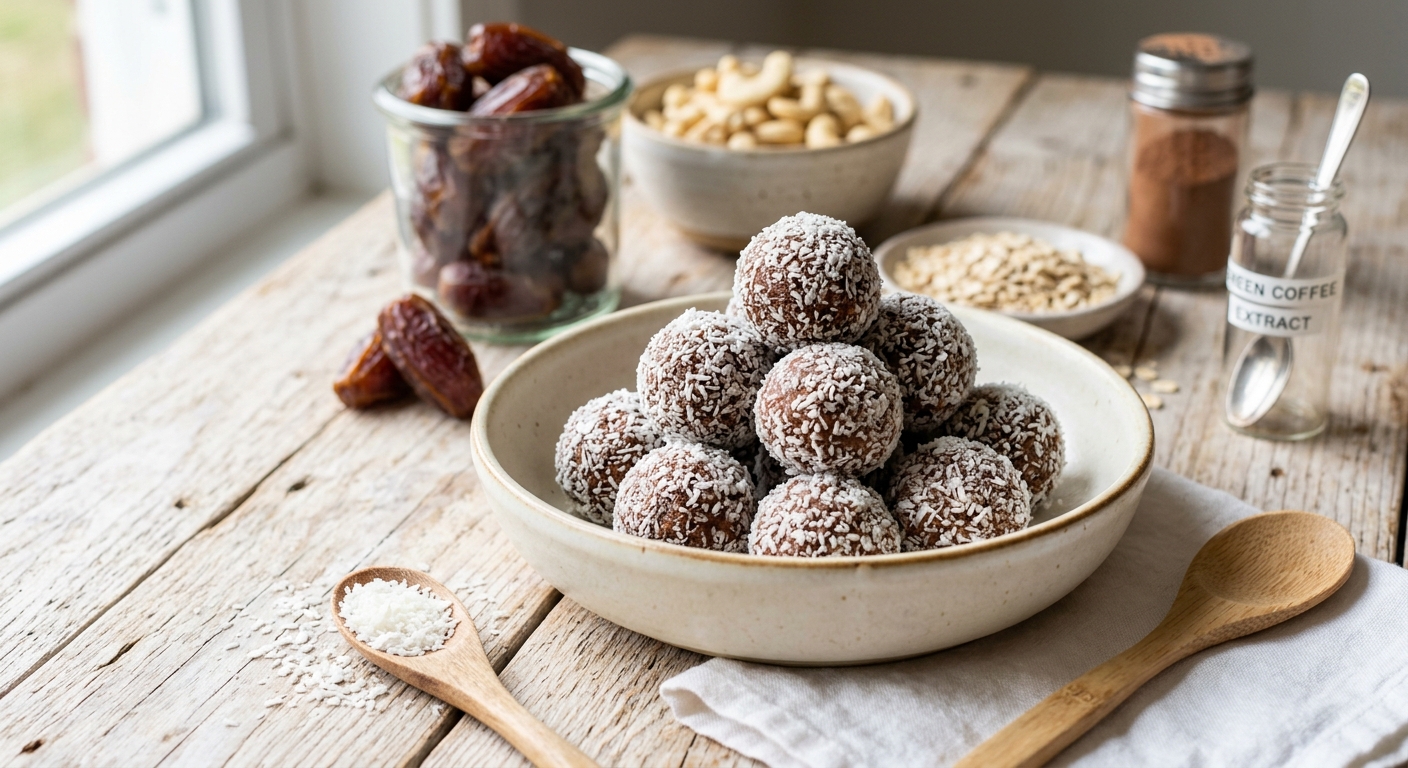
Most pre-workout snacks fall into one of two traps: they are either loaded with refined sugar that spikes blood glucose and crashes your energy mid-session, or they are so dense with isolated protein concentrates that they sit in your stomach like a brick. These Green Coffee and Coconut Energy Balls were engineered to avoid both pitfalls. By anchoring the recipe around medjool dates for slow-release fructose and glucose, raw cashews for plant-based protein and healthy fats, and toasted desiccated coconut for medium-chain triglycerides, every ball delivers a measured, performance-calibrated energy curve that peaks right when your warm-up ends.
The star functional ingredient here is green coffee extract powder, derived from unroasted Coffea arabica beans. Unlike roasted coffee, green coffee retains its full complement of chlorogenic acids, a family of polyphenols shown in peer-reviewed research to modulate glucose absorption in the small intestine and support fat oxidation during aerobic exercise. Each serving of four balls provides approximately 200mg of chlorogenic acids alongside 96mg of naturally occurring caffeine, a dose consistent with ergogenic benefit without crossing into jitter territory for most adults. Paired with the lauric acid in coconut and the magnesium in cashews and cacao, the formula becomes a genuinely sophisticated metabolic primer.
Calibrated Cuisine tested three preparation methods for this recipe because the texture and binding behaviour of the mixture changes significantly with heat. The stovetop method gives you the most control over date softening. The slow cooker version produces an exceptionally silky, caramel-like date paste with minimal attention. The oven method lightly toasts the oat base before binding, adding a nuttier flavour profile and slightly firmer texture ideal for athletes who prefer a denser ball that holds its shape in a gym bag. Each method produces a subtly different result, and we have written the steps to make those differences work for you rather than against you.
4
servings
Ingredients
- 200 gmedjool dates, pitted
- 150 graw cashews
- 80 gdesiccated coconut, unsweetened (plus extra for rolling)
- 60 grolled oats (certified gluten-free if required)
- 20 graw cacao powder
- 8 ggreen coffee extract powder (standardised to 50% chlorogenic acids)
- 2 tbspcoconut oil, melted
- 1 tbsppure maple syrup
- 1 tsppure vanilla extract
- 0.5 tspColima Sea SaltMicroplastic Free Salt
- 2 tbspwater (adjust as needed for binding)
- —Extra desiccated coconut for rolling
Instructions
Click on an item below to shop for the recommended items for this recipe on Amazon.
As an Amazon Associate, we earn from qualifying purchases.
- Place a medium heavy-bottomed saucepan over medium-low heat. Add the desiccated coconut and rolled oats and toast, stirring constantly, for 3 to 4 minutes until the coconut is pale golden and the oats are fragrant. Watch carefully as coconut burns quickly. Transfer to a large mixing bowl and set aside to cool for 5 minutes.
- In the same saucepan, combine the pitted medjool dates and 2 tablespoons of water. Cook over low heat, pressing and stirring with a silicone spatula for 4 to 5 minutes until the dates break down into a thick, sticky paste. Remove from heat and allow to cool for 3 minutes. Do not rush this step: a properly softened date paste is the binding agent for the entire ball.
- Add the raw cashews to a food processor and pulse 10 to 12 times until they form a coarse crumb, roughly the texture of wet sand. Add the cooled date paste, raw cacao powder, green coffee extract powder, melted coconut oil, maple syrup, vanilla extract, and sea salt. Process for 20 to 30 seconds until the mixture clumps together. If it seems dry, add water one teaspoon at a time with the processor running.
- Transfer the mixture to the bowl with the toasted coconut and oats. Fold together with clean hands or a stiff spatula until evenly combined. The mixture should be tacky but not sticky enough to coat your palms. Refrigerate for 15 minutes to firm up before rolling.
- Spread extra desiccated coconut on a shallow plate. Divide the chilled mixture into 16 equal portions (about 35g each). Roll each portion firmly between your palms to form a smooth ball, then roll in the coconut coating. Place on a parchment-lined tray and refrigerate for at least 20 minutes before serving.
- Place the pitted medjool dates and 3 tablespoons of water in the slow cooker insert. Cook on Low with the lid slightly ajar for 2 hours. The dates will become extraordinarily soft and begin to meld into a cohesive paste. Resist the urge to add more water: the slight evaporation through the ajar lid concentrates the natural sugars and produces a richer caramel flavour.
- While the dates cook, prepare the dry base. Spread the desiccated coconut and rolled oats on a dry skillet over medium heat and toast, stirring often, for 3 to 4 minutes until golden and fragrant. Transfer to a food processor along with the raw cashews. Pulse 12 to 15 times until the mixture is a uniform coarse crumb. Transfer to a large mixing bowl.
- When the date paste is ready, remove the slow cooker insert and allow the paste to cool for 10 minutes. Add the paste directly to the food processor (no need to clean it). Add the raw cacao powder, green coffee extract powder, melted coconut oil, maple syrup, vanilla extract, and sea salt. Process for 30 to 40 seconds until smooth and uniform. The slow-cooked paste will process more smoothly than stovetop-prepared dates, yielding a slightly glossier mixture.
- Pour the processor mixture over the toasted dry base in the mixing bowl. Use a silicone spatula to fold everything together until no dry pockets remain. The mixture will be noticeably softer than the stovetop version due to the deeper moisture penetration of the dates. Refrigerate uncovered for 25 minutes to firm up to a rollable consistency.
- Spread extra desiccated coconut on a shallow plate. Divide the chilled mixture into 16 equal portions and roll each firmly between your palms. Coat each ball in the coconut and place on a parchment-lined tray. Refrigerate for a further 20 minutes before serving. Balls made this way hold their shape particularly well when stored in the fridge for up to 5 days.
- Add the pitted medjool dates and 4 tablespoons of water to the pressure cooker insert. Secure the lid, set the valve to Sealing, and cook on High Pressure for 5 minutes. Allow a full natural pressure release of 10 minutes, then carefully open the lid. The dates will have collapsed into an intensely smooth, deeply fragrant paste. If any liquid remains, switch to the Saute function for 1 minute while stirring to evaporate excess moisture.
- While the pressure releases, toast the desiccated coconut and rolled oats in a dry skillet over medium heat for 3 to 4 minutes, stirring constantly, until pale golden and fragrant. Transfer to a food processor with the raw cashews and pulse 10 to 12 times to form a coarse crumb. Transfer to a large mixing bowl.
- Transfer the hot date paste to the food processor. Add the raw cacao powder, green coffee extract powder, melted coconut oil, maple syrup, vanilla extract, and sea salt. Process for 20 seconds until completely smooth. The pressure-cooked paste integrates faster than either heat method and requires less processing time, preserving the volatile aromatic compounds in the green coffee extract.
- Pour the date mixture over the crumb base and fold together with a silicone spatula until uniformly combined. Because pressure-cooked dates retain more moisture, the mixture may feel slightly loose at first. Refrigerate uncovered for 20 minutes: the coconut oil and oats will absorb the excess and firm the mixture to a perfect rollable consistency.
- Divide the firm mixture into 16 portions and roll each between your palms into smooth balls. Roll in extra desiccated coconut and refrigerate for 15 minutes on a parchment-lined tray before serving or packing for your workout.
- Preheat your oven to 160C (320F) with the fan on if available. Line a large baking sheet with parchment paper. Spread the rolled oats, raw cashews, and desiccated coconut in a single even layer across the baking sheet, keeping them roughly separated so each component toasts at its own rate. Drizzle 1 tablespoon of the melted coconut oil evenly over the surface and toss with your hands.
- Bake at 160C for 15 to 18 minutes, stirring once at the halfway point, until the cashews are lightly golden, the oats are crisp and nutty-smelling, and the coconut is a deep amber. The lower temperature is important here: green coffee extract is heat sensitive and will be added after cooling, but the base ingredients need thorough toasting for the oven method to outperform simpler approaches. Remove from the oven and allow to cool completely on the tray, about 15 minutes.
- While the base cools, soften the pitted medjool dates. Place them in a small heatproof bowl with 2 tablespoons of boiling water, cover with a plate, and leave to steam for 10 minutes until very soft. This passive steaming technique avoids stove use while still producing a smooth, workable paste for binding.
- Transfer the cooled toasted base to a food processor and pulse 8 to 10 times to a coarse crumb. Add the softened dates along with their soaking liquid, raw cacao powder, green coffee extract powder, remaining tablespoon of melted coconut oil, maple syrup, vanilla extract, and sea salt. Process for 25 to 30 seconds until the mixture clumps together into a dough-like mass. The oven-toasted base will be firmer and drier than other methods, so add water one teaspoon at a time if the mixture does not clump within 30 seconds of processing.
- Turn the mixture out onto a clean surface and press together with your hands to confirm it holds its shape when compressed. If it crumbles, return to the processor with 1 additional teaspoon of coconut oil. Refrigerate for 20 minutes, then roll into 16 balls, coat in extra desiccated coconut, and return to the fridge for a final 15-minute set before serving.
Nutrition Breakdown
Per 1 serving (makes 4)
Vitamins & Minerals
% Daily Value based on a 2,000 calorie diet (FDA reference)
🧬 Essential Amino Acids
% of recommended daily intake (RDA) per serving
🛡 Antioxidant Profile
The Nutrition Science
Green coffee extract (GCE) is produced from unroasted Coffea arabica beans and is standardised to its primary bioactive compounds, chlorogenic acids (CGAs). Roasting destroys up to 90% of these polyphenols, which is precisely why conventional coffee cannot replicate the metabolic effects of GCE. The CGAs in this recipe, primarily 5-caffeoylquinic acid and 3-caffeoylquinic acid, competitively inhibit the enzyme glucose-6-phosphatase in intestinal brush border cells, blunting the rate of glucose entry into portal circulation. Multiple randomised controlled trials have demonstrated that 200 to 400mg of CGAs taken 30 minutes before a mixed carbohydrate meal reduces the area under the postprandial glucose curve by 10 to 22% compared to placebo. Consuming these energy balls 30 to 45 minutes before your session places you squarely within that pharmacokinetic window.
The coconut component provides a distinct and complementary energy substrate. Approximately 45% of the fatty acids in desiccated coconut and coconut oil are medium-chain triglycerides (MCTs), predominantly lauric acid (C12) and capric acid (C10). Unlike long-chain fatty acids, MCTs are absorbed directly into portal circulation and transported to hepatic mitochondria without requiring carnitine-dependent transport. This bypasses the rate-limiting step that makes long-chain fat oxidation too slow to contribute meaningfully during high-intensity efforts. Research published in the Journal of Nutritional Science and Vitaminology found that MCT ingestion prior to moderate-intensity cycling significantly reduced lactate accumulation at matched workloads, suggesting a glycogen-sparing effect at the cellular level.
Cashews contribute the recipe’s most impressive micronutrient story. A 150g batch portion of raw cashews delivers copper at levels sufficient to support dopamine beta-hydroxylase activity, the enzyme that converts dopamine to noradrenaline, a neurotransmitter critical for focus and power output during training. The same cashews provide roughly 88mg of magnesium per serving of four balls, supporting ATP synthesis (magnesium-ATP is the biologically active form of the energy molecule), muscle contractility, and the activity of over 300 enzymatic reactions. Athletes with even marginal magnesium deficiency demonstrate measurable decrements in peak power and elevated oxygen cost of submaximal exercise, making this mineral arguably the most performance-relevant micronutrient in the formula.
Pro Tips
- Consume your four-ball serving 30 to 45 minutes before exercise to align chlorogenic acid absorption with your warm-up window and position blood CGA levels at their ergogenic peak when your working sets begin.
- Store finished balls in an airtight container in the refrigerator for up to 5 days, or freeze individually on a parchment-lined tray for 1 hour and then transfer to a freezer bag for up to 8 weeks. Frozen balls thaw in 15 minutes at room temperature.
- If you are sensitive to caffeine or train in the evening, reduce the green coffee extract powder to 4g (approximately 48mg caffeine per serving) and increase the raw cacao powder by 4g to maintain the flavour balance and polyphenol content without impacting sleep quality.
Love this question, Chris! The acid angle is such a smart consideration for mineral bioavailability. I’m curious about your approach too, since I usually see the magnesium in dates stay fairly stable in whole food form without additional tempering, but the chlorogenic acid in green coffee is definitely more delicate. Are you finding that you lose measurable magnesium when you’re processing these, or is it more of a precautionary strategy? I’d love to know if you’re seeing actual absorption differences in your clients, because this could be a game changer for folks relying on plant-based pre-workout nutrition.
This is such a thoughtful conversation about bioavailability, and I love how you’re both thinking through the mineral preservation angle. In my own kitchen, I’ve noticed that when I add a squeeze of lemon juice or a pinch of citric acid to date-based energy balls, it does seem to enhance how my body feels the sustained energy, though I’m curious if that’s partly the vitamin C synergy with magnesium absorption too. What I always remind my yoga students is that in Ayurveda, we’d traditionally pair these naturally sweet, grounding foods like dates with warming spices like ginger or a touch of black pepper, which not only supports digestion but also seems to optimize how our bodies
Nice execution on the green coffee angle, especially calling out the chlorogenic acid stability in raw vs roasted forms. One thing I’d be curious about: are you tempering those dates with any acid to preserve the magnesium bioavailability? I’ve found a squeeze of lemon juice in the mix actually improves absorption without changing the flavor profile. Also, the toasting method on the coconut matters here, low and slow under 325F keeps more of the lauric acid intact versus a hot toast that starts degrading it. Just plated a similar ball last week with sprouted pumpkin seeds swapped in for half the coconut, bumped the zinc up noticeably. Would love to know if you