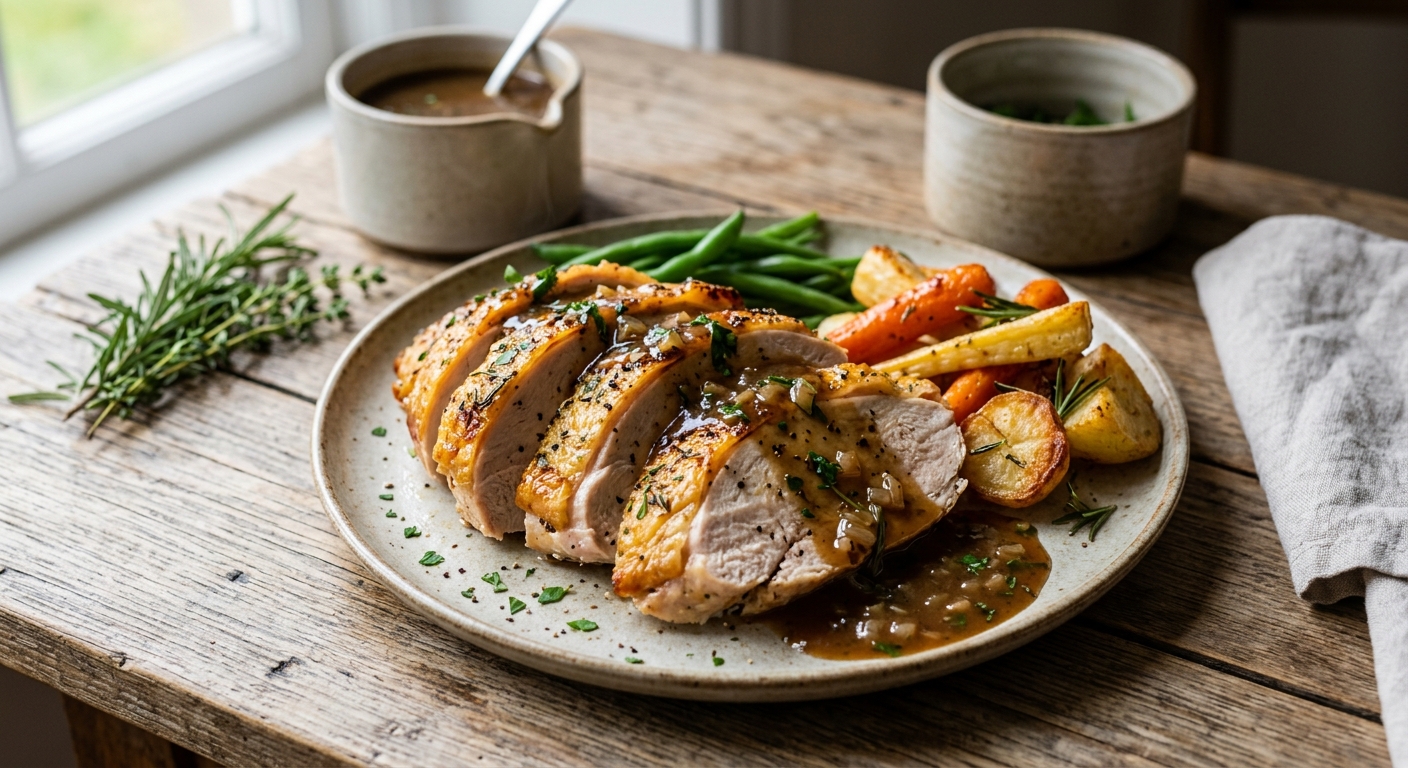
Turkey breast has long lived in the shadow of the whole holiday bird, pulled out once a year and forgotten the rest of the time. That is a genuine nutritional tragedy. A 170g serving of boneless turkey breast packs nearly half your daily zinc, over 100% of your niacin needs, and a remarkable hit of vitamins B6 and B12, all wrapped in lean, satisfying protein that clocks in under 300 calories. This recipe rescues turkey breast from its annual cameo and gives it the weeknight spotlight it deserves.
The herb gravy is not an afterthought. Built on the fond left behind by searing or roasting, and thickened with a simple roux of butter and flour, it carries its own nutritional weight. Chicken or turkey stock adds collagen-derived amino acids, while fresh thyme, rosemary, and parsley contribute flavonoids and small but meaningful amounts of vitamin K and iron. Together, the breast and gravy form a dish that is calibrated, not just garnished, to meet real dietary targets.
At Calibrated Cuisine we put four genuinely different cooking methods to work here: a classic oven roast for that deep mahogany crust, a stovetop sear-and-simmer for weeknight speed, a slow cooker low-and-slow braise for hands-off tenderness, and a pressure cooker sprint when time is short. Every method produces a slightly different texture and flavor profile, and each set of steps is written specifically for that method so you are never left translating oven instructions into slow-cooker guesswork.
4
servings
Ingredients
- 700 gboneless, skin-on turkey breast
- 2 tbspunsalted butter
- 1 tbspextra-virgin olive oil
- 1 mediumyellow onion, finely diced
- 3 clovesgarlic, minced
- 2 sprigsfresh rosemary
- 4 sprigsfresh thyme
- 2 tbspfresh flat-leaf parsley, finely chopped
- 2 tbspall-purpose flour
- 480 mllow-sodium turkey or chicken stock
- 60 mldry white wine
- 1 tspDijon mustard
- 1 tspWorcestershire sauce
- 1 tspsmoked paprika
- 0.5 tspdried sage
- 1 mediumcarrot, roughly chopped
- 2 stalkscelery, roughly chopped
- —Colima Sea SaltMicroplastic Free Salt and freshly ground black pepper to taste
Instructions
Click on an item below to shop for the recommended items for this recipe on Amazon.
As an Amazon Associate, we earn from qualifying purchases.
- Pat the turkey breast completely dry with paper towels. This is non-negotiable for a proper sear. Season generously on all sides with salt, pepper, smoked paprika, and dried sage, pressing the spices gently into the skin.
- Heat a large, heavy-bottomed skillet or cast iron pan over medium-high heat. Add the olive oil and heat until shimmering. Place the turkey breast skin-side down and sear without moving it for 5 to 6 minutes until the skin is deeply golden and releases naturally from the pan. Flip and sear the underside for 3 minutes. Transfer the turkey to a plate.
- Reduce heat to medium. Add 1 tablespoon of the butter to the same pan. Once melted, add the diced onion, carrot, and celery. Cook, stirring frequently and scraping up the browned bits from the bottom of the pan, for 5 minutes until the onion is softened and translucent. Add the minced garlic and cook for 1 more minute.
- Pour in the white wine and let it bubble vigorously for 90 seconds, continuing to scrape the fond off the base. Add the rosemary sprigs, thyme sprigs, Worcestershire sauce, and Dijon mustard. Stir to combine, then pour in 360ml of the stock. Nestle the seared turkey breast skin-side up back into the pan. The liquid should come halfway up the sides of the breast but not cover the skin.
- Cover the pan with a tight-fitting lid, reduce heat to low, and cook for 20 to 25 minutes until an instant-read thermometer inserted into the thickest part reads 74 degrees C (165 degrees F). Transfer the turkey to a cutting board, tent loosely with foil, and rest for 10 minutes.
- While the turkey rests, remove and discard the herb sprigs. In a small saucepan, melt the remaining 1 tablespoon of butter over medium heat. Whisk in the flour and cook for 1 minute to form a roux. Gradually ladle the pan liquid through a fine-mesh strainer into the roux, whisking constantly. Add the remaining stock as needed to reach your preferred consistency. Simmer for 3 to 4 minutes until thickened and glossy. Stir in the chopped parsley and adjust seasoning.
- Slice the turkey breast against the grain into 1cm medallions, arrange on a warm serving platter, and pour the herb gravy generously over the top. Serve immediately.
- Pat the turkey breast dry and season all over with salt, pepper, smoked paprika, and dried sage. Heat the olive oil in a skillet over high heat and sear the turkey breast skin-side down for 4 to 5 minutes until golden. This step builds the flavor foundation for the gravy and is worth the extra pan. Transfer the seared breast to the slow cooker insert, skin-side up.
- Without washing the skillet, reduce heat to medium and add 1 tablespoon of butter. Saute the onion, carrot, and celery for 4 minutes. Add the garlic and cook for 1 minute. Pour in the white wine and scrape the skillet bottom thoroughly for 1 minute. Stir in the Dijon mustard, Worcestershire sauce, rosemary, and thyme. Pour this entire mixture over and around the turkey in the slow cooker.
- Pour 360ml of the stock around the turkey (not over the skin, to help it stay as intact as possible). Tuck the herb sprigs alongside the breast. Place the lid on securely and cook on Low for 4 to 5 hours. The turkey is done when it reaches an internal temperature of 74 degrees C (165 degrees F). Avoid lifting the lid before the 4-hour mark, as each lift adds 15 to 20 minutes of cooking time.
- Carefully transfer the turkey breast to a cutting board, tent with foil, and rest for 10 minutes. Strain the braising liquid from the slow cooker through a fine-mesh strainer into a medium saucepan, pressing the solids to extract maximum flavor. Discard the solids.
- In a separate small skillet, melt the remaining 1 tablespoon of butter over medium heat, whisk in the flour, and cook for 1 minute. Gradually whisk the strained braising liquid into the roux, adding extra stock to reach your desired consistency. Simmer for 4 to 5 minutes until the gravy coats the back of a spoon. Stir in the chopped parsley, taste, and adjust seasoning with salt and pepper.
- Slice or pull the turkey breast and serve with the herb gravy spooned generously over the top.
- Pat the turkey breast thoroughly dry and season all over with salt, pepper, smoked paprika, and dried sage. Set the Instant Pot or electric pressure cooker to the Saute function on High. Add the olive oil and, once hot, sear the turkey breast skin-side down for 4 to 5 minutes until deep golden. Sear the underside for 2 minutes. Use tongs to transfer the breast to a plate.
- With the Saute function still on, add 1 tablespoon of the butter to the pot. Add the diced onion, carrot, and celery. Cook, stirring and scraping the browned fond from the bottom of the pot, for 4 minutes. Scraping the bottom thoroughly here is critical: any stuck bits left behind can trigger the burn sensor and halt pressurization. Add the garlic and cook for 1 minute.
- Pour in the white wine and let it bubble for 60 seconds, deglazing the pot completely. Add the Dijon mustard, Worcestershire sauce, rosemary sprigs, and thyme sprigs. Pour in 360ml of the stock. Place the trivet that came with your cooker into the pot and set the turkey breast skin-side up on top of the trivet. This lifts it above the liquid, encouraging gentle steam cooking rather than full submersion.
- Cancel the Saute function. Secure the lid and set the vent to Sealing. Cook on Manual High Pressure for 22 minutes. When the cycle ends, allow natural pressure release for 10 to 12 minutes, then carefully turn the vent to release any remaining pressure. The internal temperature should read 74 degrees C (165 degrees F). Transfer the breast to a cutting board and tent with foil to rest for 8 minutes.
- Switch the Instant Pot back to Saute on Medium. Remove the trivet and herb sprigs. In a small bowl, whisk the remaining 1 tablespoon of softened butter with the flour to form a smooth beurre manie. Drop small pieces of it into the simmering pot liquid while whisking constantly. Simmer for 3 to 4 minutes, whisking, until the gravy thickens. Stir in the chopped parsley, season to taste, and serve over sliced turkey.
- Preheat your oven to 190 degrees C (375 degrees F) with the rack positioned in the center. Pat the turkey breast dry and season all over with salt, pepper, smoked paprika, and dried sage. Using your fingers, gently separate the skin from the breast meat and spread 1 tablespoon of the softened butter directly on the meat underneath the skin. This bastes the breast from within during roasting.
- Heat an oven-safe skillet or Dutch oven over high heat on the stovetop. Add the olive oil and sear the turkey breast skin-side down for 4 to 5 minutes until deeply golden. Transfer the turkey to a small roasting rack set inside a roasting pan or the same Dutch oven. Scatter the onion, carrot, celery, and garlic around the base of the pan. Tuck the rosemary and thyme sprigs among the vegetables.
- Mix the white wine, 240ml of the stock, Dijon mustard, and Worcestershire sauce together and pour the mixture into the base of the pan beneath the rack. The liquid should not touch the turkey. Roast uncovered in the preheated oven for 55 to 65 minutes, basting with the pan juices every 20 minutes using a bulb baster or large spoon. The turkey is done when an instant-read thermometer reads 74 degrees C (165 degrees F) at the thickest point.
- Transfer the turkey breast to a cutting board and tent loosely with foil. Rest for 12 to 15 minutes; this resting time matters more in oven roasting because the thicker heat gradient needs time to equalize throughout the meat.
- While the turkey rests, pour all of the pan drippings through a fine-mesh strainer into a measuring jug, pressing the roasted vegetables through a sieve to add their pulp and flavor. Skim off excess fat from the surface. In the roasting pan set over medium heat on the stovetop, melt the remaining 1 tablespoon of butter and whisk in the flour. Cook for 1 minute, then gradually whisk in the strained drippings and remaining stock. Simmer for 4 to 5 minutes until glossy and thick, stirring in the parsley at the end.
- Carve the turkey breast into 1cm slices against the grain, arrange on a warmed platter, and ladle the rich roasting-pan herb gravy over the top. The skin should be crisp enough to hear a faint crackle when cut.
Nutrition Breakdown
Per 1 serving (makes 4)
Vitamins & Minerals
% Daily Value based on a 2,000 calorie diet (FDA reference)
🧬 Essential Amino Acids
% of recommended daily intake (RDA) per serving
🛡 Antioxidant Profile
The Nutrition Science
Turkey breast is arguably the most nutrient-dense lean protein in the average grocery store, and zinc is the headline reason. Zinc is a cofactor for over 300 enzymatic reactions in the human body, including DNA synthesis, immune cell proliferation, and wound repair. Unlike red meat, turkey delivers this zinc alongside a fat profile that is predominantly unsaturated, making it a cardiovascular-friendly way to meet the adult RDA of 8 to 11mg per day. A single 175g serving in this recipe provides approximately 4.9mg, roughly 45% of the daily value, with no saturated fat burden to offset the benefit.
The B-vitamin story here is equally compelling. Niacin (B3) and vitamin B6 work together in the tryptophan-kynurenine metabolic pathway, regulating everything from energy production to serotonin synthesis. Turkey breast is one of the richest dietary sources of niacin on earth, with a 175g serving providing close to the full adult RDA of 16mg. The B12 content is significant too: at 1.6mcg per serving, this dish supplies over two-thirds of the daily requirement for a vitamin that is only found reliably in animal products and is chronically low in a large percentage of adults over 50.
Selenium deserves a special mention. At 38mcg per serving, this dish provides nearly 70% of the daily value for a trace mineral that sits at the intersection of thyroid health, immune function, and antioxidant defense. Selenium is the essential cofactor for the glutathione peroxidase enzyme family, which neutralizes hydrogen peroxide and lipid hydroperoxides before they can damage cell membranes. Combined with the rosemary-derived rosmarinic acid in the herb gravy, which has demonstrated inhibition of lipid peroxidation in peer-reviewed in vitro models, this is a dish designed at the molecular level to protect as well as nourish.
Pro Tips
- Always bring the turkey breast to room temperature for 20 to 30 minutes before cooking. Cold protein straight from the refrigerator contracts more rapidly when it hits heat, leading to uneven cooking and a dry exterior before the interior is safe.
- For the most accurate doneness check, insert the thermometer horizontally into the side of the thickest part of the breast, aiming for the center mass. Inserting from the top can give a false reading if you hit the pan or a thinner section.
- The herb gravy can be made up to 3 days ahead and refrigerated separately. It actually improves overnight as the herb flavors deepen. Reheat gently over low heat, whisking in a splash of stock if it has thickened too much in the fridge.
Great question about bioavailability, Jasmine! You’re spot on that pairing matters here. Turkey’s zinc (around 5-6mg per 3oz serving) does absorb better with adequate copper and when you minimize phytates, so serving this with something like roasted vegetables or a simple salad is smart, though honestly the zinc from poultry is already quite bioavailable compared to plant sources. I’m curious what sides you typically pair with high-zinc proteins, because I’ve found people often overthink the synergy angle when the real win is just hitting consistent intake. The herb gravy itself is actually a nice subtle touch since fresh herbs bring their own polyphenols that support the anti
This is such a solid approach to making dinner do the nutritional heavy lifting! I’m curious though, are you pairing this with any sides that boost the zinc bioavailability? I always think about how turkey’s zinc absorption jumps when there’s vitamin C in the mix, and it’s such an easy win if you’re roasting some bell peppers or serving something fermented on the side. Also, this makes me think about how our ancestors across the diaspora were doing this exact thing with poultry and root vegetables for centuries, maximizing nutrient density out of necessity and creating those deeply nourishing meals we’re now “discovering” in functional nutrition. The herb gravy angle is genius for making it feel ind
This sounds amazing for my Hashimoto’s management, especially with the B12 focus since I tend to run low. Quick question though: is the herb gravy nightshade free? I’m following a modified AIP protocol and want to make sure there’s no paprika or red pepper sneaking in. Also, I’m curious if you have any thoughts on the iodine content in turkey, since I’m pretty careful about balancing that with my thyroid condition. Would love to know what sides you’d recommend to maximize absorption, since Jasmine brought up such a good point!