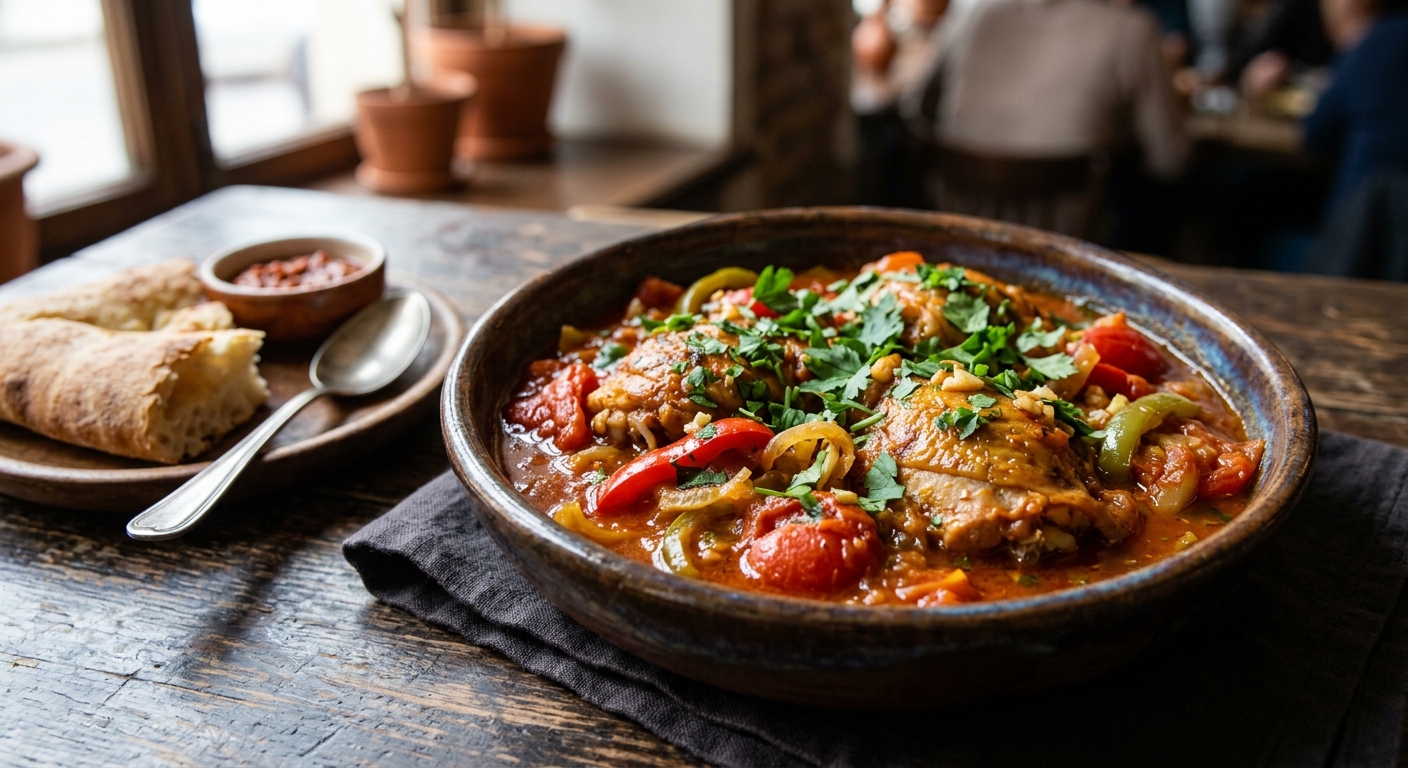
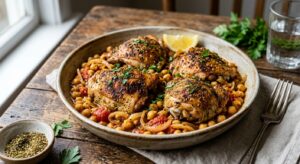
Long before vitamin C was isolated in a laboratory, the cooks of Georgia had already perfected a dish that delivers it in spectacular quantities. Chakhokhbili (cha-KHO-khbi-li) is named after the pheasant it was originally made with, but modern versions use bone-in chicken thighs braised in a river of ripe tomatoes, red and green bell peppers, onions, garlic, fresh coriander, parsley, fenugreek, and a finishing handful of fresh basil. The result is a stew so fragrant and deeply coloured that it looks like a painting, and so nutritionally dense that a single bowl covers more than half your micronutrient bases for the day.
What sets Chakhokhbili apart from other tomato-braised chicken dishes is its deliberately dry-roasted chicken start: no added oil initially, just the rendered fat from the skin meeting a screaming-hot pan, which builds a caramelised fond that gives the broth extraordinary depth without extra calories. The tomatoes are added raw and cooked down entirely, so no jarred sauce is needed, and the herbs go in three waves to preserve both their aromatic top notes and their deep vegetal character. This layering technique is standard in Georgian kitchens and it is the key to getting a stew that tastes like it was made by someone who really knew what they were doing.
From a nutritional standpoint, this dish is a vitamin C delivery system disguised as comfort food. A single serving contains vitamin C from four distinct sources: fresh tomatoes, red bell peppers, green bell peppers, and a generous heap of fresh parsley, each contributing meaningfully to the total. Pair that with the iron and B6 from chicken thighs, folate from the herb load, and potassium from the tomatoes, and you have a bowl that ticks more RDI boxes than most carefully engineered supplements.
4
servings
Ingredients
- 1200 gbone-in, skin-on chicken thighs (about 4 large)
- 700 gripe tomatoes, roughly chopped (about 4 medium)
- 200 gred bell pepper, deseeded and sliced (about 1 large)
- 150 ggreen bell pepper, deseeded and sliced (about 1 medium)
- 300 gyellow onion, thinly sliced (about 2 medium)
- 5 clovesgarlic, minced
- 30 gfresh flat-leaf parsley, roughly chopped
- 25 gfresh coriander (cilantro), roughly chopped
- 20 gfresh basil leaves, torn
- 1 tspground fenugreek
- 1 tspsweet paprika
- 0.5 tspdried chilli flakes (optional, to taste)
- 1 tbspunsalted butter
- 2 tbspextra-virgin olive oil
- —Colima Sea SaltMicroplastic Free Salt and freshly ground black pepper to taste
Instructions
Click on an item below to shop for the recommended items for this recipe on Amazon.
As an Amazon Associate, we earn from qualifying purchases.
- Pat the chicken thighs completely dry with paper towels and season generously on both sides with salt and pepper. Heat a wide, heavy-bottomed Dutch oven or deep skillet over medium-high heat until very hot. Place the chicken thighs skin-side down directly into the dry pan (no oil) and cook undisturbed for 6 to 8 minutes until the skin is deeply golden and the fat has rendered. Flip and cook a further 3 minutes. Transfer to a plate and pour off all but about 1 tablespoon of rendered fat.
- Reduce heat to medium. Add the butter to the reserved fat in the pan. Once foaming, add the sliced onions and a pinch of salt. Cook, stirring frequently, for 10 to 12 minutes until the onions are soft, golden, and beginning to caramelise at the edges. Add the minced garlic and cook a further 60 seconds until fragrant.
- Add the sliced red and green bell peppers to the onions. Stir to coat and cook for 4 minutes until beginning to soften. Sprinkle in the ground fenugreek, sweet paprika, and chilli flakes if using. Stir continuously for 30 seconds to bloom the spices in the fat.
- Add the chopped tomatoes and all their juices. Stir to combine and press them down gently. Return the chicken thighs to the pan skin-side up, nestling them into the tomato mixture so the liquid comes halfway up the sides. Bring to a lively simmer, then reduce heat to low-medium, cover with the lid slightly ajar, and braise for 25 to 30 minutes until the chicken is cooked through (internal temperature 74 degrees C / 165 degrees F) and the sauce has thickened.
- Stir in half the parsley and half the coriander. Taste and adjust seasoning with salt and pepper. Remove from heat and scatter the torn basil, remaining parsley, and remaining coriander over the top. Let the stew rest uncovered for 5 minutes, allowing the residual heat to wilt the fresh herbs gently without destroying their vitamin C content. Serve directly from the pot.
- Season the chicken thighs all over with salt and pepper. For best flavour, render the skin: heat a skillet over medium-high heat and cook the chicken skin-side down in a dry pan for 5 to 6 minutes until golden. This step is optional but adds significant depth. Transfer the chicken directly to the slow cooker insert, skin-side up, in a single layer.
- In the same skillet with the residual fat (or with 1 tablespoon of olive oil if skipping the sear), cook the sliced onions over medium heat for 7 minutes until softened and translucent. Add the garlic and cook 1 minute more. Stir in the fenugreek, paprika, and chilli flakes and cook 30 seconds. Deglaze the pan with 2 tablespoons of water, scraping up any browned bits, then transfer the entire onion mixture to the slow cooker.
- Add the sliced red and green bell peppers and the chopped tomatoes to the slow cooker, tucking them around and beneath the chicken thighs. Add half the parsley and half the coriander now, as the long cook will mellow their flavour into the broth. Season the vegetable mixture with salt and pepper. Do not add any extra liquid as the tomatoes and peppers will release plenty.
- Place the lid on the slow cooker and cook on Low for 6 to 7 hours, or on High for 3 to 3.5 hours. The chicken should be completely tender and pulling away from the bone. In the final 30 minutes of cooking, tilt the lid slightly to allow steam to escape and the sauce to concentrate.
- Once cooking is complete, taste the braising liquid and adjust seasoning. Scatter the torn basil and the reserved parsley and coriander over the top of the chicken directly in the slow cooker. Replace the lid for 5 minutes so the herbs just wilt in the residual heat, preserving their brightness and vitamin C content. Serve from the insert.
- Set the Instant Pot or electric pressure cooker to Saute on High (or heat a stovetop pressure cooker over medium-high heat). Season the chicken thighs with salt and pepper. Once the pot reads Hot, place the chicken skin-side down directly into the dry insert and sear, undisturbed, for 5 to 6 minutes until the skin is golden and fat has rendered. Flip and sear 2 minutes on the second side. Remove and set aside. Cancel Saute mode.
- Add the butter to the rendered fat in the pot. Add the sliced onions and cook on Saute for 5 minutes, stirring occasionally, until softened. Add the garlic, fenugreek, paprika, and chilli flakes. Stir for 30 seconds. Pour in the chopped tomatoes and use a wooden spoon to scrape the bottom of the pot clean. This step is critical as any stuck fond will trigger a Burn warning during pressurisation.
- Add the sliced red and green bell peppers to the pot. Stir everything to combine, then nestle the seared chicken thighs skin-side up on top of the vegetable mixture. Do not stir after adding the chicken as layering helps the pot come to pressure efficiently. Add half the parsley and half the coriander at this stage.
- Secure the lid and set the valve to Sealing. Cook on Manual High Pressure for 15 minutes. Once the cycle completes, allow a 10-minute natural pressure release, then carefully switch the valve to Venting to release any remaining steam.
- Remove the lid away from you. Transfer the chicken to a plate. If the sauce is thinner than desired, set the pot to Saute on High and reduce the liquid for 4 to 6 minutes, stirring occasionally. Return the chicken to the pot. Stir in the reserved parsley and coriander, then scatter the torn basil over the top. Rest for 3 minutes off heat before serving.
- Preheat your oven to 180 degrees C (350 degrees F) with a rack positioned in the lower third. Pat the chicken thighs dry and season generously with salt and pepper. Heat a Dutch oven or cast-iron braiser over medium-high heat on the stovetop. Place the chicken skin-side down into the dry pan and sear for 7 to 8 minutes until the skin is deep golden and the fat has rendered. Flip and sear 2 minutes. Transfer to a plate.
- Pour off all but 1 tablespoon of fat. Reduce heat to medium and add the butter. Cook the sliced onions in the butter and chicken fat for 8 to 10 minutes, stirring often, until soft and caramel-coloured. Stir in the garlic, fenugreek, paprika, and chilli flakes and cook for 1 minute. The fond developing on the base of the pot is critical flavour: do not let it burn.
- Add the sliced bell peppers and cook for 3 minutes. Add the chopped tomatoes and stir everything together, scraping up all the fond from the base. Bring to a simmer and cook on the stovetop for 5 minutes to give the tomatoes a head start. Stir in half the parsley and half the coriander.
- Nestle the seared chicken thighs skin-side up into the tomato mixture so the skin sits above the sauce level. Transfer the Dutch oven to the oven, uncovered. Roast at 180 degrees C for 30 minutes, then increase the oven to 210 degrees C (410 degrees F) and roast a further 15 to 20 minutes until the chicken skin is lacquered and crisp and an instant-read thermometer inserted into the thickest part reads 74 degrees C (165 degrees F). The sauce will have reduced and concentrated around the base.
- Remove from the oven and rest the stew for 8 minutes before serving: the carryover heat will finish any residual cooking and allow the juices to redistribute. Scatter the torn basil, remaining parsley, and remaining coriander over the top of the dish just before serving to preserve their vitamin C content.
Nutrition Breakdown
Per 1 serving (makes 4)
Vitamins & Minerals
% Daily Value based on a 2,000 calorie diet (FDA reference)
🧬 Essential Amino Acids
% of recommended daily intake (RDA) per serving
🛡 Antioxidant Profile
The Nutrition Science
The extraordinary vitamin C figure in Chakhokhbili comes from four independent sources acting in concert. Red bell peppers are among the most concentrated whole-food sources of ascorbic acid at roughly 128mg per 100g raw, which is three times the amount found in an orange. Green bell peppers contribute around 80mg per 100g. Fresh tomatoes add a further 14mg per 100g, and flat-leaf parsley is a surprisingly potent source at over 130mg per 100g, though its per-serving contribution is smaller due to volume. Because vitamin C is water-soluble and heat-sensitive, the finishing technique matters: adding the final wave of herbs off heat preserves a significant fraction of their ascorbic acid content, with research suggesting that brief heat exposure (under 5 minutes) retains 70 to 90 percent of the vitamin C in leafy herbs.
Lycopene, the red carotenoid in tomatoes, tells a different story. Unlike vitamin C, lycopene’s bioavailability actually increases with heat and fat. When tomatoes are cooked, the cell walls break down and the lycopene migrates from its protein-bound matrix into a more absorbable isomeric form (cis-lycopene). The butter and olive oil in this recipe provide the dietary fat required for lycopene absorption, since it is fat-soluble. Studies consistently show that cooked tomato preparations in the presence of fat deliver two to three times more bioavailable lycopene than raw tomatoes alone. The ~9.8mg per serving found here exceeds the amount associated with reduced prostate cancer risk in epidemiological studies (typically cited at 6 to 8mg per day).
The synergy between vitamin C and the non-haem iron from the chicken and herbs is clinically meaningful. Non-haem iron, the form found in plant foods and present in smaller quantities in poultry, has a baseline absorption rate of around 2 to 10 percent. Ascorbic acid consumed in the same meal chelates ferric iron and reduces it to the more soluble ferrous form, increasing non-haem iron absorption by up to 300 percent. This is why traditional cuisines that combine herb-heavy sauces with meat have an accidental but real nutritional intelligence: the herbs were not just flavour, they were bioavailability enhancers.
Pro Tips
- Do not skip the dry-sear step: rendering the chicken fat without added oil creates the flavour foundation of the dish, and the fond left in the pan dissolves into the tomatoes to give the sauce its complex, almost meaty depth that you simply cannot replicate by poaching the chicken directly.
- Add the fresh herbs in two waves: half goes in early to build background flavour and integrate into the sauce, and the other half goes on at the very end off the heat to preserve their bright colour, volatile aromatics, and the bulk of their vitamin C. This two-wave technique is the single most important thing you can do for both flavour and nutrition.
- For maximum lycopene, use the ripest, deepest red tomatoes you can find and do not rush the tomato-cooking phase. If good fresh tomatoes are out of season, 600g of whole peeled canned tomatoes crushed by hand is nutritionally superior to pale out-of-season fresh ones, as canned tomatoes are processed at peak ripeness and their lycopene content is often higher.

honestly the herb load here is what id focus on if nightshades are a concern – parsley alone brings serious vitamin c and its got decent b6 which matters for thyroid function. ive seen clients with autoimmune stuff do way better when they dial down the tomato volume but keep the braise method and load up on the herbs and bone broth base instead, totally changes the inflammation profile without losing that depth. maybe try subbing half the tomatoes with extra peppers at first and see how you feel, thats what i usually recommend before cutting them out entirely.
This looks absolutely delicious, but I have to ask about the nightshade content since I’m managing Hashimoto’s and trying to minimize inflammation triggers. I’m guessing the tomatoes and peppers are pretty central to the flavor profile here, so I’m wondering if you’ve ever experimented with substitutions like roasted carrots or beets to build that same depth? Also, if you have iodine information on the herbs used, I’d love to know – I’m always trying to balance thyroid support with keeping nightshades minimal. Even if I can’t do the traditional version right now, I’d genuinely love to adapt this somehow because the herb combination sounds amazing!
Great question, Anna – and I appreciate you thinking critically about this rather than just assuming “anti-inflammatory” means it works for everyone! The tomato and pepper situation is actually really interesting here because nightshades do contain alkaloids that *can* trigger responses in sensitive individuals, but the evidence for a universal Hashimoto’s connection is surprisingly weak when you dig into the literature. That said, your individual response matters way more than any general claim, so if you’ve noticed a pattern with nightshades, that’s your real data. The good news is that chakhokhbili’s magic is honestly as much in those fresh herbs (which bring their own polyphenols and anti-inflammatory compounds) as it is in