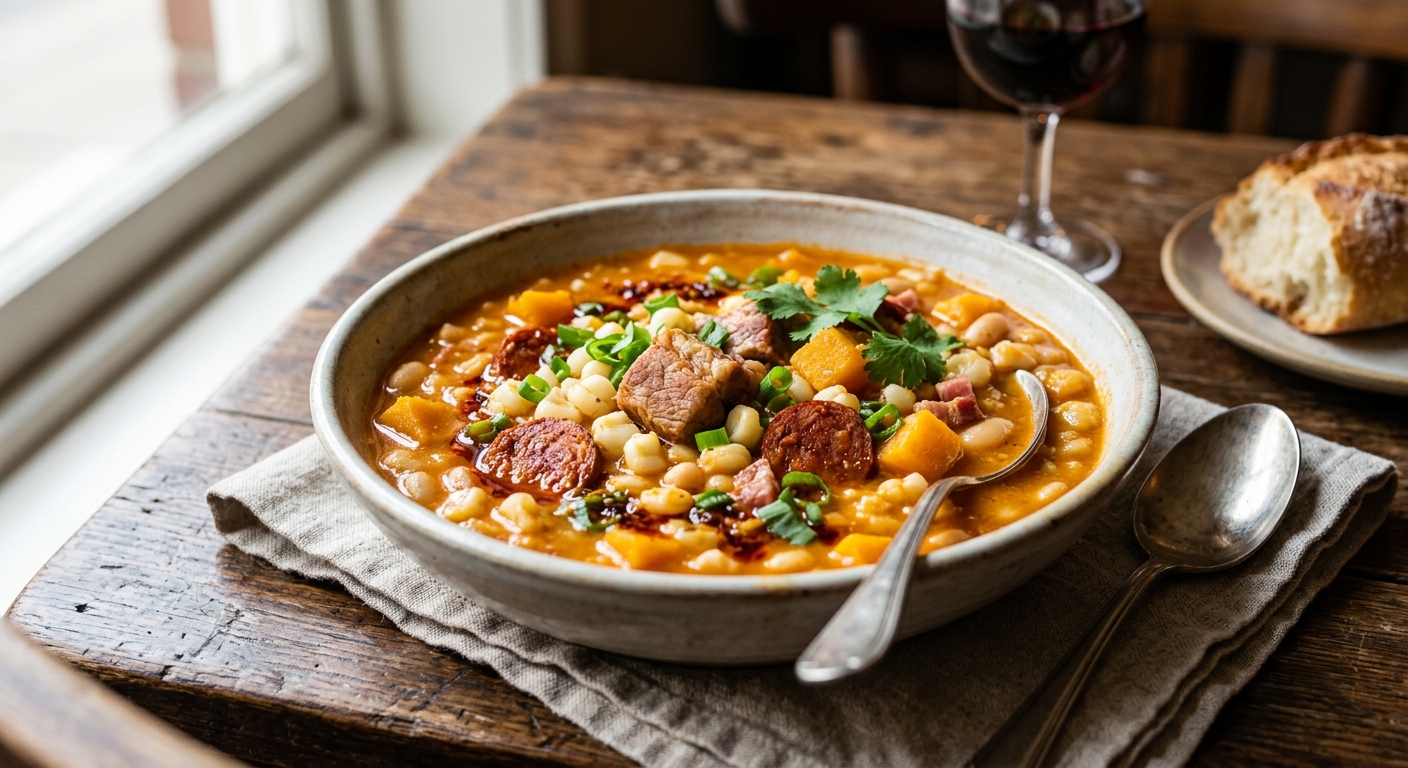
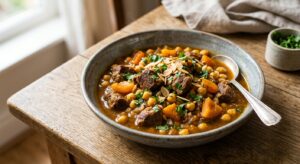
Locro is not merely a stew. It is the soul of the Andean winter, a dish that has fed Quechua communities and gauchos for centuries and still appears on every Argentine table on the 25th of Mayo, the national holiday marking the 1810 revolution. The word itself comes from the Quechua ruqru, and the dish predates the Spanish conquest, originally built around hominy corn, potatoes, and whatever protein the land provided. Today’s classic version layers white corn, creamy white beans, kabocha or butternut squash, cured pork, and a fiery sofrito of smoked paprika and cumin into something that is equal parts history and nourishment.
From a nutritional standpoint, locro is a mineral matrix in a single pot. The combination of pork shoulder, white beans, and corn delivers a broad essential amino acid profile, while the beans contribute non-heme iron that is meaningfully enhanced by the vitamin C present in the squash and the acidic sofrito. A single bowl provides over a third of your daily iron needs, more than 40% of your daily zinc, and a substantial hit of folate, magnesium, and phosphorus. The slow rendering of pork collagen also releases glycine and proline, two conditionally essential amino acids that support connective tissue and gut lining integrity.
What makes locro stand apart from other bean stews is texture: the hominy corn softens but never dissolves, giving each spoonful a pleasant chew against the silky beans and the collapsing squash. The finishing touch is a spoonful of grasita colorada, a quick pan sauce of lard or olive oil bloomed with smoked paprika and chili flakes, drizzled tableside. It is the dish’s signature flourish and the moment that transforms a nourishing pot of stew into something you will crave every winter.
6
servings
Ingredients
- 300 gdried hominy corn (maiz blanco), soaked overnight and drained
- 250 gdried white beans (cannellini or Great Northern), soaked overnight and drained
- 400 gpork shoulder, cut into 2cm cubes
- 200 gcured chorizo colorado or smoked kielbasa, sliced 1cm thick
- 150 gpancetta or thick-cut bacon, diced
- 500 gkabocha or butternut squash, peeled and cut into 2cm cubes
- 1 largewhite onion, finely diced
- 1 mediumleek, white and light-green parts only, sliced into half-moons
- 4 clovesgarlic, minced
- 2 tbspextra-virgin olive oil
- 2 tspsmoked paprika (pimenton ahumado)
- 1 tspground cumin
- 1 tspdried oregano
- 1.5 literslow-sodium chicken or pork stock
- 2 tbspolive oil or lard (for grasita colorada)
- 1 tspsmoked paprika (for grasita colorada)
- 0.5 tspdried chili flakes (for grasita colorada)
- —Colima Sea SaltMicroplastic Free Salt and freshly ground black pepper to taste
- —Fresh flat-leaf parsley or spring onion, chopped, to serve
Instructions
Click on an item below to shop for the recommended items for this recipe on Amazon.
As an Amazon Associate, we earn from qualifying purchases.
- Drain the soaked hominy corn and white beans separately. Place the hominy in a large pot, cover with cold water by 5cm, bring to a boil over high heat, then reduce to a steady simmer. Cook uncovered for 45 minutes until the corn is just beginning to soften but still has significant resistance. Drain and set aside. The beans will be added later as they cook faster.
- In a large Dutch oven or heavy-bottomed stockpot, render the diced pancetta over medium heat for 5 to 6 minutes, stirring occasionally, until the fat has released and the pieces are lightly golden. Add the pork shoulder cubes in a single layer (work in batches if needed) and sear over medium-high heat for 3 to 4 minutes per side until deeply browned. Remove the pork and pancetta to a plate, leaving the fat in the pot.
- Reduce heat to medium. Add the 2 tablespoons of olive oil, then add the diced onion and leek to the pot. Cook, stirring frequently, for 8 to 10 minutes until softened and translucent. Add the minced garlic, smoked paprika, cumin, and oregano. Stir constantly for 90 seconds until the spices are fragrant and beginning to stick to the bottom of the pot.
- Return the seared pork and pancetta to the pot. Add the chorizo slices, pre-cooked hominy corn, and drained soaked white beans. Pour in the stock and stir to combine, scraping up any browned bits from the bottom. Bring to a boil, then reduce to a gentle simmer. Season lightly with salt, keeping in mind the cured meats will release more salt as they cook.
- Cover loosely with a lid and cook at a gentle simmer for 1 hour 15 minutes, stirring every 20 minutes. After 1 hour 15 minutes, add the squash cubes, pressing them gently into the liquid. Continue to simmer uncovered for a further 30 minutes, until the squash is completely tender and beginning to break apart, the beans are creamy, and the stew has thickened to a porridge-like consistency. Use the back of a spoon to mash some squash pieces against the side of the pot to further thicken the broth.
- While the stew finishes, make the grasita colorada: heat 2 tablespoons of olive oil or lard in a small skillet over medium-low heat. Add 1 teaspoon of smoked paprika and the chili flakes and cook, swirling the pan, for 60 to 90 seconds until the oil turns a vivid red and smells fragrant. Remove from heat immediately to avoid burning.
- Taste the locro and adjust salt and pepper. Ladle into deep bowls and finish each serving with a teaspoon of grasita colorada drizzled across the surface. Scatter with chopped flat-leaf parsley or spring onion and serve with crusty bread.
- The night before, soak the hominy corn and white beans in separate large bowls with cold water covering by at least 8cm. Drain both in the morning. Place the hominy in a saucepan, cover with fresh water, bring to a boil and cook for 45 minutes until partially softened. Drain and set aside. This pre-cook step is essential in the slow cooker because the low temperature will not fully break down the hominy’s tough pericarp without it.
- In a large skillet over medium-high heat, cook the diced pancetta until the fat renders, about 5 minutes. Add the pork shoulder cubes and sear in batches until browned on at least two sides, about 3 minutes per side. Transfer everything to the slow cooker insert. In the same skillet, cook the onion and leek in the residual fat over medium heat for 5 minutes until softened. Add the garlic, smoked paprika, cumin, and oregano and stir for 60 seconds. Deglaze with a splash of stock, scraping up all the browned bits, then pour everything into the slow cooker.
- Add the chorizo slices, pre-cooked hominy corn, and drained soaked white beans to the slow cooker. Pour in the remaining stock. Stir to combine, ensuring everything is submerged. Season lightly with salt. Do not add the squash yet as it will become waterlogged and dissolve over a long cook.
- Place the lid on and cook on Low for 6 hours or High for 3 hours. At that point, add the squash cubes, pressing them beneath the surface of the liquid. Replace the lid and continue cooking on Low for a further 2 hours or High for 1 to 1.5 hours, until the squash is completely tender, the beans are creamy, and the pork is falling apart.
- Once cooking is complete, use a large spoon to mash roughly one quarter of the squash and beans directly in the slow cooker insert. Stir vigorously to incorporate, which will thicken the broth to the traditional porridge-like consistency. If the stew seems thin, leave the lid off and cook on High for a further 20 to 30 minutes.
- Prepare the grasita colorada in a small skillet just before serving: heat 2 tablespoons of olive oil or lard over medium-low heat, add the smoked paprika and chili flakes, and swirl for 60 to 90 seconds until the oil is vivid red and fragrant. Remove from heat. Ladle the locro into deep bowls, drizzle with grasita colorada, and finish with parsley or spring onion.
- Drain the soaked hominy and white beans. Set the Instant Pot or electric pressure cooker to Saute on High. Add the pancetta and cook for 4 to 5 minutes until the fat renders. Add the pork shoulder cubes in a single layer and sear for 2 to 3 minutes per side until browned. Work in batches if the insert is crowded. Remove the meats and set aside.
- With the cooker still on Saute, add the olive oil, onion, and leek to the insert. Cook for 5 to 6 minutes until softened, stirring frequently. Add the garlic, smoked paprika, cumin, and oregano and cook for 60 seconds, stirring constantly. Deglaze with 120ml of the stock, scraping the bottom of the insert thoroughly to lift any browned bits. This step prevents the burn warning from triggering during pressurization.
- Return the seared pork and pancetta to the insert. Add the chorizo, drained hominy, and drained white beans. Pour in the remaining stock. The liquid should just cover the ingredients. Do not add the squash at this stage as it will overcook and disappear into the broth. Season lightly with salt. Stir once to combine.
- Cancel the Saute function. Secure the lid and set the pressure release valve to Sealing. Select Manual or Pressure Cook and set to 45 minutes at High Pressure. Once the cycle completes, allow a full natural pressure release for 15 minutes before carefully turning the valve to Venting to release any remaining steam.
- Open the lid and stir. The hominy and beans should be very tender. Switch back to Saute on Low. Add the squash cubes and cook uncovered for 12 to 15 minutes, stirring occasionally, until the squash is completely soft. Mash some pieces against the side of the insert to thicken the broth. Taste and adjust salt and pepper.
- Make the grasita colorada in a small pan: heat 2 tablespoons of olive oil or lard over medium-low heat, add smoked paprika and chili flakes, swirl for 60 to 90 seconds until vivid and fragrant, then remove from heat. Serve the locro in deep bowls, drizzle generously with grasita colorada, and garnish with parsley or spring onion.
- Preheat the oven to 160C (325F). Pre-boil the drained soaked hominy corn in a saucepan of water for 45 minutes until partially tender, then drain. On the stovetop, heat a large oven-safe Dutch oven over medium-high heat. Cook the pancetta until the fat renders, about 5 minutes. Add the pork shoulder in batches and sear on two to three sides until deeply browned, about 3 to 4 minutes per side. Remove all meats to a plate.
- Reduce the heat to medium. Add olive oil, onion, and leek to the Dutch oven and cook in the rendered fat for 8 to 10 minutes until softened and lightly golden at the edges. Add the garlic, smoked paprika, cumin, and oregano. Stir for 90 seconds until the spices bloom and stick to the bottom. Deglaze with 200ml of the stock, scraping vigorously.
- Return the pork and pancetta to the pot. Add the chorizo, pre-cooked hominy, and drained soaked white beans. Pour in the remaining stock. Stir well to combine and bring to a boil on the stovetop. Season lightly with salt. Once at a boil, cover the Dutch oven tightly with its lid and carefully transfer to the centre rack of the preheated oven.
- Braise in the oven for 1 hour 45 minutes. Remove from the oven and carefully lift the lid away from you. Add the squash cubes, pressing them into the liquid, and stir gently. Return the Dutch oven to the oven with the lid slightly ajar (use a folded piece of foil to prop it open about 2cm). This allows some evaporation for thickening. Continue to braise for a further 45 to 60 minutes until the squash is completely tender and the stew is thick.
- Remove from the oven. Use the back of a large spoon to crush some squash pieces against the side of the pot and stir to incorporate. Taste and adjust salt and pepper. The oven-braised version typically needs less final adjustment as the enclosed heat melds the flavors seamlessly.
- Prepare the grasita colorada on the stovetop: heat 2 tablespoons of olive oil or lard in a small pan over medium-low heat, add the smoked paprika and chili flakes, and swirl for 60 to 90 seconds until the oil turns vivid red and is deeply fragrant. Ladle the locro into warmed deep bowls, drizzle with grasita colorada, and finish with fresh parsley or spring onion.
Nutrition Breakdown
Per 1 serving (makes 6)
Vitamins & Minerals
% Daily Value based on a 2,000 calorie diet (FDA reference)
🧬 Essential Amino Acids
% of recommended daily intake (RDA) per serving
🛡 Antioxidant Profile
The Nutrition Science
The iron story in locro is one of strategic combination. White beans and pork shoulder each contribute meaningful amounts of iron, but they operate through different mechanisms. Pork provides heme iron (primarily as myoglobin), which is absorbed at a rate of 15 to 35% regardless of dietary context. The beans provide non-heme iron, which is more variable in its absorption, typically ranging from 2 to 20% depending on enhancers and inhibitors present in the same meal. The kabocha squash provides a modest but real contribution of vitamin C, which reduces ferric iron (Fe3+) to the more bioavailable ferrous form (Fe2+) and forms a soluble chelate that passes readily through the intestinal mucosa. Cooking the stew together means these compounds are already co-localized in the same bolus, maximizing their synergistic effect.
Zinc bioavailability in this dish is unusually high for a legume-heavy preparation. Overnight soaking and extended cooking significantly reduce phytic acid in both the hominy and the beans. Phytic acid (inositol hexaphosphate) is the primary inhibitor of zinc and iron absorption in plant foods, binding to these minerals in the intestinal lumen and preventing uptake. Studies show that soaking followed by cooking can reduce phytate content by 60 to 75%, shifting the phytate-to-zinc molar ratio well below the threshold of 15:1 at which absorption becomes meaningfully impaired. The pork also contributes what researchers call the meat factor, a peptide-mediated enhancement of non-heme mineral absorption that has been observed consistently in mixed-diet studies.
The collagen contribution from slow-cooked pork shoulder deserves attention. Pork shoulder contains approximately 7 to 9% collagen by weight, predominantly types I and III. During extended moist heat cooking, collagen undergoes hydrolysis into gelatin and free amino acids, particularly glycine, proline, and hydroxyproline. Glycine is conditionally essential during periods of high physiological stress and is a direct precursor to glutathione, the body’s master antioxidant molecule. It is also required for creatine synthesis and bile acid conjugation. While the body can synthesize glycine endogenously, evidence suggests that dietary glycine from collagen-rich sources provides a meaningful pool that supports gut barrier function and connective tissue remodeling, particularly relevant in winter months of higher metabolic demand.
Pro Tips
- If you cannot find dried hominy corn (maiz blanco), canned hominy (posole) is an excellent substitute. Add it in the final 30 minutes of cooking on the stovetop or oven, or after pressure release in the Instant Pot, as it is already fully cooked and will disintegrate if overheated.
- The stew thickens dramatically as it cools. If reheating the next day, add 100 to 150ml of stock or water and stir over gentle heat. Locro is widely considered to be even better on day two as the flavors continue to develop overnight.
- For a smokier depth, replace 200ml of the stock with a dry Spanish cava or white wine, adding it after the sofrito step and reducing by half before adding the remaining liquid. The alcohol dissolves fat-soluble flavor compounds from the paprika that water alone cannot extract.
omg this is perfect timing because ive been experimenting with iron timing around my long runs and the heme iron from the pork plus the vitamin c from the squash combo is actually genius for absorption, like way better than taking a supplement before a 20 miler. also curious if you tested this as a post run meal too because that white corn and bean combo would be such solid glycogen replenishment without feeling heavy? might be my new race week dinner tbh
This is such a smart observation about the heme/non-heme iron synergy, especially for endurance athletes. I’m curious whether you’ve noticed any difference in recovery inflammation markers when eating locro versus lighter post-run meals, because that slow-cooked bone broth base and the white beans together create a pretty compelling anti-inflammatory profile I’ve seen shift things for distance runners I work with. The glycogen + mineral density angle is solid, but I’m wondering if adding something like a dried mushroom powder (maybe reishi or cordyceps for recovery support) to the broth would enhance the whole picture without adding bulk, since you mentioned not wanting heaviness before big efforts.
Oh this is speaking my language right now. I’ve been tracking how animal protein + plant-based iron sources actually *work* together in my body during this perimenopausal phase, and locro seems like it’s hitting all the marks: the pork for heme iron absorption, the white beans for folate (which I’m apparently depleting faster these days), plus the corn and squash for those minerals my bones are apparently desperate for. I’m definitely making this next week and comparing notes on my hot flash frequency before and after, because honestly slow-cooked stews have been my secret weapon for feeling less ragey at 3am.