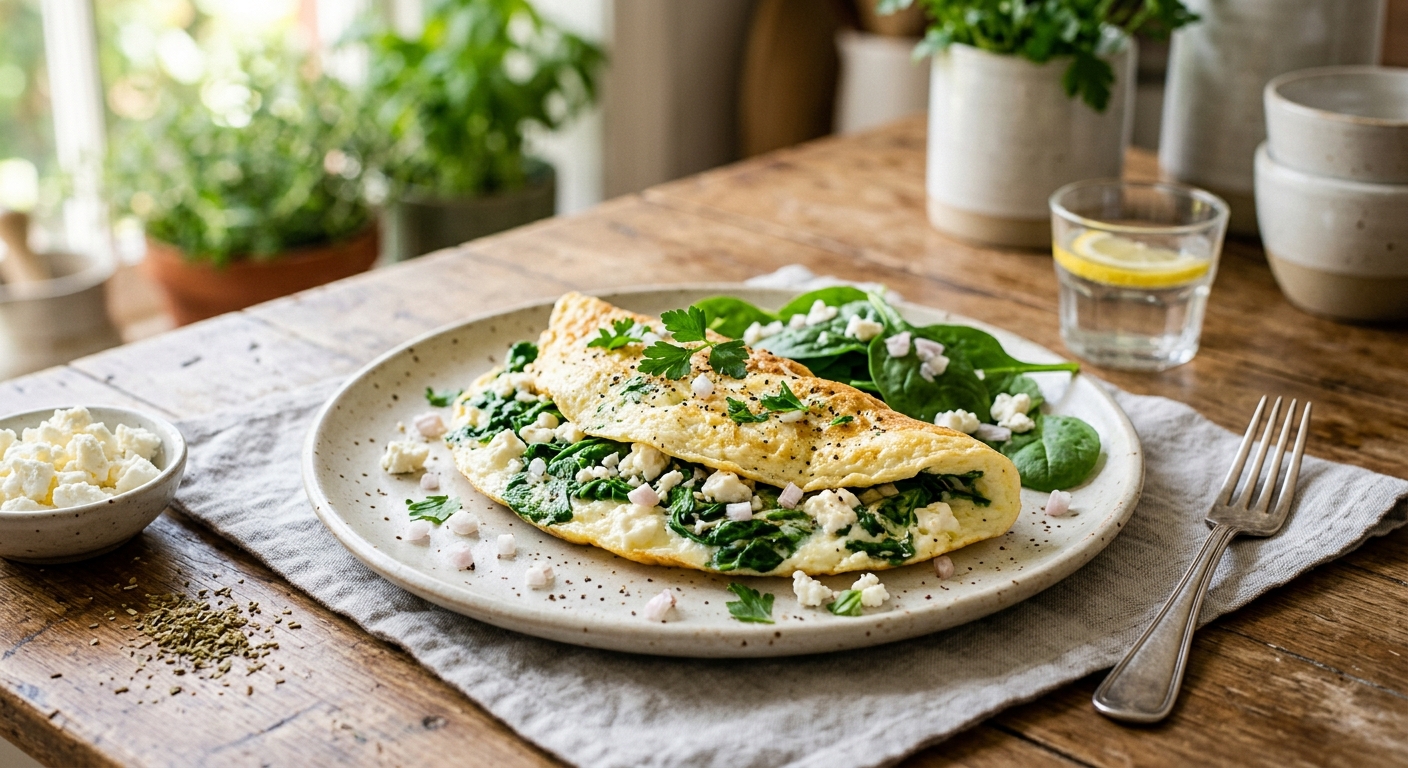
There is a reason egg whites have anchored athlete and clinical nutrition plans for decades, and it has everything to do with biological value. Egg whites score a near-perfect 100 on the protein digestibility scale, meaning virtually every gram of protein they contain is absorbed and put to work by your body. Pair that with iron-rich baby spinach and calcium-dense feta cheese, and you have a breakfast or light meal that reads like a nutritional checklist brought to life on a plate.
What elevates this omelette beyond the ordinary is technique. Whisking the egg whites to soft, airy peaks before cooking produces a soufflé-like texture that is worlds away from the rubbery egg white discs that gave this dish an unfair reputation. The spinach is wilted just enough to concentrate its flavor without losing its brilliant color, and the feta is added off the heat so it softens into creamy pockets rather than melting into a greasy puddle. Every element has a purpose, and every element has been measured against real dietary reference intake data so you know exactly what you are getting.
With 30 grams of complete protein, 45% of your daily folate needs, and a meaningful contribution toward your iron and calcium targets, this omelette does the kind of nutritional work that most breakfasts cannot. It also comes together in under 15 minutes on the stovetop, making it genuinely practical for weekday mornings. Whether you are building muscle, managing weight, or simply trying to front-load your day with quality nutrition, this recipe was calibrated for you.
2
servings
Ingredients
- 360 gliquid egg whites (from carton, or approximately 10 large eggs separated)
- 120 gbaby spinach, washed and dried
- 80 greduced-fat feta cheese, crumbled
- 30 gshallot (about 1 medium), finely diced
- 1 clovegarlic, minced
- 1 tbspextra-virgin olive oil
- 1 tspfresh lemon juice
- 0.5 tspdried oregano
- 0.25 tspcrushed red pepper flakes (optional)
- —Colima Sea SaltMicroplastic Free Salt and freshly cracked black pepper to taste
- —Fresh dill or flat-leaf parsley, roughly chopped, to garnish
Instructions
Click on an item below to shop for the recommended items for this recipe on Amazon.
As an Amazon Associate, we earn from qualifying purchases.
- Season your egg whites with a small pinch of fine sea salt and several cracks of black pepper. Using a hand whisk or electric beaters, whisk vigorously for 60 to 90 seconds until the mixture is very frothy and has increased slightly in volume. You are not looking for stiff peaks, just a uniform, airy foam. Set aside.
- Place a 10-inch non-stick skillet over medium heat and add half the olive oil (about 1.5 teaspoons). Once the oil shimmers, add the diced shallot and cook for 2 minutes, stirring frequently, until softened and translucent. Add the minced garlic and red pepper flakes and cook for 30 seconds more until fragrant.
- Add the baby spinach to the pan in two handfuls, tossing with tongs as each handful wilts down. This should take about 90 seconds total. Add the lemon juice, toss once more, then transfer the spinach mixture to a small bowl and press gently with a spoon to remove excess moisture. Wipe the skillet clean with a folded paper towel held with tongs.
- Return the clean skillet to medium-low heat and add the remaining olive oil. Once the oil is hot but not smoking, pour in all of the whisked egg whites. Use a silicone spatula to gently pull the cooked edges toward the centre while tilting the pan so the uncooked egg whites flow to the edges. Continue this motion for about 2 to 3 minutes until the surface is mostly set but still looks slightly glossy in the centre.
- Scatter the wilted spinach mixture evenly over one half of the omelette, then distribute the crumbled feta on top of the spinach. Sprinkle with dried oregano. Remove the pan from the heat entirely and let the residual warmth finish setting the centre for 60 seconds.
- Tilt the pan over a warm plate and use the spatula to fold the unfilled half of the omelette over the filled half as you slide it out. Cut in half to serve two portions. Garnish with fresh dill or parsley and serve immediately.
- Lightly coat the entire interior of a 3 to 4 quart slow cooker with non-stick cooking spray, paying close attention to the curved sides. Line the bottom with a strip of parchment paper cut to fit, then spray the parchment as well. This double layer of protection is essential because egg whites cling to surfaces far more aggressively than whole eggs.
- Heat the olive oil in a small skillet over medium heat. Sauté the diced shallot for 2 minutes until softened, then add the garlic and cook 30 seconds more. Add the baby spinach and lemon juice and stir until fully wilted, about 90 seconds. Remove from heat, allow to cool for 5 minutes, then press out as much liquid as possible using the back of a spoon against a sieve. Roughly chop the spinach mixture and set aside.
- In a large bowl, whisk the egg whites with the dried oregano, red pepper flakes, salt, and black pepper until uniformly combined and slightly frothy. Fold in the cooled spinach mixture and half of the crumbled feta. Pour the entire mixture into the prepared slow cooker and spread evenly. Scatter the remaining feta across the surface.
- Place a double layer of paper towels directly under the lid of the slow cooker before sealing it. The paper towels absorb condensation that would otherwise drip back onto the egg whites and create a watery, uneven texture on the surface. Cook on Low for 1 hour 30 minutes, checking at the 1 hour 15 minute mark.
- The frittata is done when the edges are set and golden, the centre no longer jiggles when you gently shake the pot, and a toothpick inserted in the middle comes out clean. Turn off the slow cooker and let it rest with the lid cracked open for 10 minutes before slicing. Run a silicone spatula around the edges, then lift out using the parchment paper strip. Slice into wedges, garnish with fresh herbs, and serve.
- Grease a 7-inch round heatproof baking dish or springform pan thoroughly with non-stick spray. Place the trivet that came with your pressure cooker inside the pot and add 1 cup of cold water to the bottom. The water must not touch the bottom of the baking dish when it rests on the trivet.
- In a small skillet over medium-high heat, add the olive oil and sauté the shallot for 2 minutes. Add the garlic and cook 30 seconds. Add the spinach and lemon juice and stir until just wilted, about 60 to 75 seconds. This pre-cooking step is important here because the pressure cooker environment does not allow excess moisture to evaporate, and raw spinach would release water that dilutes the egg mixture. Press the wilted spinach firmly in a sieve to drain, then chop roughly.
- Whisk the egg whites with the dried oregano, red pepper flakes, salt, and pepper until frothy. Fold in the spinach mixture and half the feta. Pour into the prepared baking dish. Tap the dish gently on the counter two or three times to pop large air bubbles. Scatter the remaining feta across the top. Cover the baking dish tightly with a sheet of aluminium foil, pressing it snugly against the rim to prevent condensation from dripping onto the surface during cooking.
- Lower the covered baking dish onto the trivet using a foil sling (fold a long piece of foil into thirds lengthwise and use it as a cradle to lower and later lift the dish). Seal the pressure cooker lid and set the valve to Sealing. Cook on Manual High Pressure for 8 minutes.
- Once the cooking cycle ends, perform a quick pressure release by carefully turning the valve to Venting. Wait for the float valve to drop fully before opening the lid. Remove the foil cover from the baking dish and check that the centre is fully set by inserting a toothpick. If needed, reseal the pot and pressure cook for an additional 2 minutes. Allow to rest for 5 minutes, then lift out using the sling, run a spatula around the edge, and unmold. Slice, garnish with fresh herbs, and serve.
- Preheat your oven to 375°F (190°C) with a rack positioned in the centre. Place a 10-inch oven-safe non-stick skillet over medium heat on the stovetop and add the olive oil. Sauté the diced shallot for 2 minutes, then add the garlic and red pepper flakes and cook 30 seconds more until fragrant.
- Add the baby spinach and lemon juice to the skillet and toss with tongs until fully wilted, about 90 seconds. Use the back of a spoon to press any pooled liquid from the spinach to the side of the pan and tilt to drain it off. Spread the spinach mixture in an even layer across the bottom of the skillet and reduce the stovetop heat to low.
- In a bowl, whisk the egg whites with the dried oregano, salt, and black pepper until uniformly frothy, about 60 seconds. Pour the egg white mixture slowly and evenly over the spinach in the skillet. Use a silicone spatula to gently distribute any spinach that has clumped. Cook on the stovetop over low heat for 3 to 4 minutes, just until the very bottom and outer edges begin to set. Do not stir. This partial stovetop cooking creates a stable base that prevents the egg whites from floating the filling when transferred to the oven.
- Scatter all of the crumbled feta evenly across the surface of the partially set egg whites. Transfer the skillet carefully to the preheated oven. Bake for 18 to 22 minutes, until the frittata has puffed noticeably, the surface is set and dry to the touch, and the top is a pale golden colour with lightly browned edges. A skewer inserted in the centre should come out clean with no wet egg white clinging to it.
- Remove the skillet from the oven using heavy oven mitts and set on a heatproof surface. Important: leave a folded kitchen towel draped over the handle as a reminder that it is dangerously hot. Allow the frittata to rest in the pan for 5 minutes, during which it will deflate slightly. This resting period allows the proteins to finish setting and makes slicing cleaner. Garnish with fresh dill or parsley, slice into wedges, and serve directly from the pan.
Nutrition Breakdown
Per 1 serving (makes 2)
Vitamins & Minerals
% Daily Value based on a 2,000 calorie diet (FDA reference)
🧬 Essential Amino Acids
% of recommended daily intake (RDA) per serving
🛡 Antioxidant Profile
The Nutrition Science
Egg whites are one of the most thoroughly studied protein sources in nutritional science. Their protein digestibility-corrected amino acid score (PDCAAS) of 1.0 indicates a complete essential amino acid profile that the human body can absorb and utilise with exceptional efficiency. Each serving of this omelette provides over 100% of the RDA for leucine, the key branched-chain amino acid that triggers muscle protein synthesis via the mTOR signalling pathway, as well as 120% of the RDA for lysine, an amino acid commonly limiting in grain-based diets. For muscle repair, recovery, or healthy aging, the protein quality here is clinically meaningful, not just a marketing claim.
Spinach contributes a remarkable 242% of the daily value for vitamin K per serving, almost entirely as phylloquinone (vitamin K1), which plays a non-negotiable role in activating the clotting proteins that stop bleeding and, increasingly, in regulating bone mineralisation via osteocalcin carboxylation. The folate content (45% DV) is particularly relevant for anyone of reproductive age, as adequate folate intake in early pregnancy is one of the most evidence-backed interventions in preventive medicine for reducing neural tube defect risk. The iron in spinach is non-heme iron, which is less bioavailable than heme iron from meat, but the lemon juice in this recipe provides vitamin C that directly enhances non-heme iron absorption by reducing ferric iron (Fe3+) to the more absorbable ferrous form (Fe2+).
The feta cheese, though modest in quantity, contributes calcium and phosphorus in a ratio that supports bone mineralisation, as well as a small but meaningful dose of conjugated linoleic acid (CLA), a fatty acid with emerging research supporting body composition and anti-inflammatory benefits. Reduced-fat feta keeps the saturated fat content controlled without sacrificing the tangy, creamy contrast that makes this omelette genuinely satisfying, which matters because palatability drives adherence, and adherence is where the real nutritional outcomes are won.
Pro Tips
- For the fluffiest stovetop omelette, make sure your egg whites are at room temperature before whisking. Cold egg whites from the refrigerator do not aerate as efficiently, and the temperature differential also causes them to seize when they hit the hot pan, resulting in uneven cooking.
- Pressing moisture from the wilted spinach is not optional. Spinach is approximately 91% water by weight, and any excess liquid left in the filling will steam the bottom of the omelette from the inside, creating a wet, rubbery texture regardless of the cooking method you choose.
- If using eggs rather than carton egg whites, save the yolks. Freeze them in an ice cube tray covered with cling film for up to 3 months and use them later in hollandaise, lemon curd, or pasta dough. This eliminates food waste and honours the full nutritional value of the eggs you purchased.





I’m really glad you brought this up, Irene, because the whole egg vs. egg white question comes up a lot in my practice! The yolk contains choline and lutein which do support joint health, plus the fat actually helps absorb the fat-soluble vitamins in that spinach (like vitamin K). You might’ve also been missing out on some satiety signals with whites-only, which can affect inflammation indirectly. That said, this recipe could honestly work beautifully with whole eggs if that feels better for your body, you’d just be looking at closer to 35-40g protein depending on how many you use.
Love the protein focus here, but I’m curious if you’ve experimented with using whole eggs instead of just whites? I switched back to whole eggs a few years ago after noticing my joint inflammation actually increased on egg-white-only diets, and the yolk’s choline and lutein seem to matter for my RA symptoms. That said, the spinach and feta combo is *chef’s kiss* for anti-inflammatory eating, and I’d definitely add a drizzle of extra virgin olive oil to this for even more benefit. Has anyone else found their body responds differently to whole eggs versus whites?
Irene, I love that you’re paying attention to how your body actually responds – that’s so important and often overlooked! I’ll say though, the spinach in this recipe is actually a big deal for joint and overall inflammation, especially if it’s cooked down like a proper wilted green. Raw spinach has those goitrogens that can interfere with thyroid function, but cooking it significantly reduces them and unlocks all that anti-inflammatory potential with the selenium and zinc. That said, whole eggs do have choline and other compounds that egg whites lack, so if they made a real difference for your inflammation, that’s your body telling you something worth listening to, regardless of which part of the egg it is