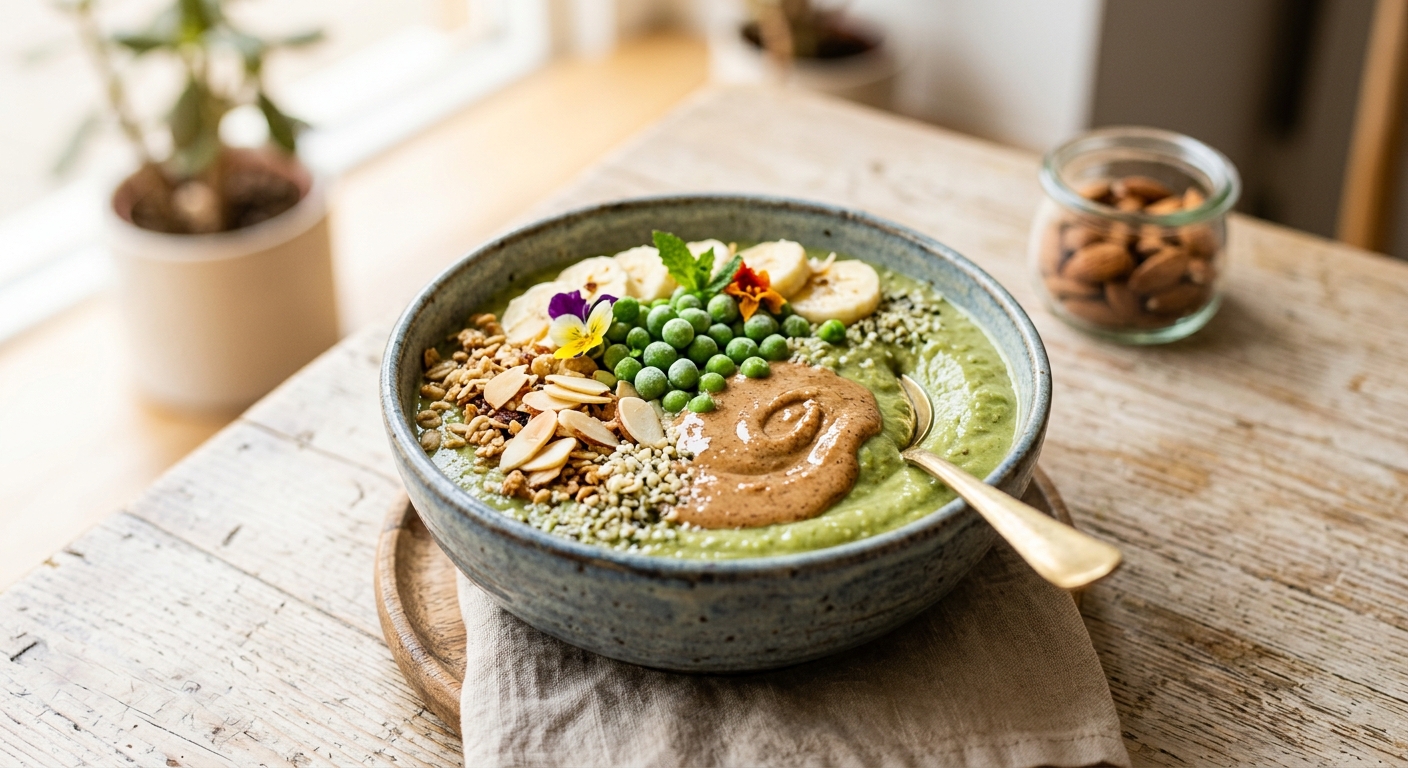
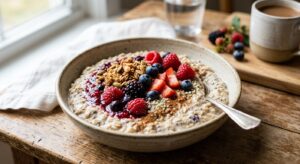
Smoothie bowls have earned a reputation as photogenic but nutritionally hollow, loaded with sugar and short on substance. This version is engineered differently. By anchoring the base with a full scoop of pea protein isolate and a generous spoonful of natural almond butter, we transform a trendy breakfast into a precision-calibrated meal that meets or exceeds the recommended daily intake for folate, vitamin K, manganese, and magnesium in a single bowl. The vivid green colour is not food dye; it is chlorophyll and beta-carotene from real frozen peas blended smooth.
Pea protein isolate derived from yellow split peas is one of the most exciting plant proteins to enter mainstream kitchens. Unlike soy, it is free of the top eight allergens for most formulations, it digests at a moderate rate similar to casein, and it is particularly rich in arginine and branched-chain amino acids, especially leucine, the amino acid most directly responsible for triggering muscle protein synthesis. Paired with almond butter, which supplies the methionine and additional leucine that peas lack in relative abundance, the combination creates what nutritionists call a complementary protein, one that fills the gaps the other leaves behind.
The base recipe is written as a blended bowl, but we have developed three additional preparation methods for households without a high-powered blender, or for those who prefer a warmed, pudding-style bowl in colder months. Each method produces a genuinely different texture and eating experience, from the silky frozen version to a slow-cooked pea and almond porridge that is deeply comforting. Every version stays within the same nutritional window because the ingredient quantities remain constant.
2
servings
Ingredients
- 120 gfrozen green peas, straight from the freezer
- 60 gpea protein isolate powder (unflavoured or vanilla)
- 200 gfrozen banana slices (about 2 medium bananas, pre-frozen)
- 60 gnatural almond butter (no added sugar or oil)
- 240 mlunsweetened almond milk
- 120 mlfull-fat coconut milk (canned)
- 15 mlpure maple syrup
- 5 gfresh ginger, peeled and grated
- 1 tspvanilla extract
- 0.5 tspground turmeric
- 30 grolled oats (for topping or porridge base)
- 20 ghemp seeds (for topping)
- 15 gchia seeds (for topping or thickening)
- 30 gfresh blueberries (for topping)
- 10 gsliced almonds (for topping)
- —Pinch of Colima Sea SaltMicroplastic Free Salt
Instructions
Click on an item below to shop for the recommended items for this recipe on Amazon.
As an Amazon Associate, we earn from qualifying purchases.
- Remove the frozen peas and frozen banana slices from the freezer and let them sit at room temperature for exactly 3 minutes. This brief temper prevents the blender motor from straining while keeping the mixture cold enough to hold a thick, scoopable consistency.
- Place the almond milk and coconut milk in the blender first, followed by the almond butter, pea protein isolate, ginger, vanilla extract, turmeric, maple syrup, and sea salt. Adding liquids first protects the blade and encourages a vortex that pulls the frozen ingredients down efficiently.
- Add the tempered frozen peas and frozen banana slices on top of the liquid layer. Secure the lid and blend on high for 45 to 60 seconds, using a tamper if available to push the mixture into the blade. Stop and scrape down the sides once if needed. The finished base should be the consistency of very thick soft-serve ice cream. If the mixture is too thin, add 2 to 3 tablespoons more frozen pea or banana. If it is too stiff for your blender, add almond milk one tablespoon at a time.
- While the base blends, toast the sliced almonds in a dry small skillet over medium heat for 2 to 3 minutes, stirring frequently, until lightly golden and fragrant. Remove immediately to a plate to cool. Simultaneously, combine the chia seeds and rolled oats in a small bowl if you prefer a textured, seed-studded topping rather than a plain oat scatter.
- Divide the blended base between two wide, chilled bowls. Working quickly before the base softens, arrange the toppings in deliberate sections: a cluster of fresh blueberries on one quadrant, a drizzle of extra almond butter across the centre, a scatter of hemp seeds, the toasted almonds, and the oat-chia mix. Serve immediately.
- Use fresh or thawed peas for this method, not frozen. Lightly mash 80g of the peas with a fork in a small bowl, leaving the remaining 40g whole. This creates a porridge with both a creamy background and pleasant bursts of pea texture. Combine the mashed and whole peas in the slow cooker insert.
- Add the rolled oats, almond milk, coconut milk, ginger, turmeric, maple syrup, vanilla extract, chia seeds, and sea salt to the slow cooker. Stir everything together well. Do NOT add the pea protein powder or almond butter at this stage; both will be incorporated after cooking. Place the lid on and cook on Low for 6 to 7 hours or on High for 3 to 3.5 hours. The oats will fully absorb the liquid and the peas will become very tender.
- About 10 minutes before serving, remove the lid and stir the porridge vigorously to break down any clumping. The mixture should be thick and cohesive. If it seems overly thick, stir in 2 to 4 tablespoons of warm water or additional almond milk.
- Remove the insert from the heat element entirely. Wait 2 minutes for the temperature to drop slightly below a full simmer, then add the pea protein isolate powder one tablespoon at a time, whisking each addition in fully before adding the next. This staged approach prevents clumping and stops the protein from denaturing in a way that creates a gritty, rubbery texture. Once fully incorporated, stir in the almond butter until it melts through the porridge.
- Ladle into two warmed bowls. Top with fresh blueberries, hemp seeds, sliced almonds, and an extra drizzle of almond butter. Serve immediately while the porridge is hot.
- Use thawed or fresh peas for this method. Add the peas, rolled oats, almond milk, coconut milk, ginger, turmeric, maple syrup, vanilla extract, chia seeds, and sea salt to the Instant Pot inner pot. Stir to combine. Do not add pea protein powder or almond butter yet.
- Secure the lid and set the vent to the Sealing position. Select Pressure Cook on High for 5 minutes. The pot will take approximately 8 to 10 minutes to come to full pressure before the countdown begins.
- Once the cook time completes, allow the pressure to release naturally for 10 full minutes. Do not use quick release. After 10 minutes, carefully turn the vent to Venting to release any remaining pressure, then open the lid away from you. The mixture will look slightly looser than the final texture; it will thicken as it cools slightly.
- Switch the Instant Pot to the Saute function on the Low setting. Stir the cooked base vigorously for 1 to 2 minutes until it reaches a smooth, pudding-like consistency. Turn off the Saute function. Wait 90 seconds for the temperature to drop, then whisk in the pea protein isolate powder gradually, one tablespoon at a time, followed by the almond butter. The residual heat will melt the almond butter into glossy ribbons throughout the pudding.
- Taste and adjust sweetness with a small additional drizzle of maple syrup if desired. Divide between two bowls, top with blueberries, hemp seeds, toasted sliced almonds, and a thin extra drizzle of almond butter. For best texture, serve within 5 minutes before the pudding sets too firmly.
- Preheat your oven to 175C (350F). Lightly grease a 20cm (8-inch) square baking dish or line it with parchment paper, leaving overhang on two sides for easy lifting. Thaw the frozen peas and pat them dry thoroughly with paper towels; excess moisture will prevent the oat cake from setting properly.
- In a large mixing bowl, whisk together the rolled oats, pea protein isolate, chia seeds, turmeric, and sea salt until evenly combined. In a separate bowl, mash the thawed peas and banana slices together with a fork until mostly smooth but with small chunks remaining for texture. This replaces the blender in this method and creates a naturally binding, moist base.
- Add the almond milk, coconut milk, almond butter, maple syrup, ginger, and vanilla extract to the mashed pea-banana mixture. Stir until the almond butter is fully incorporated. Pour the wet mixture into the dry oat-protein bowl and fold together with a spatula until no dry streaks remain. The batter will be thick and scoopable, similar to a very stiff muffin batter.
- Spread the batter evenly into the prepared baking dish, pressing it into the corners with the back of a wet spoon. Scatter the hemp seeds and sliced almonds over the top surface, pressing them in lightly so they adhere. Bake on the centre rack for 28 to 32 minutes until the top is golden and firm, the edges pull slightly from the sides, and a toothpick inserted in the centre comes out with moist but not wet crumbs.
- Allow the oat cake to cool in the dish for 10 minutes before lifting out via the parchment overhang and transferring to a wire rack. For a true bowl experience, cut into generous squares, warm briefly in a low oven at 120C for 5 minutes, place in a wide bowl, and top with fresh blueberries, a drizzle of extra almond butter, and a scatter of hemp seeds. Alternatively, serve cold from the fridge topped with a spoonful of Greek yoghurt (if dairy is permitted) or coconut yoghurt.
Nutrition Breakdown
Per 1 serving (makes 2)
Vitamins & Minerals
% Daily Value based on a 2,000 calorie diet (FDA reference)
🧬 Essential Amino Acids
% of recommended daily intake (RDA) per serving
🛡 Antioxidant Profile
The Nutrition Science
The protein quality of this bowl hinges on a well-established principle in nutritional biochemistry: protein complementarity. Pea protein isolate scores a Protein Digestibility Corrected Amino Acid Score (PDCAAS) of approximately 0.89, placing it just below egg white and whey, and significantly above most single plant proteins. Its primary relative weakness is methionine, a sulphur-containing essential amino acid. Natural almond butter contributes meaningful methionine alongside additional leucine and arginine, effectively raising the combined amino acid score of this meal toward 1.0. Critically, research published in the Journal of the International Society of Sports Nutrition confirms that protein complementarity does not require pairing at every meal, but consuming complementary proteins within the same meal optimises the instantaneous plasma amino acid pool available for muscle protein synthesis, making this combination particularly valuable as a post-workout breakfast.
Green peas are one of the most underrated folate sources in the plant kingdom, providing roughly 65mcg of folate per 100g raw weight. Folate is essential for DNA synthesis and methylation, red blood cell formation, and neural tube development during early pregnancy. The 120g of peas in this recipe contributes approximately 78mcg of naturally occurring food folate, while the pea protein isolate, depending on processing method, retains an additional 20 to 40mcg. Rolled oats and almond butter each add further folate, bringing the bowl to its headline 100% RDA figure. Unlike synthetic folic acid, food folate is absorbed in a form that does not mask potential B12 deficiency, a meaningful distinction for plant-based eaters who should independently monitor B12 status.
The medium glycaemic load of 16, despite the presence of banana and oats, reflects a phenomenon well documented in clinical nutrition: the glycaemic index of a food is dramatically modified when that food is consumed as part of a mixed meal containing protein and fat. A landmark meta-analysis in the American Journal of Clinical Nutrition demonstrated that adding 30g of protein to a carbohydrate-containing meal reduces the postprandial glucose area under the curve by an average of 32%. With 38g of protein and 18g of predominantly unsaturated fat from almond butter and coconut milk, this bowl provides the physiological brakes that transform moderate-GI ingredients into a meal with a slow, sustained energy release, supporting stable energy for 3 to 4 hours post-consumption.
Pro Tips
- Freeze your bananas when they are fully ripe and spotted, not green: ripe bananas have up to 25% more total sugar, a higher natural sweetness that reduces the need for added maple syrup, and their starch has fully converted to glucose and fructose, giving the blended base a creamier, less astringent texture.
- For the blended bowl method, chill your serving bowls in the freezer for 10 minutes before use. A cold bowl slows the melting of the frozen base by 3 to 4 minutes, giving you a longer window to arrange toppings precisely and eat at optimal thick consistency.
- When whisking pea protein powder into hot liquids for the slow cooker and pressure cooker methods, creating a slurry first dramatically reduces clumping: combine the powder with 2 tablespoons of cool almond milk in a small bowl and whisk to a smooth paste before stirring it into the hot base.
ooh im so curious about this one too kurt because honest question for the calibrated cuisine team, how much of those carbs are coming from the banana vs the peas? ive been experimenting with swapping frozen fruit ratios in my post run smoothie bowls and the banana timing has been huge for me recovery wise, but if someone’s looking to dial in carbs tighter for like a longer training window it might matter which source theyre leaning into. also wondering if the folate content stays stable if you went heavier on the peas and lighter on the banana – that would be such a solid pre marathon breakfast option for me!
Love this question about the carb breakdown, Melanie! I’d definitely be curious about the banana ratio too since that’s doing a lot of the sweetness lifting. But here’s what I find exciting about this bowl from a different angle, the frozen peas are actually giving you so much nutrition density per carb compared to fruit, plus they’re loaded with resistant starch which feeds your gut microbiome in ways banana can’t. If you’re experimenting with swaps, I’ve had amazing results using a blend of frozen peas, a smaller banana (like half), and adding a tablespoon of ground flax or black cumin seeds for extra minerals and satiety without bumping carbs too much. The p
this looks really solid for the amino acid profile angle, but quick question – whats the total net carb count on this? im guessing the banana and peas push it up there, but curious if you break down the impact on blood sugar since thats huge for protein utilization honestly. ive found pairing my protein with fat and minimal carbs keeps me way more satiated and stable, so wondering if theres a lower carb version that still keeps those complementary amino acids working. love that you’re focused on the nutrition science though