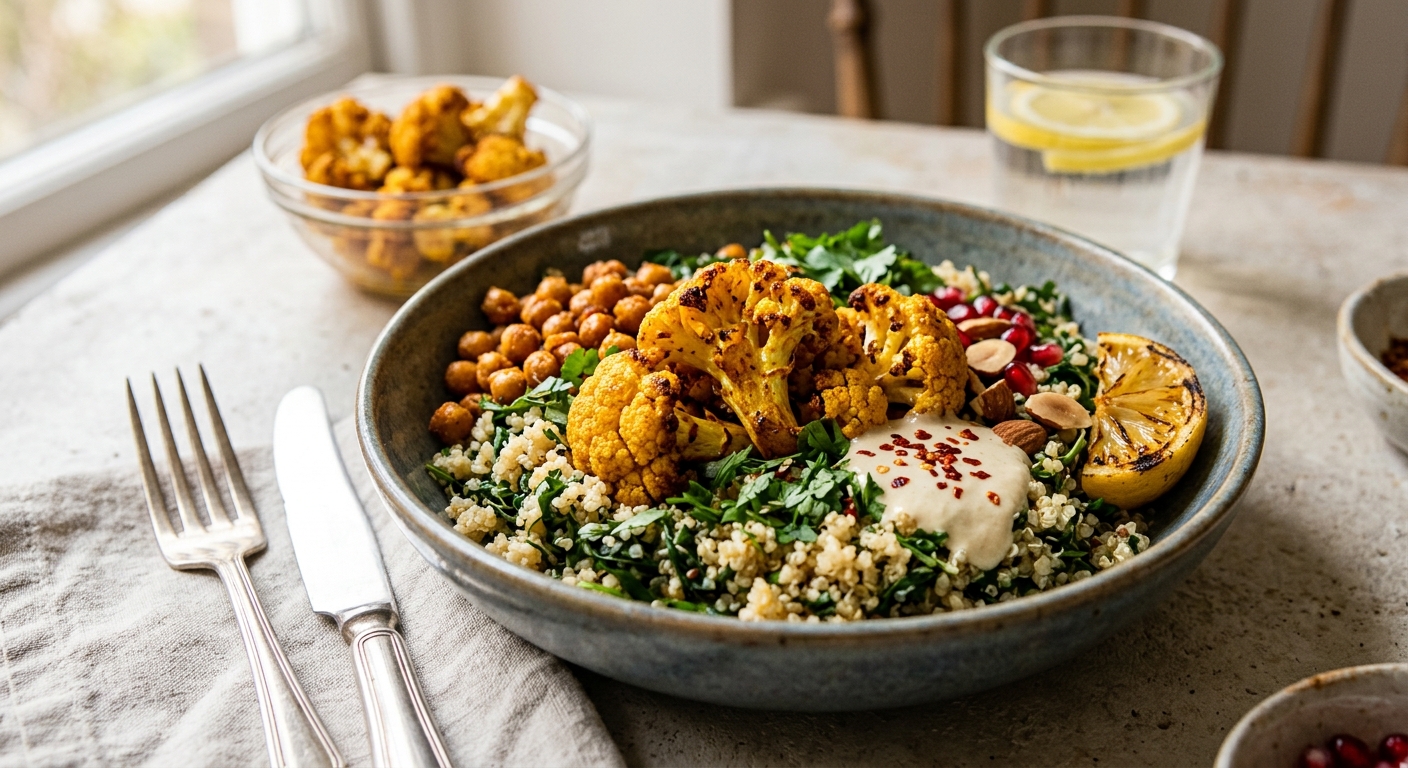
This Anti-Inflammatory Spice Blend Roasted Cauliflower Bowl was designed from the ground up with a single question: what would a bowl look like if you built it specifically to fight chronic, low-grade inflammation? The answer turned out to be one of the most satisfying, craveable meals in the Calibrated Cuisine repertoire. Cauliflower is the star, but it is the interplay of fat-soluble spices, a complete-protein grain base, and a finishing drizzle of tahini that transforms this from a simple vegetable dish into a genuinely therapeutic meal.
Cauliflower belongs to the Brassica family and contains glucosinolates that convert to isothiocyanates (including sulforaphane) upon chopping and cooking. Paired with turmeric’s curcumin, which has over 3,000 peer-reviewed studies behind it, black pepper’s piperine (shown to increase curcumin bioavailability by up to 2,000%), and anti-inflammatory gingerols from fresh ginger, this spice blend is not decorative. Each ingredient earns its place on the periodic table of this dish. The olive oil used to coat the cauliflower is equally intentional: fat dramatically increases absorption of fat-soluble curcuminoids and carotenoids from paprika.
Quinoa provides all nine essential amino acids, making this bowl completely plant-based yet rich in complete protein. Chickpeas add additional folate, iron, and resistant starch that feeds beneficial gut bacteria and blunts the glycemic response. The result is a bowl with a medium-low glycemic load, substantial fiber, and a nutrient density per calorie that is difficult to match in any cuisine. Whether you roast the cauliflower in a screaming-hot oven, build it slowly in a braised slow-cooker preparation, pressure-cook it into a fragrant golden stew, or char it in a skillet on the stovetop, each method produces a distinct and wonderful dish.
4
servings
Ingredients
- 900 gcauliflower (1 large head), cut into medium florets
- 240 gdry quinoa, rinsed well
- 400 gcanned chickpeas (1 can, 400g), drained and rinsed
- 4 tbspextra-virgin olive oil, divided
- 2 tspground turmeric
- 2 tspground cumin
- 1.5 tspsmoked paprika
- 1 tspground coriander
- 1 tspground ginger (or 1 tbsp freshly grated)
- 0.5 tspground cinnamon
- 0.5 tspfreshly ground black pepper
- 0.25 tspcayenne pepper
- 3 clovesgarlic, minced
- 1 mediumyellow onion, thinly sliced
- 400 mlvegetable broth, low-sodium
- 3 tbsptahini (sesame paste)
- 2 tbspfresh lemon juice
- 2 tbspwarm water (to thin tahini)
- 30 gfresh flat-leaf parsley, roughly chopped
- 20 gfresh cilantro leaves
- 60 gbaby spinach
- —Colima Sea SaltMicroplastic Free Salt and black pepper to taste
- —Lemon wedges to serve
- —Optional: pomegranate seeds or toasted pumpkin seeds to garnish
Instructions
Click on an item below to shop for the recommended items for this recipe on Amazon.
As an Amazon Associate, we earn from qualifying purchases.
- Cook the quinoa: Combine rinsed quinoa with 480ml of cold water and a pinch of salt in a medium saucepan. Bring to a boil over high heat, then reduce heat to low, cover tightly, and simmer for 14 to 15 minutes until all water is absorbed. Remove from heat and let steam, covered, for 5 minutes. Fluff with a fork and stir in baby spinach (it will wilt from residual heat). Keep warm.
- Make the spice blend: In a small bowl, combine turmeric, cumin, smoked paprika, coriander, ginger, cinnamon, black pepper, cayenne, and 1 teaspoon of fine sea salt. Stir until evenly mixed.
- Coat the cauliflower: In a large bowl, toss cauliflower florets with 2.5 tablespoons of olive oil and three-quarters of the spice blend until every surface is coated. Reserve the remaining spice blend for the chickpeas.
- Sear the cauliflower in batches: Heat a large (30cm) cast-iron skillet or heavy-bottomed pan over high heat until very hot, about 2 minutes. Add the oiled cauliflower in a single layer (work in 2 batches to avoid steaming). Cook without stirring for 3 to 4 minutes until deeply golden on the flat side, then toss and cook for another 2 to 3 minutes. The goal is char marks and caramelization. Transfer to a plate and repeat with the second batch.
- Sauté onion, garlic, and chickpeas: Lower the heat to medium. Add the remaining 1.5 tablespoons of olive oil to the same skillet. Add sliced onion and cook, stirring frequently, for 6 to 7 minutes until softened and golden. Add garlic and cook 1 minute more. Add drained chickpeas and the reserved spice blend. Stir to coat and cook for 3 to 4 minutes until chickpeas are lightly crisped at the edges.
- Deglaze and finish: Return the seared cauliflower to the skillet with the chickpea mixture. Pour in 120ml of vegetable broth to deglaze, scraping up any browned bits. Stir gently and cook for 2 to 3 minutes until the broth reduces to a glaze coating everything. Taste and adjust salt.
- Make the tahini drizzle: Whisk together tahini, fresh lemon juice, minced garlic (optional, from an extra raw clove), warm water, and a pinch of salt until smooth and pourable. If it seizes, add warm water one teaspoon at a time.
- Assemble the bowls: Divide the spinach-quinoa base among four bowls. Top with the spiced cauliflower and chickpea mixture. Drizzle generously with tahini sauce. Scatter parsley, cilantro, and optional pomegranate or pumpkin seeds over the top. Serve with lemon wedges alongside.
- Bloom the spices: In a small skillet over medium heat, warm 2 tablespoons of olive oil for 1 minute. Add the minced garlic and sliced onion, cook for 3 to 4 minutes until just softened. Add all the spices (turmeric, cumin, smoked paprika, coriander, ginger, cinnamon, black pepper, cayenne, and 1 teaspoon salt) and stir constantly for 60 seconds until the spices are fragrant and coat the onion. This critical step prevents raw-spice flavor in the finished dish. Transfer to the slow cooker insert.
- Load the slow cooker: Add the cauliflower florets and drained chickpeas to the slow cooker insert on top of the spiced onion mixture. Pour the full 400ml of vegetable broth over everything. Drizzle the remaining 2 tablespoons of olive oil over the top. Stir once gently to distribute, then lay the baby spinach over the surface (it will wilt down as it cooks).
- Cook low and slow: Place the lid on the slow cooker and cook on Low for 4 hours. Do not cook on High, as the cauliflower will turn to mush. At the 3.5-hour mark, check tenderness: florets should be fork-tender but still holding their shape. If there is excess liquid, remove the lid for the final 30 minutes to allow it to reduce into a concentrated sauce.
- Cook the quinoa: About 20 minutes before the slow cooker is done, cook the quinoa on the stovetop: combine rinsed quinoa with 480ml cold water and a pinch of salt in a saucepan. Bring to a boil, reduce to low, cover and cook 14 minutes. Remove from heat, rest 5 minutes, then fluff with a fork.
- Make the tahini drizzle and assemble: Whisk together tahini, fresh lemon juice, warm water, and a pinch of salt until silky and pourable. Divide cooked quinoa among four bowls. Spoon the braised cauliflower and chickpea mixture generously over the quinoa, including a ladle of the concentrated broth as a sauce. Drizzle with tahini, scatter fresh parsley and cilantro over the top, and serve with lemon wedges.
- Sauté the aromatics using the Sauté function: Set your Instant Pot or electric pressure cooker to Sauté on Normal. Add 2 tablespoons of olive oil and heat for 1 minute. Add the sliced onion and cook for 4 minutes, stirring occasionally, until softened. Add the minced garlic and all the spices (turmeric, cumin, smoked paprika, coriander, ginger, cinnamon, black pepper, cayenne, and 1 teaspoon salt). Stir continuously for 45 seconds until the spices are fragrant and clinging to the onion.
- Add remaining ingredients: Pour in the full 400ml of vegetable broth and stir, scraping the bottom of the insert thoroughly to lift any stuck spice bits (this prevents the Burn warning). Add the cauliflower florets and drained chickpeas. Stir gently to coat everything in the spiced broth. Do not add the quinoa to the pressure cooker: it will be cooked separately.
- Pressure cook: Secure the lid and set the steam release valve to Sealing. Cook on Manual (High Pressure) for 3 minutes. As soon as the timer sounds, perform a Quick Release by carefully switching the valve to Venting. Open the lid immediately once all steam has escaped. The cauliflower should be just fork-tender with slight resistance at the center.
- Reduce and finish: Switch back to Sauté mode on Low. Stir gently and simmer uncovered for 3 to 4 minutes to reduce the liquid to a light, glossy sauce that coats the vegetables. Stir in baby spinach and let it wilt for 1 minute. Taste and adjust salt. Cancel Sauté.
- Cook quinoa and assemble: While the Instant Pot is doing its pressure-release phase, cook quinoa on the stovetop: bring 480ml water with a pinch of salt to a boil in a saucepan, add rinsed quinoa, reduce to low, cover and cook 14 minutes, then rest 5 minutes. Whisk tahini, lemon juice, warm water, and a pinch of salt until smooth. Divide quinoa among four bowls, top with the spiced cauliflower and chickpea mixture and its sauce, drizzle liberally with tahini, and finish with fresh parsley, cilantro, and lemon wedges.
- Preheat and prep: Position two oven racks in the upper-middle and lower-middle positions. Preheat oven to 220C (425F) with convection if available (or 230C / 450F for a conventional oven). Line two large rimmed baking sheets with parchment paper.
- Season the cauliflower and chickpeas separately: In a large bowl, toss cauliflower florets with 2.5 tablespoons of olive oil and the full spice blend (turmeric, cumin, smoked paprika, coriander, ginger, cinnamon, black pepper, cayenne, and 1 teaspoon salt). In a separate small bowl, toss the drained and thoroughly dried chickpeas with the remaining 1.5 tablespoons of olive oil and a pinch of salt plus a pinch of the leftover spice blend. Patting chickpeas dry before seasoning is essential for crispiness.
- Roast at high heat: Spread the cauliflower in a single layer across one large baking sheet, ensuring florets are not touching. Spread chickpeas on the second baking sheet. Place cauliflower on the upper rack and chickpeas on the lower rack. Roast for 20 minutes without opening the oven.
- Flip and finish: After 20 minutes, remove both pans and flip the cauliflower florets using tongs. Stir the chickpeas. Return both pans to the oven, swapping their rack positions. Roast for another 10 to 15 minutes until the cauliflower is deeply golden with charred edges and the chickpeas are crispy and crunchy throughout.
- Cook the quinoa concurrently: While the vegetables roast, cook quinoa on the stovetop (see Stovetop method step 1). Sauté the sliced onion in a small skillet with 1 teaspoon olive oil over medium heat for 6 to 7 minutes until golden. Stir in the minced garlic for 1 minute. Add 120ml vegetable broth, simmer for 2 minutes to create a light pan sauce, and stir the roasted cauliflower into this sauce to glaze it briefly off the heat.
- Make tahini drizzle and assemble: Whisk tahini, lemon juice, warm water, and a pinch of salt to a smooth drizzleable sauce. Toss quinoa with baby spinach (the heat will wilt it). Divide quinoa among four bowls, pile on the glazed roasted cauliflower, spoon over crispy chickpeas, drizzle generously with tahini sauce, and garnish with fresh parsley, cilantro, pomegranate seeds, or toasted pumpkin seeds. Serve with lemon wedges.
Nutrition Breakdown
Per 1 serving (makes 4)
Vitamins & Minerals
% Daily Value based on a 2,000 calorie diet (FDA reference)
🧬 Essential Amino Acids
% of recommended daily intake (RDA) per serving
🛡 Antioxidant Profile
The Nutrition Science
The anti-inflammatory design of this bowl works through multiple distinct biochemical mechanisms, not a single compound. Curcumin from turmeric is the headline act: it inhibits nuclear factor kappa-B (NF-kB), a transcription factor that acts as a master regulator of the inflammatory response. When NF-kB is activated by oxidative stress, poor diet, or environmental toxins, it switches on the genes that produce pro-inflammatory cytokines including TNF-alpha, IL-1beta, and IL-6. Curcumin disrupts this process upstream. The black pepper in this spice blend is not just for flavor: piperine inhibits the glucuronidation enzyme that would otherwise rapidly clear curcumin from the bloodstream, extending its half-life and increasing serum concentration by a studied factor of up to 20-fold.
Cauliflower contributes glucosinolates, sulfur-containing compounds that are enzymatically converted by myrosinase (released when cauliflower is chopped) into isothiocyanates including sulforaphane. Sulforaphane activates the Nrf2 pathway, which upregulates the body’s own antioxidant defense enzymes including glutathione S-transferase and superoxide dismutase. This is an indirect but highly efficient antioxidant mechanism: rather than quenching one free radical at a time, Nrf2 activation can neutralize millions via enzymatic amplification. Cooking temperature matters here: high-heat roasting (the oven method) deactivates some myrosinase but the presence of gut bacteria partially compensates by hydrolyzing glucosinolates in the colon.
Quinoa and chickpeas combine to provide all nine essential amino acids with a PDCAAS (Protein Digestibility Corrected Amino Acid Score) approaching 0.85 together, making this a nutritionally complete plant-based protein source. The resistant starch in chickpeas (type 2 and 3) is fermented by Bifidobacterium and Lactobacillus species in the large intestine, producing short-chain fatty acids, particularly butyrate, which are themselves anti-inflammatory and serve as the primary fuel source for colonocytes. This gut-microbiome axis is increasingly recognized as a key modulator of systemic inflammation, meaning the benefits of this bowl extend well beyond the nutrients listed on any label.
Pro Tips
- Dry your chickpeas thoroughly before roasting or pan-cooking: moisture is the enemy of crispiness. Spread them on a clean kitchen towel and pat aggressively, or let them air-dry on the baking sheet for 10 minutes before oiling.
- For maximum curcumin bioavailability, ensure black pepper and a fat source (olive oil or tahini) are present in every serving. The fat dissolves curcuminoids and the piperine in black pepper slows their metabolic clearance by up to 2,000% according to research published in Planta Medica.
- If using fresh ginger instead of ground (recommended for maximum gingerol content), grate it on a microplane directly into the spice paste. One tablespoon of fresh ginger provides roughly four times the active gingerol content of half a teaspoon of dried ground ginger.
- Quinoa has a natural saponin coating that causes bitterness. Always rinse it in a fine-mesh strainer under cold running water for at least 60 seconds, rubbing with your fingers, until the water runs completely clear.
- Leftovers store beautifully: keep the quinoa base, cauliflower mixture, and tahini sauce in separate airtight containers in the refrigerator for up to 4 days. Reheat the cauliflower and chickpeas in a dry skillet over medium heat for 3 to 4 minutes to restore some texture, rather than microwaving.
okay this is calling my name because the vitamin c + iron combo is literally everything for someone like me trying to optimize absorption, and the fact that lemony chickpeas are already in there means youre not leaving it to chance. the tahini is such a smart play too since the calcium wont totally block the iron when youve got that much vitamin c doing the heavy lifting. gonna need to know if the lemon juice is fresh squeezed or if the recipe accounts for that, but either way im bookmarking this one for my next ferritin check!
This is such a thoughtful combo because you’re hitting on something that gets overlooked, especially in nutrition spaces that don’t center Black and Caribbean foodways, where chickpeas (and their cousins like black-eyed peas) have been doing this nutrient pairing work for centuries! The lemony acid + iron + plant compounds together is exactly why West African and Caribbean bean stews with citrus or vinegar are so functionally brilliant, and I love seeing it get that vitamin C breakdown here so people understand the *why* behind traditional flavor combos.
omg YES the lemon + iron combo is such a game changer, right?? i love that youre thinking about absorption because so many people just eat the nutrient and dont realize half of it wont even stick around without the right cofactors. my kids were actually anemic last year and our doctor was like “more iron isnt enough, you need vitamin c in the same meal” and this bowl is literally THAT. plus honestly the turmeric and ginger are gonna reduce inflammation so their little bodies can actually utilize everything better, and im obsessed with how this is basically a nutrient absorption masterclass disguised as a delicious lunch!