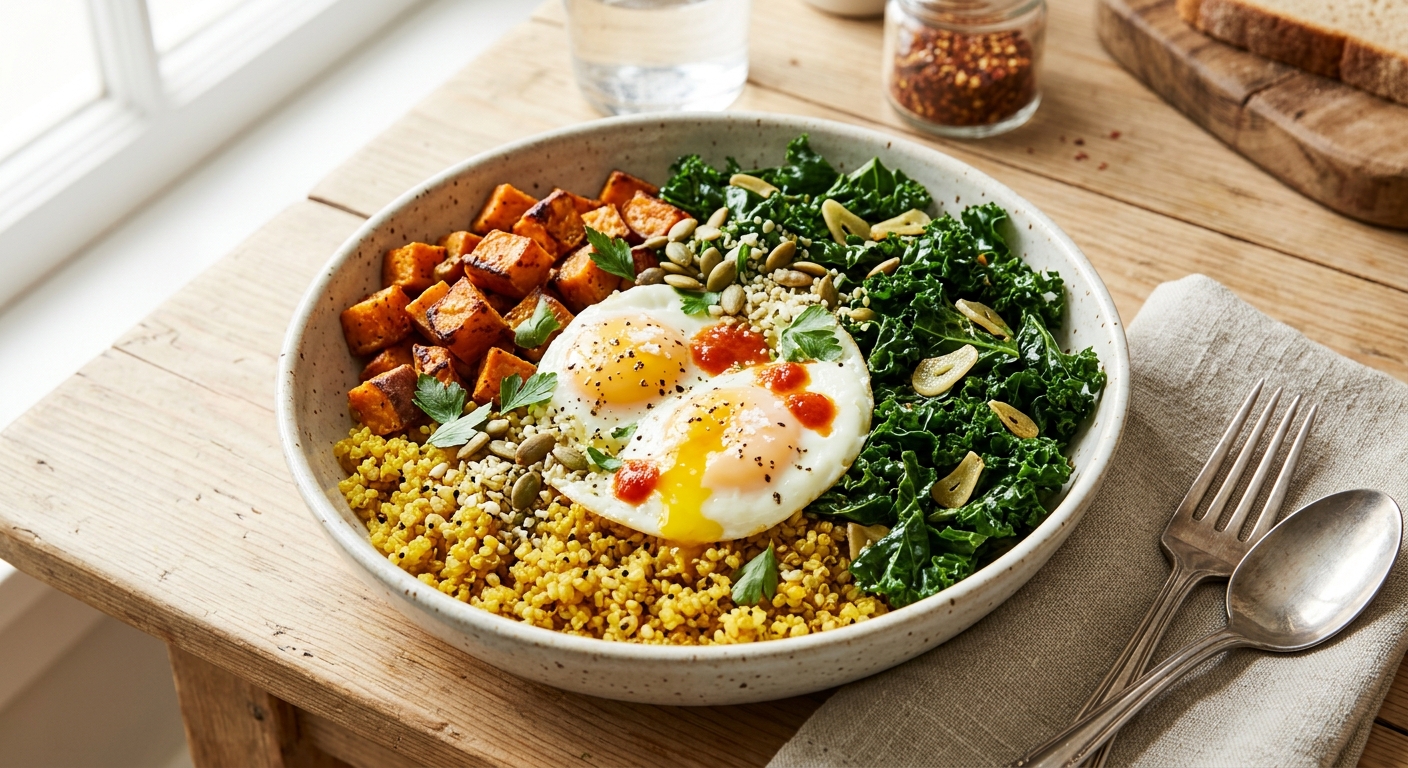
Your eyes have a favourite breakfast, and this is it. The macula, the central region of the retina responsible for sharp vision, is densely packed with two carotenoids: lutein and zeaxanthin. Research published in Nutrients and the landmark AREDS2 trial both identify dietary lutein and zeaxanthin as protective factors against age-related macular degeneration and cataracts. One serving of this bowl delivers approximately 12mg of lutein plus zeaxanthin, placing it comfortably above the 10mg daily threshold associated with meaningful macular pigment optical density gains.
The architecture of this bowl is intentional. Kale brings the lutein payload, but fat is required for carotenoid absorption. Extra-virgin olive oil and the yolk fat in the eggs solve that problem simultaneously, while the egg yolk itself contributes zeaxanthin in its most bioavailable form. Sweet potato layers in beta-carotene (provitamin A, essential for rhodopsin synthesis in rod photoreceptors), and turmeric-spiced quinoa adds curcumin, one of the most studied anti-inflammatory compounds in nutritional science. Every ingredient earns its place on the plate.
Beyond eye health, this bowl is a complete anti-inflammatory morning meal. The quercetin in kale, the selenium in eggs, the potassium in sweet potato, and the magnesium in quinoa collectively address oxidative stress, cortisol regulation, and low-grade systemic inflammation. With 28 grams of protein per serving and a medium-low glycemic load, it sustains energy and satiety without the glucose spike that undermines morning focus. This is precision nutrition that also happens to taste extraordinary.
4
servings
Ingredients
- 200 gquinoa, rinsed thoroughly
- 480 mllow-sodium vegetable broth
- 1 tspground turmeric
- 0.5 tspground black pepper (enhances curcumin absorption)
- 500 gsweet potato, peeled and cut into 1.5cm cubes
- 3 tbspextra-virgin olive oil, divided
- 300 gcurly kale, stems removed, leaves torn into bite-sized pieces
- 4 clovesgarlic, thinly sliced
- 1 tspchilli flakes (optional, for anti-inflammatory capsaicin)
- 8 largeeggs (pasture-raised preferred for higher yolk carotenoids)
- 2 tbspapple cider vinegar (for poaching, stovetop method)
- 30 gpumpkin seeds, toasted
- 1 mediumlemon, zested and juiced
- 2 tsptahini
- —Colima Sea SaltMicroplastic Free Salt and black pepper to taste
Instructions
Click on an item below to shop for the recommended items for this recipe on Amazon.
As an Amazon Associate, we earn from qualifying purchases.
- Cook the quinoa: combine rinsed quinoa, vegetable broth, turmeric, and black pepper in a medium saucepan. Bring to a boil over high heat, then reduce to a low simmer, cover with a tight-fitting lid, and cook for 15 minutes. Remove from heat and let steam, covered, for 5 minutes. Fluff with a fork and set aside warm.
- Sear the sweet potato: heat 1.5 tbsp olive oil in a large cast-iron or non-stick skillet over medium-high heat until shimmering. Add sweet potato cubes in a single layer, season with salt and pepper, and cook undisturbed for 4 minutes until a golden crust forms. Flip and cook a further 3 to 4 minutes until tender and caramelised on both sides. Transfer to a plate and tent loosely with foil.
- Wilt the kale: in the same skillet, reduce heat to medium and add the remaining 1.5 tbsp olive oil. Add sliced garlic and chilli flakes and cook for 60 to 90 seconds, stirring, until fragrant and just turning golden. Add kale in batches, tossing with tongs, allowing each addition to wilt slightly before adding more. Season with salt, squeeze in half the lemon juice, and cook for 3 to 4 minutes total until kale is tender but still vibrantly green. Remove from heat.
- Poach the eggs: fill a wide, deep saucepan or saute pan with at least 8cm of water and bring to a gentle simmer (approximately 90 degrees C, with small bubbles rising but no rolling boil). Add apple cider vinegar. Working in two batches of four, crack each egg into a small ramekin and slide it gently into the water near the surface. Cook for 3 minutes for a flowing yolk or 3.5 minutes for a just-set yolk. Remove with a slotted spoon and drain briefly on a clean kitchen towel.
- Make the tahini dressing: whisk together tahini, remaining lemon juice, lemon zest, 2 tbsp warm water, and a pinch of salt until smooth and pourable. Adjust consistency with additional water if needed.
- Assemble: divide turmeric quinoa among four warmed bowls. Arrange kale and sweet potato alongside each other over the quinoa. Nestle two poached eggs per bowl into the kale. Drizzle tahini dressing over everything, scatter toasted pumpkin seeds on top, and finish with a light grind of black pepper.
- Build the slow cooker base: spray the insert of a 5 to 6 litre slow cooker with olive oil spray. Add rinsed quinoa, vegetable broth, turmeric, black pepper, sweet potato cubes, sliced garlic, chilli flakes (if using), 2 tbsp olive oil, and a generous pinch of salt. Stir to combine, ensuring the quinoa is submerged in the broth. The liquid level should just cover the ingredients. Add up to 60ml additional water if needed.
- Cook low and slow: place the lid on the slow cooker and cook on High for 3 to 3.5 hours, or until quinoa is tender and all liquid has been absorbed. Do not open the lid during the first 2.5 hours, as this releases the steam needed to cook the quinoa. The sweet potato will become very tender and will partially break down, creating a natural, creamy texture in the base.
- Stir in the kale: once the quinoa and sweet potato base is cooked, remove the lid and stir in the torn kale leaves, lemon juice, and lemon zest. Re-cover and cook on High for a further 10 to 15 minutes until the kale is wilted and tender. Taste and adjust seasoning.
- Fry the eggs to order: heat the remaining 1 tbsp olive oil in a non-stick skillet over medium heat. Fry eggs in two batches of two to four (depending on pan size), basting the whites with the hot oil using a spoon for even setting. Cook for 2 to 3 minutes for a runny yolk with fully set whites. Season lightly with salt and pepper.
- Make the tahini dressing and assemble: whisk tahini with lemon zest, 2 tbsp warm water, and a pinch of salt until pourable. Spoon the kale-quinoa-sweet potato base into four bowls. Lay two fried eggs over each portion, drizzle generously with tahini dressing, scatter toasted pumpkin seeds over the top, and serve immediately.
- Layer the pressure cooker base: add rinsed quinoa, vegetable broth, turmeric, black pepper, sweet potato cubes, garlic, chilli flakes, 2 tbsp olive oil, and salt to the Instant Pot inner pot. Stir to combine. Place the trivet over the top of the ingredients.
- Prepare the eggs for pot-in-pot cooking: place all 8 eggs (still in their shells) directly onto the trivet in a single layer. They will steam-cook to a soft-boiled consistency as the quinoa and sweet potato cook under pressure.
- Pressure cook: secure the lid, set the valve to Sealing, and cook on Manual High Pressure for 1 minute. Allow a full natural pressure release for 12 minutes, then carefully switch the valve to Venting to release any remaining pressure. Remove the lid, lifting it away from you to avoid the steam.
- Peel the eggs and wilt the kale: carefully transfer the eggs to a bowl of cold water for 2 minutes using tongs, then peel. Remove the trivet. Stir kale, lemon juice, and lemon zest into the hot quinoa base, replacing the lid for 3 to 4 minutes off heat (residual heat will wilt the kale). The kale retains its bright colour and most of its lutein because it is not exposed to prolonged high heat.
- Make the tahini dressing and assemble: whisk tahini with warm water, lemon zest, and a pinch of salt until smooth. Fluff the quinoa-sweet potato-kale mixture with a fork and divide among four bowls. Halve the soft-boiled eggs and nestle four halves per bowl into the greens. Drizzle with tahini dressing, top with toasted pumpkin seeds, and serve immediately while warm.
- Preheat and roast the sweet potato: preheat the oven to 220 degrees C (200 degrees C fan). Toss sweet potato cubes with 1.5 tbsp olive oil, a generous pinch of salt, and black pepper on a large rimmed baking sheet. Spread into a single layer with space between pieces. Roast on the top third rack for 25 to 30 minutes, flipping once at the 15-minute mark, until deeply golden and caramelised at the edges.
- Cook the turmeric quinoa in parallel: while the sweet potato roasts, combine quinoa, vegetable broth, turmeric, and black pepper in a medium saucepan on the stovetop. Bring to a boil, reduce to a low simmer, cover, and cook for 15 minutes. Rest off the heat for 5 minutes, then fluff with a fork.
- Roast the kale: about 12 minutes before the sweet potato finishes, toss kale with the remaining 1.5 tbsp olive oil, sliced garlic, chilli flakes, a pinch of salt, and lemon juice directly on a second baking sheet. Spread evenly. Slide the kale sheet onto the lower rack of the oven and roast for 8 to 10 minutes until the edges are lightly crisped and the stems are just tender. Watch carefully as kale can go from crisp to bitter-burnt quickly.
- Bake the eggs: reduce oven temperature to 190 degrees C (170 degrees C fan). Lightly oil four small oven-safe ramekins or a muffin tin. Crack two eggs into each ramekin. Season with salt and pepper. Bake for 10 to 12 minutes for runny yolks or 13 to 14 minutes for softly set yolks. The whites should be fully opaque. Remove from the oven and rest for 1 minute before serving.
- Make the tahini dressing and assemble: whisk tahini, lemon zest, warm water, and salt together until a pourable consistency is achieved. Divide quinoa among four bowls, pile roasted kale alongside, and add a portion of sweet potato. Slide two baked eggs from each ramekin over the top, drizzle generously with tahini dressing, scatter pumpkin seeds across the bowl, and finish with black pepper and lemon zest.
Nutrition Breakdown
Per 1 serving (makes 4)
Vitamins & Minerals
% Daily Value based on a 2,000 calorie diet (FDA reference)
🧬 Essential Amino Acids
% of recommended daily intake (RDA) per serving
🛡 Antioxidant Profile
The Nutrition Science
The lutein and zeaxanthin in this bowl operate as a biological sunscreen inside your eyes. These two xanthophyll carotenoids are selectively transported across the blood-retina barrier and deposited in the macula at concentrations up to 1,000 times higher than in blood plasma. They absorb blue light wavelengths (415 to 455nm) before those photons can generate singlet oxygen and hydroxyl radicals in the polyunsaturated fat-rich photoreceptor membranes. The AREDS2 study demonstrated that supplementation with 10mg lutein and 2mg zeaxanthin daily reduced the risk of advanced age-related macular degeneration by 26% in high-risk individuals. One serving of this bowl provides that threshold dose from whole food sources, where the carotenoids are embedded in a food matrix with co-present fats that drive significantly higher bioavailability than isolated supplements.
The piperine in black pepper is not decorative here. Studies show that 20mg of piperine, present in approximately half a teaspoon of black pepper, increases curcumin bioavailability from turmeric by up to 2,000% by inhibiting intestinal CYP3A4 enzymes and P-glycoprotein efflux that would otherwise rapidly clear curcumin from circulation. This recipe deliberately pairs turmeric and black pepper in the quinoa base. Curcumin acts on multiple inflammatory pathways simultaneously: it downregulates NF-kB (the master switch for inflammatory gene expression), inhibits COX-2 (the same enzyme targeted by ibuprofen), and suppresses production of interleukin-6, a cytokine strongly associated with both chronic low-grade inflammation and macular degeneration progression.
The choline content of this bowl (approximately 280mg per serving from two eggs) deserves specific attention for eye health. Choline is a structural component of phosphatidylcholine, a dominant phospholipid in photoreceptor outer segment membranes. Adequate dietary choline is also necessary for the hepatic synthesis of VLDL, the lipoprotein that transports lutein from the gut to peripheral tissues including the retina. In short, the egg yolks in this bowl serve triple duty: delivering zeaxanthin directly, providing the fat needed to absorb kale’s lutein, and supplying the choline needed to package and transport those carotenoids to the tissues that need them most.
Pro Tips
- Do not substitute kale with spinach if maximising lutein is the goal. Curly kale provides approximately 11mg of lutein per 100g raw, compared to 7mg in spinach. Cooked weight concentrates this further, and the fibrous cell walls of kale are partially broken down by heat and fat, significantly improving carotenoid extraction during digestion.
- Use pasture-raised eggs whenever possible. Research from Penn State found that pasture-raised hens produce eggs with up to 38mg of lutein plus zeaxanthin per yolk compared to under 10mg in conventional eggs, a direct reflection of the carotenoid-rich grasses and insects in their diet. The difference in yolk colour (deep orange versus pale yellow) is a reliable proxy for carotenoid concentration.
- Tahini is not merely flavour here. Sesame paste provides an additional 1.4mg of zinc and 0.5mg of iron per two-teaspoon serving, and its sesamin lignans have demonstrated synergistic anti-inflammatory activity alongside curcumin in vitro. Make the tahini dressing immediately before serving to preserve the sesame polyphenols that begin oxidising on contact with lemon juice.

This looks like exactly the kind of intentional layering I’ve been trying to build into my own breakfasts, especially since lutein is one of those compounds that seems to support both eye health and neuroinflammation markers. I’m really glad you highlighted the egg and kale pairing because the bioavailability difference between getting zeaxanthin from eggs versus plant sources has actually made a noticeable difference for me. Quick question though, do you have thoughts on whether the fat content in the egg yolk is essential for absorbing those carotenoids, or would a version with egg whites still work? I’m always trying to maximize nutrient density without overdoing saturated fat.
This is such a beautifully thoughtful approach to eye health, and I love how you’ve layered the lutein, zeaxanthin, and beta-carotene together. I’m curious though, do you include black pepper with that turmeric in the quinoa? In Ayurvedic practice, we always pair them together because the piperine in black pepper dramatically increases curcumin absorption, and it feels like such a missed opportunity for bioavailability when they’re separated. I make a similar bowl most mornings and adding that black pepper layer (plus a tiny pinch of raw honey to cool the warming spices) has genuinely transformed how my eyes feel by afternoon, especially after teaching
omg YES to the black pepper tip, i didnt know that about the piperine boosting curcumin absorption but that makes so much sense! im definitely adding that to my rotation because honestly im always looking for ways to maximize nutrient uptake, especially when im sneaking these bowls into my kids lunches. the honey detail is genius too because my youngest will actually eat turmeric quinoa if its slightly sweet rather than just spicy. im also wondering if you’ve experimented with adding any magnesium rich stuff like pumpkin seeds on top? because combined with what youre already doing with the lutein and zeaxanthin, that could be such a powerhouse anti inflammatory plate for those long