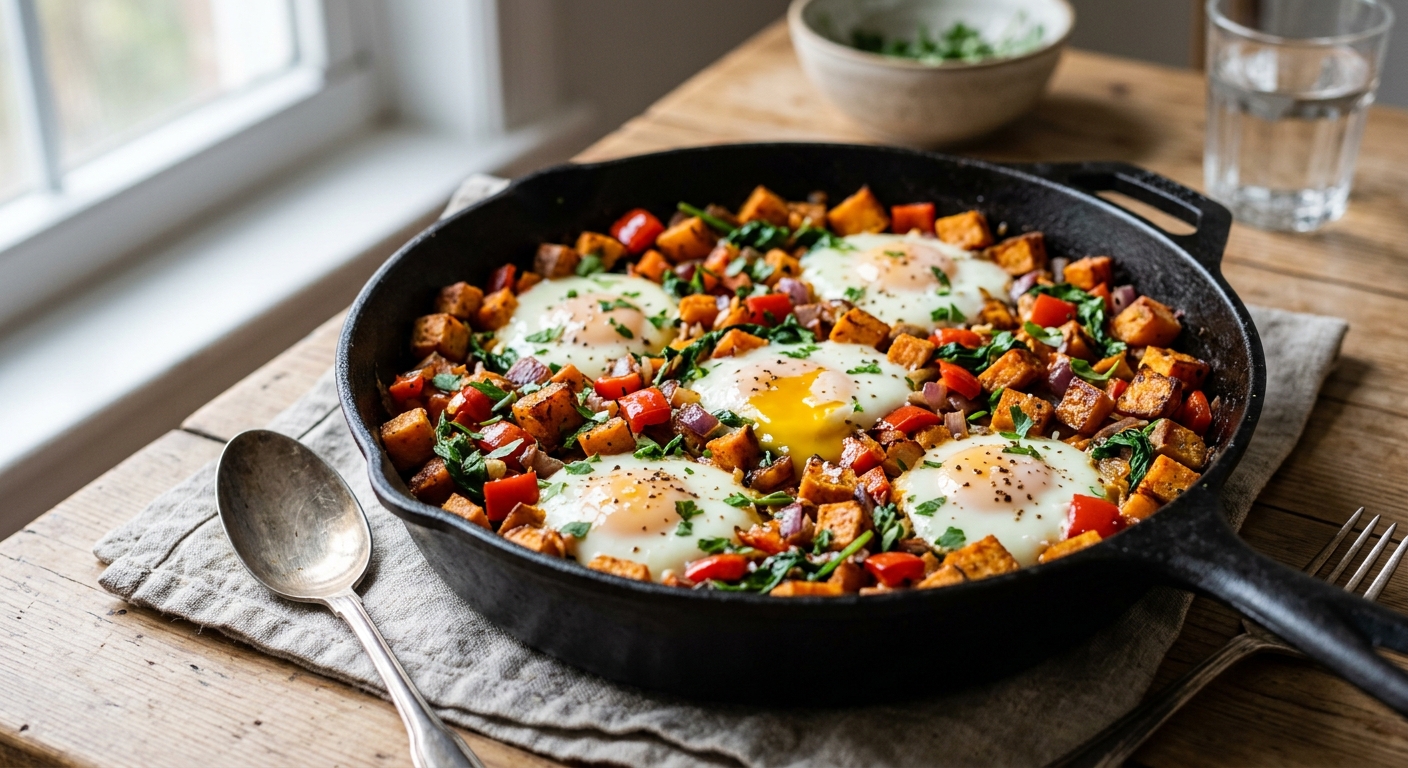
Breakfast is the meal most likely to be rushed, simplified, or skipped entirely, and yet it is also the meal with the greatest opportunity to front-load your micronutrient intake for the day. This Egg and Sweet Potato Breakfast Hash was designed from the ingredient list outward, pairing the two most concentrated everyday sources of biotin, whole eggs and sweet potato, with a supporting cast of bell pepper, red onion, baby spinach, and smoked paprika that collectively turn a humble skillet dish into a genuine nutritional event. The result is a breakfast that looks and tastes like something from a weekend brunch menu but performs like a precision supplement stack.
Sweet potatoes bring far more than their famous beta-carotene to this dish. They are a meaningful source of biotin, providing roughly 2.4 mcg per 100 g cooked, and their natural sweetness caramelises beautifully against a hot cast iron surface, creating those lacquered, slightly charred edges that make hash so craveable. Eggs contribute the lion’s share of the biotin here, with one large egg delivering approximately 10 mcg, and they also supply choline, selenium, and all nine essential amino acids in a highly bioavailable package. Together, these two ingredients achieve a nutritional synergy that neither could accomplish alone.
What sets this recipe apart technically is the deliberate two-stage cooking process: sweet potato cubes are par-cooked first to achieve a fully tender interior, then left undisturbed in a hot pan long enough to develop a genuine crust before the aromatics and eggs are introduced. Whether you use a cast iron skillet on the stovetop, a sheet pan in the oven, a slow cooker for a hands-off morning, or a pressure cooker for maximum speed, each method has been engineered to protect the eggs from overcooking while still achieving that characteristic hash texture. Every technique note below reflects how heat behaves differently in each vessel and adjusts accordingly.
4
servings
Ingredients
- 600 gsweet potatoes, peeled and cut into 1.5 cm dice
- 8 largefree-range eggs
- 1 largered bell pepper, seeded and cut into 1 cm dice
- 1 mediumred onion, finely diced
- 3 clovesgarlic, minced
- 90 gbaby spinach, roughly chopped
- 3 tbspextra-virgin olive oil
- 1.5 tspsmoked paprika
- 0.5 tspground cumin
- 0.25 tspcayenne pepper
- 2 tbspfresh flat-leaf parsley, finely chopped
- 1 tbspfresh chives, thinly sliced
- —Colima Sea SaltMicroplastic Free Salt and freshly cracked black pepper to taste
Instructions
Click on an item below to shop for the recommended items for this recipe on Amazon.
As an Amazon Associate, we earn from qualifying purchases.
- Bring a medium saucepan of well-salted water to a rolling boil. Add the diced sweet potato and par-cook for 6 minutes, until just barely fork-tender but still holding their shape firmly. Drain immediately and spread on a clean kitchen towel or paper towels for at least 3 minutes; dry potato cubes crust far more effectively than wet ones.
- Heat 2 tablespoons of the olive oil in a large cast iron skillet over medium-high heat until shimmering and just beginning to smoke. Add the par-cooked sweet potato in a single layer, pressing them gently down with a spatula. Season generously with salt, pepper, smoked paprika, cumin, and cayenne. Leave completely undisturbed for 4 to 5 minutes until a deep golden crust forms on the underside. Toss once, then cook for another 3 to 4 minutes to crust a second side.
- Push the sweet potato to the outer edges of the pan. Add the remaining 1 tablespoon of olive oil to the centre, then add the red onion and bell pepper. Cook over medium heat, stirring the aromatics frequently while leaving the potato largely undisturbed, for 4 to 5 minutes until the onion is translucent and the pepper is softened and lightly charred at the edges. Add the minced garlic and stir for 60 seconds until fragrant.
- Fold the baby spinach into the hash and toss everything together until the spinach is just wilted, about 90 seconds. Taste and adjust seasoning. Use a spoon to create 8 shallow wells evenly spaced across the hash, pressing the vegetables slightly aside to expose the pan surface at the base of each well.
- Crack one egg into each well. Reduce the heat to medium-low, cover the skillet with a tight-fitting lid or a sheet of aluminium foil, and cook for 4 to 5 minutes for set whites with runny yolks, or 6 to 7 minutes for fully set yolks. Remove from heat immediately. Scatter parsley and chives over the top and serve directly from the pan.
- Preheat the oven to 220 C (200 C fan, Gas Mark 7). Line a large rimmed baking sheet with parchment paper. Place the raw diced sweet potato on the sheet, drizzle with 2 tablespoons of olive oil, and toss with smoked paprika, cumin, cayenne, salt, and pepper until evenly coated. Spread into a single, uncrowded layer. Roast on the centre rack for 18 minutes without touching, allowing the undersides to caramelise against the hot pan.
- Remove the baking sheet from the oven. Scatter the diced red onion and bell pepper over the sweet potato, drizzle with the remaining tablespoon of olive oil, and toss gently. Return to the oven for another 10 minutes, until the onion is soft and the pepper edges are lightly blistered.
- Remove the sheet again and scatter the minced garlic and chopped baby spinach over the vegetables. Toss briefly so the spinach begins to wilt from the residual heat of the roasted vegetables. Spread everything back into an even layer.
- Create 8 wells in the hash by pressing a spoon into the vegetable mixture. Crack one egg carefully into each well, keeping the yolks intact. Season the eggs lightly with salt and pepper. Return the sheet to the oven and bake for 6 to 8 minutes until the egg whites are fully opaque and set but the yolks remain soft and jammy. Watch carefully from the 5-minute mark, as oven-baked eggs can overcook quickly.
- Remove from the oven, rest for 2 minutes, then scatter generously with fresh parsley and chives. Portion into four servings directly from the sheet pan at the table.
- Lightly grease the insert of a 5 to 6 litre slow cooker with a small amount of olive oil or cooking spray. Combine the raw diced sweet potato, diced red onion, bell pepper, and minced garlic directly in the insert. Drizzle with 2 tablespoons of olive oil and sprinkle over the smoked paprika, cumin, cayenne, salt, and pepper. Toss well so every piece is evenly coated.
- Spread the vegetables into an even layer as much as possible. Place the lid on the slow cooker and cook on High for 2.5 to 3 hours, until the sweet potato is fully tender and has absorbed the spiced oil. There is no need to stir during this time.
- Remove the lid. Scatter the chopped baby spinach across the top of the cooked vegetables and stir gently to incorporate. The spinach will wilt almost immediately from the residual heat. Spread the hash back into an even layer.
- Using the back of a spoon, create 8 shallow wells in the hash, pressing firmly down to the bottom of the insert. Crack one egg into each well. Replace the lid and cook on High for a further 25 to 35 minutes, checking at the 25-minute mark. Slow cooker eggs cook more gently and evenly than stovetop eggs; whites should be fully set and yolks will be medium-soft. Avoid lifting the lid before 25 minutes to prevent heat loss.
- Once the eggs are set to your preference, turn the slow cooker to Warm. Season the eggs with a pinch of salt and black pepper, then finish with a generous scattering of fresh parsley and chives. Serve directly from the insert.
- Select the Saute function on your Instant Pot or electric pressure cooker and set to High (or use the stovetop on medium-high for a stovetop pressure cooker). Add 2 tablespoons of olive oil. Once shimmering, add the diced red onion and bell pepper and cook, stirring frequently, for 3 minutes until softened and fragrant. Add the garlic and stir for 30 seconds. Press Cancel to turn off the Saute function.
- Add the raw diced sweet potato to the pot along with the smoked paprika, cumin, cayenne, salt, and pepper. Pour in 60 ml of water to create the steam needed for pressurisation. Stir everything together to distribute the spices. Secure the lid and set the pressure valve to Sealing.
- Cook on Manual High Pressure for 4 minutes. When the cycle completes, perform a Quick Release by carefully switching the valve to Venting. Wait for all steam to fully exhaust before opening the lid. The sweet potato should be tender and infused with the spiced aromatics; there will be a small amount of liquid in the base of the pot.
- Select the Saute function again on Normal or Medium heat. Stir the chopped baby spinach into the hash and fold until wilted, about 60 seconds. Allow any excess liquid to cook off for 1 to 2 minutes so the base of the hash begins to sizzle. Add the remaining tablespoon of olive oil around the edges of the pot to encourage crisping.
- Create 8 wells in the hash and crack one egg into each. Drape a sheet of aluminium foil loosely over the top of the insert (do not lock the lid, as pressure must not build during this stage). Cook for 5 to 7 minutes on Saute Normal until the whites are fully set and the yolks are cooked to your liking. Check frequently and press Cancel as soon as the eggs reach your preferred doneness. Finish with salt, pepper, parsley, and chives, then serve immediately.
Nutrition Breakdown
Per 1 serving (makes 4)
Vitamins & Minerals
% Daily Value based on a 2,000 calorie diet (FDA reference)
🧬 Essential Amino Acids
% of recommended daily intake (RDA) per serving
🛡 Antioxidant Profile
The Nutrition Science
Biotin, also called vitamin B7, is a water-soluble cofactor essential for five carboxylase enzymes that govern fatty acid synthesis, gluconeogenesis, and the catabolism of branched-chain amino acids. Despite its critical role, biotin rarely appears in conversations about micronutrient sufficiency, partly because clinical deficiency is rare in populations eating whole foods and partly because it tends to be overshadowed by more famous B vitamins like folate and B12. This recipe deliberately brings biotin to the foreground. Two whole eggs provide approximately 20 mcg of biotin, and 150 g of cooked sweet potato contributes a further 4.8 mcg. Combined with smaller amounts from spinach and red bell pepper, each serving lands at roughly 47 mcg, exceeding the Adequate Intake of 30 mcg set by the Institute of Medicine. It is worth noting that consuming eggs cooked rather than raw is essential: raw egg whites contain avidin, a glycoprotein that binds biotin in the intestine with extraordinary affinity and renders it completely unabsorbable. Cooking denatures avidin fully, restoring complete biotin bioavailability from the yolk.
The choline content of this dish deserves equal attention. Each serving provides approximately 310 mg of choline, principally from egg yolks (one large egg contains roughly 147 mg). Choline is the metabolic precursor to acetylcholine, the neurotransmitter governing memory consolidation and neuromuscular signalling, and to phosphatidylcholine, the dominant phospholipid in all mammalian cell membranes. Despite its foundational importance, surveys consistently show that over 90% of Americans fail to meet the Adequate Intake of 550 mg per day for men and 425 mg for women. Two eggs at breakfast, as served here, puts most adults well past the female AI and within easy reach of the male target with a single meal.
The fat profile of this dish is also strategically relevant. The olive oil and egg yolks together deliver primarily monounsaturated and polyunsaturated fats alongside the fat-soluble vitamins A, K, and the carotenoids beta-carotene, lutein, and zeaxanthin. Fat-soluble micronutrients require dietary fat present in the same meal for efficient micellar absorption in the small intestine. Research published in the American Journal of Clinical Nutrition demonstrated that consuming carotenoid-rich vegetables with whole eggs rather than egg whites or no fat increased beta-carotene absorption by up to 4.6-fold and lutein absorption by over 9-fold. The egg yolks in this hash are therefore not merely a protein source; they are a bioavailability amplifier for the sweet potato and spinach sitting beside them in the pan.
Pro Tips
- Dry your par-cooked sweet potato cubes thoroughly before they hit the pan. Surface moisture creates steam that prevents the Maillard reaction from occurring, and you will end up with soft, pale potato instead of the caramelised crust that defines a proper hash. Spread them on a clean towel for at least 3 minutes after draining.
- For perfect oven-baked or skillet eggs, crack each egg into a small ramekin first before sliding it into its well. This lets you catch any broken yolks and gives you precise placement control, which matters in a crowded hash where misplaced whites can merge and cook unevenly.
- Smoked paprika loses potency quickly once opened. If your paprika has been in the spice cabinet for more than six months, bloom it in the warm olive oil for 30 seconds before adding the vegetables, which extracts the remaining fat-soluble flavour compounds and revives its smokiness considerably.
This is exactly the kind of careful micronutrient pairing I’ve been looking for, honestly. The biotin and choline combination is particularly interesting for me because I’ve noticed they work synergistically with B12 absorption, and combining them with the spinach’s folate in one meal means my body isn’t scrambling to process everything separately throughout the day. Greta’s question about fiber and egg absorption really resonates too, since I’ve learned that the timing and ratio matter more than most people realize. Thank you for building recipes with this level of intentionality around how nutrients actually interact in our bodies, not just hitting individual percentages.
This sounds like such a nourishing combo! I love that you’re thinking about how fiber and choline interact, Greta – that’s the kind of nuanced nutrient pairing that really matters. One heads up from my own experience: I have a rare sulfur metabolism issue, so I’d probably swap out the spinach for something like arugula or romaine to keep things gentle for my system, but for most people that spinach is going to be a nutrient goldmine. The eggs, sweet potato, and bell pepper combo is honestly something I come back to all the time because it’s so well-tolerated and bioavailable for me. Curious if you end up testing how the hash affects your
Oh wow, I’m so intrigued by the biotin angle here – I don’t see that micronutrient highlighted nearly enough! Quick question though: how does the sweet potato’s fiber content interact with the egg absorption, especially the choline? I’ve been tracking this exact combo in my food diary for about three months now (whole eggs plus complex carbs) and noticed it made a huge difference in my IBS flare patterns compared to eggs alone. The spinach addition is *chef’s kiss* for me too – those prebiotic compounds have been game-changing for my gut inflammation markers. Definitely trying this version with the paprika since I’m always looking for anti-inflammatory seasonings that actually have depth!