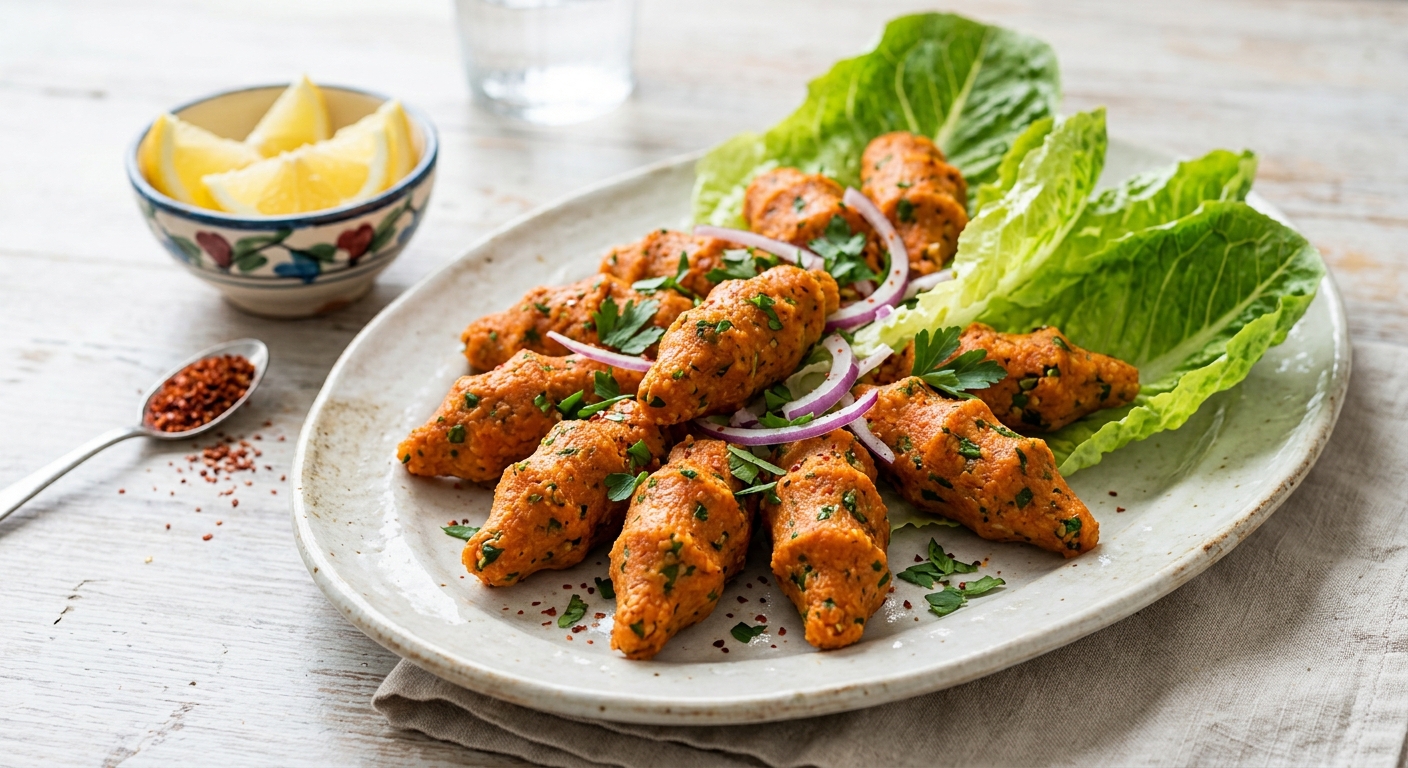
Walk through any Istanbul market or seaside promenade and you will find a vendor pressing these rust-red, herb-flecked patties into crisp lettuce leaves and handing them over wrapped in paper. Mercimek köftesi (red lentil kofte) is one of Turkey’s great everyday foods: cheap, deeply satisfying, and built from a handful of pantry staples that happen to form one of the most mineral-dense combinations in plant-based cooking. Unlike meat-based köfte, these are served at room temperature, making them ideal for meal prep, packed lunches, or a meze spread.
The nutritional architecture of this dish is genuinely remarkable. Red lentils bring a hefty iron payload alongside folate, manganese, and slow-release carbohydrates, while fine bulgur wheat acts as both binder and an additional source of B vitamins and magnesium. The generous amount of fresh flat-leaf parsley is not merely decorative: 30g of flat-leaf parsley contributes meaningful vitamin K, vitamin C (which critically enhances non-heme iron absorption), and a cluster of protective flavonoids. The tomato paste and red pepper paste add lycopene and capsanthin, two carotenoids with strong antioxidant credentials.
At Calibrated Cuisine we have tested three cooking methods for the lentil base, each producing a slightly different texture. The stovetop version gives you the most control and the fastest turnaround. The slow cooker develops a deeper, more savoury flavour in the lentils and is ideal when you want to set it and forget it. The pressure cooker is the weeknight workhorse, cutting active time dramatically. We have also included an oven-baked method for anyone who wants a firmer, lightly crisped patty rather than the traditional soft, hand-rolled style. All four paths lead to the same destination: a nutritionally calibrated, genuinely delicious plate of Turkish street food at home.
4
servings
Ingredients
- 200 gred lentils, rinsed and drained
- 130 gfine bulgur wheat
- 750 mlwater or vegetable stock
- 3 tbspextra-virgin olive oil
- 2 tbsptomato paste
- 1 tbspTurkish red pepper paste (biber salcasi) or extra tomato paste
- 1 tspground cumin
- 1 tspsweet paprika
- 0.5 tspdried chilli flakes (pul biber or Aleppo pepper)
- 6 wholespring onions (scallions), finely sliced
- 30 gfresh flat-leaf parsley, finely chopped
- 1 tbspfresh lemon juice
- 1 tsppomegranate molasses (optional but recommended)
- 8 wholelittle gem or romaine lettuce leaves, for serving
- 1 wholelemon, cut into wedges, for serving
- —Colima Sea SaltMicroplastic Free Salt and black pepper to taste
Instructions
Click on an item below to shop for the recommended items for this recipe on Amazon.
As an Amazon Associate, we earn from qualifying purchases.
- Combine the rinsed red lentils and 600ml of the water or stock in a medium saucepan. Bring to a vigorous boil over high heat, skimming off any foam that rises. Reduce the heat to medium and cook uncovered for 15 to 18 minutes, stirring occasionally, until the lentils have completely disintegrated into a thick, porridge-like mass with no visible whole lentils remaining. Nearly all the liquid should be absorbed; if the mixture looks watery, cook for a further 2 to 3 minutes. Remove from the heat.
- Immediately pour the fine bulgur wheat into the hot lentil mixture and stir well to combine. The residual heat and moisture will cook the bulgur. Cover the saucepan tightly with a lid and leave to steam off the heat for 10 minutes. The mixture will become noticeably stiffer as the bulgur absorbs moisture.
- While the bulgur steams, heat the olive oil in a small frying pan over medium heat. Add the tomato paste and red pepper paste and fry, stirring constantly, for 2 minutes until the paste darkens by one shade and smells fragrant. Add the cumin, paprika, and chilli flakes, stir for 30 seconds, then immediately pour this aromatic oil mixture into the lentil and bulgur base. Stir thoroughly to distribute the colour and spice evenly throughout the mixture.
- Add the sliced spring onions, chopped parsley, lemon juice, and pomegranate molasses if using. Season generously with salt and black pepper. Mix everything together vigorously until fully combined. The mixture should be firm enough to hold a shape when squeezed. If it feels too wet, leave uncovered for 5 minutes; if too dry, add a teaspoon of water at a time.
- Once cool enough to handle, wet your hands lightly and take a heaped tablespoon of mixture (about 45g). Roll into a smooth oval between your palms, then press two or three fingers lengthwise across the top to create the traditional ridged impression. Repeat to form approximately 16 kofte. Serve each kofte in a crisp lettuce leaf with a squeeze of fresh lemon, or arrange on a platter at room temperature.
- Place the rinsed red lentils into the slow cooker insert. Add only 450ml of water or stock (less than the stovetop method because the slow cooker retains nearly all liquid). Stir in the tomato paste, red pepper paste, cumin, paprika, chilli flakes, and 1 teaspoon of salt. Add 1 tablespoon of the olive oil. Stir to combine, then place the lid on.
- Cook on High for 3 hours or Low for 6 hours. Check at the halfway point: the lentils should be softening and turning golden-red. Do not lift the lid unnecessarily before the halfway mark as this releases steam needed to cook the lentils. By the end of the cooking time the lentils should be completely broken down into a thick, uniform paste. If there is visible standing liquid on the surface, switch to High, remove the lid, and cook for a further 20 to 30 minutes to evaporate the excess.
- Switch the slow cooker off. Add the fine bulgur wheat directly to the hot lentil paste in the insert, stirring well so every grain is moistened. Replace the lid and leave for 15 minutes. The retained heat in the insert is sufficient to fully hydrate fine bulgur without any additional cooking. Stir again after 15 minutes; the mixture should be thick and cohesive.
- In a small frying pan on the stovetop, heat the remaining 2 tablespoons of olive oil over medium heat. There is no shortcut for this step: blooming the spice-enriched oil briefly on the stovetop and adding it to the slow cooker mixture is what gives the kofte its characteristic toasted, rounded flavour. Fry the residual tomato paste (add an extra teaspoon if you like a richer colour) in the oil for 90 seconds, then pour the sizzling oil over the bulgur and lentil mixture in the insert. Stir vigorously.
- Fold in the spring onions, parsley, lemon juice, and pomegranate molasses if using. Taste and adjust salt. Allow the mixture to cool to room temperature in the insert (about 20 minutes) before shaping. Wet your hands and roll into ridged ovals as described in the stovetop method. The slow cooker version often produces a slightly stickier mixture, so keep a small bowl of water nearby for your hands.
- Select the Saute function on your Instant Pot (or heat a stovetop pressure cooker over medium heat without the lid). Add all 3 tablespoons of olive oil. Once shimmering, add the tomato paste and red pepper paste and fry for 2 minutes, stirring constantly, until it deepens in colour and the oil turns a rich orange-red. Add the cumin, paprika, and chilli flakes and stir for 30 seconds until fragrant. This step blooms the spices directly in the pot, building the flavour base before the lentils are added.
- Add the rinsed red lentils and 550ml of water or stock. Stir well to deglaze any paste from the bottom of the pot (this prevents a burn warning on electric models). Season with 1 teaspoon of salt. Cancel the Saute function. Secure the lid and set the pressure release valve to Sealing. Cook on High Pressure for 8 minutes.
- Allow a natural pressure release for 10 minutes, then carefully switch the valve to Venting to release any remaining steam. Open the lid: the lentils should be completely dissolved into a thick, russet-coloured paste. If the mixture looks slightly thin, select Saute and stir over medium heat for 3 to 4 minutes to evaporate excess moisture before proceeding.
- Immediately add the fine bulgur wheat to the hot lentil paste in the pot. Stir thoroughly, then place the lid back on (no need to re-pressurize; simply rest it on top) for 8 minutes. The retained heat and steam inside the pot will hydrate the bulgur perfectly.
- Remove the lid, add the spring onions, parsley, lemon juice, and pomegranate molasses if using. Stir vigorously to combine. Taste and adjust seasoning. Leave to cool for 10 minutes before shaping. The pressure cooker version tends to produce the smoothest, most uniform mixture, making it the easiest to roll into neat kofte. Shape, ridge, and serve as described in the stovetop method.
- Prepare the lentil and bulgur base using the stovetop method (steps 1 through 4 of the Stovetop instructions), including the aromatic oil, spices, spring onions, and parsley. Once the mixture is fully combined, allow it to cool to room temperature (approximately 20 minutes). The mixture needs to be cool and firm before baking; a warm mixture will spread in the oven rather than hold its shape.
- Preheat your oven to 200C fan (390F / Gas Mark 6). Line a large baking sheet with parchment paper and brush the parchment lightly with olive oil to prevent sticking.
- Wet your hands and shape the mixture into approximately 16 ovals, applying firm, even pressure so each kofte is compact with no cracks. Press the traditional finger ridges along the top. Unlike the hand-served version, make the oven kofte slightly flatter (about 1.5cm thick) so the inside heats through and the outside can develop a crust without over-drying. Arrange on the prepared baking sheet with at least 2cm of space between each one.
- Brush or spray the tops of the kofte lightly with olive oil. This encourages browning and prevents the surface from drying out. Bake on the middle rack for 20 to 22 minutes, turning once at the 12-minute mark using a thin spatula, until both sides are lightly golden and the kofte feel firm and set to the touch. Do not over-bake: these should be firm outside and still slightly tender in the centre, not hard or dry.
- Remove from the oven and leave to cool on the baking sheet for 5 minutes before serving. Oven-baked kofte can be served warm or at room temperature and will hold their shape for up to 24 hours when stored covered in the refrigerator, making them an excellent meal-prep option. Serve with lemon wedges, sliced tomatoes, and a drizzle of pomegranate molasses.
Nutrition Breakdown
Per 1 serving (makes 4)
Vitamins & Minerals
% Daily Value based on a 2,000 calorie diet (FDA reference)
🧬 Essential Amino Acids
% of recommended daily intake (RDA) per serving
🛡 Antioxidant Profile
The Nutrition Science
The iron in this dish is entirely non-heme iron, the form found in plant foods, which is absorbed at a lower baseline rate than the heme iron in red meat. However, several factors in this recipe are specifically chosen to close that gap. The 24mg of vitamin C per serving (from parsley, lemon juice, and pepper paste) chemically reduces ferric iron (Fe3+) to ferrous iron (Fe2+) directly in the small intestine, a form that the divalent metal transporter DMT-1 can actively absorb. Research consistently shows vitamin C can triple or quadruple the absorption of non-heme iron when consumed in the same meal. This is why the parsley and lemon are added fresh and not cooked: heat degrades ascorbic acid rapidly.
Folate deserves particular attention here. With 210mcg per serving (53% of the 400mcg Daily Value), this dish makes a substantial contribution to DNA synthesis and red blood cell maturation, processes that work in concert with iron. Folate deficiency and iron deficiency frequently co-exist and produce a clinically similar macrocytic and microcytic anaemia respectively. Red lentils are one of the most folate-dense foods available, with approximately 181mcg per 100g cooked, which is why lentil-based dishes appear prominently in public health dietary guidance for women of childbearing age and adolescents. The bulgur adds further B6 and magnesium, which support haemoglobin synthesis and over 300 enzymatic reactions respectively.
The manganese content (83% DV per serving) deserves a mention beyond the headline minerals. Manganese is an essential cofactor for superoxide dismutase (MnSOD), the mitochondrial antioxidant enzyme that neutralises superoxide radicals produced during energy metabolism. It is also required for the synthesis of proteoglycans in cartilage and bone matrix. Fine bulgur and red lentils together represent one of the most concentrated dietary sources of manganese, and this dish provides nearly the full daily requirement in a single plate, making it particularly relevant for athletes with high oxidative stress loads and for individuals with inflammatory joint conditions.
Pro Tips
- Do not substitute coarse bulgur for fine bulgur in this recipe. Coarse bulgur will not hydrate fully from residual heat and will produce a gritty, poorly bound mixture. Fine (number 1) bulgur is essential and can be found in Middle Eastern grocery stores or ordered online.
- Turkish red pepper paste (biber salcasi) is the ingredient that most distinguishes an authentic köfte from a generic lentil patty. Look for the mild (tatli) version for everyday cooking; the hot (aci) version will significantly increase spice levels. A good substitute is 1 teaspoon of smoked paprika whisked into an extra tablespoon of tomato paste.
- The kofte mixture can be made up to 48 hours in advance and stored covered in the refrigerator. The flavours deepen considerably overnight as the spices meld. Shape and serve directly from the fridge; the cold mixture is actually easier to roll into neat ovals than a warm one.
- To maximise iron absorption, avoid drinking tea or coffee within an hour of eating this dish. Tannins and polyphenols in both beverages bind non-heme iron in the gut and can reduce absorption by 50 to 75%. Calcium-rich foods consumed simultaneously (like a large serving of yogurt) can also compete with iron at absorption sites, so save dairy components for a separate meal or snack.



oh this is cool, ngl im curious about the iron bioavailability here tho – red lentils lose some of that heat sensitive stuff when cooked but i wonder if the vitamin c from the herbs and lemon juice (if theres any?) helps with absorption enough to make up for it? ive been experimenting with sprouted lentil versions to preserve more enzymes and see if thats actually better for my digestion, but tbh the cooked version might actually have more bioavailable iron in the end, which would be wild lol.
ooh this is right up my alley – lentils are one of my safest proteins during flares because theyre so gentle on the gut when theyre cooked down properly. my question is about the bulgur though, do you find it adds a lot of texture or does it break down enough that it feels smooth? im in remission now so i can handle more fiber but ive learned the hard way that certain grains can be really triggering for my crohn’s, and im curious if this recipe has that softer mouthfeel or if its more substantial. the iron content sounds amazing either way though.
this is exactly the kind of recipe ive been looking for tbh – after my heart attack five years ago my cardiologist was really pushing plant based iron sources and lentils became my best friend, literally. ive been making something similar in my slow cooker as like a base for stews but never thought to hand roll them, and your breakdown on the folate really speaks to me since my homocysteine levels were high and that was scary. the fact that you included the actual mg of iron is so helpful, ngl most recipe blogs just say “good source” and leave you guessing, but you’re giving us real numbers we can track. gonna try your version this week and see how it compares to