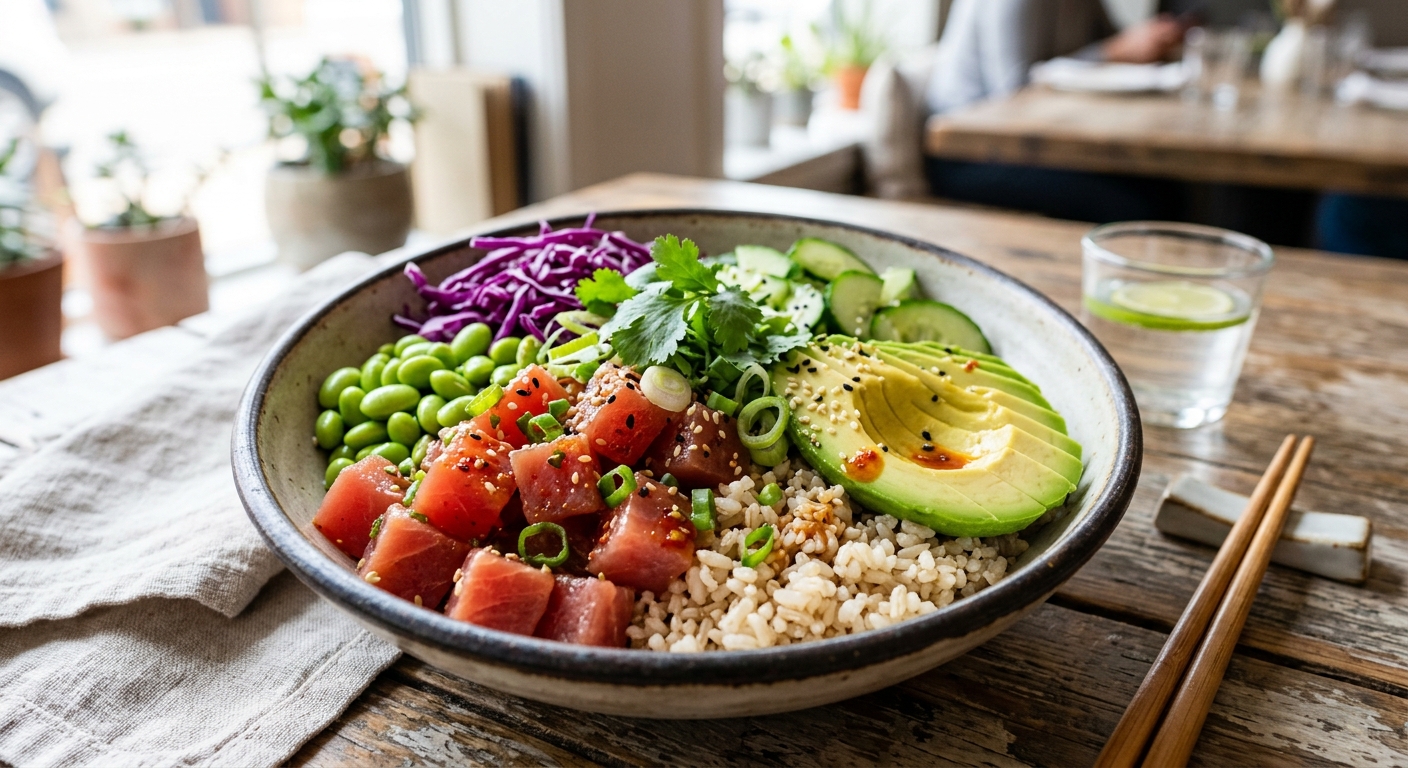
The poke bowl is one of the few dishes where nutritional precision and pure culinary pleasure are inseparable. At its core sits sushi-grade ahi tuna, one of the most concentrated sources of EPA and DHA omega-3 fatty acids in the human diet. Paired with edamame for plant-based protein and complete amino acid coverage, ripe avocado for monounsaturated fats, and a fiery sriracha-tamari glaze that doubles as an anti-inflammatory delivery system, this bowl was engineered to be as effective as it is beautiful.
What separates this recipe from a standard poke bowl is the deliberate layering of anti-inflammatory compounds. Turmeric in the rice, ginger and garlic in the marinade, sesame oil for its sesamol content, and the capsaicin in sriracha all work synergistically to suppress NF-kB pathways, the molecular switch that drives chronic inflammation. Every ingredient earns its place not just for flavor, but for function.
The cooking methods here are genuinely different experiences. The stovetop version gives you the most control over rice texture and timing, the pressure cooker produces perfectly al dente brown rice in a fraction of the time, and the oven method creates a baked poke-inspired bowl where the tuna is gently warmed through with a caramelized glaze. The slow cooker version transforms the concept into a warm, deeply savory tuna and edamame rice bowl, ideal for meal prep. Choose your method, and trust the calibration.
4
servings
Ingredients
- 500 gsushi-grade ahi tuna, cut into 2cm cubes
- 300 gshort-grain brown rice, rinsed until water runs clear
- 200 gshelled edamame, thawed if frozen
- 1 largeripe avocado, halved, pitted, and sliced
- 200 gEnglish cucumber, thinly sliced into half-moons
- 80 gshredded purple cabbage
- 4 tbspreduced-sodium tamari (certified gluten-free)
- 2 tbsptoasted sesame oil
- 1 tbspsriracha, plus more to serve
- 1 tbsprice wine vinegar
- 1 tspfresh ginger, finely grated
- 2 clovesgarlic, minced
- 1 tspground turmeric
- 2 tbsptoasted sesame seeds
- 4 stalksscallions, thinly sliced
- 1 sheetnori, cut into thin strips
- 1 tbsphoney or maple syrup
- —Colima Sea SaltMicroplastic Free Salt to taste
- —Pickled ginger, to serve
Instructions
Click on an item below to shop for the recommended items for this recipe on Amazon.
As an Amazon Associate, we earn from qualifying purchases.
- Cook the brown rice: combine the rinsed rice with 600ml cold water and 1 tsp fine sea salt in a medium heavy-bottomed saucepan. Add the ground turmeric and stir once. Bring to a vigorous boil over high heat, then immediately reduce to the lowest possible simmer. Cover tightly with a lid and cook undisturbed for 35 minutes. Remove from heat and let steam, still covered, for 10 minutes. Fluff with a fork.
- While the rice cooks, make the spicy tamari marinade: whisk together the tamari, toasted sesame oil, sriracha, rice wine vinegar, grated ginger, minced garlic, and honey in a medium bowl until smooth and fully emulsified.
- Pat the tuna cubes completely dry with paper towels. Add them to the marinade bowl and gently fold to coat every surface. Cover and refrigerate for 10 to 15 minutes. Do not marinate longer than 20 minutes or the tamari will begin to cook the tuna, altering the texture.
- While the tuna marinates, bring a small saucepan of salted water to a boil over medium-high heat. Add the shelled edamame and cook for 3 to 4 minutes until bright green and tender. Drain and rinse under cold water to stop cooking. Set aside.
- Assemble the bowls: divide the turmeric brown rice evenly among four wide shallow bowls, pressing it slightly off-centre to leave room for toppings. Arrange the marinated tuna, edamame, sliced avocado, cucumber half-moons, and shredded purple cabbage in distinct sections over the rice. Drizzle any remaining marinade from the bowl over the top. Garnish with toasted sesame seeds, sliced scallions, nori strips, and a side of pickled ginger. Serve immediately.
- Lightly grease the insert of a 5 to 6 quart slow cooker with a neutral oil. Add the rinsed brown rice, 650ml cold water, ground turmeric, and 1 tsp fine sea salt. Stir to combine, ensuring the rice is evenly distributed across the bottom of the insert.
- Whisk together the tamari, sesame oil, sriracha, rice wine vinegar, grated ginger, minced garlic, and honey in a small bowl. Pour half of this marinade over the rice and stir gently. Reserve the other half separately in the refrigerator.
- Cover and cook on High for 2 hours, until the rice is almost fully cooked but still has a slight bite and most of the liquid is absorbed. Do not lift the lid during this period, as steam loss will result in undercooked rice.
- Place the tuna cubes in a single layer directly on top of the cooked rice. Pour the reserved marinade evenly over the tuna. Scatter the edamame around the tuna. Place the lid back on and cook on High for a further 20 to 30 minutes, until the tuna is just cooked through but still moist and tender in the centre. It should be opaque on the outside but barely set at the core.
- Gently fluff the rice around the tuna with a fork, being careful not to break up the tuna pieces. Divide among four bowls, adding fresh cucumber, sliced avocado, and shredded purple cabbage alongside each serving. Drizzle with extra sriracha, garnish with sesame seeds, scallions, and nori strips, and serve with pickled ginger.
- Add the rinsed brown rice to the Instant Pot or electric pressure cooker insert. Pour in 480ml cold water (use this precise 1:1.6 ratio for short-grain brown rice under pressure). Add ground turmeric and 1 tsp fine sea salt. Stir once to distribute.
- Secure the lid and set the valve to Sealing. Select Pressure Cook (Manual) on High Pressure and set the timer for 22 minutes. While the cooker comes to pressure and cooks, prepare the marinade: whisk together the tamari, sesame oil, sriracha, rice wine vinegar, grated ginger, minced garlic, and honey in a medium bowl.
- Once the cook cycle completes, allow a natural pressure release for 10 minutes. Do not use a quick release, as this causes the rice to become gummy. After 10 minutes, carefully turn the valve to Venting to release any remaining pressure. Open the lid, fluff the rice with a fork, and let it sit uncovered for 2 minutes to dry out slightly.
- While the pressure releases naturally, pat the tuna cubes dry and add them to the marinade bowl. Fold gently to coat and allow to marinate for exactly 10 to 12 minutes in the refrigerator. In a separate small pan over medium-high heat, blanch the edamame in salted boiling water for 3 minutes, then drain and cool under cold running water.
- Divide the turmeric pressure-cooked rice among four bowls. Arrange the marinated tuna, edamame, avocado, cucumber, and purple cabbage over the rice in organised sections. Spoon any remaining marinade from the tuna bowl over each serving. Finish with toasted sesame seeds, scallions, nori strips, a drizzle of extra sriracha, and pickled ginger on the side.
- Preheat your oven to 200C (400F) with a rack in the upper-middle position. Line a rimmed baking sheet with foil and lightly brush with neutral oil. Cook the brown rice on the stovetop using the stovetop method above, or use 600g pre-cooked brown rice warmed through with turmeric and a pinch of salt.
- Make a thicker basting glaze by whisking together the tamari, sesame oil, sriracha, rice wine vinegar, ginger, garlic, and honey in a bowl. Because this glaze will be exposed to oven heat, add 1 tsp cornstarch to the mixture and whisk until dissolved. This helps the glaze cling and caramelise rather than run off.
- Pat the tuna cubes completely dry. Arrange them in a single layer on the prepared baking sheet with at least 2cm of space between each piece. Brush generously with two-thirds of the glaze. Scatter the thawed edamame around the tuna on the same baking sheet and brush lightly with the remaining glaze.
- Roast in the preheated oven for 8 to 10 minutes for medium (slightly pink centre) or 12 minutes for well done. Watch carefully after 8 minutes as the tamari glaze can over-caramelise quickly. The tuna should have a lacquered, slightly charred exterior and give just slightly when pressed. For a more caramelised finish, switch to the broiler (grill) for the final 90 seconds.
- Remove from the oven and allow the tuna to rest on the baking sheet for 2 minutes. The residual heat will continue cooking the tuna slightly. Divide the warm turmeric rice among four bowls. Arrange the glazed tuna and roasted edamame over the rice alongside fresh cucumber, sliced avocado, and purple cabbage. Finish with sesame seeds, scallions, nori, and pickled ginger.
Nutrition Breakdown
Per 1 serving (makes 4)
Vitamins & Minerals
% Daily Value based on a 2,000 calorie diet (FDA reference)
🧬 Essential Amino Acids
% of recommended daily intake (RDA) per serving
🛡 Antioxidant Profile
The Nutrition Science
The omega-3 story in this bowl centres on eicosapentaenoic acid (EPA) and docosahexaenoic acid (DHA), long-chain polyunsaturated fatty acids found almost exclusively in marine sources. A 125g serving of ahi tuna provides approximately 1,800 to 2,200mg of combined EPA and DHA, directly meeting the American Heart Association’s recommended weekly intake in a single sitting. Unlike the ALA found in flaxseed or walnuts, EPA and DHA require no metabolic conversion and are incorporated directly into cell membrane phospholipids, where they physically alter membrane fluidity, reduce arachidonic acid production, and generate anti-inflammatory resolvins and protectins.
The deliberate inclusion of curcumin (from turmeric in the rice) alongside the omega-3 fatty acids is nutritionally strategic. Research published in Prostaglandins, Leukotrienes and Essential Fatty Acids demonstrates that curcumin and omega-3 fatty acids act through complementary but non-overlapping anti-inflammatory pathways. Curcumin suppresses NF-kB transcription while EPA and DHA reduce pro-inflammatory eicosanoid synthesis via COX and LOX enzyme inhibition. Together, their combined effect on inflammatory markers such as CRP and IL-6 is greater than either compound alone, a genuine case of nutritional synergy.
Edamame contributes more than protein here. Its isoflavone content (approximately 18mg per 100g) provides phytoestrogenic antioxidant activity, while its folate content (148mcg per 100g) supports one-carbon metabolism and DNA methylation. Combined with the selenium from tuna (a cofactor for glutathione peroxidase, the body’s primary endogenous antioxidant enzyme) and vitamin E from avocado, this bowl delivers a complete antioxidant network operating across both aqueous and lipid cellular compartments.
Pro Tips
- Always source sushi-grade or sashimi-grade tuna from a reputable fishmonger and confirm it has been previously frozen to FDA standards (minus 20C for 7 days or minus 35C for 15 hours), which eliminates parasitic risk in raw preparations.
- Toast sesame seeds in a dry skillet over medium heat for 2 to 3 minutes, shaking constantly, until golden and fragrant. Pre-toasted seeds from a bag lose much of their sesamol content and nutty flavour within weeks of opening.
- For maximum omega-3 bioavailability, consume the bowl within 20 minutes of assembly. The vitamin E in avocado actively protects the EPA and DHA from oxidation, but sliced avocado begins browning and losing antioxidant efficacy quickly once cut.

ooh the edamame detail is getting me excited because theyre such an underrated fermentation candidate! have you ever thought about doing a quick miso-cured edamame situation or even fermenting them lightly for a few days? the probiotics would complement those omegas so well for your gut lining health, especially since healthy fat absorption really does depend on good microbiome diversity. the brown rice is also lowkey a prebiotic hero if you let it cool fully before eating it, the resistant starch that forms is basically a feast for your beneficial bacteria!
The sriracha-sesame marinade is smart for nutrient bioavailability, heat helps lycopene absorption, but I’d gently push back on cooking temp here – raw or seared just the surface keeps that EPA/DHA intact since heat degrades those long-chains. I’ve had better omega-3 retention results serving it barely seared on cast iron (literally 90 seconds per side) versus the traditional poke marinating method, and clients notice the difference in their inflammatory markers within weeks.
This is such a smart composition for methylation support, honestly – the tuna’s providing those long-chain omega-3s that reduce inflammatory signaling, but I’m really curious about your brown rice choice here instead of white rice or cauliflower rice. I’ve been experimenting with how refined vs. whole grains affect my own methylation donors (especially folate availability), and I wonder if you’ve noticed differences in how people respond to the carb load depending on their MTHFR status or histamine tolerance from the fermented sesame paste? What made you land on brown rice specifically for this particular nutrient profile?