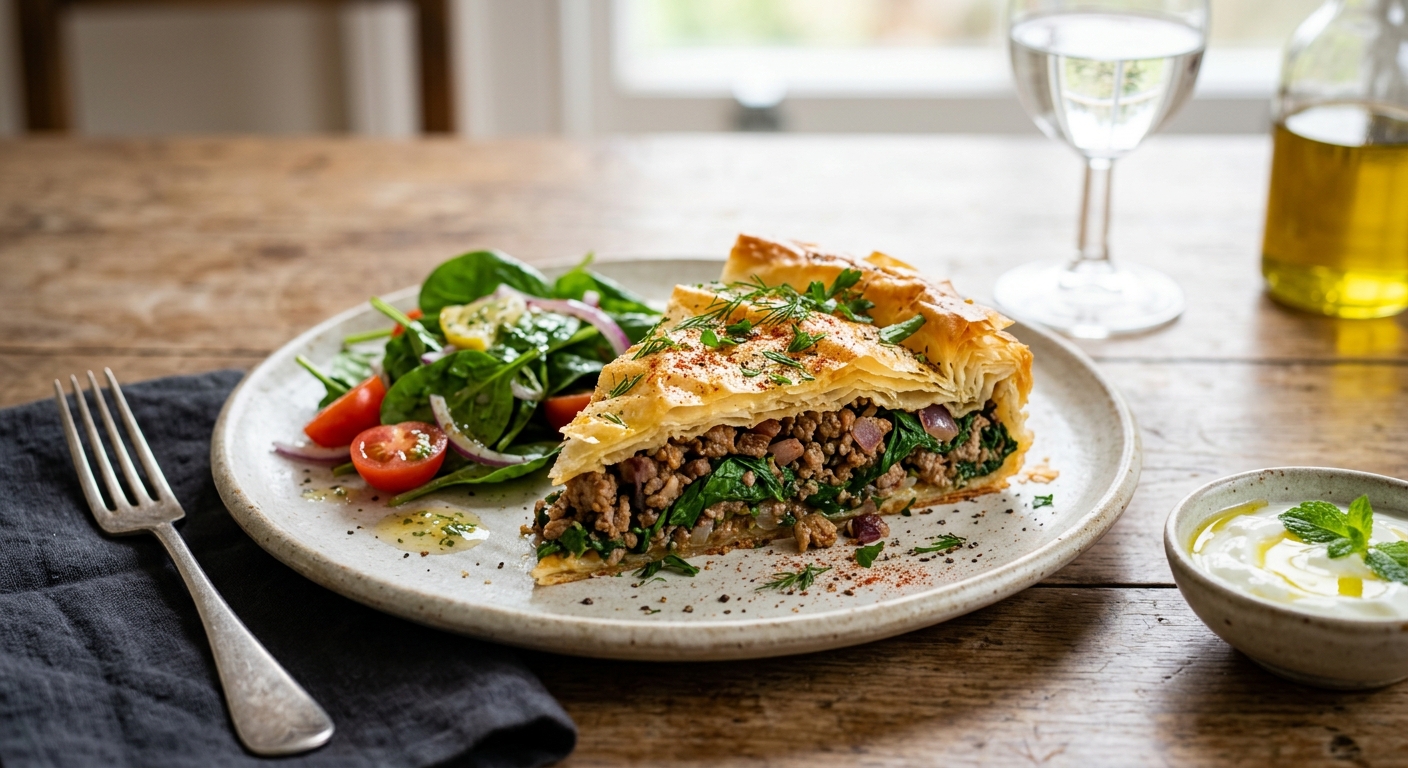
There is a moment when you pull a filo pie from the oven, its surface blistered and lacquered to a deep amber, and the kitchen fills with the scent of cumin, cinnamon, and braised lamb, that you understand why this style of cooking has endured for centuries across the Mediterranean and Middle East. Our version of this classic spanakopita-meets-kibbeh hybrid is built from the ground up with a single nutritional mission: to deliver a genuinely meaningful dose of iron and vitamin K in a format so delicious that no one at the table will suspect they are eating a calibrated meal.
The filling is the nutritional engine here. Lean minced lamb contributes haem iron, the most bioavailable form the body can absorb, at roughly two to three times the absorption rate of plant-based iron. That haem iron is then amplified by a generous quantity of fresh baby spinach, which adds non-haem iron alongside a remarkable concentration of vitamin K1. The spice blend, anchored by cumin and coriander, is not merely decorative: cumin contains apigenin and luteolin, two flavonoids that research suggests may support anti-inflammatory pathways, while the pinch of cayenne drives mild thermogenesis and supports circulation, which in turn helps nutrient delivery. Red onion and garlic provide quercetin and allicin respectively, rounding out a genuinely functional antioxidant profile.
Filo pastry is one of the leanest options in the pastry family. A single sheet brushed lightly with olive oil contributes minimal saturated fat while providing the structural crunch that makes every bite texturally satisfying. We use extra-virgin olive oil throughout, not butter, keeping the saturated fat low and adding oleocanthal, a polyphenol with well-documented anti-inflammatory properties. The result is a pie that clocks in at around 420 calories per generous serving while providing 36% of your daily iron needs, over 60% of your vitamin K requirement, and a complete essential amino acid profile from the lamb. It is, without exaggeration, one of the most nutritionally dense comfort foods you can make at home.
4
servings
Ingredients
- 500 glean minced lamb (10% fat)
- 200 gfresh baby spinach, washed
- 8 sheetsfilo pastry (approximately 270g total, thawed if frozen)
- 1 largered onion, finely diced
- 4 clovesgarlic, minced
- 400 gcanned diced tomatoes, drained
- 3 tbspextra-virgin olive oil, plus extra for brushing filo
- 1.5 tspground cumin
- 1 tspground coriander
- 1 tspsweet smoked paprika
- 0.5 tspground cinnamon
- 0.25 tspcayenne pepper
- 0.5 tspground allspice
- 30 gpine nuts, lightly toasted
- 1 tbsplemon juice, freshly squeezed
- 2 tbspflat-leaf parsley, finely chopped
- —Colima Sea SaltMicroplastic Free Salt and freshly cracked black pepper to taste
Instructions
Click on an item below to shop for the recommended items for this recipe on Amazon.
As an Amazon Associate, we earn from qualifying purchases.
- Heat 2 tablespoons of the olive oil in a wide, heavy-based skillet or saute pan over medium-high heat until shimmering. Add the diced red onion and cook, stirring occasionally, for 5 to 6 minutes until softened and beginning to colour at the edges. Add the minced garlic and cook for a further 60 seconds, stirring constantly, until fragrant but not browned.
- Increase the heat to high. Add the minced lamb and break it up aggressively with a wooden spoon or potato masher into very fine crumbles. Cook for 7 to 9 minutes, stirring and pressing frequently, until every piece is deeply browned and all rendered fat has evaporated. Do not rush this step: proper browning creates the Maillard compounds that give the filling its savoury depth. If there is excess fat pooling in the pan, carefully tilt and spoon it off.
- Reduce heat to medium. Push the lamb to one side of the pan and add the cumin, coriander, paprika, cinnamon, cayenne, and allspice directly to the cleared space. Toast the spices in the oil for 30 to 45 seconds until darkened and very fragrant, then stir them through the lamb. Add the drained canned tomatoes and stir to combine. Cook for 6 to 8 minutes, stirring occasionally, until the mixture is thick and almost completely dry with no visible liquid. Season generously with salt and pepper.
- Add the baby spinach to the pan in three batches, folding each batch through the hot lamb mixture and allowing it to wilt completely before adding the next. This prevents the pan from cooling down too rapidly and avoids excess steam. Once all spinach is wilted, increase the heat to medium-high for 2 minutes to drive off any residual moisture. Stir in the lemon juice, toasted pine nuts, and chopped parsley. Taste and adjust seasoning. Spread the filling on a large tray or baking sheet and allow it to cool for at least 15 minutes before assembling the pie.
- Preheat your oven to 200 degrees Celsius (180 degrees fan, 400 degrees Fahrenheit). Lightly brush a 20x30cm (8×12 inch) baking dish or a 26cm (10 inch) round springform tin with olive oil. Lay one sheet of filo into the dish, allowing the edges to overhang. Brush with olive oil. Repeat with 3 more sheets, rotating each sheet 45 degrees to create a full overhang around the perimeter. Spoon the cooled filling evenly over the filo base. Fold the overhanging edges up over the filling. Layer the remaining 4 sheets of filo on top, brushing each with olive oil and tucking the edges down the sides. Score the top layer in a diamond or square pattern with a sharp knife (this prevents the filo from shattering uncontrollably when cut). Brush the surface generously with olive oil.
- Bake for 22 to 28 minutes until the top is deeply golden and the sides are visibly crisp. Allow the pie to rest for 8 minutes before cutting. This resting period allows the filling to settle and makes clean slices possible.
- Brown the lamb first for maximum flavour: heat 1 tablespoon of olive oil in a skillet over high heat and cook the minced lamb in a single layer for 3 to 4 minutes without stirring, forming a crust, then break it up. Transfer the browned lamb to the slow cooker insert. This step can be skipped if you are short on time, though the filling will be noticeably less savoury.
- In the same skillet, soften the diced red onion over medium heat for 4 minutes, then add the garlic and cook for 1 minute. Add all the spices (cumin, coriander, paprika, cinnamon, cayenne, allspice) directly to the onion mixture and stir for 45 seconds. Deglaze with the drained canned tomatoes, scraping up any spice residue from the pan. Pour everything over the lamb in the slow cooker. Season with salt and pepper and stir to combine.
- Cook on Low for 3.5 to 4 hours. The mixture will be looser than a stovetop filling due to condensation in the slow cooker. During the last 30 minutes, remove the lid and switch to High. Add the baby spinach in batches, stirring it through as it wilts. Cooking uncovered on High for the final 30 minutes evaporates the excess liquid, which is critical for a dry enough filling to avoid a soggy filo base.
- Once the filling is thick with very little visible liquid, stir in the lemon juice, toasted pine nuts, and parsley. Taste and adjust seasoning. Spread the filling on a baking tray and allow it to cool for at least 20 minutes. Because the slow cooker filling retains more moisture than stovetop, pressing it gently with a clean cloth or paper towels before assembling is strongly recommended.
- Preheat your oven to 200 degrees Celsius (180 degrees fan). Assemble and bake exactly as directed in the stovetop method steps 5 and 6, brushing each filo sheet generously with olive oil to ensure maximum crisping.
- Set the Instant Pot or electric pressure cooker to the Saute function on High. Add 2 tablespoons of olive oil and, once hot, add the diced red onion. Cook for 4 minutes until softened. Add the garlic and all the spices (cumin, coriander, paprika, cinnamon, cayenne, allspice) and stir vigorously for 45 seconds until the spices are toasted and deeply fragrant.
- Add the minced lamb and break it up with a wooden spoon. Saute for 4 to 5 minutes, browning the outside of the lamb pieces. The lamb does not need to be fully cooked at this stage. Add the drained canned tomatoes, season with salt and pepper, and stir everything together. Add 60ml (quarter cup) of water to ensure sufficient liquid for the pressure build.
- Cancel the Saute function. Secure the lid and set the pressure valve to Sealing. Cook on Manual High Pressure for 8 minutes. When the timer ends, perform a Quick Release by carefully moving the valve to Venting. Open the lid away from you to avoid the steam. The filling will be very moist and tender.
- Switch back to Saute on High. Add the baby spinach in three batches, stirring and folding until fully wilted after each addition. Cook, stirring frequently and without the lid, for 8 to 12 minutes until virtually all liquid has evaporated and the mixture is dry enough to hold its shape on a spoon. This reduction step is the most important stage for pressure cooker users. Stir in the lemon juice, pine nuts, and parsley. Adjust seasoning. Transfer to a tray to cool for 15 minutes.
- Preheat your oven to 200 degrees Celsius (180 degrees fan). Assemble and bake the pie exactly as directed in the stovetop method steps 5 and 6, brushing each filo layer generously with olive oil.
- Preheat your oven to 220 degrees Celsius (200 degrees fan, 425 degrees Fahrenheit). Place a large (26cm minimum) oven-safe cast iron skillet or shallow Dutch oven in the oven while it heats. Letting the pan preheat is the key to this method: a screaming-hot surface will sear the lamb and evaporate moisture rapidly without needing to babysit the heat.
- In a bowl, combine the minced lamb with the cumin, coriander, paprika, cinnamon, cayenne, and allspice. Use your hands to work the spices evenly through the meat. This dry-spicing technique before cooking means the spices bloom directly in the lamb fat as it renders, creating more intense flavour than adding them to the pan mid-cook.
- Carefully remove the hot skillet from the oven and set it over medium-high heat on the stovetop. Add 2 tablespoons of olive oil and immediately add the red onion. The residual heat will sear the onion instantly. Stir for 2 minutes, add the garlic, then press the spiced lamb into the pan in a flat layer. Return the skillet to the 220-degree oven for 12 minutes. This combination of stovetop start and oven finish browns the lamb on the bottom while letting hot circulating air attack moisture from all sides simultaneously.
- Remove the skillet from the oven. Break up the lamb thoroughly with a wooden spoon. Add the drained tomatoes and stir to combine, scraping up all the browned bits from the base. Return the skillet to the oven uncovered for a further 8 minutes, until the tomatoes have reduced and the mixture looks almost dry. Remove from the oven and fold in the baby spinach in batches over medium stovetop heat until fully wilted. Add lemon juice, pine nuts, and parsley. Season and allow the filling to cool in the pan for 20 minutes. Reduce the oven temperature to 200 degrees Celsius (180 degrees fan).
- If using the same skillet for the pie, spread the filling evenly across the base. Lay the filo sheets on top, one at a time, each brushed with olive oil, tucking the edges down around the filling to create a rough but rustic crimped lid. Alternatively, transfer the filling to a baking dish and assemble as in the stovetop method for a neater presentation. Score the top in a diamond pattern and brush generously with olive oil. Bake at 200 degrees Celsius for 22 to 26 minutes until deeply golden and shatteringly crisp. Rest for 8 minutes before serving.
Nutrition Breakdown
Per 1 serving (makes 4)
Vitamins & Minerals
% Daily Value based on a 2,000 calorie diet (FDA reference)
🧬 Essential Amino Acids
% of recommended daily intake (RDA) per serving
🛡 Antioxidant Profile
The Nutrition Science
Iron comes in two distinct biochemical forms, and understanding the difference is key to getting the most from this recipe. Haem iron, found exclusively in animal muscle tissue such as lamb, is bound within a porphyrin ring that allows it to be absorbed directly through intestinal mucosal cells via specific haem transporter proteins, independent of competing dietary factors. Non-haem iron, the form found in spinach, legumes, and fortified foods, must first be reduced from ferric (Fe3+) to ferrous (Fe2+) by stomach acid and duodenal reductase enzymes before absorption. In this filling, both forms are present simultaneously: the lamb provides haem iron with an absorption rate of 15 to 35%, while the spinach provides non-haem iron whose absorption can be nudged upward significantly by the presence of meat (via a still-debated mechanism often called the meat factor) and by consuming vitamin C alongside the meal.
Vitamin K1 (phylloquinone), delivered here primarily by the baby spinach, is one of the most under-consumed fat-soluble vitamins in Western diets, with surveys suggesting that a significant proportion of adults consume less than 80% of the adequate intake. It serves as an essential cofactor for gamma-carboxylation, a post-translational modification required to activate at least 17 proteins. The most clinically significant of these are the coagulation factors II, VII, IX, and X, along with the bone matrix proteins osteocalcin and matrix Gla protein (MGP). MGP in particular is of growing research interest: in its carboxylated (vitamin K-dependent) form it actively inhibits arterial calcification. Because vitamin K1 is fat-soluble, its absorption is dramatically enhanced when consumed alongside dietary fat, making the olive oil in this recipe nutritionally synergistic rather than merely culinary.
The spice profile of this dish contributes more than flavour. Cumin (Cuminum cyminum) is one of the richest plant sources of iron by weight at approximately 66mg per 100g, though the amounts used in cooking are small. More meaningfully, cumin contains the flavones apigenin and luteolin at concentrations that, even at culinary doses, have demonstrated measurable effects on inflammatory biomarkers in controlled studies. Cinnamon contributes type A proanthocyanidins that activate insulin receptor kinase and may improve glucose uptake into skeletal muscle, which partially explains the relatively moderate glycaemic response despite the presence of filo pastry. These are not magic quantities, but they represent a coherent anti-inflammatory matrix that makes the nutritional sum of this dish genuinely greater than its parts.
Pro Tips
- Keep filo from drying out while you work by laying a barely damp (not wet) kitchen towel over the unused sheets. Dry filo tears and crumbles when you try to lift it, while wet filo becomes gluey and fuses together. The goal is to maintain pliability without adding moisture.
- For maximum iron absorption, avoid drinking tea or coffee within 1 hour of eating this dish. Tannins in tea and chlorogenic acids in coffee bind non-haem iron in the digestive tract and can reduce absorption by up to 60%. Saving your post-dinner coffee for at least an hour later is a simple habit that makes a measurable nutritional difference.
- The filling freezes exceptionally well without the filo. Make a double batch of filling and freeze half in a sealed container for up to 3 months. When ready to use, thaw overnight in the refrigerator, reheat in a skillet to drive off any residual moisture, and assemble with fresh filo for a genuinely fast weeknight dinner with no compromise on quality.
oh the iron bioavailability piece is so good! ive been thinking a lot lately about how fermented foods can actually boost mineral absorption too, so pairing this with something like a tangy fermented yogurt or even a quick lacto fermented hot sauce on the side would be incredible for getting even more out of all that spinach and lamb iron. the spices are already doing heavy lifting but yeah those warming notes plus the fermentation funk could be such a game changer for how your gut actually processes it all!
This is such a thoughtful addition, Kirsten. I’ve been experimenting with fermented components alongside my regular meals for similar reasons, and pairing them with iron-rich dishes like this has genuinely seemed to improve how I feel energy-wise, though honestly it’s hard to isolate what’s actually working when you’re managing multiple nutritional needs. The lacto-fermented hot sauce idea is brilliant because you’re stacking bioavailability enhancers, and I love that you’re thinking about the gut microbiome angle too, since that’s becoming more central to how I understand my own inflammation markers. Thanks for that suggestion, I’m definitely trying it with this recipe.
Oh this is such a smart recipe for iron bioavailability, especially pairing that lamb with spinach and the warming spices like cinnamon that can enhance mineral absorption! It reminds me of how many West African and Middle Eastern cuisines have been doing this intuitively for centuries, layering iron-rich leafy greens with spiced meat and aromatics. I’m curious about your spice blend here, because I always think about how turmeric, ginger, and black pepper in traditional dishes aren’t just flavor, they’re working overtime on digestion and nutrient availability too.