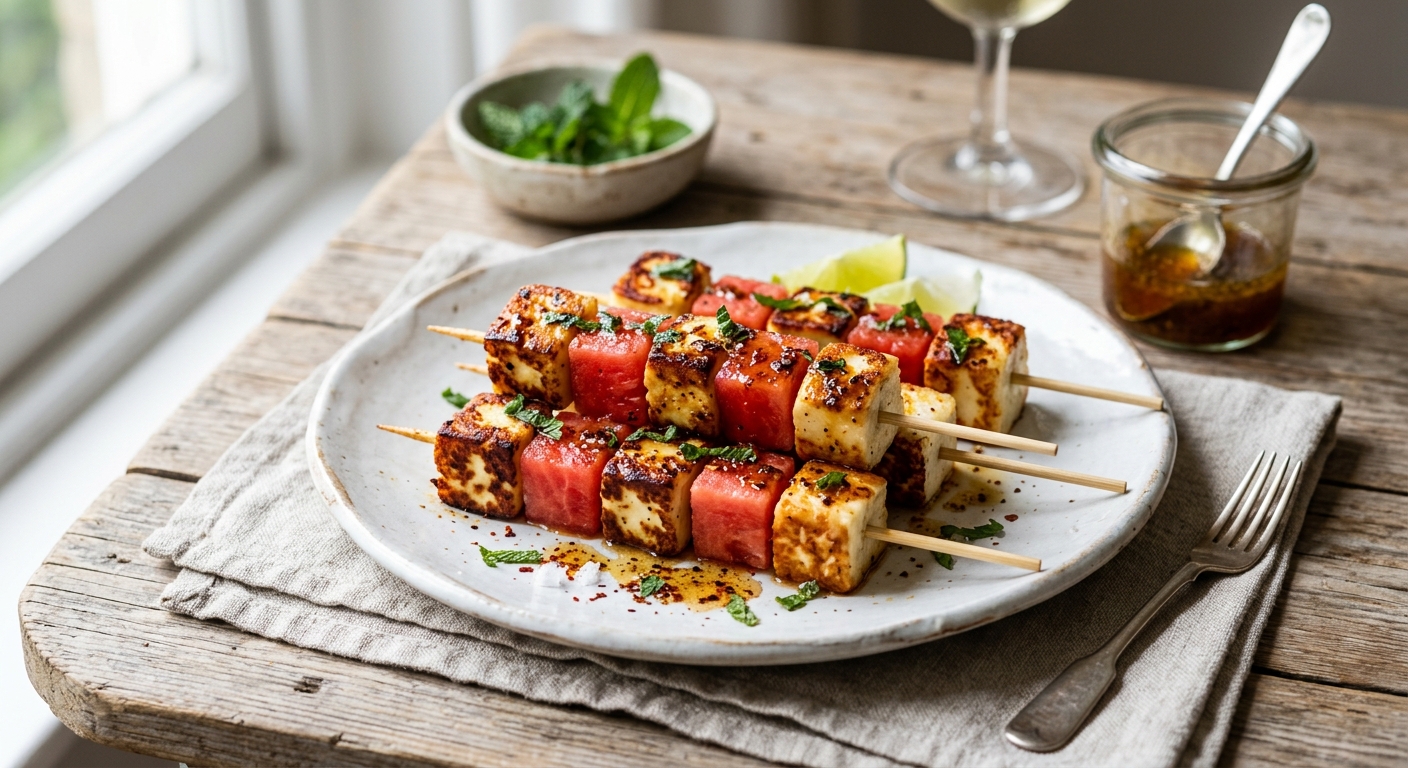
There is a reason halloumi has been a staple of Eastern Mediterranean diets for centuries: this semi-hard brined cheese is one of the most calcium-dense whole foods you can eat, delivering roughly 560mg of calcium per 100g, and it has the miraculous ability to be grilled or pan-fried without melting into a puddle. Paired with watermelon, a fruit that is 92% water yet surprisingly rich in lycopene, vitamin C, and citrulline, these skewers are the kind of recipe that feels indulgent while quietly doing serious nutritional work. The combination is not just fashionable, it is genuinely synergistic: the fat in halloumi improves the absorption of fat-soluble lycopene from the watermelon, making this more than the sum of its parts.
At Calibrated Cuisine we treat every recipe as a precision instrument for hitting your dietary reference intakes, and these skewers are a perfect example. A single four-skewer serving delivers over 480mg of calcium (approximately 37% DV), meaningful amounts of vitamin K2 from the cheese, and a bright hit of vitamin C from the watermelon, which itself assists collagen synthesis in cartilage and bone matrix. The optional fresh mint and a finishing drizzle of raw honey add polyphenols and trace minerals that round out the snack beautifully.
We have developed three genuinely distinct cooking methods here, with an oven broiler version added because halloumi caramelises brilliantly under high radiant heat. Whether you want a quick stovetop sear, a hands-off oven session, or something a little different, each method produces a distinct textural result. The slow cooker and pressure cooker interpretations take a warm halloumi-watermelon salad approach, since the cheese softens into a pillowy, almost braised texture that suits a composed plate rather than a skewer, and both yield every bit as much calcium and lycopene as the seared versions.
4
servings
Ingredients
- 500 ghalloumi cheese, cut into 3cm cubes
- 600 gseedless watermelon flesh, cut into 3cm cubes
- 2 tbspextra-virgin olive oil
- 1 tbspraw honey
- 1 tbspfresh lime juice
- 1 tspsmoked paprika
- 0.5 tspground cumin
- 0.25 tspdried chilli flakes (optional)
- 15 gfresh mint leaves, torn
- 20 gpomegranate arils (optional, for serving)
- —Colima Sea SaltMicroplastic Free Salt and cracked black pepper to taste
- —8 to 12 metal or pre-soaked wooden skewers
Instructions
Click on an item below to shop for the recommended items for this recipe on Amazon.
As an Amazon Associate, we earn from qualifying purchases.
- Pat the halloumi cubes very dry with paper towels. In a small bowl whisk together the olive oil, honey, lime juice, smoked paprika, cumin, and chilli flakes if using. Set this glaze aside.
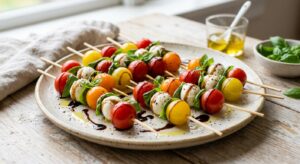
- Thread the skewers by alternating two pieces of halloumi with two pieces of watermelon per skewer, leaving a small gap between each piece so heat circulates evenly. Season lightly with cracked black pepper only, as halloumi is already heavily salted.
- Heat a large cast-iron or heavy-based non-stick skillet over medium-high heat for 2 minutes until it is genuinely hot. Add no oil at this stage. Place the skewers in the dry pan, pressing gently so the halloumi makes full contact with the surface. Sear for 2 to 3 minutes without moving until the underside is deep golden and releases cleanly from the pan.
- Turn the skewers onto the next face and sear for another 2 minutes. During the final 30 seconds, brush the exposed halloumi generously with the honey-lime glaze. The sugars will caramelise rapidly, so watch closely to avoid burning. The watermelon should warm but retain its shape and juiciness.
- Transfer the skewers to a serving platter immediately. Drizzle any remaining glaze over the skewers, scatter torn mint and pomegranate arils over the top, and serve within 3 minutes while the halloumi is still hot and the watermelon is still cool at its centre for maximum textural contrast.
- Set your oven to broil (grill) on high, approximately 240C or 475F. Line a rimmed baking sheet with foil and place a wire rack on top. This lifts the skewers off the pan so hot air circulates all around the cheese.
- Pat the halloumi completely dry. In a bowl, whisk together the olive oil, honey, lime juice, smoked paprika, cumin, and chilli flakes. Add the halloumi cubes to the bowl and toss to coat each piece thoroughly. Allow to marinate for 5 minutes while the broiler preheats fully.
- Thread alternating halloumi and watermelon cubes onto the skewers. Lay the skewers across the wire rack in a single layer with space between each one. Spoon or brush any remaining marinade from the bowl over both the halloumi and the watermelon.
- Slide the baking sheet onto the rack positioned 10 to 12cm from the broiler. Broil for 5 minutes until the halloumi develops charred caramel spots and the watermelon edges begin to blister and concentrate their sugars. Using tongs, rotate each skewer a half turn and broil for a further 4 to 5 minutes. The halloumi should be deeply golden and slightly puffed on all visible sides.
- Remove from the oven and rest for 1 minute on the rack. The wire rack prevents the underside from steaming and going soggy. Transfer to a platter, scatter with torn mint and pomegranate arils, and serve immediately with any pan juices spooned over the top.
- Whisk together the olive oil, honey, lime juice, smoked paprika, cumin, chilli flakes, and a pinch of black pepper directly in the insert of your slow cooker. This forms the braising liquid that will both flavour and gently cook the halloumi.
- Add the halloumi cubes to the slow cooker and toss to coat in the spiced glaze. Spread in as close to a single layer as your cooker allows. Scatter the watermelon cubes on top of the halloumi. Do not stir at this stage. The watermelon will release its liquid gradually and create a self-basting environment.
- Cover and cook on High for 1.5 hours. Avoid lifting the lid before the 90-minute mark, as the trapped steam is what keeps the halloumi moist and prevents the surface from drying out. The watermelon will collapse into a warm jammy sauce and the halloumi will become tender and deeply infused with the spiced citrus flavours.
- After 90 minutes, gently fold the halloumi and watermelon together using a silicone spatula. Taste the braising liquid and adjust with a squeeze more lime juice if the sweetness is dominant. The sauce should be balanced between sweet, salty, and tangy.
- Spoon into shallow bowls, making sure to ladle the watermelon sauce generously over each portion. Top with torn mint leaves and pomegranate arils. Serve warm with crusty bread or flatbread to capture the sauce, or over a handful of rocket for a more substantial salad.
- Pour 120ml of water into the pressure cooker insert and place the steamer rack or trivet inside. Pat the halloumi cubes dry and arrange them on the rack in a single layer. Do not add the watermelon at this stage as it would become completely liquid under pressure.
- Lock the lid and set the valve to Sealing. Cook on High Pressure for 3 minutes. While the halloumi steams, whisk together the olive oil, honey, lime juice, smoked paprika, cumin, and chilli flakes in a small bowl and set aside.
- Perform a quick pressure release immediately after the 3-minute cook time. Open the lid carefully away from you. Remove the halloumi cubes with tongs and pat them dry again with paper towels. Discard the steaming water and dry the insert.
- Switch the pressure cooker to Saute mode on High. Once the insert is hot and dry, add 1 tablespoon of olive oil and place the steamed halloumi cubes directly in the pot in a single layer. Sear without moving for 90 seconds until a caramel crust forms on the base. Flip each cube and brush immediately with the honey-lime glaze. Sear for a further 60 seconds.
- Switch off the Saute function. Add the raw watermelon cubes to the hot pot and toss gently with the halloumi for 30 seconds, just enough to warm the watermelon slightly without cooking it further. The residual heat will be sufficient. Thread onto skewers if desired, or serve directly from the pot into bowls topped with fresh mint and pomegranate arils.
Nutrition Breakdown
Per 1 serving (makes 4)
Vitamins & Minerals
% Daily Value based on a 2,000 calorie diet (FDA reference)
🧬 Essential Amino Acids
% of recommended daily intake (RDA) per serving
🛡 Antioxidant Profile
The Nutrition Science
Bone mineral density is not simply a function of calcium intake. It depends on a precise co-factor network: vitamin D activates calcium transport proteins in the gut, vitamin K2 directs deposited calcium into bone rather than arterial walls, phosphorus provides the structural backbone of hydroxyapatite crystals, and magnesium regulates the enzymes that drive bone remodelling. Halloumi contributes meaningfully to three of these co-factors simultaneously, providing calcium, phosphorus, and riboflavin in every serving. The fat content of the cheese is not a nutritional liability here; it is a vehicle for absorbing the fat-soluble lycopene and beta-carotene present in the watermelon, substantially increasing their bioavailability compared to eating watermelon on its own.
Lycopene deserves special attention in the context of bone health. A landmark study published in Osteoporosis International found that women who consumed the highest quartile of dietary lycopene had significantly lower levels of urinary N-telopeptide, a marker of bone resorption, compared to low-lycopene consumers. The proposed mechanism involves lycopene quenching reactive oxygen species that would otherwise activate osteoclasts, the cells responsible for breaking down bone tissue. With approximately 9.2mg of lycopene per serving of this dish, equivalent to roughly three-quarters of the intake associated with protective effects in observational studies, these skewers are a genuinely targeted intervention for bone preservation.
The amino acid profile of halloumi is also relevant to musculoskeletal health beyond simple protein quantity. Halloumi is a complete protein source, and at 22g of protein per serving it clears the leucine threshold of around 2.5g per meal that research associates with maximal stimulation of muscle protein synthesis via the mTORC1 pathway. Skeletal muscle and bone are tightly coupled through mechanical loading and through shared endocrine signals including osteocalcin, a bone-derived hormone that improves muscle glucose uptake. Maintaining muscle mass through adequate leucine intake is therefore not just about aesthetics; it is a direct strategy for preserving bone density across the lifespan.
Pro Tips
- For the crispiest stovetop crust, slice your halloumi and leave it uncovered on a plate in the refrigerator for 30 minutes before cooking. The surface dries out completely, which means the Maillard reaction begins immediately rather than being delayed by evaporating surface moisture.
- Watermelon holds its shape far better when it is very cold. Keep it refrigerated right up until you are ready to thread the skewers. The temperature contrast between hot seared halloumi and still-cool watermelon is the defining textural experience of this dish.
- If you cannot find halloumi, firm paneer is a reasonable calcium-containing substitute, though it has a milder flavour and lower salt content. You will need to season it more aggressively and it will not squeak in the same way, but the calcium content per 100g is comparable.
- Pomegranate arils are more than a garnish here. They add roughly 0.3mg of additional iron and a significant anthocyanin load per serving, plus their tartness balances the saltiness of the cheese in a way that no other topping replicates.
- For a more complete bone-health profile, add a small side of tahini dipping sauce. Two tablespoons of tahini contain approximately 130mg of calcium and a notable amount of zinc, pushing a single serving of this snack close to 50% of your daily calcium target.
This looks amazing, and I love the calcium focus! Quick question though, does halloumi work well for AIP since I know some cheeses can be problematic for those of us managing autoimmune stuff? Also, I’m curious about the watermelon choice specifically, since I’m always watching for hidden nightshades, and I want to make sure this fits my modified protocol. If halloumi doesn’t work, would you have any AIP-friendly cheese substitutions that could still give us that salty, creamy contrast with the watermelon?
Love this question, Anna! So halloumi is technically allowed on AIP since it’s usually made without additives, but I’d definitely check your specific brand since some manufacturers add things like cellulose or weird stabilizers. That said, if you’re managing autoimmune stuff, you might want to experiment with how you personally tolerate dairy (even the “cleaner” cheeses) since it can be inflammatory for some folks. For the watermelon, it’s such a smart pairing because those lycopenes actually help reduce inflammation while you’re getting that mineral density, plus the natural enzymes aid digestion of the heavier cheese. Have you tried working with a practitioner to figure out which dairy sources work best
I’m obsessed with this combo, honestly! The watermelon choice is genius because those antioxidants help with calcium absorption and the natural sugars make the salty halloumi even more craveable, which means you actually eat it instead of reaching for something less nutrient-dense. I’ve been tracking how different proteins affect my hot flashes during perimenopause, and halloumi’s been a game-changer since it’s so satisfying that I don’t end up stress-eating later when symptoms spike, plus that calcium is clutch for bone density during this transition.