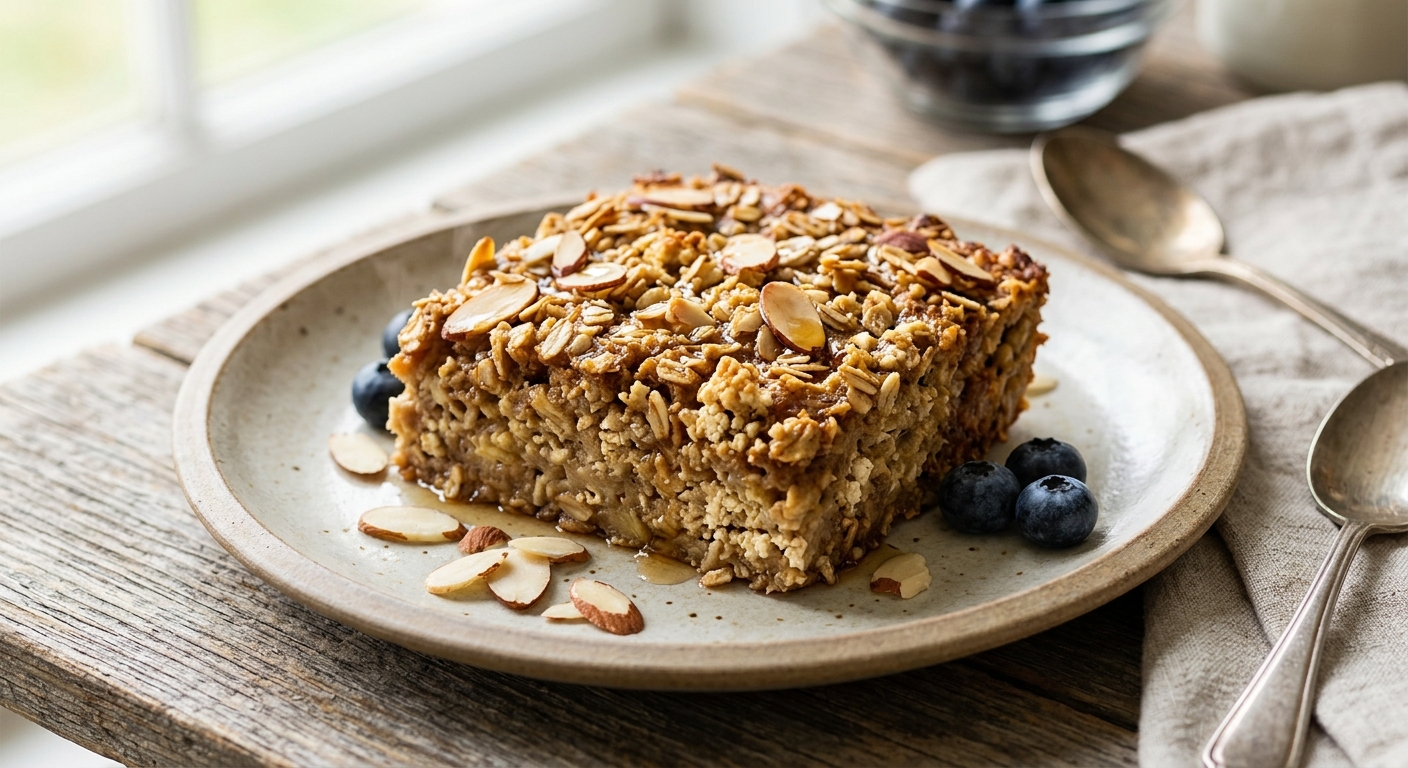
Most breakfast foods quietly underdeliver on calcium. A bowl of cereal with a splash of regular milk might scrape together 20% of your daily value if you are lucky. This Almond and Oat Breakfast Bake was engineered from the ground up to change that calculus entirely. By combining calcium-set tofu (which uses calcium sulfate as a coagulant), fortified almond milk, whole almonds, and calcium-rich blackstrap molasses in a single baked dish, every serving pushes past the 45% daily value mark without a single dairy ingredient in sight.
Beyond the calcium headline, this bake is genuinely worth eating. The rolled oats absorb the spiced almond custard overnight or during cooking, swelling into a tender, almost bread-pudding-like texture. Toasted almond slivers provide crunch and richness, a ribbon of mashed banana provides natural sweetness and potassium, and a dusting of cinnamon and cardamom gives the whole thing an aromatic warmth that makes the kitchen smell extraordinary. It is substantial enough to fuel a full morning of work, providing 14 grams of protein and 8 grams of fiber per serving.
This recipe was designed for flexibility. You can prep the base the night before and bake it in the morning, set it in a slow cooker before bed for a warm breakfast waiting for you at dawn, or fire up the pressure cooker for a weekday version ready in under 30 minutes. Whichever method you choose, you are starting the day with a serious nutritional foundation for your bones, joints, and long-term skeletal health.
4
servings
Ingredients
- 300 grolled oats (not instant)
- 200 gfirm calcium-set tofu, crumbled finely
- 720 mlcalcium-fortified unsweetened almond milk
- 80 gwhole raw almonds, roughly chopped
- 30 galmond slivers, for topping
- 2 mediumripe bananas, mashed
- 2 tbspblackstrap molasses
- 2 tbsppure maple syrup
- 2 tbspchia seeds
- 1 tspground cinnamon
- 0.5 tspground cardamom
- 0.5 tspvanilla extract
- 0.25 tspground nutmeg
- 1 tbspcoconut oil, for greasing or sauteing
- —Colima Sea SaltMicroplastic Free Salt to taste
Instructions
Click on an item below to shop for the recommended items for this recipe on Amazon.
As an Amazon Associate, we earn from qualifying purchases.
- In a large heavy-bottomed saucepan or Dutch oven, heat the coconut oil over medium heat. Add the chopped almonds and toast, stirring frequently, for 2 to 3 minutes until they are golden and fragrant. Remove with a slotted spoon and set aside, leaving any residual oil in the pan.
- Reduce the heat to medium-low. Pour the fortified almond milk into the same pan and bring it to a gentle simmer. Whisk in the blackstrap molasses, maple syrup, cinnamon, cardamom, nutmeg, vanilla extract, and a pinch of fine sea salt. Stir until everything is fully dissolved and the liquid is uniformly dark and aromatic.
- Stir in the rolled oats and chia seeds. Cook uncovered over medium-low heat for 10 to 12 minutes, stirring every 2 minutes to prevent sticking, until the oats have absorbed most of the liquid and the mixture has thickened to a dense porridge consistency.
- Fold in the mashed banana and the crumbled calcium-set tofu. The tofu will not taste distinctly of itself; it melds into the oat base, adding creaminess and a significant calcium boost. Stir well, then continue cooking for another 5 to 7 minutes on low heat, pressing the mixture lightly against the base of the pan to help it set. The finished texture should be thick enough to hold its shape briefly when spooned.
- Spoon into bowls, scatter the toasted almonds and almond slivers over the top, and finish with an extra drizzle of maple syrup if desired. Serve immediately, or press the mixture into a lightly greased pan and place under a broiler at high for 3 minutes to form a golden crust before portioning.
- Grease the insert of a 4 to 6 quart slow cooker generously with coconut oil, making sure to coat the sides at least 5 cm up to prevent the oats from crusting and sticking during the long cook.
- In a large mixing bowl, combine the fortified almond milk, blackstrap molasses, maple syrup, mashed banana, vanilla extract, cinnamon, cardamom, nutmeg, and a pinch of sea salt. Whisk vigorously until the molasses is fully dissolved and no streaks remain. Add the chia seeds and whisk again, then let the mixture rest for 5 minutes so the chia seeds begin to hydrate and the liquid thickens slightly.
- Stir the rolled oats and crumbled calcium-set tofu into the spiced liquid base. Fold in the roughly chopped raw almonds. Pour the entire mixture into the prepared slow cooker insert and spread it into an even layer with a spatula. Scatter the almond slivers evenly across the top.
- Lay a double layer of paper towels across the top of the slow cooker insert before placing the lid on. This absorbs condensation as it builds, preventing water from dripping back onto the bake and making the top soggy. Cook on Low for 7 to 8 hours (overnight) or on High for 3.5 hours.
- When the cook time is complete, remove the lid and paper towels carefully. The bake should be set at the edges with a slightly softer center, similar to a baked custard. Turn off the heat, replace the lid without the paper towels, and let it rest for 15 minutes. This resting period allows the center to firm up fully using residual heat. Slice or scoop directly from the insert and serve warm.
- Grease a 6 to 7 inch round springform pan or a heat-safe baking tin that fits inside your pressure cooker insert with coconut oil. In a mixing bowl, whisk together the fortified almond milk, blackstrap molasses, maple syrup, mashed banana, vanilla extract, cinnamon, cardamom, nutmeg, and sea salt until the molasses is fully dissolved.
- Stir the chia seeds into the liquid and let stand for 3 minutes. Then fold in the rolled oats, crumbled calcium-set tofu, and chopped raw almonds. Pour the mixture into the prepared tin, pressing it down firmly to eliminate air pockets and create an even surface. Scatter almond slivers across the top and press them in lightly so they do not float.
- Cover the tin tightly with a sheet of aluminium foil, crimping the edges firmly around the rim. This prevents condensation from falling directly onto the surface and keeps steam from waterlogging the top layer during pressurized cooking.
- Pour 250 ml of water into the bottom of the pressure cooker insert. Place the metal trivet inside and lower the foil-covered tin onto the trivet using a foil sling (two long strips of foil folded lengthwise, crossed under the tin, with the ends draped over the sides for easy lifting). Seal the lid, set the valve to Sealing, and cook on Manual High Pressure for 10 minutes.
- Allow the pressure to release naturally for 10 minutes, then switch the valve to Venting to release any remaining pressure. Carefully lift the tin out using the foil sling. Remove the foil cover and check that the center is set; it should not jiggle. Let the bake rest in the tin for 5 minutes, then unmold, slice into wedges, and serve. For a firmer top, place under a broiler for 2 to 3 minutes before unmolding.
- Preheat your oven to 175C (350F). Grease an 8×8 inch (20×20 cm) baking dish generously with coconut oil, then line the base with a strip of parchment paper for easy unmolding. Spread the chopped raw almonds on a dry baking sheet and toast in the preheating oven for 5 to 6 minutes until golden. Remove and set aside to cool.
- In a large mixing bowl, whisk together the fortified almond milk, blackstrap molasses, maple syrup, mashed banana, vanilla extract, cinnamon, cardamom, nutmeg, and a generous pinch of sea salt until the molasses is completely dissolved and the mixture is smooth and uniform in color.
- Stir the chia seeds into the spiced liquid and let the mixture rest for 5 minutes. Then fold in the rolled oats and crumbled calcium-set tofu, stirring thoroughly so that the tofu is evenly distributed throughout rather than clumped. Finally, fold in the toasted chopped almonds, reserving the almond slivers for the top.
- Pour the oat mixture into the prepared baking dish and smooth the surface with a spatula. Scatter the reserved almond slivers evenly over the top, pressing them lightly into the surface. Cover the dish tightly with aluminium foil.
- Bake covered at 175C (350F) for 30 minutes. Remove the foil and continue baking uncovered for a further 15 minutes, until the top is deep golden, the edges pull away from the sides of the dish, and the center feels set when gently pressed with a fingertip. Remove from the oven and allow to cool in the dish for at least 10 minutes before slicing. This resting time is critical for clean, firm slices. Cut into four portions and serve warm with a drizzle of maple syrup.
Nutrition Breakdown
Per 1 serving (makes 4)
Vitamins & Minerals
% Daily Value based on a 2,000 calorie diet (FDA reference)
🧬 Essential Amino Acids
% of recommended daily intake (RDA) per serving
🛡 Antioxidant Profile
The Nutrition Science
Calcium absorption is not simply about how much calcium you eat; it is about how much your body can actually use. This recipe stacks three distinct high-bioavailability calcium sources: calcium-set tofu (which uses calcium sulfate as the coagulant, making it one of the richest plant calcium sources at roughly 350mg per 200g), calcium-fortified almond milk (typically providing 300mg per 240ml), and blackstrap molasses (approximately 200mg per 2 tablespoons). Together these three ingredients form the backbone of the recipe’s remarkable 45% DV calcium per serving, all from non-dairy sources with excellent absorption rates in the 30 to 40% range.
The oats contribute far beyond their well-known beta-glucan fiber. Rolled oats are one of the best dietary sources of manganese, a trace mineral that is a required cofactor for the enzyme manganese superoxide dismutase, the primary antioxidant defense within the mitochondria of bone-forming osteoblast cells. Low manganese status is consistently correlated with reduced bone mineral density in epidemiological studies. Each serving of this bake provides over 100% of the adequate intake for manganese, making it one of the most concentrated single-meal sources of this underappreciated bone mineral available in a whole-food diet.
Magnesium plays a biochemical role that most calcium-focused discussions overlook: roughly 60% of the body’s magnesium is stored in bone tissue, where it influences the size and crystalline structure of hydroxyapatite, the mineral matrix that gives bone its hardness. The almonds and oats in this recipe together contribute approximately 120mg of magnesium per serving, providing 29% DV and meaningfully supporting bone matrix integrity alongside the headline calcium content. The chia seeds add omega-3 alpha-linolenic acid, which has been shown in several observational studies to correlate with higher bone mineral density, completing a genuinely comprehensive bone-health nutritional profile in a single morning meal.
Pro Tips
- For the cleanest slices when using the oven or pressure cooker method, refrigerate the fully cooked and cooled bake overnight before slicing. It firms up considerably and can then be reheated in slices in a dry skillet or toaster oven, developing a lightly crisped exterior.
- The blackstrap molasses is non-negotiable for the calcium and iron targets. Do not substitute regular molasses or golden syrup, which have a fraction of the mineral content. Blackstrap is darker, slightly more bitter, and dramatically more nutrient-dense.
- If you need to increase the calcium content further, swap 120ml of the almond milk for calcium-fortified orange juice. The citric and ascorbic acid in the juice also actively enhance iron absorption from the oats and tofu, making this a particularly smart substitution on days when you need both minerals.

ooh love this angle tiara! ive been experimenting with turmeric in my post run breakfasts specifically because the curcumin helps with inflammation after hard training sessions, and pairing it with calcium rich foods like this makes so much sense for recovery and bone health when youre logging serious miles. curious if you have a fav ratio of turmeric to ginger that doesnt overpower the oats, because id totally make this as a make ahead race week fuel option and dont want the spices to get too intense after sitting overnight!
This looks absolutely nourishing, and I love how you’re approaching calcium through whole foods rather than just fortification alone. I’m curious whether you included any turmeric or ginger in those warming spices? I find that layering anti-inflammatory spices with calcium-rich foods creates a beautiful synergy, especially since ginger can actually support mineral absorption and turmeric’s curcumin becomes so much more bioavailable when paired with black pepper and a touch of fat from those almonds. I’d definitely be adding a pinch of black pepper to mine if I made this, and maybe a hint of cardamom for that deeper golden warmth.
this looks great but quick question – whats the net carb count per serving? oats can add up fast even though theyre whole grain, and if theres added sweetener in there that could spike things pretty quick. im asking because ive found that stable blood sugar actually matters way more for inflammation than anything else, and ive seen people get better results swapping the oats for almond flour or coconut flour to keep it lower carb while keeping all those minerals intact. would love to know what the total carbs look like though because the calcium angle is solid