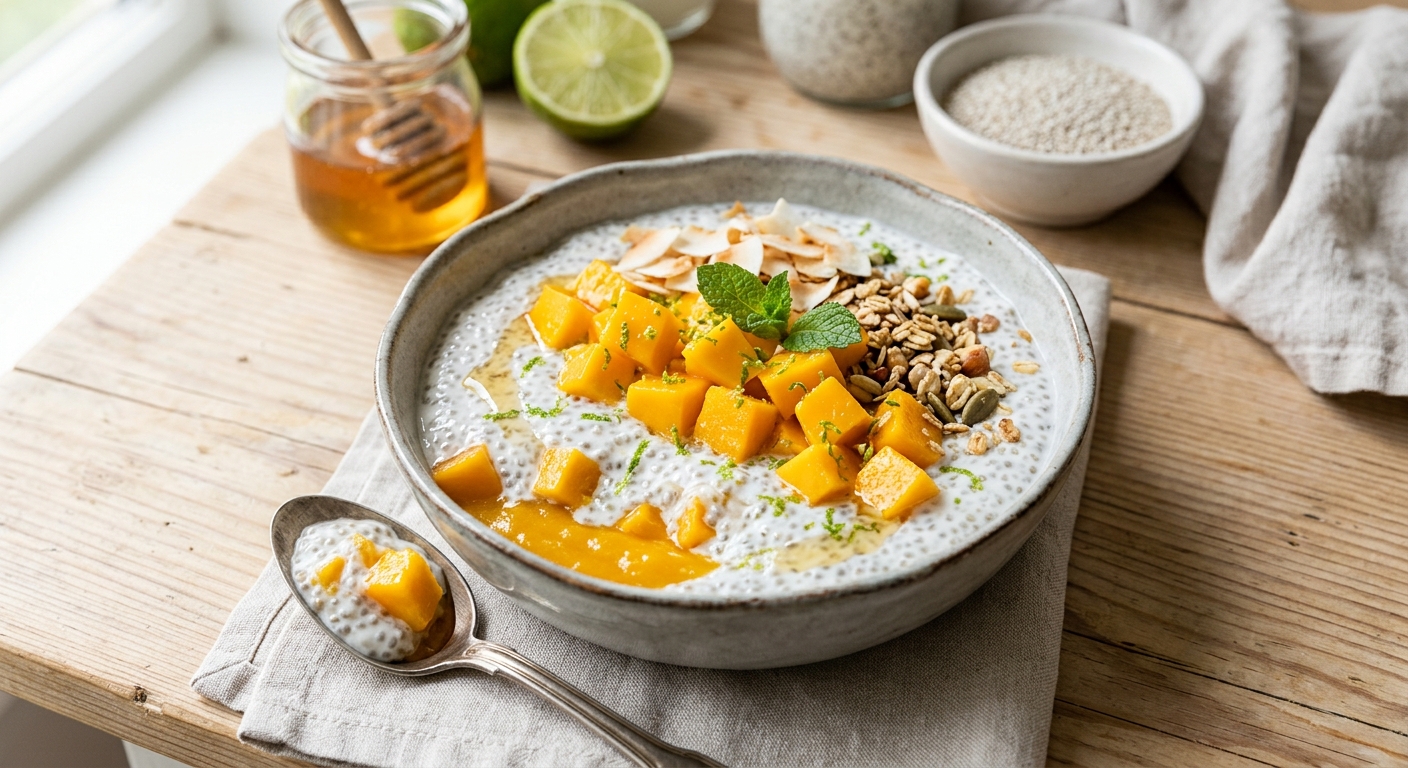
Some breakfasts sustain you. This one transforms you. Mango and Coconut Chia Pudding is the kind of dish that feels indulgent, tropical, and deeply nourishing all at once, the sort of thing you would expect at a five-star resort breakfast and yet it comes together in minutes with a handful of pantry staples. The base is full-fat coconut milk, rich in medium-chain triglycerides that provide fast, clean fuel for the brain. Into that goes a generous measure of chia seeds, tiny nutritional powerhouses that absorb twelve times their weight in liquid and form a naturally thickened, tapioca-like pudding without any cooking required.
The real star, however, is the mango. A single 200g serving of ripe Ataulfo or Kent mango delivers approximately 76mg of Vitamin C, putting you firmly at 85% of the 90mg daily reference intake before you have even left the kitchen. That same mango provides 1,262mcg of beta-carotene, a meaningful hit of folate, and natural fructose bound to fiber, which keeps blood glucose far more stable than a glass of orange juice would. Combined with the healthy fats from coconut and the protein-plus-fiber matrix of chia, this breakfast has the glycemic control credentials of a functional food.
At Calibrated Cuisine we developed four distinct preparation methods for this pudding because not every kitchen looks the same and not every morning has the same rhythm. The classic stovetop warm method creates a gently heated, custard-adjacent pudding that is especially comforting in cooler months. The slow cooker overnight technique delivers a supremely creamy, almost panna-cotta texture by morning. The pressure cooker produces a set, slightly denser pudding in under fifteen minutes of active time. And the oven method, baked low and slow in a bain-marie, yields a firm, sliceable pudding reminiscent of a coconut flan, perfect for meal-prepped portions. Choose your method, choose your morning.
4
servings
Ingredients
- 120 gwhite chia seeds
- 400 mlfull-fat coconut milk (one standard can)
- 300 mlunsweetened coconut water
- 500 gripe fresh mango, peeled and diced (about 2 medium mangoes)
- 2 tbsppure maple syrup or raw honey
- 1 tsppure vanilla extract
- 1 tspfresh lime zest (about 1 lime)
- 1 tbspfresh lime juice
- 30 gunsweetened desiccated coconut, lightly toasted
- 120 gfresh mango, extra-diced, for topping
- —Fresh mint leaves, for garnish
- —Pinch of Colima Sea SaltMicroplastic Free Salt
Instructions
Click on an item below to shop for the recommended items for this recipe on Amazon.
As an Amazon Associate, we earn from qualifying purchases.
- In a medium heavy-bottomed saucepan, combine the coconut milk and coconut water over medium-low heat. Warm gently, stirring occasionally, until the mixture reaches approximately 60 to 65 degrees C (just below a simmer, about 4 to 5 minutes). You should see wisps of steam rising but no bubbles breaking the surface. Remove from heat.
- Whisk in the maple syrup, vanilla extract, lime zest, lime juice, and a pinch of sea salt until fully combined. Taste the warm liquid and adjust sweetness at this stage, as chia will dilute the sweetness slightly once set.
- Sprinkle the chia seeds in a thin, even stream into the warm coconut liquid while whisking constantly to prevent clumping. Whisk vigorously for 60 to 90 seconds to ensure every seed is suspended and coated. Let the mixture sit in the pan for 5 minutes, then whisk again firmly to break up any clumps that have formed at the bottom.
- Divide the warm chia mixture evenly among four glasses or bowls. Place 300g of the diced mango (reserving 120g for topping) into a blender or food processor and blend until completely smooth. Spoon or pour a layer of mango puree over the top of each pudding glass, reserving a little for final presentation.
- Allow the puddings to cool at room temperature for 10 minutes before transferring to the refrigerator. Chill uncovered for 30 minutes, then cover with plastic wrap or lids and continue chilling for at least a further 45 minutes until fully set and cold. The warm-start method means they will set in about half the time of a cold-start pudding.
- To serve, add the reserved extra-diced fresh mango on top, scatter with toasted desiccated coconut, add a drizzle of the remaining mango puree, and garnish with fresh mint leaves.
- Lightly grease the insert of your slow cooker with a neutral oil or a light spray of coconut oil. This prevents any sticking around the edges and makes cleanup much easier. Set the slow cooker to its Low setting.
- Add the coconut milk, coconut water, maple syrup, vanilla extract, lime zest, lime juice, and sea salt directly to the slow cooker insert. Whisk everything together thoroughly until the coconut milk (which may be solid in the can) has fully dissolved into the liquid.
- Add the chia seeds and whisk immediately and vigorously for 90 seconds to distribute them evenly throughout the coconut liquid. Place the lid on the slow cooker but leave it slightly ajar (prop it open about 1cm with a small folded piece of foil) to allow some steam to escape and prevent excess condensation from dripping back in and making the pudding watery.
- Cook on Low for 6 to 7 hours, ideally overnight. Do not stir during cooking. The slow, even heat will cause the chia seeds to fully bloom and the natural starches and gels to knit the pudding into a uniform, silky texture.
- In the morning, remove the lid and gently stir the pudding with a silicone spatula, folding from the edges inward. The texture should be thick and creamy. If it appears thinner than desired, replace the lid (this time fully closed) and cook for a further 30 minutes on Low.
- Blend 300g of the fresh mango until smooth. Allow the pudding to cool for 10 minutes, then spoon into serving glasses, layering with the mango puree. Top each portion with the reserved diced mango, toasted coconut, and fresh mint. Serve immediately or refrigerate for up to 3 days.
- Pour the coconut milk and coconut water into the Instant Pot inner pot. Add the maple syrup, vanilla extract, lime zest, lime juice, and sea salt. Whisk vigorously until the coconut milk is fully liquid and all ingredients are combined.
- Add the chia seeds and whisk constantly for 2 full minutes to thoroughly disperse the seeds. It is critical to avoid any seed clumps at the bottom of the pot before sealing, as clumps will not hydrate evenly under pressure. Use a silicone spatula to scrape along the bottom and confirm no seeds are settled.
- Secure the Instant Pot lid and set the valve to Sealing. Select Pressure Cook (Manual) on High Pressure and set the timer for 8 minutes. The pot will take approximately 8 to 10 minutes to come to pressure before the countdown begins.
- When the cook cycle ends, allow the pressure to release naturally for 15 minutes. Do not use a quick release, as the rapid depressurization can cause the delicate pudding structure to collapse and become grainy. After 15 minutes, carefully turn the valve to Venting to release any remaining pressure, then open the lid away from you.
- Stir the pudding firmly with a silicone whisk or spatula to smooth out the surface and reintegrate any slight separation. Blend 300g of the fresh mango to a smooth puree. Transfer the warm pudding into serving glasses or bowls, top immediately with mango puree, then allow to cool for 10 minutes before adding the diced mango topping, toasted coconut, and mint. Refrigerate for at least 20 minutes before serving for a firmer, cooler result.
- Preheat your oven to 150 degrees C (130 degrees C fan-forced). Place four 200ml ovenproof ramekins into a deep roasting pan or baking dish large enough to hold them without touching. Lightly grease each ramekin with coconut oil.
- In a medium bowl, whisk together the coconut milk, coconut water, maple syrup, vanilla extract, lime zest, lime juice, and sea salt until completely smooth. Add the chia seeds and whisk aggressively for 2 minutes. Let the mixture stand for 5 minutes, then whisk again to break up any clumps that have formed. Allow the mixture to rest for a further 5 minutes; it should be noticeably thicker and slightly gel-like before going into the oven.
- Ladle the thickened chia mixture evenly among the four prepared ramekins, filling each to about 1cm below the rim. Tap each ramekin gently on the counter twice to level the surface and release any air pockets.
- Pour hot (not boiling) water into the roasting pan until it reaches halfway up the sides of the ramekins, creating a bain-marie. This water bath ensures even, gentle heat distribution and prevents the edges of the pudding from overcooking or drying out while the centre sets.
- Carefully slide the roasting pan into the preheated oven. Bake for 50 to 55 minutes, until the puddings are set at the edges but have a very slight jiggle in the very centre, similar to a baked cheesecake. Avoid opening the oven in the first 40 minutes.
- Remove the roasting pan from the oven and let the ramekins cool in the water bath for 20 minutes. Transfer to the refrigerator and chill for at least 45 minutes. To serve, blend 300g of fresh mango into a smooth coulis and spoon onto plates. Run a thin knife around the edge of each ramekin and unmould onto the plate (or serve directly in the ramekin). Top with diced fresh mango, toasted coconut, and mint.
Nutrition Breakdown
Per 1 serving (makes 4)
Vitamins & Minerals
% Daily Value based on a 2,000 calorie diet (FDA reference)
🧬 Essential Amino Acids
% of recommended daily intake (RDA) per serving
🛡 Antioxidant Profile
The Nutrition Science
The nutritional architecture of this pudding is built on a principle of synergy. Chia seeds (Salvia hispanica) are among the most concentrated plant sources of alpha-linolenic acid (ALA), the omega-3 precursor, providing approximately 2.2g per 30g serving. They are also exceptional sources of soluble fiber in the form of mucilage, the very substance responsible for their characteristic gel-forming behaviour. This mucilage creates a viscous matrix in the gut that slows the absorption of glucose and cholesterol, measurably reducing postprandial glycaemic response. A 2017 randomised controlled trial published in the European Journal of Clinical Nutrition found that chia seed supplementation significantly reduced peak postprandial blood glucose compared to control meals of equal carbohydrate content.
The mangoes contribute far more than Vitamin C. Mangiferin, a polyphenol unique to the Mangifera indica species, has been the subject of over 300 peer-reviewed studies examining its anti-inflammatory, antidiabetic, and neuroprotective properties. Mechanistically, mangiferin inhibits the NLRP3 inflammasome pathway and suppresses pro-inflammatory cytokine production, effects observed at concentrations achievable through regular dietary mango consumption. The beta-carotene in mango is also notable: unlike the isolated beta-carotene supplements linked to adverse outcomes in smokers in the CARET trial, dietary carotenoids embedded in a food matrix with co-present fats (here, the coconut milk) are absorbed more safely and converted to Vitamin A with greater regulatory control via feedback inhibition.
Full-fat coconut milk provides medium-chain triglycerides (MCTs), primarily lauric acid (C12), which are metabolised differently from long-chain fats. Rather than undergoing chylomicron-mediated lymphatic transport, MCTs are absorbed directly into the portal vein and transported to the liver, where they are rapidly converted to ketone bodies. This makes them a uniquely fast and efficient fuel source for the brain and is the biochemical reason that coconut fat can support cognitive clarity in the morning without the blood sugar spike of a high-carbohydrate breakfast. The combination of MCTs, chia ALA, and mango polyphenols creates a breakfast that addresses inflammation, glycaemic control, and antioxidant protection simultaneously.
Pro Tips
- For the deepest mango flavour, use Ataulfo (Honey) or Alphonso mangoes when in season. Their low-fiber, high-soluble-solids flesh blends into a perfectly smooth, vivid orange puree with no stringiness. Kent and Keitt mangoes are excellent year-round alternatives.
- Chia seed clumping is the most common point of failure. The fix is to whisk twice: once immediately after adding the seeds, then again after a 5-minute rest when initial gelling has begun. Breaking up that first gel layer prevents the seeds from cementing into irreversible clumps.
- To maximise Vitamin C retention, add the fresh mango only after cooking or cooling. Vitamin C degrades rapidly above 70 degrees C, so folding hot pudding into fresh mango puree, rather than cooking the mango, preserves the full antioxidant payload that makes this recipe nutritionally significant.
- Make a larger batch and store covered portions in the refrigerator for up to 4 days. The pudding actually improves in texture after 24 hours as the chia seeds continue to fully hydrate and the flavours meld. Add the fresh mango topping only at serving time to keep it vibrant.
- Toast the desiccated coconut in a dry skillet over medium heat for 2 to 3 minutes, stirring constantly, until golden and fragrant. This takes 60 seconds of attention but adds a toasty, caramelised depth that transforms the topping from a garnish into a flavour component.
That vitamin C content is huge, especially for methylation support, since ascorbic acid works synergistically with folate and B12 to keep your one-carbon metabolism humming along. I’ve been experimenting with adding a teaspoon of raw cacao nibs to my chia puddles because they’re loaded with polyphenols that seem to help stabilize gene expression patterns, and the mango’s beta-carotene converts to retinol which is itself an epigenetic regulator, so you’re basically stacking methylation donors and modulators in one bowl. Have you noticed whether the fresh mango preserves its enzymatic activity better than frozen, or does it matter once it’s sitting overnight
This looks like such a nourishing way to start the day, especially with that vitamin C boost for immune support. I’m curious if you’ve experimented with adding any adaptogens to this base, like reishi or cordyceps powder? I’ve found that blending them into coconut milk the night before lets their earthy notes meld beautifully with the tropical flavors, and the combination of vitamin C plus adaptogens seems to have a synergistic effect on my cortisol patterns. The chia seed gel is already doing great work with the prebiotic fiber, so you’d really be layering in stress resilience alongside the micronutrients.
oh man, alex just made me think of something – have you considered layering in some dried shiitake or maitake powder instead of or alongside those adaptogens? i know reishi and cordyceps are incredible but shiitakes bring this umami depth that actually complements the tropical sweetness way better than you’d expect, plus theyre packed with beta-glucans and polysaccharides that support the immune response even more synergistically with that vitamin c from the mango. ive been adding finely ground dried shiitake to coconut milk bases and it creates this subtle earthy undertone that makes the whole thing feel less like a supplement situation and more like an intentional flavor profile