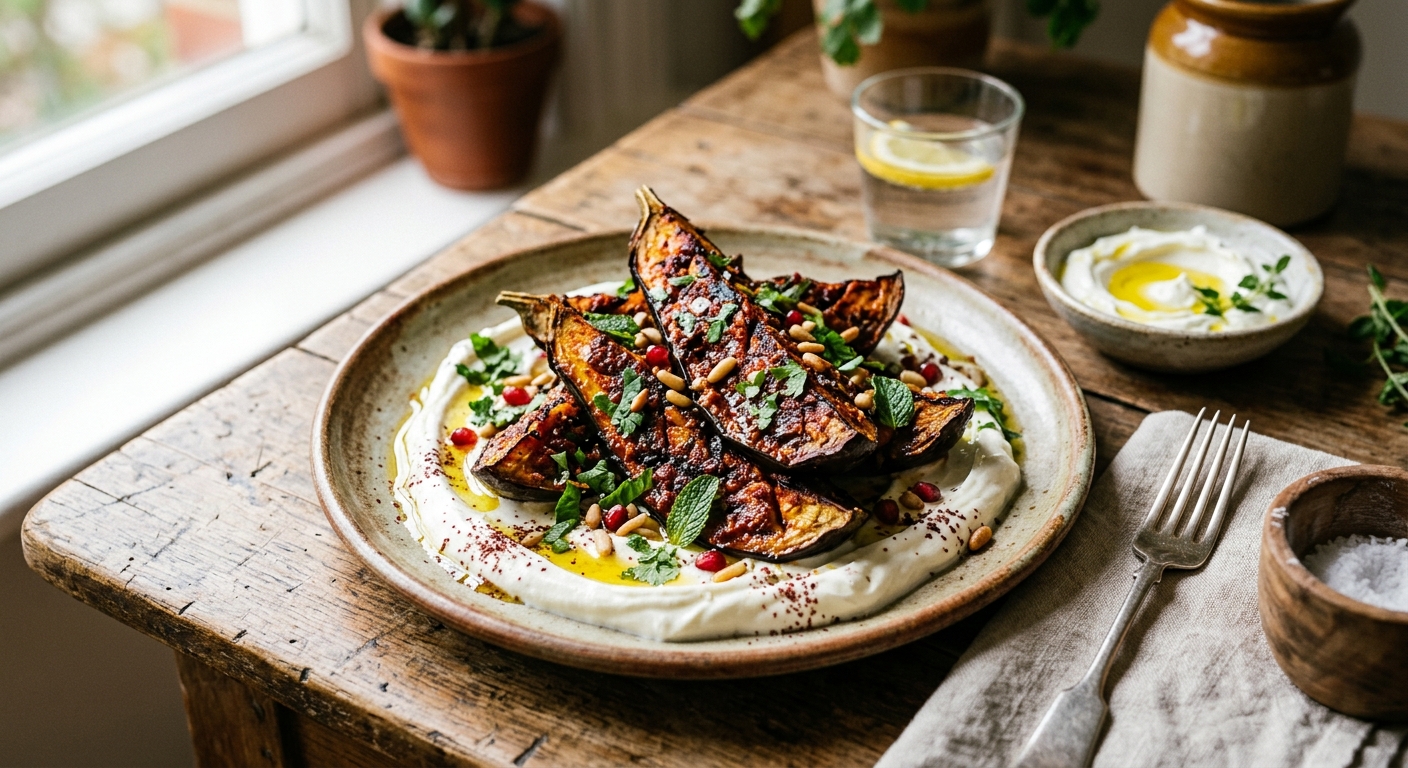
Harissa Roasted Eggplant with Labneh is the kind of recipe that makes you rethink what a bone-health meal looks like. Forget the glass of milk and the calcium supplement: this deeply savory, Levantine-inspired dish stacks full-fat labneh (strained yogurt cheese with roughly twice the calcium density of regular Greek yogurt) against caramelized eggplant that has been marinated in rose harissa, smoked paprika, and extra-virgin olive oil. The result is a plate of burnished purples and creamy whites that tastes like something a Beirut grandmother perfected over decades, not a nutrition intervention.
Eggplant is the unsung hero of this formula. Its spongy flesh soaks up the harissa paste like a sponge, and when subjected to high dry heat it undergoes rapid Maillard browning on the surface while steaming tender inside. That caramelized exterior is not just flavor, it is a concentration of chlorogenic acid, nasunin (the anthocyanin responsible for eggplant’s deep purple skin), and delphinidin, three distinct antioxidant compounds that have been studied for their ability to reduce oxidative stress in synovial joint tissue. For anyone eating toward bone and joint health, reducing inflammatory oxidative load is just as important as hitting calcium targets, and this dish does both in a single serving.
The labneh is not merely a garnish. A generous 80-gram dollop per serving contributes approximately 230 mg of calcium, around 23% of the adult daily value on its own, along with bioavailable phosphorus and a notable hit of protein to support collagen synthesis. Drizzled with grassy olive oil and finished with toasted pine nuts, fresh mint, and a pinch of sumac, this dish earns its place at the center of the table rather than as a side note on a supplement label.
4
servings
Ingredients
- 900 geggplant (2 large), cut into 3cm wedges or rounds
- 3 tbsprose harissa paste
- 3 tbspextra-virgin olive oil, divided
- 1 tspsmoked paprika
- 1 tspground cumin
- 1 tspground coriander
- 4 clovesgarlic, minced
- 1 tbsptomato paste
- 2 tsphoney or maple syrup
- 1 tbspfresh lemon juice
- 320 glabneh (strained yogurt cheese), full-fat
- 30 gpine nuts, lightly toasted
- 15 gfresh mint leaves, torn
- 10 gfresh flat-leaf parsley, roughly chopped
- 1 tspsumac
- 2 tbsppomegranate molasses, for drizzling
- —Colima Sea SaltMicroplastic Free Salt and black pepper to taste
- —Warm flatbread or pita, to serve
Instructions
Click on an item below to shop for the recommended items for this recipe on Amazon.
As an Amazon Associate, we earn from qualifying purchases.
- In a large bowl, whisk together the harissa paste, 2 tablespoons of the olive oil, smoked paprika, cumin, coriander, minced garlic, tomato paste, honey, lemon juice, 1 teaspoon salt, and a generous grind of black pepper. Add the eggplant wedges and toss thoroughly to coat every surface. Set aside to marinate at room temperature for at least 15 minutes while you prepare the remaining ingredients.
- Heat a large cast iron skillet over high heat until it begins to smoke lightly, about 3 minutes. Add the remaining 1 tablespoon of olive oil and swirl to coat. Working in two batches to avoid crowding, place the eggplant pieces cut-side down in a single layer. Cook without moving for 4 to 5 minutes until a deep, charred crust forms on the contact surface. Flip each piece and cook for another 3 to 4 minutes. Transfer the first batch to a plate and repeat with the second batch.
- Once all eggplant is browned, return everything to the skillet and reduce the heat to medium-low. Add any residual marinade left in the bowl along with 3 tablespoons of water. Cover the skillet with a lid or foil and allow the eggplant to steam-braise for 8 to 10 minutes until completely tender when pierced with a knife. The flesh should be silky and yielding throughout, not at all firm.
- While the eggplant finishes cooking, season the labneh with a pinch of salt and a small drizzle of olive oil, then stir briefly. Spread the labneh in a thick, swooping layer across a large serving platter or individual plates, creating a shallow well in the center using the back of a spoon.
- Arrange the harissa eggplant over and into the labneh, spooning any pan juices from the skillet over the top. Scatter toasted pine nuts, torn mint, and chopped parsley generously over the dish. Finish with a dusting of sumac and a zigzag drizzle of pomegranate molasses. Serve immediately with warm flatbread alongside.
- In a small bowl, combine the harissa paste, 2 tablespoons of olive oil, smoked paprika, cumin, coriander, minced garlic, tomato paste, honey, lemon juice, 1 teaspoon salt, black pepper, and 60ml (1/4 cup) of water to thin the marinade slightly. Stir well until smooth.
- Lightly brush the inside of the slow cooker insert with the remaining 1 tablespoon of olive oil. Arrange the eggplant pieces in overlapping layers in the insert. Pour the harissa marinade over the eggplant, ensuring you spoon it between the layers so the flavor penetrates throughout. Do not add extra water beyond what is already in the marinade.
- Place the lid on the slow cooker and cook on High for 3 hours or Low for 5 to 6 hours. The eggplant is ready when it is completely collapsed and very tender throughout. Slow cooking concentrates the harissa spices intensely, so taste and adjust seasoning with a little extra lemon juice if the flavor feels flat after the long cook.
- Optional but strongly recommended: transfer the slow-cooked eggplant pieces carefully to a foil-lined baking sheet. Spoon the concentrated braising juices from the insert over each piece. Place under a preheated grill (broiler) on the highest setting for 4 to 5 minutes until the surfaces blister and char slightly, mimicking the texture of oven or skillet roasting.
- Spread the lightly seasoned labneh across a serving platter in a thick layer. Arrange the eggplant over the labneh and spoon any remaining braising juices from the slow cooker insert over the top as a sauce. Garnish with toasted pine nuts, torn mint, flat-leaf parsley, a dusting of sumac, and the pomegranate molasses drizzle. Serve at once with warm flatbread.
- Mix the harissa paste, 1 tablespoon of olive oil (reserve the rest for finishing), smoked paprika, cumin, coriander, garlic, tomato paste, honey, lemon juice, salt, pepper, and 80ml (1/3 cup) of water in the Instant Pot or pressure cooker insert. Stir until the marinade is well combined.
- Add the eggplant wedges to the insert and toss directly in the marinade using tongs or a spatula, making sure all pieces are coated. Arrange them as flat as possible for even cooking. Lock the lid in place and set the pressure release valve to Sealing.
- Select Manual or Pressure Cook on High Pressure and set the timer for 5 minutes. The pot will take approximately 8 minutes to come to pressure. The moment the cook cycle ends, perform an immediate Quick Release by carefully turning the valve to Venting. Do not use Natural Release as the residual heat will overcook the eggplant.
- Using a slotted spoon, carefully transfer the eggplant pieces to a foil-lined baking sheet in a single layer. The eggplant will be tender but pale. Preheat your oven grill (broiler) to high. Spoon some of the concentrated harissa liquid from the pot over each piece and drizzle with the remaining 2 tablespoons of olive oil. Broil for 5 to 6 minutes until the surfaces are blistered, caramelized, and slightly charred at the edges.
- Reduce the pressure cooker liquid by selecting the Saute function and simmering uncovered for 3 to 4 minutes until it thickens into a glossy, spoonable sauce. Spread the labneh across a platter, arrange the broiled eggplant on top, and spoon the reduced sauce over everything. Finish with pine nuts, mint, parsley, sumac, and pomegranate molasses.
- Preheat your oven to 220C (425F) with the convection fan on, or 230C (450F) for a conventional (non-fan) oven. Line two large rimmed baking sheets with parchment paper and brush each lightly with olive oil. Positioning two racks in the upper-middle and lower-middle positions of the oven will allow you to roast both trays simultaneously.
- In a large bowl, whisk together the harissa paste, all 3 tablespoons of olive oil, smoked paprika, cumin, coriander, garlic, tomato paste, honey, lemon juice, 1 teaspoon salt, and black pepper into a thick, cohesive marinade. Add the eggplant wedges and use your hands or tongs to massage the marinade thoroughly into each piece, ensuring the cut surfaces are generously coated. Allow to sit for 10 minutes if time permits.
- Spread the eggplant pieces cut-side down in a single layer across both prepared baking sheets, leaving at least 2cm of space between each piece. Crowding the pan creates steam and prevents browning, so resist the temptation to combine onto one sheet. Scrape any remaining marinade from the bowl and dot it over the top surfaces.
- Roast for 20 minutes, then remove both trays from the oven and flip each eggplant piece using tongs or a thin spatula. Rotate the trays (top tray to bottom, bottom to top) for even cooking. Return to the oven and roast for a further 15 to 20 minutes until the eggplant is deeply caramelized, slightly charred at the edges, and completely tender when pressed.
- Remove from the oven and allow to rest for 5 minutes on the trays. Meanwhile, stir a pinch of salt and a drizzle of olive oil into the labneh and spread it in a generous, uneven layer across a warm serving platter. Arrange the roasted eggplant over the labneh, letting some pieces overlap naturally. Drizzle with any caramelized juices left on the baking sheets, then scatter pine nuts, mint, parsley, sumac, and pomegranate molasses over the top. Serve immediately.
Nutrition Breakdown
Per 1 serving (makes 4)
Vitamins & Minerals
% Daily Value based on a 2,000 calorie diet (FDA reference)
🧬 Essential Amino Acids
% of recommended daily intake (RDA) per serving
🛡 Antioxidant Profile
The Nutrition Science
The calcium in this recipe is exceptional not just in quantity but in bioavailability. Labneh, produced by straining yogurt to remove most of the whey, concentrates casein-bound calcium to levels approaching 290mg per 100g, compared to approximately 120mg per 100g in standard Greek yogurt. Critically, the acidity of the labneh, combined with the lemon juice and sumac in this recipe, lowers the local pH of the dish and enhances calcium solubility in the digestive tract. Calcium absorption from dairy sources averages 30 to 35%, notably higher than most plant-based calcium sources, making the labneh an unusually efficient vehicle for this mineral. The olive oil in the dish also plays a structural role: fat-soluble vitamin K2 precursors from the fresh herbs require dietary fat for absorption, and vitamin K is essential for activating osteocalcin, the bone-matrix protein that actually anchors calcium into the hydroxyapatite crystal structure of bone tissue.
Eggplant’s contribution to joint health operates along a different but complementary pathway. Nasunin, the anthocyanin pigment concentrated in the deep purple skin, has demonstrated the ability to inhibit the activity of matrix metalloproteinase enzymes (MMP-1, MMP-2, and MMP-3) in in vitro studies. These enzymes are responsible for degrading type II collagen in articular cartilage, the breakdown mechanism central to osteoarthritis progression. Chlorogenic acid, present at approximately 24mg per serving in cooked eggplant, has separately been shown to reduce serum concentrations of C-reactive protein (CRP), a key circulating biomarker of systemic inflammation. Together, these phytocompounds create a meaningful anti-inflammatory environment that reduces the oxidative burden on bone and joint tissue.
The oleocanthal in extra-virgin olive oil rounds out the recipe’s anti-inflammatory profile. Research published in the journal Nature first identified this compound as a dual COX-1 and COX-2 inhibitor, meaning it shares the same mechanism of action as non-steroidal anti-inflammatory drugs but within the dose range naturally consumed in a Mediterranean-style diet. Three tablespoons of a high-quality extra-virgin olive oil, as used in this recipe, contribute an estimated 20 to 45mg of oleocanthal per serving, within the range associated with measurable anti-inflammatory effects in clinical dietary studies. This makes the choice of olive oil quality, not just quantity, a genuine nutritional decision in this recipe.
Pro Tips
- Salt the eggplant wedges lightly and let them sit in a colander for 20 minutes before marinating if your eggplant seems particularly seedy or bitter. Pat dry thoroughly before adding to the marinade, as excess surface moisture will steam rather than sear the flesh.
- For the richest labneh, make your own by lining a sieve with cheesecloth, spooning in full-fat Greek yogurt, and refrigerating for 24 to 48 hours. The result has a creamier texture and noticeably higher calcium density than most commercial labneh products.
- The quality of your harissa paste matters enormously here. Look for a paste made with whole dried chilies, caraway, and coriander rather than a ketchup-style sauce. Refrigerated artisanal harissa or a homemade version will deliver a layered, complex heat that defines the dish’s flavor; generic shelf-stable versions tend to be one-dimensional and slightly acidic.





Labneh is such an underrated calcium source, and you’re hitting on something important here: the bioavailability angle matters as much as the raw numbers. The casein protein actually helps with calcium absorption, plus you’re sidestepping the lactose issue that trips up a lot of people. One thing worth noting though, the eggplant itself is fairly omega-6 neutral, so this dish would be even more anti-inflammatory if served alongside something with stronger omega-3 profile (wild salmon, walnuts, ground flax) – just a thought for readers looking to maximize the anti-inflammatory potential alongside the calcium benefit.
This sounds delicious and I love that you’re highlighting labneh as a calcium powerhouse! One note from my own experience with sulfur sensitivities (I have a CBS mutation) – I’d probably swap out the traditional harissa for a simpler spice blend since garlic and onions in store-bought harissa can be tricky for me, but for most people this would be an amazing nutrient-dense meal. The eggplant and labneh pairing itself is really smart for that bioavailable calcium angle you mentioned.
This is such a smart calcium delivery mechanism, especially for people who don’t do well with dairy milk. I’ve been experimenting with labneh as a post-workout recovery tool for my clients and noticed the casein protein + bioavailable calcium combo seems to improve next-day cognitive clarity noticeably more than standard yogurt. The eggplant’s anthocyanins would reduce any neuroinflammation from the harissa heat too, so you’re essentially building a meal that supports both bone density and brain resilience. Definitely saving this one.