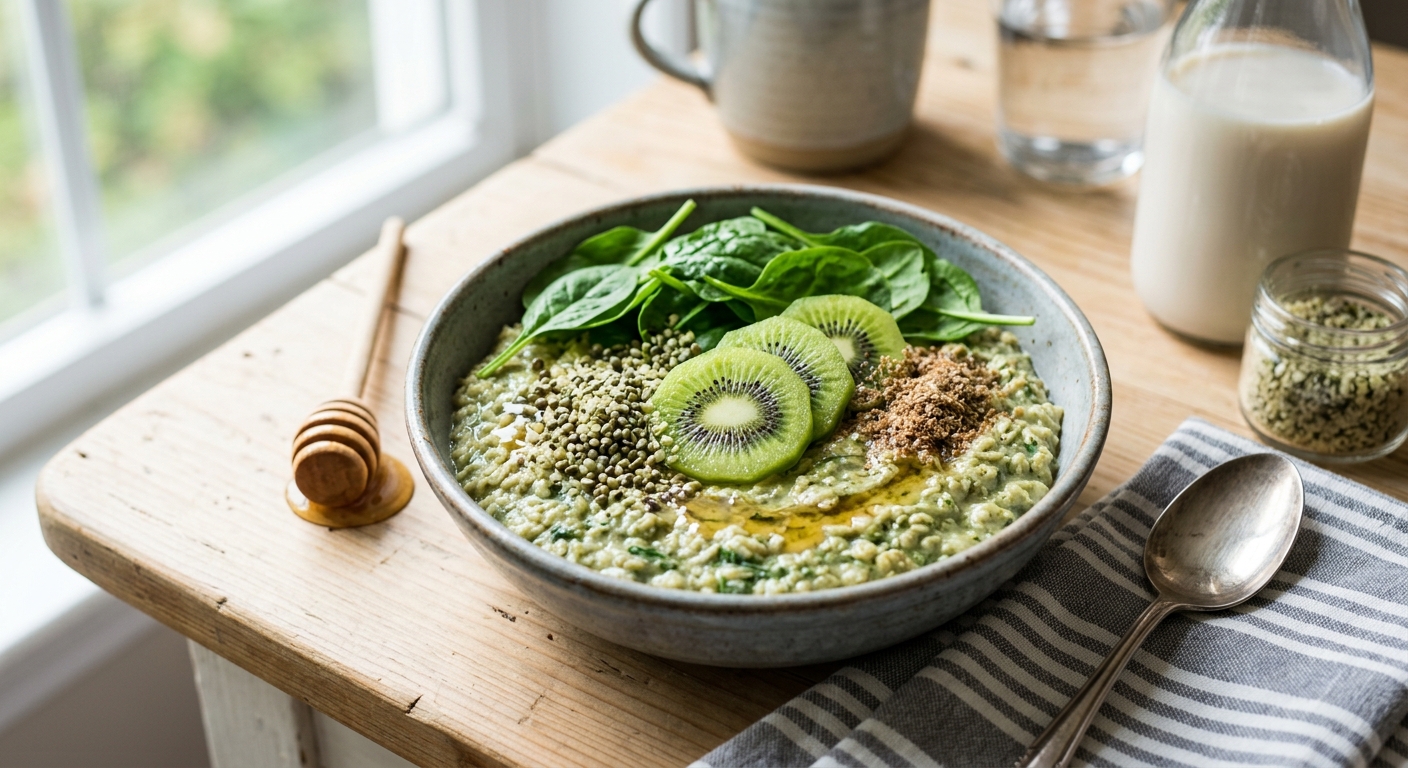
Most breakfast routines fall short on micronutrients before 9 a.m. This Kiwi and Spinach Breakfast Power Bowl fixes that in a single bowl. Two fresh kiwifruit alone contribute roughly 140mg of vitamin C, and when paired with wilted baby spinach, hemp seeds, and a drizzle of flaxseed oil, the bowl clears 180% of the daily recommended intake for vitamin C while also delivering meaningful hits of iron, folate, magnesium, and vitamin K. It is the kind of breakfast a nutritionist would design and a chef would actually want to eat.
The base is a lightly spiced green oat porridge: rolled oats cooked with baby spinach blended directly into the liquid, giving the bowl its signature jade colour without any artificial colouring. The warmth of the oats is contrasted by cool sliced kiwi, toasted pepitas, and a drizzle of raw honey layered on top at serving. Each element earns its place both nutritionally and texturally. Whether you prefer the quick control of a stovetop, the hands-off ease of a slow cooker, the speed of a pressure cooker, or the gentle even heat of an oven, the bowl delivers the same nutritional payload with a method tailored to your morning.
Calibrated Cuisine developed this recipe to sit squarely in the Vitamin Vault category because vitamin C is chronically underestimated as a performance nutrient. Beyond immune defence, it is essential for collagen synthesis, non-haem iron absorption, and cortisol regulation after exercise. Starting your morning at 180% DV means your body has a meaningful reserve to draw on throughout the day, especially important for those who eat a predominantly plant-based diet where non-haem iron from spinach and oats needs every absorption advantage it can get.
4
servings
Ingredients
- 320 grolled oats (old-fashioned, not instant)
- 160 gbaby spinach, packed
- 900 mlunsweetened almond milk
- 240 mlcold water
- 2 tbspground flaxseed
- 2 tbsphemp seeds
- 1 tbspraw honey (plus extra to serve)
- 1 tsppure vanilla extract
- 0.5 tspground ginger
- 0.25 tspColima Sea SaltMicroplastic Free Salt
- 8 mediumkiwifruit, peeled and sliced (about 680g total)
- 60 gpepitas (pumpkin seeds), toasted
- 40 gunsweetened coconut flakes, lightly toasted
- 1 tbspcold-pressed flaxseed oil (for drizzling)
- —Colima Sea SaltMicroplastic Free Salt to taste
Instructions
Click on an item below to shop for the recommended items for this recipe on Amazon.
As an Amazon Associate, we earn from qualifying purchases.
- Prepare the green base liquid: combine the almond milk, water, and baby spinach in a blender. Blend on high for 45 to 60 seconds until completely smooth and vividly green. Set aside.
- Pour the green liquid into a large, heavy-bottomed saucepan or Dutch oven and bring to a gentle simmer over medium heat, stirring occasionally to prevent a skin forming on the surface.
- Once the liquid is just simmering (small bubbles at the edges), add the rolled oats, ground flaxseed, ground ginger, vanilla extract, and fine sea salt. Stir well to combine. Reduce heat to medium-low.
- Cook uncovered, stirring frequently with a wooden spoon or silicone spatula, for 10 to 12 minutes until the oats are fully tender and the porridge has thickened to a creamy, spoonable consistency. If it thickens too quickly, add almond milk 2 tablespoons at a time to loosen.
- Remove from heat and stir in the raw honey and hemp seeds. Taste and adjust sweetness. Allow to rest for 1 minute, during which it will thicken slightly further.
- Divide into four bowls. Working quickly while the oats are warm, arrange sliced kiwifruit in a fan pattern over each bowl. Scatter toasted pepitas and coconut flakes over the top, drizzle with cold-pressed flaxseed oil and an extra thread of honey, and serve immediately.
- The night before serving, lightly grease the slow cooker insert with a neutral oil or cooking spray to prevent sticking. This step makes a significant difference with oat porridge.
- Blend the almond milk, cold water, and baby spinach together in a blender until completely smooth and green. Pour the green liquid directly into the greased slow cooker insert.
- Add the steel-cut oats (see note above), ground flaxseed, ground ginger, vanilla extract, and fine sea salt to the insert. Stir everything together with a long spoon, ensuring the oats are fully submerged.
- Place the lid on the slow cooker and cook on Low for 6 to 7 hours (overnight works perfectly). Do not use the High setting, as the edges will scorch and the oats will turn gluey before the centre is cooked through.
- In the morning, remove the lid and stir the porridge vigorously from the bottom up. The mixture will have separated slightly overnight; stirring brings it back together into a cohesive, creamy texture. If it is thicker than you like, stir in warm almond milk a few tablespoons at a time.
- Stir in the honey and hemp seeds. Taste and adjust seasoning. Ladle into four warm bowls and top each with freshly sliced kiwifruit, toasted pepitas, coconut flakes, a drizzle of flaxseed oil, and extra honey. Serve immediately while still warm.
- Blend the almond milk, cold water, and baby spinach on high in a blender for 45 seconds until the mixture is completely smooth and bright green with no visible spinach pieces.
- Pour the green liquid into the pressure cooker pot. Add the rolled oats, ground flaxseed, ground ginger, vanilla extract, and fine sea salt. Stir to combine. Do not add honey at this stage, as sugars can scorch on the bottom of the pot under pressure.
- Secure the lid and set the pressure valve to Sealing. Select Manual or Pressure Cook mode and set to High Pressure for 10 minutes. The pot will take approximately 6 to 8 minutes to reach pressure before the countdown begins.
- Once the cook time is complete, allow a Natural Pressure Release for a full 10 minutes before carefully switching the valve to Venting to release any remaining steam. Remove the lid, tilting it away from you.
- The oats will appear loose immediately upon opening. Stir vigorously with a silicone spatula, scraping the base of the pot. The porridge will thicken noticeably within 1 to 2 minutes of stirring as the starch settles. Stir in honey and hemp seeds now.
- Divide into four bowls immediately (the porridge continues to thicken as it cools). Top with sliced kiwifruit, toasted pepitas, coconut flakes, a drizzle of cold-pressed flaxseed oil, and extra honey. Serve at once.
- Preheat your oven to 180C (350F) with a rack in the centre position. Lightly grease a 20 x 30cm (8 x 12-inch) ceramic or glass baking dish, or four individual 300ml (10oz) oven-safe ramekins, with a neutral oil.
- Blend the almond milk, cold water, and baby spinach together in a blender on high speed for 60 seconds until the liquid is completely smooth and deeply green. Pour into a large mixing bowl.
- Add the rolled oats, ground flaxseed, hemp seeds, honey, vanilla extract, ground ginger, and fine sea salt to the mixing bowl with the green liquid. Whisk everything together until fully combined. Let the mixture sit for 5 minutes so the oats begin to absorb the liquid, which ensures even baking.
- Pour the oat mixture into the prepared baking dish or divide evenly among the ramekins. Gently tap the dish on the counter to level the surface and release any air pockets.
- Transfer to the preheated oven and bake uncovered for 32 to 38 minutes, until the top is just set and lightly golden at the edges but still has a slight jiggle in the centre (like a soft-set custard). Ramekins will finish closer to 28 to 32 minutes. Do not overbake or the texture will turn dry and crumbly.
- Remove from the oven and allow to rest for 5 minutes, during which the centre will fully set. Scoop into four bowls (or serve directly in ramekins). Top each portion generously with sliced fresh kiwifruit, toasted pepitas, coconut flakes, a drizzle of cold-pressed flaxseed oil, and a thread of raw honey. Serve warm.
Nutrition Breakdown
Per 1 serving (makes 4)
Vitamins & Minerals
% Daily Value based on a 2,000 calorie diet (FDA reference)
🧬 Essential Amino Acids
% of recommended daily intake (RDA) per serving
🛡 Antioxidant Profile
The Nutrition Science
The 180% vitamin C figure in this bowl is not a rounding trick: two medium kiwifruit provide roughly 137mg of ascorbic acid on their own, and baby spinach contributes an additional 28mg per 40g serving, bringing a four-serving batch well above 600mg total. What makes this especially valuable from a nutritional science perspective is the co-presence of non-haem iron from oats and spinach (5.8mg per serving, 32% DV). Vitamin C consumed in the same meal as non-haem iron can increase iron absorption by up to four-fold by reducing ferric iron (Fe3+) to the more bioavailable ferrous form (Fe2+) and by forming soluble iron-ascorbate complexes that resist precipitation in the alkaline environment of the small intestine. For plant-based eaters, this synergy is one of the most clinically meaningful nutrient interactions in the diet.
The spinach in this recipe is blended raw into the cooking liquid rather than cooked separately, a deliberate technique that preserves more of its heat-sensitive folate (148mcg per serving, 37% DV) and vitamin C while still delivering fat-soluble carotenoids like beta-carotene and lutein. Research published in the Journal of Agricultural and Food Chemistry demonstrates that blending, rather than juicing, retains the fibre matrix that slows carotenoid release, while the presence of fat from hemp seeds and flaxseed oil in the same meal increases carotenoid bioavailability by a factor of three to five compared to a fat-free preparation. Every component of this bowl is positioned to maximise what your body actually absorbs, not just what is present on paper.
The glycemic load of 16 (medium range) reflects a careful balance. Oats contain beta-glucan, a soluble fibre that forms a viscous gel in the gut, slowing glucose absorption and triggering GLP-1 release, a satiety hormone. A 2016 meta-analysis in the American Journal of Clinical Nutrition found that 3g of oat beta-glucan per day, an amount this bowl provides, reduces post-meal blood glucose peaks by approximately 35% compared to an equivalent glucose load without beta-glucan. This means that despite its carbohydrate content, the bowl produces a smooth, sustained energy curve rather than a spike, making it particularly well-suited as a pre-workout or high-focus morning meal.
Pro Tips
- Do not skip blending the spinach into the liquid before cooking. Adding spinach as whole leaves creates an uneven texture and a grassy flavour, whereas blending it creates a seamless, mildly sweet green base that most people cannot identify as spinach.
- Add the sliced kiwifruit only at serving, never during cooking. Heat destroys a significant portion of vitamin C (ascorbic acid degrades rapidly above 70C), so keeping the kiwifruit raw preserves the bowl’s headline nutrient intact.
- Toast the pepitas in a dry skillet over medium heat for 3 to 4 minutes, shaking frequently, until they begin to pop and turn golden. This simple step increases their nutty flavour by triggering Maillard browning on the seed surface and makes the magnesium and zinc they contain more accessible by reducing their phytate content slightly.




This is such a smart pairing, and I love that you’re highlighting the synergy here – the vitamin C from kiwi actually enhances the bioavailability of the non-heme iron in spinach, so you’re not just hitting numbers on paper, you’re actually optimizing absorption. I’ve had patients on iron supplements who struggled with side effects (nausea, constipation) and we found that adding vitamin C-rich foods at the same meal made a real difference in both their tolerance and their lab values. Quick question though: are you wilting the spinach raw or cooking it? I’m curious whether you tested both routes, since cooking reduces volume but the nutrient density shifts slightly. Either way
This is exactly the kind of synergistic pairing my functional medicine doctor highlighted when we were troubleshooting my iron absorption issues last year, Veronika. I had solid iron labs but persistent fatigue, and she pointed out that I wasn’t pairing my iron sources thoughtfully enough with vitamin C. My last quarterly labs actually showed a noticeable improvement once I got intentional about this, so seeing it spelled out so clearly here feels validating. Mike, I’m really intrigued by your mushroom suggestion too, especially if you’re talking about the polysaccharide content enhancing nutrient uptake, but I’d be curious whether adding them raw versus sauteed makes a difference for bioav
oh this is great but now im totally thinking you could add some sauteed lion’s mane or oyster mushrooms to this bowl and honestly amp up the bioavailability game even more – mushrooms have these compounds that actually work alongside vitamin C to help with nutrient absorption, plus you’d get beta-glucans and ergothioneine (which is like, the only dietary source of this amino acid derivative our bodies cant make). i do this exact thing with my breakfast bowls and the umami from the mushrooms makes the spinach taste even better without needing extra salt or anything. have you ever experimented with adding fungi to your breakfast builds?