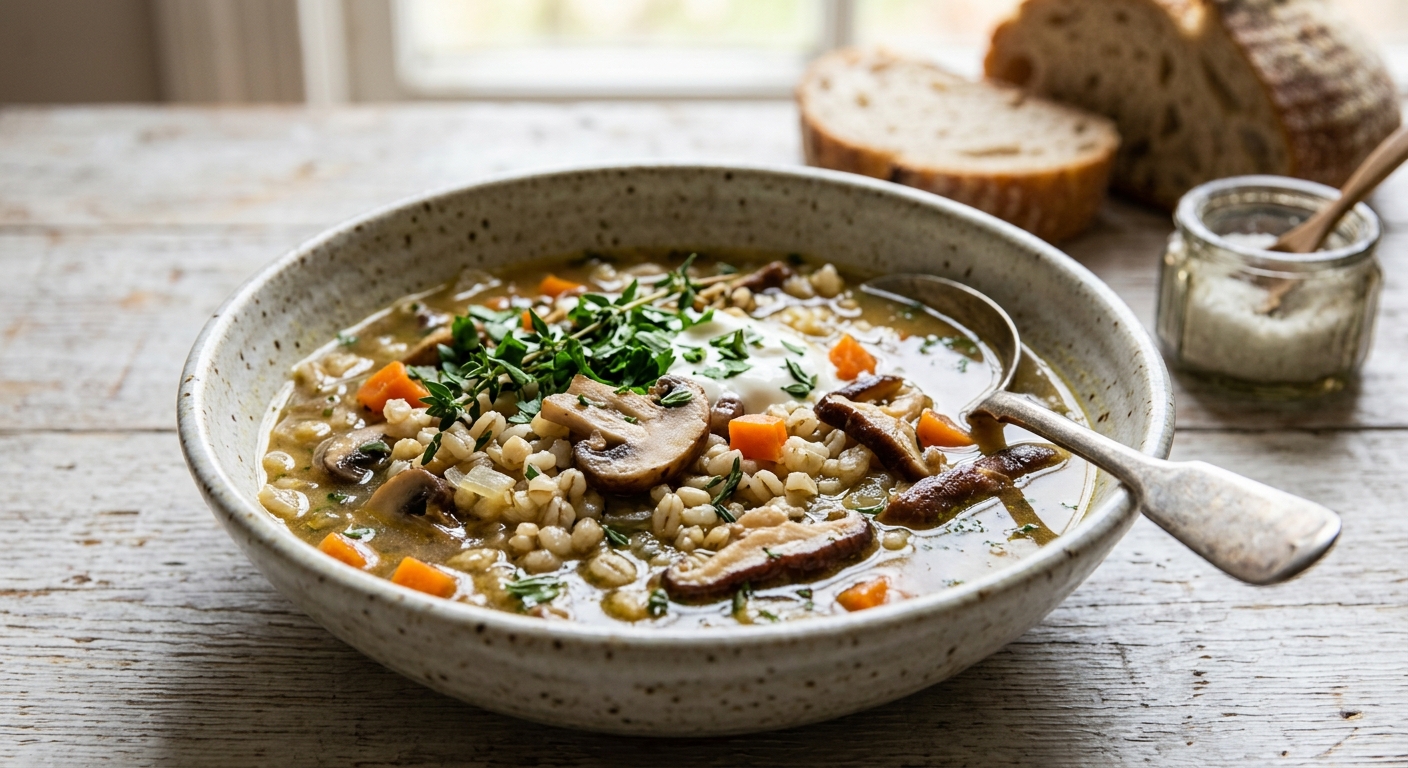
There is a reason every traditional culture that cultivated grain also made barley soup: the grain has an almost supernatural ability to transform a modest pot of vegetables and water into something silky, nourishing, and profoundly satisfying. What those cooks could not have known is that the secret lies in beta-glucan, a soluble fiber that dissolves into the broth as barley cooks, creating a gentle viscosity and simultaneously delivering one of the most studied anti-inflammatory compounds in the food supply. A single generous serving of this soup provides roughly 2.5 grams of beta-glucan, approaching the 3-gram daily threshold the FDA recognizes for cardiovascular benefit.
The mushroom trio here, cremini, shiitake, and dried porcini, is chosen for both flavor and function. Cremini deliver meaty texture and a reliable base of selenium and B vitamins. Shiitake contribute lentinan, a polysaccharide linked to immune modulation, along with a uniquely high natural glutamate content that deepens the broth without any added flavor enhancers. Dried porcini, rehydrated and added with their soaking liquid, act as a concentrated umami bomb and bring a woodsy complexity that would take hours to build any other way. The result is a broth so rich it is hard to believe no bones were involved. Fresh thyme ties everything together, contributing rosmarinic acid and luteolin, two of the most rigorously studied plant anti-inflammatories, right alongside the mushrooms they were made to accompany.
Every cooking method below is calibrated to get the best from these ingredients. The stovetop version gives you the most control and the best opportunity to develop fond and build layers of flavor. The slow cooker produces an extraordinarily rich, deeply infused broth with almost no active effort. The pressure cooker delivers a fully developed soup in under 40 minutes total. Each method is genuinely different, not simply a timing adjustment, because barley and mushrooms respond differently to dry heat, prolonged low moisture, and pressurized steam. Choose the method that fits your day, and every version will deliver the same precise nutritional payload.
4
servings
Ingredients
- 180 gpearl barley, rinsed and drained
- 300 gcremini mushrooms, sliced 5mm thick
- 150 gfresh shiitake mushrooms, stems removed, caps sliced
- 25 gdried porcini mushrooms
- 250 mlboiling water (for rehydrating porcini)
- 1 mediumyellow onion, finely diced
- 3 clovesgarlic, minced
- 2 mediumcarrots, peeled and cut into 1cm dice
- 2 stalkscelery, cut into 1cm dice
- 2 tbspextra-virgin olive oil
- 2 tbsptomato paste
- 1.5 literslow-sodium vegetable broth
- 1 tbspfresh thyme leaves (from about 8 sprigs), plus extra to serve
- 2 tspfresh thyme sprigs (whole, for slow cooker and oven methods)
- 1 tbspsoy sauce or tamari (use tamari for gluten-free)
- 1 tbspapple cider vinegar
- 1 tspsmoked paprika
- 0.5 tspfreshly ground black pepper
- —Colima Sea SaltMicroplastic Free Salt to taste
- —Fresh flat-leaf parsley, roughly chopped, to serve
Instructions
Click on an item below to shop for the recommended items for this recipe on Amazon.
As an Amazon Associate, we earn from qualifying purchases.
- Place the dried porcini in a heatproof bowl and pour 250ml of boiling water over them. Let steep for 15 minutes until fully rehydrated and fragrant. Lift the porcini out with a slotted spoon, squeeze gently, and roughly chop. Pour the soaking liquid through a fine-mesh sieve lined with a paper towel into a measuring jug, leaving any grit behind. Set both aside.
- Heat the olive oil in a large Dutch oven or heavy-based pot over medium-high heat. Once shimmering, add the cremini and shiitake mushrooms in a single layer. Resist the urge to stir for the first 3 to 4 minutes, allowing the mushrooms to develop deep golden-brown sear marks on the base of the pot. Once browned on one side, stir and cook for a further 2 minutes. Season lightly with salt, then transfer the seared mushrooms to a plate.
- Reduce the heat to medium and add the diced onion, carrots, and celery to the same pot. Cook, stirring occasionally, for 6 to 7 minutes until the onion is soft and translucent. Add the garlic, smoked paprika, black pepper, and tomato paste. Stir constantly for 90 seconds, cooking the tomato paste until it darkens slightly and sticks to the bottom of the pot. This fond is pure flavor.
- Pour in approximately 100ml of the vegetable broth and use a wooden spoon to scrape up all the caramelized bits from the bottom of the pot. Add the rinsed pearl barley, soy sauce, the reserved porcini soaking liquid, the chopped porcini, and the remaining vegetable broth. Stir to combine, then bring to a vigorous boil.
- Once boiling, reduce to a steady simmer, add the fresh thyme leaves, and return the seared mushrooms to the pot. Partially cover with a lid, leaving a 2cm gap to allow steam to escape. Simmer for 45 to 50 minutes, stirring every 10 minutes, until the barley is tender and has released enough starch to give the broth a slightly silky consistency. If the soup thickens beyond your preference, add up to 200ml of hot water.
- Remove from heat. Stir in the apple cider vinegar, which brightens all the earthy flavors. Taste carefully and adjust salt. Ladle into deep bowls, finish with a scatter of fresh thyme leaves and chopped parsley, and serve immediately.
- Begin by rehydrating the porcini: place them in a heatproof bowl with 250ml of boiling water and let steep for 15 minutes. Lift out, squeeze gently, and roughly chop. Strain the soaking liquid through a fine-mesh sieve into the slow cooker insert. Add all remaining liquid, the vegetable broth, directly to the insert as well.
- Without cleaning it, place the slow cooker insert aside. In a large skillet over high heat, heat the olive oil until shimmering. Add the cremini and shiitake mushrooms in a single layer and sear undisturbed for 4 minutes to develop significant browning. Stir once and sear for 2 more minutes. This step is not optional in the slow cooker method: it creates the Maillard compounds that give the broth depth and color that long, low heat alone cannot build. Add the mushrooms directly to the slow cooker insert.
- In the same skillet over medium heat, cook the onion, carrots, and celery for 5 minutes until beginning to soften. Add the garlic, smoked paprika, black pepper, and tomato paste and stir for 60 seconds. Deglaze with a splash of the broth from the insert if needed to lift any stuck bits, then scrape everything into the slow cooker.
- Add the rinsed pearl barley, chopped porcini, soy sauce, whole thyme sprigs, and the remaining vegetable broth to the slow cooker. Stir once to distribute everything evenly. Place the whole thyme sprigs on top so they are easy to retrieve later. Do not add the apple cider vinegar yet, as long acid exposure can dull the mushroom flavor.
- Place the lid on the slow cooker and cook on Low for 7 to 8 hours or on High for 4 hours. The soup is ready when the barley is completely tender and has thickened the broth noticeably. Discard the whole thyme sprigs. Stir in the apple cider vinegar and taste for salt. Ladle into bowls and finish with fresh parsley and thyme leaves.
- Combine the dried porcini with 250ml of boiling water in a small bowl and steep while you prepare the aromatics, about 10 minutes. Lift out, squeeze, and chop roughly. Pour the strained soaking liquid into a separate cup and set aside.
- Set the Instant Pot or electric pressure cooker to Saute on High (or use the stovetop pressure cooker over high heat with the lid off). Heat the olive oil, then add the cremini and shiitake mushrooms. Sear without stirring for 3 to 4 minutes until well browned on the base. Stir once and cook for 90 more seconds. Remove and set aside on a plate.
- Add the onion, carrots, and celery to the pot and saute for 4 minutes, stirring often, until beginning to soften. Add the garlic, smoked paprika, black pepper, and tomato paste and stir for 60 seconds until fragrant and the paste begins to darken. Pour in 100ml of the vegetable broth and scrape the bottom of the pot thoroughly with a wooden spoon to lift all fond, as any stuck bits can trigger the burn sensor in electric models.
- Add the rinsed pearl barley, chopped porcini, porcini soaking liquid, soy sauce, fresh thyme leaves, the seared mushrooms, and the remaining vegetable broth. Stir to combine. The liquid should come no higher than the two-thirds fill line. Cancel the Saute function.
- Secure the lid and set the pressure valve to Sealing. Cook at High Pressure for 22 minutes. Allow a natural pressure release for 10 minutes, then carefully perform a quick release for any remaining pressure. Open the lid away from your face. Stir the soup, add the apple cider vinegar, and taste for salt. If the consistency is thicker than desired, add hot water in 50ml increments. Serve immediately with parsley and fresh thyme.
- Position an oven rack in the lower-middle of the oven and preheat to 170C (340F) conventional, or 155C (310F) fan-forced. Steep the dried porcini in 250ml of boiling water for 15 minutes, then lift out, chop, and strain the soaking liquid as described above.
- Set a large oven-safe Dutch oven over high heat on the stovetop. Heat the olive oil until just smoking. Add the cremini and shiitake mushrooms and sear undisturbed for 4 to 5 minutes, developing a deep, almost mahogany-brown crust. Stir once and sear for 2 more minutes. The deeper the sear here, the more complex the finished soup will taste after its long oven braise. Transfer mushrooms to a plate.
- Reduce stovetop heat to medium. Cook onion, carrots, and celery in the same pot for 6 minutes until softened. Add the garlic, smoked paprika, black pepper, and tomato paste, stirring constantly for 90 seconds. Add 100ml of broth and scrape the bottom clean. This fond will caramelize further during the oven phase, so every bit of it matters.
- Add the rinsed pearl barley, chopped porcini, strained porcini soaking liquid, soy sauce, whole thyme sprigs, the seared mushrooms, and all remaining vegetable broth. Stir well and bring to a boil on the stovetop. Once you see a rolling boil, remove from the heat, place the lid on firmly, and transfer the entire pot to the preheated oven.
- Braise in the oven for 1 hour and 15 minutes without lifting the lid. The trapped steam and gentle, even heat from all sides will cook the barley evenly, infuse the broth with roasted depth, and allow the beta-glucan fiber to fully hydrate and bloom into the liquid. After the time is up, carefully remove the pot using oven mitts and set on a heat-safe surface.
- Remove and discard the whole thyme sprigs. Stir the soup, noticing the rich, deeply colored broth. Stir in the apple cider vinegar, taste for salt and pepper, and adjust as needed. If a slight skin has formed on the surface (normal with oven braises), simply stir it back in. Ladle into bowls, finish with fresh parsley and thyme leaves, and serve.
Nutrition Breakdown
Per 1 serving (makes 4)
Vitamins & Minerals
% Daily Value based on a 2,000 calorie diet (FDA reference)
🧬 Essential Amino Acids
% of recommended daily intake (RDA) per serving
🛡 Antioxidant Profile
The Nutrition Science
The headline compound in this soup is beta-glucan, a mixed-linkage soluble fiber found in the cell walls of barley (and oats). Unlike insoluble fiber that passes through largely unchanged, beta-glucan dissolves into aqueous solution during cooking and forms a viscous gel in the small intestine. This gel slows glucose absorption, blunts the post-meal insulin spike, and physically traps bile acids for excretion, forcing the liver to synthesize new bile from circulating LDL cholesterol. These mechanisms together explain why the FDA authorizes a health claim for barley beta-glucan and cardiovascular disease at intakes of 3 grams per day. A single bowl of this soup provides approximately 2.4 to 2.6 grams, making it one of the most efficient single-meal beta-glucan sources available.
The anti-inflammatory picture extends well beyond beta-glucan. Ergothioneine, found almost exclusively in mushrooms and certain bacteria, is absorbed by a dedicated transporter (OCTN1) and concentrates in tissues under high oxidative stress, including the liver, kidney, bone marrow, and mitochondria. Unlike many plant antioxidants that are rapidly metabolized, ergothioneine has a half-life in humans measured in weeks, which is why researchers have proposed it qualifies as a conditionally essential nutrient. The cremini and shiitake combination in this recipe contributes approximately 4 to 6 mg per serving, a meaningful amount given that typical dietary intakes in non-mushroom-consuming populations hover near zero. Meanwhile, the thyme contributes rosmarinic acid and luteolin, both of which have been shown in human cell studies to downregulate NF-kB, the transcription factor that governs the production of pro-inflammatory cytokines including TNF-alpha and IL-6.
The inclusion of apple cider vinegar at the end of cooking is not merely a flavor decision. The acetic acid in vinegar has been shown in controlled trials to reduce postprandial blood glucose response by up to 20%, likely by inhibiting salivary amylase and slowing gastric emptying. Combined with the viscous beta-glucan gel already present, this soup produces one of the most attenuated postprandial glucose curves achievable from a grain-based meal. The smoked paprika contributes capsaicin-adjacent compounds (specifically capsinoids and capsaicinoids in sweet paprika) that activate TRPV1 receptors and have been associated with reduced inflammatory cytokine expression in adipose tissue, providing yet another layer to a dish that is, in the most literal sense, calibrated for systemic anti-inflammatory effect.
Pro Tips
- Do not skip searing the mushrooms, regardless of cooking method. Mushrooms are 90% water, and only sustained high heat drives off enough moisture to trigger Maillard browning. A properly seared mushroom contributes flavor compounds that are chemically impossible to develop through steaming or slow cooking alone.
- The porcini soaking liquid is liquid gold. Pour it slowly and stop before the last few milliliters, where grit settles. That dark, intensely flavored liquid adds more umami depth than any store-bought stock concentrate.
- Pearl barley continues to absorb liquid as the soup cools and especially when refrigerated. When reheating leftovers, add a splash of water or broth and stir over medium heat. The soup keeps for 4 days refrigerated and freezes well for up to 3 months, making it an ideal batch-cook meal for anti-inflammatory meal planning.


This is exactly the kind of recipe I come back to with my clients who need sustained cognitive support without the complexity. The beta-glucan piece is huge for gut barrier function, which directly influences neuroinflammation, but I love that you’re leading with the practical outcome (a deeply satisfying bowl) rather than the mechanism. Quick question: are you finding that the fresh thyme makes a meaningful difference over dried, or is that more of a flavor preference? I’ve been experimenting with thyme’s thymol content as a mild neuroprotective, but the literature seems murky on whether the fresh/dried distinction matters for that specific compound.
This hits exactly where I’ve been trying to land with my own cooking lately. I’ve noticed that when I’m consistent with beta-glucan sources, my fatigue patterns shift in ways I can actually track, and I think it’s because of that gut barrier connection Naomi mentioned. The selenium and B12 combination here is what really caught my eye though, especially since those often run low together in MS and contribute to that neuroinflammatory spiral. Thank you for breaking down not just what’s in the bowl, but why each element matters for someone managing a chronic inflammatory condition.
ok this is gonna sound like the sleep researcher version of “everything reminds me of my ex” but the selenium and B6 in this combo have me genuinely excited, especially paired with the thyme. thyme’s got compounds that can shift circadian rhythm sensitivity and the barley’s beta-glucan keeps your gut microbiome stable which… directly affects tryptophan metabolism and melatonin production. been experimenting with mushroom soups for like three weeks and my sleep tracker data is actually showing better sleep consolidation, not just falling asleep faster. havent nailed down if its the mushroom polysaccharides themselves or the fact that stable gut function = better serotonin baseline but