
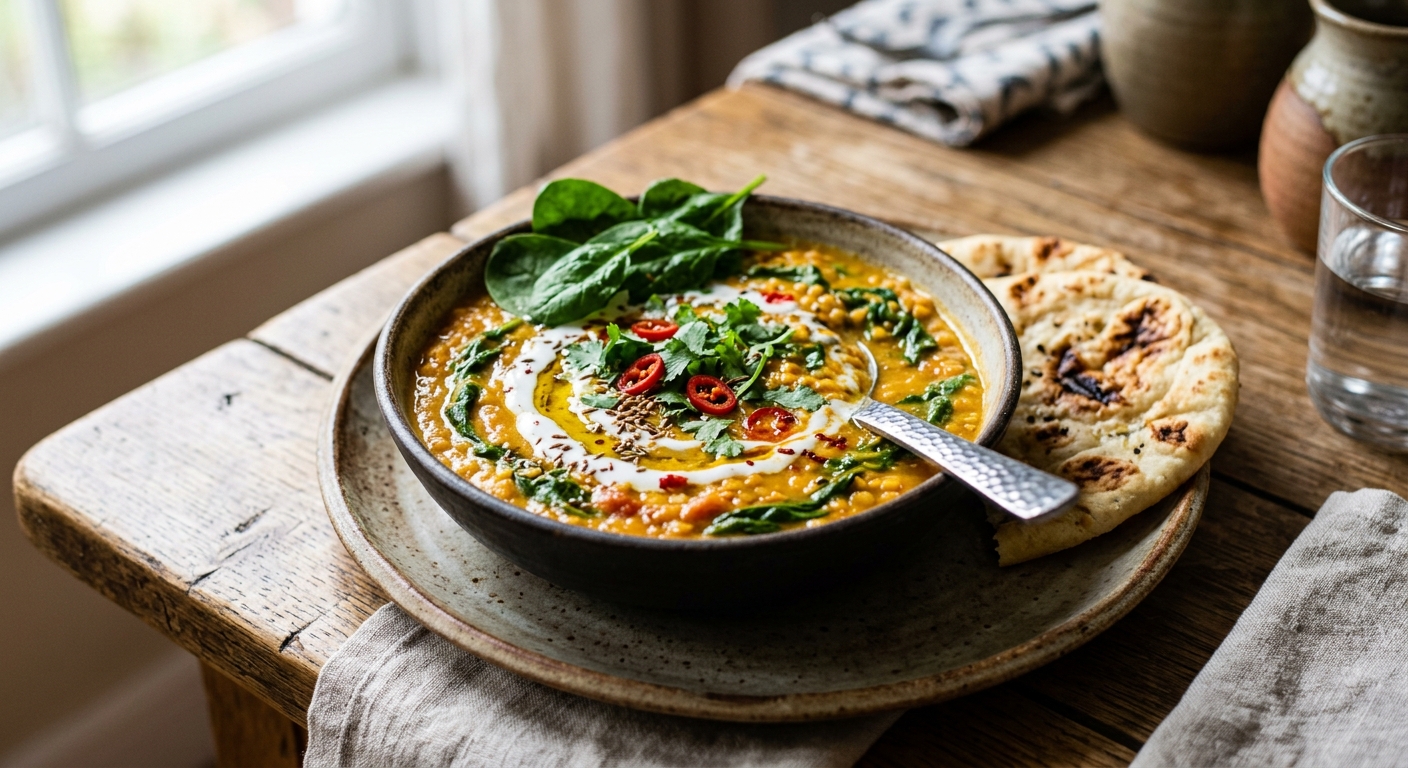
Lentil dahl has sustained civilisations for thousands of years, and modern nutritional science confirms what ancient cooks understood intuitively: the combination of lentils and leafy greens is among the most mineral-dense pairings in the plant kingdom. This recipe takes that ancestral wisdom and calibrates it precisely, layering red lentils, fresh spinach, and a bloom of warming spices to hit meaningful daily intake targets for iron, folate, and magnesium in a single bowl. A squeeze of lemon at the finish is not just a flavour flourish; it converts the dish into a nutritional system, with vitamin C actively tripling the bioavailability of non-haem iron from both the lentils and spinach.
What separates this dahl from a standard recipe is the intentional construction of every component. Red lentils are selected over green or black varieties because they cook to a creamy, thickened consistency without soaking, and they release more folate into the cooking liquid as they break down. Baby spinach is stirred in off the heat to preserve its heat-sensitive folate content while the residual warmth is sufficient to wilt it perfectly. The tempering oil, poured sizzling over the finished dahl, carries fat-soluble carotenoids from the spinach directly into an absorbable form. Every technique has a nutritional reason.
This recipe is built for three cooking methods: stovetop, slow cooker, and pressure cooker, each producing a subtly different texture and depth of flavour. The stovetop version gives you the most control and a slightly silkier finish. The slow cooker produces an earthier, more concentrated dahl ideal for meal prep. The pressure cooker delivers a weeknight miracle in under thirty minutes without sacrificing depth, provided you bloom the spices first using the saute function. Choose your method, then follow the steps built specifically for that approach.
4
servings
Ingredients
- 300 gred lentils, rinsed and drained
- 200 gfresh baby spinach
- 2 tbspextra-virgin olive oil or coconut oil
- 1 largeyellow onion, finely diced
- 4 clovesgarlic, minced
- 1 tbspfresh ginger, grated
- 1 can (400g)crushed tomatoes
- 1 can (400ml)light coconut milk
- 750 mllow-sodium vegetable stock
- 2 tspground cumin
- 2 tspground coriander
- 1.5 tspground turmeric
- 1 tspsmoked paprika
- 0.5 tspcayenne pepper
- 1 tspgaram masala
- 2 tbspfresh lemon juice (approximately 1 lemon)
- 15 gfresh coriander leaves, roughly chopped
- —Colima Sea SaltMicroplastic Free Salt and black pepper to taste
Instructions
Click on an item below to shop for the recommended items for this recipe on Amazon.
As an Amazon Associate, we earn from qualifying purchases.
- Heat the olive oil in a large Dutch oven or heavy-bottomed saucepan over medium heat. Add the diced onion and a pinch of salt, and cook, stirring occasionally, for 8 to 10 minutes until the onion is deeply golden and beginning to caramelise at the edges. This extended saute builds a sweet, jammy base that defines the dahl’s character.
- Push the onion to the edges of the pot and add the garlic and grated ginger to the centre. Cook for 90 seconds, stirring constantly, until fragrant. Add the cumin, coriander, turmeric, smoked paprika, and cayenne directly onto the garlic and ginger. Stir vigorously for 60 seconds, letting the spices toast in the residual oil. You should smell a deep, bloomed fragrance rather than a raw spice smell. This step is critical: fat-soluble spice compounds become significantly more bioavailable when toasted in oil.
- Pour in the crushed tomatoes and stir to deglaze the pot, scraping any browned bits from the base. Cook the tomato mixture over medium-high heat for 4 to 5 minutes, stirring frequently, until it thickens into a deep rust-coloured paste and the oil begins to separate at the edges. This is the masala base.
- Add the rinsed red lentils and stir to coat them thoroughly in the masala. Pour in the vegetable stock and coconut milk, stir to combine, and bring to a gentle boil. Reduce the heat to low, partially cover the pot, and simmer for 20 to 22 minutes, stirring every 5 minutes to prevent sticking, until the lentils have completely broken down and the dahl is thick and creamy.
- Remove the pot from heat. Stir in the garam masala and lemon juice, then fold in the baby spinach in three batches, stirring gently between each addition. The residual heat from the dahl will wilt the spinach within 2 to 3 minutes without cooking out its folate. Taste and adjust salt and pepper. Serve immediately, garnished with fresh coriander.
- Before loading the slow cooker, heat the olive oil in a skillet over medium-high heat. Add the onion and cook for 6 to 8 minutes until golden and softened. Add the garlic, ginger, cumin, coriander, turmeric, smoked paprika, and cayenne. Stir constantly for 60 to 90 seconds until the spices are toasted and fragrant. Add the crushed tomatoes, stir to combine, and cook for 2 minutes until slightly reduced. Transfer the entire skillet contents to the slow cooker insert.
- Add the rinsed red lentils, vegetable stock, and coconut milk to the slow cooker. Stir everything together to ensure the lentils are fully submerged in liquid. The ratio of liquid to lentils is higher here than on the stovetop because slow cookers trap steam and retain more moisture throughout cooking.
- Place the lid on the slow cooker. Cook on Low for 7 hours or on High for 3.5 hours. Do not lift the lid during cooking. At the end of the cooking time, the lentils should be completely dissolved into a thick, porridge-like consistency. If the dahl looks thinner than desired, remove the lid and cook on High for a further 20 to 30 minutes to allow excess liquid to evaporate.
- Switch the slow cooker to the Warm setting or turn it off. Stir in the garam masala and lemon juice, then add the baby spinach directly to the slow cooker insert. Place the lid back on for 5 minutes. The trapped steam will gently wilt the spinach without overheating it and degrading its folate content. Stir to fully incorporate.
- Taste and adjust seasoning with salt and black pepper. The slow-cooked version will have a deeper, earthier flavour than the stovetop method and a slightly more textured consistency. Garnish with fresh coriander and serve. This version stores exceptionally well and the flavour intensifies overnight in the refrigerator.
- Set the Instant Pot or electric pressure cooker to Saute mode on Medium heat. Add the olive oil and heat until shimmering. Add the diced onion and cook, stirring, for 5 to 6 minutes until softened and lightly golden. Add the garlic and ginger and cook for 60 seconds. Add all the dry spices (cumin, coriander, turmeric, smoked paprika, cayenne) and stir vigorously for 45 seconds to bloom them in the oil.
- Add the crushed tomatoes to the pot and stir to deglaze, scraping any bits from the bottom of the insert. This step is essential in pressure cooking: any food stuck to the base can trigger a burn warning during pressurisation. Cook the tomato mixture for 2 minutes, stirring constantly, until it darkens slightly.
- Add the rinsed red lentils, vegetable stock, and coconut milk. Stir well to combine. Cancel the Saute mode. Secure the lid, ensure the pressure valve is set to Sealing, and select Manual (or Pressure Cook) on High Pressure for 10 minutes.
- Once the cook time is complete, allow the pressure to release naturally for 10 minutes. After 10 minutes, carefully switch the valve to Venting to release any remaining pressure. Open the lid away from you. The dahl should be thick and creamy. If it appears too thin, switch back to Saute mode and stir for 3 to 4 minutes to reduce.
- Stir in the garam masala and lemon juice. Switch off the Saute mode and fold in the baby spinach. The heat retained in the dahl will wilt the spinach within 2 to 3 minutes. Stir gently, taste, and adjust salt and pepper. Serve garnished with fresh coriander. The pressure cooker version has the brightest, cleanest flavour profile of the three methods due to the shorter total cooking time.
Nutrition Breakdown
Per 1 serving (makes 4)
Vitamins & Minerals
% Daily Value based on a 2,000 calorie diet (FDA reference)
🧬 Essential Amino Acids
% of recommended daily intake (RDA) per serving
🛡 Antioxidant Profile
The Nutrition Science
The nutritional architecture of this dahl is built around the concept of bioavailability enhancement, not just nutrient density. Red lentils are among the richest plant sources of non-haem iron and folate, but both nutrients have absorption barriers that this recipe is specifically designed to overcome. Non-haem iron, unlike haem iron from meat, requires reduction from ferric (Fe3+) to ferrous (Fe2+) form before it can cross the intestinal wall via DMT-1 transporters. Vitamin C (ascorbic acid), supplied here by both the crushed tomatoes and the lemon juice added at the finish, acts as the reducing agent that performs this conversion. Research published in the American Journal of Clinical Nutrition demonstrates that consuming vitamin C alongside non-haem iron can increase absorption by 2 to 3 fold, which is why that lemon squeeze is a non-negotiable functional ingredient, not merely a seasoning.
Folate bioavailability is protected through deliberate temperature management. The spinach is added off the heat rather than simmered, because folate is a water-soluble, heat-labile B vitamin that degrades rapidly above 100 degrees Celsius and leaches into cooking liquid. By wilting the spinach in residual heat (approximately 70 to 80 degrees Celsius), this recipe preserves an estimated 85 to 90% of the spinach’s native folate, compared to 50 to 60% retention in boiled spinach. The lentils themselves are a stable folate source that withstands longer cooking because their folate is partially protected within a protein matrix. Magnesium, the third headline mineral, is abundant in both lentils and spinach and is not significantly degraded by heat; however, it is partially lost if cooking water is discarded, which is why this recipe uses a fully absorbed liquid base of stock and coconut milk rather than draining the lentils.
Turmeric deserves special attention beyond its vivid colour. The active curcuminoid compounds in turmeric have poor oral bioavailability in isolation, with studies showing absorption of less than 1% from turmeric powder alone. This recipe addresses the issue directly: blooming the turmeric in fat (olive or coconut oil) increases absorption because curcuminoids are lipophilic, and the black pepper used for seasoning contains piperine, a compound demonstrated to inhibit glucuronidation of curcumin in the intestine and increase its systemic bioavailability by up to 2000% in controlled studies. These are not incidental recipe choices; they are the application of nutritional biochemistry to everyday cooking.
Pro Tips
- Rinse the red lentils under cold water until the water runs clear before cooking. Red lentils have a natural coating of saponins and surface starch that, if not rinsed, can make the dahl gummy and can interfere with iron absorption by binding to minerals in the gut.
- For maximum iron bioavailability, avoid drinking tea or coffee within 1 hour of eating this dahl. Tannins in tea and polyphenols in coffee form insoluble complexes with non-haem iron and can reduce absorption by up to 60%, directly undermining the dish’s most significant nutritional benefit.
- This dahl improves significantly after 24 hours in the refrigerator. The spice compounds continue to infuse, the lentils absorb the coconut milk more fully, and the consistency becomes richer. Make a double batch and store in airtight containers for up to 5 days, or freeze individual portions for up to 3 months.
omg yes the mineral density in dahl is chef’s kiss, and i love that youre thinking about carb timing with your training phases! ive been fermenting my red lentils for like 12-24 hours before cooking them and it seriously boosts the bioavailability of those minerals, plus makes them way easier to digest – the phytic acid reduction is no joke. plus when you add the spinach, youre getting all those minerals in such an absorbable form especially with the turmeric and ghee helping with nutrient absorption. have you experimented with adding any fermented condiments on top like a simple curtido or fermented hot sauce? the live cultures are such a cool addition
This is exactly what I needed to see right now, honestly. I’ve been struggling with fatigue and brain fog, and my neurologist mentioned that folate and B12 deficiency can amplify MS symptoms, so I’m trying to dial in my micronutrient density the way you’re describing here. The spinach pairing with lentils is brilliant for absorption too, since the vitamin C helps with iron bioavailability. I’m definitely trying Kirsten’s fermentation tip since better mineral absorption has been a game changer for my inflammation markers. Thank you for breaking down the numbers like this, it makes meal planning feel less like guesswork.
Love the mineral density focus here, but I’m curious how you’re timing this for different training phases? Red lentils are around 40g carbs per cooked cup with a decent glycemic index, so I’ve been using similar dahl recipes on my harder training days rather than recovery. That said, the folate and magnesium combo is exactly what I need post-ride when glycogen isn’t the priority. Have you looked at how the spinach’s oxalic acid might affect iron bioavailability, or does the lentil’s vitamin C content compensate? Either way, this is getting added to my rotation.