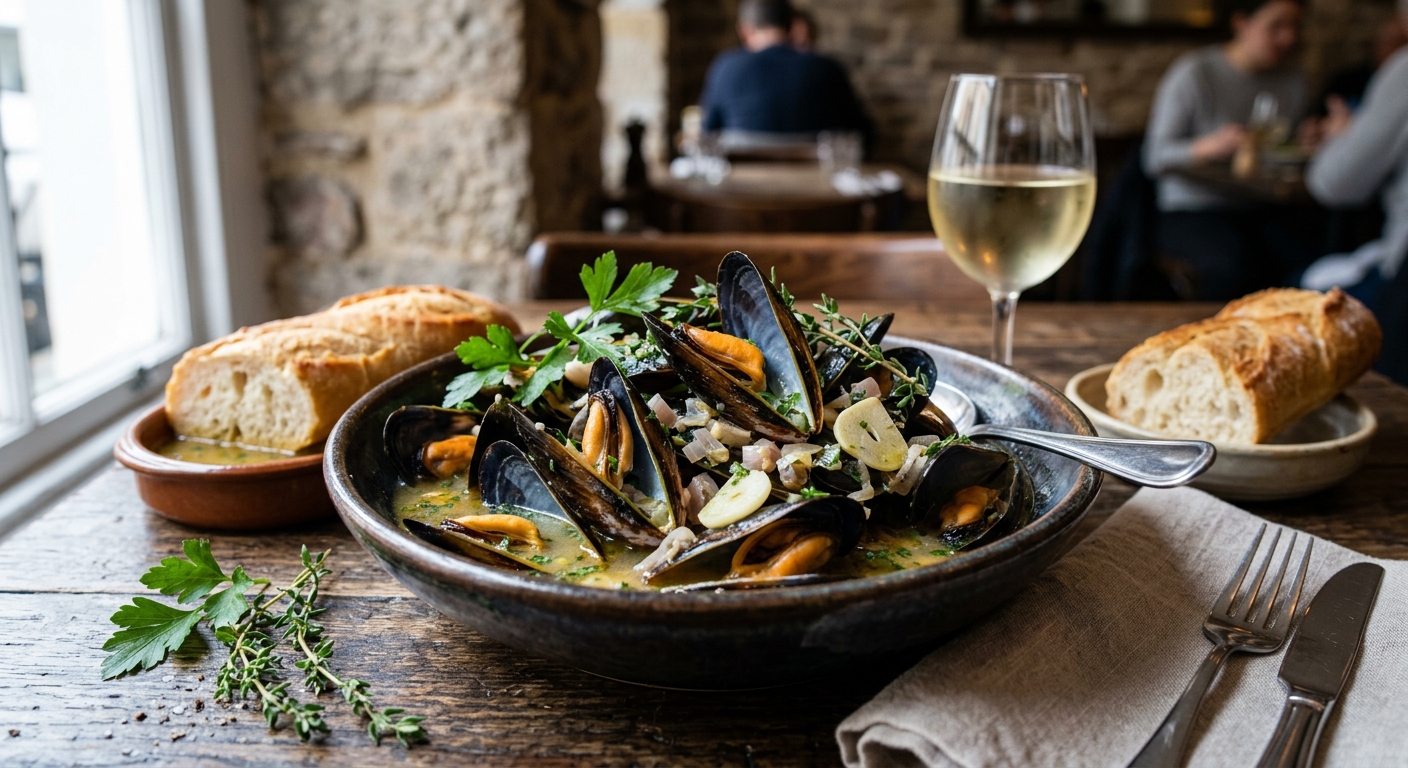
There is a reason nutritionists quietly regard mussels as one of the most underrated foods in the Western diet. A single 200-gram serving of cooked mussels delivers more zinc than a 300-gram beef steak, more selenium than almost any other whole food, and a hit of vitamin B12 so substantial it would make a supplement blush. Combined with the aromatic depth of dry white wine, shallots, garlic, and fresh thyme, these humble bivalves become something truly extraordinary on the plate. This is moules mariniere elevated by both culinary technique and nutritional precision.
What makes this dish the centrepiece of our Mineral Matrix category is the remarkable bioavailability of its nutrients. Unlike plant-based iron sources that require careful pairing to unlock their potential, the heme iron in mussels is absorbed at a rate of 15 to 35 percent, roughly three times higher than non-heme sources. The white wine broth is not merely decorative: the acidity from the wine keeps the cooking liquid bright and slightly thickened, and the liquid itself captures dissolved minerals leached from the shells during cooking, meaning every spoonful of broth is nutritionally active. Do not waste a drop.
This recipe has been calibrated for four servings and uses 1.2 kilograms of live mussels, a quantity that provides a generous main-course portion for each person while hitting meaningful thresholds for ten distinct micronutrients. Whether you cook them in a wide Dutch oven over a roaring stovetop flame, coax them open slowly in a pressure cooker, or use an unconventional low oven method for a crowd, the technique has been engineered for each vessel so the mussels open fully, the broth stays silky, and the result lands on the table in under 30 minutes by most methods.
4
servings
Ingredients
- 1200 glive mussels, scrubbed and debearded
- 250 mldry white wine (e.g. Muscadet or Pinot Grigio)
- 4 mediumshallots, finely diced
- 6 clovesgarlic, thinly sliced
- 3 tbspunsalted butter
- 2 tbspextra-virgin olive oil
- 200 mlfish stock or clam juice
- 6 sprigsfresh thyme
- 2 sprigsfresh flat-leaf parsley stems, plus leaves for garnish
- 1 mediumbay leaf
- 2 tbspheavy cream (optional, for finishing)
- 15 mlfresh lemon juice
- —Colima Sea SaltMicroplastic Free Salt and cracked black pepper to taste
- —Crusty sourdough bread, to serve
Instructions
Click on an item below to shop for the recommended items for this recipe on Amazon.
As an Amazon Associate, we earn from qualifying purchases.
- Discard any mussels with cracked shells or that remain open when firmly tapped. Scrub remaining mussels under cold running water and pull away any fibrous beards with a sharp downward tug.
- Set a large Dutch oven or wide heavy-bottomed pot (at least 6-litre capacity) over medium heat. Add the olive oil and 2 tablespoons of the butter. Once the butter foams, add the shallots and a pinch of salt. Cook, stirring frequently, for 4 to 5 minutes until softened and translucent but not browned.
- Add the sliced garlic and cook for 90 seconds, stirring constantly, until fragrant. Do not allow it to colour. Add the thyme sprigs, parsley stems, and bay leaf, then pour in the white wine and fish stock. Increase the heat to high and bring to a vigorous boil.
- Tip all the cleaned mussels into the pot at once and immediately cover tightly with a lid. Cook over maximum heat for 4 to 5 minutes, shaking the pot by its handles once or twice during cooking to redistribute the mussels. Do not lift the lid before the 4-minute mark.
- Remove the lid and check that the majority of mussels have opened. Discard any that remain firmly shut after a further 30 seconds of covered cooking. Using a slotted spoon or spider, transfer all open mussels to a large warmed serving bowl.
- Return the pot to medium heat. Remove the thyme, parsley stems, and bay leaf. Stir in the remaining tablespoon of butter, the lemon juice, and the cream if using. Taste the broth and adjust seasoning, bearing in mind the mussels and stock contribute significant salt. Pour the broth over the mussels, scatter generously with chopped fresh parsley leaves, and serve immediately with crusty bread.
- Discard any mussels with cracked shells or that fail to close when tapped. Scrub and debeard all remaining mussels under cold water and refrigerate until needed.
- Build the aromatic base separately on the stovetop: warm the olive oil in a skillet over medium heat, add the shallots with a pinch of salt, and soften for 5 minutes. Add the garlic and cook for 1 minute until fragrant. Transfer the shallot and garlic mixture to the slow cooker insert.
- Pour the white wine and fish stock into the slow cooker over the aromatics. Add the thyme sprigs, parsley stems, and bay leaf. Stir briefly, then cover and cook on High for 30 minutes to allow the broth base to develop flavour before the mussels are added.
- After 30 minutes, remove the lid and add all the cleaned mussels in an even layer, nestling them into the broth. Replace the lid and continue cooking on High for 60 to 90 minutes, checking at the 60-minute mark. The mussels are done when the majority have opened. Because the slow cooker traps steam, opening pressure builds gradually rather than in a single burst, so expect a slightly longer and gentler opening process than stovetop.
- Once open, use a slotted spoon to transfer the mussels to a warmed serving bowl, discarding any that remain shut. Switch the slow cooker to Warm. Fish out the thyme, parsley stems, and bay leaf. Stir in the butter, lemon juice, and cream if using. The broth will be more voluminous than the stovetop version due to the liquid released gently from the mussels. Ladle generously over the mussels, garnish with fresh parsley, and serve with crusty bread.
- Discard any damaged or gaping mussels. Scrub and debeard all remaining mussels and refrigerate until needed. This method is the fastest of all three and benefits from having everything prepped and staged before you begin.
- Set the Instant Pot or electric pressure cooker to Saute mode on Normal heat. Add the olive oil and 2 tablespoons of butter. When the butter foams, add the shallots and cook for 3 to 4 minutes until softened. Add the garlic and cook for 60 seconds, stirring constantly. Press Cancel to end saute mode.
- Add the white wine and fish stock to the pot, scraping any browned bits from the bottom with a wooden spoon to prevent a burn warning. Add the thyme sprigs, parsley stems, and bay leaf. Stir briefly.
- Add the cleaned mussels to the pot. Secure the lid and set the steam release valve to Sealing. Select Manual or Pressure Cook on High Pressure and set the timer for exactly 2 minutes. The pot will take approximately 5 to 7 minutes to come to pressure before the countdown begins.
- As soon as the 2 minutes are complete, perform an immediate Quick Release by carefully moving the steam valve to Venting. Once the pressure has fully dropped and the pin falls, open the lid away from you. Discard any mussels that have not opened. Transfer all open mussels to a warmed serving bowl using a slotted spoon.
- Switch back to Saute mode on Low. Remove the aromatic herbs. Stir in the remaining tablespoon of butter, the lemon juice, and cream if using. Simmer for 1 to 2 minutes to tighten the broth slightly. Taste and season, then pour over the mussels. Garnish with fresh parsley and serve at once with crusty bread.
- Preheat your oven to 230C (450F) with the rack positioned in the upper third. Discard any damaged or open mussels. Scrub and debeard all remaining mussels and keep cold until ready to use.
- On the stovetop, warm the olive oil in a small saucepan over medium heat. Add the shallots with a pinch of salt and cook for 4 minutes until soft. Add the garlic and cook for 1 minute. Pour in the white wine and fish stock, add the thyme, parsley stems, and bay leaf, and bring to a simmer for 2 minutes. Remove from heat.
- Pour the aromatic broth base into a large, heavy roasting pan (approximately 33cm x 45cm or larger). Distribute the cleaned mussels across the pan in a single layer, hinge-side down where possible. Pour any remaining broth over them. Dot the surface with small pieces of butter.
- Slide the roasting pan into the upper third of the oven and roast for 12 to 15 minutes, checking at 12 minutes. The oven’s dry, intense heat creates a convective steam environment inside the pan, forcing the mussels to open. Unlike stovetop steam, the oven heat chars the shell edges very slightly and concentrates the broth by partial evaporation, giving a deeper, more savoury finish.
- Remove the pan from the oven when the majority of mussels have opened. Discard any that remain closed. Using tongs or a slotted spoon, transfer the mussels to warmed wide bowls. Remove the herb sprigs and bay leaf from the pan. Stir in the lemon juice and cream if using, then pour the concentrated pan broth directly over the mussels. Scatter with fresh parsley and grind over black pepper. Serve immediately with crusty bread for dipping.
Nutrition Breakdown
Per 1 serving (makes 4)
Vitamins & Minerals
% Daily Value based on a 2,000 calorie diet (FDA reference)
🧬 Essential Amino Acids
% of recommended daily intake (RDA) per serving
🛡 Antioxidant Profile
The Nutrition Science
Mussels occupy a unique position in human nutrition because they are filter feeders that bioconcentrate minerals from seawater directly into their muscle tissue. Zinc, selenium, manganese, iodine, and copper accumulate at concentrations that dwarf most terrestrial protein sources. Zinc, at nearly 8mg per serving, supports over 300 enzymatic reactions including DNA synthesis, wound healing, and immune cell signalling. The 116% daily value of selenium per serving is particularly significant: selenium is incorporated directly into selenoproteins such as thioredoxin reductase and iodothyronine deiodinase, the latter being essential for converting the thyroid prohormone T4 into its active T3 form.
The vitamin B12 content deserves special attention. At over 18mcg per serving, this dish provides approximately seven times the recommended daily intake, which might initially seem excessive. However, B12 absorption is gated by intrinsic factor, a glycoprotein secreted by gastric parietal cells, which means the body self-regulates uptake. For individuals with compromised intrinsic factor production (a condition called pernicious anaemia) or those on proton pump inhibitors that reduce gastric acid, the high B12 load in mussels can provide a partial corrective even when the standard absorption pathway is impaired, as passive diffusion accounts for around 1% of intake at very high doses. Regular mussel consumption has been associated with measurable improvements in B12 status in population studies from coastal communities.
The white wine broth is not merely culinary tradition. Organic acids in dry white wine, primarily tartaric and malic acid, maintain the cooking liquid at a low pH, which enhances the solubility of mineral salts leaching from the shells during cooking. Studies on bivalve preparation methods have shown that steaming in an acidic liquid versus plain water increases the mineral concentration of the resulting broth by 15 to 25 percent. Additionally, the fat from butter and olive oil improves absorption of the fat-soluble vitamin A precursors and supports the uptake of fat-dependent minerals. This is a dish where every component of the recipe serves both flavour and nutritional function simultaneously.
Pro Tips
- Buy mussels the day you plan to cook them and store them in an open bowl covered with a damp cloth in the coldest part of your refrigerator. Never store in a sealed bag or submerged in water, both of which will kill them before cooking.
- The single most reliable freshness test: after cooking, discard mussels that have not opened. Before cooking, discard any that are already open and do not close when firmly tapped. A live mussel will always close when disturbed.
- Drink the broth. Seriously. Every mineral that leaches from the shells during cooking dissolves into the broth, making it one of the most micronutrient-dense liquids you can consume. Use crusty bread to soak up every last drop, or strain and freeze leftover broth as the base for a future seafood chowder or risotto.

oh this is perfect timing – i just ran my q3 panel and my selenium was sitting at 118 mcg/l which is solid but ive been experimenting with adding shellfish 2x week to see if i can push it higher. do you happen to know the exact selenium content per serving in your recipe? im tracking about 40 micronutrients daily and mussels are one of the few foods where the mineral profile actually justifies the effort lol. also curious if you’re accounting for the zinc bioavailability differences between raw vs steamed – ive noticed my copper/zinc ratio responds differently depending on prep method tbh.
Just pulled my CGM data from the past month and noticed a clear correlation between mussel meals and more stable glucose curves compared to other proteins I rotate through – there’s a study from the Journal of the American College of Nutrition suggesting the polysaccharide content in mussels may have a modest glycemic-dampening effect. Have you considered tracking the exact mineral bioavailability against your absorption markers, or is the cost efficiency of mussels (vs say, oysters) your main driver for the 2x weekly protocol? Would love to see if someone quantified the actual postprandial micronutrient spike from a standard 150g serving.
This is exactly the kind of recipe I’ve been looking for! I’ve noticed over the years that shellfish really helps with my joint inflammation markers, and mussels are one of the few I can afford to eat regularly. The selenium and zinc connection to immune function fascinates me, especially since my rheumatologist mentioned both affect inflammatory response. One question though, does the cooking method affect mineral bioavailability at all, or is steaming ideal for preservation? I’m definitely trying this with a splash of extra virgin olive oil drizzled in at the end, if you don’t mind me tweaking it. Thank you for highlighting a nutritional powerhouse that doesn’t get nearly enough attention!