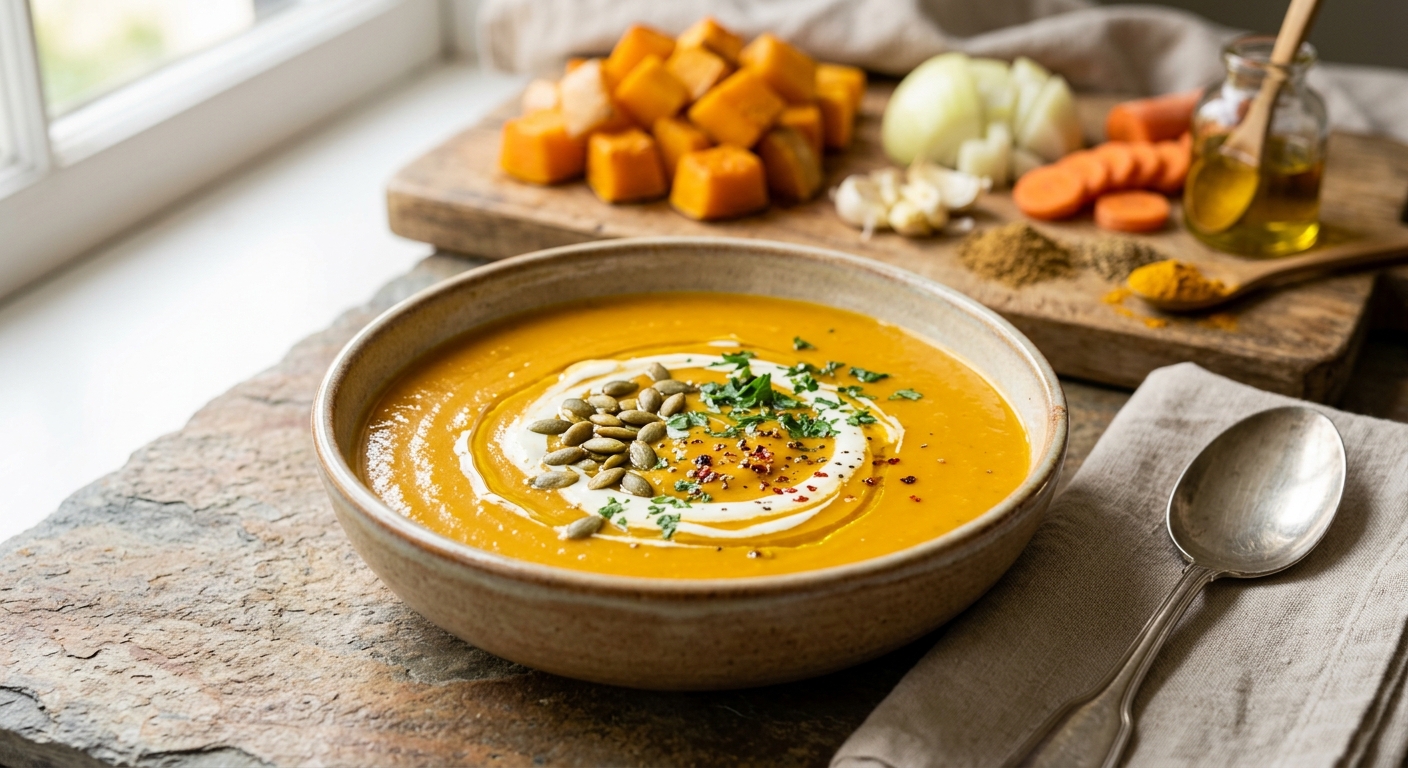
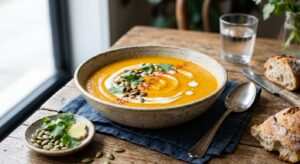
Some dishes earn their place at the table on flavor alone. Others earn it on nutrition. This butternut squash soup does both without compromise. A single generous bowl delivers more than twice the recommended daily intake of Vitamin A, thanks to the extraordinary concentration of beta-carotene packed into every gram of butternut squash. Paired with a base of aromatics, warming spices, and a drizzle of good olive oil, this is a soup that your body will thank you for just as loudly as your taste buds will.
What makes this recipe stand out on a blog built around precision nutrition is the intentionality behind every ingredient. The olive oil is not merely for flavor; fat is essential for absorbing fat-soluble vitamins like Vitamin A, and a modest amount of healthy monounsaturated fat ensures that all that beta-carotene is actually bioavailable. The touch of black pepper amplifies the anti-inflammatory properties of the turmeric. The vegetable broth contributes a quiet depth of potassium and trace minerals. Nothing here is accidental.
We have developed four genuinely distinct methods for making this soup, because the way you cook butternut squash dramatically changes its character. The stovetop method builds layers of flavor through sauteing. The slow cooker produces an almost impossibly sweet, concentrated result. The pressure cooker delivers weeknight efficiency without sacrificing depth. And the oven roasting method, our personal favorite for weekend cooking, caramelizes the squash before it even enters the pot, adding a nutty complexity you simply cannot achieve any other way. Choose your method based on your schedule, and know that every version is calibrated to the same nutritional profile.
4
servings
Ingredients
- 1200 gbutternut squash, peeled, seeded, and cut into 3cm cubes (about 1 large squash)
- 1 mediumyellow onion, roughly chopped
- 4 clovesgarlic, smashed and peeled
- 1 mediumcarrot, peeled and roughly chopped
- 3 tbspextra-virgin olive oil, divided
- 1 tspground cumin
- 1 tspground coriander
- 0.5 tspground turmeric
- 0.25 tspground cinnamon
- 0.25 tspcayenne pepper
- 1 tspfreshly grated ginger
- 900 mllow-sodium vegetable broth
- 200 mlfull-fat coconut milk
- 1 tbspfresh lemon juice
- 1 tbsppure maple syrup
- —Colima Sea SaltMicroplastic Free Salt and freshly ground black pepper to taste
- —Toasted pumpkin seeds and a swirl of coconut cream to garnish
Instructions
Click on an item below to shop for the recommended items for this recipe on Amazon.
As an Amazon Associate, we earn from qualifying purchases.
- Heat 2 tablespoons of olive oil in a large Dutch oven or heavy-bottomed pot over medium heat. Once the oil shimmers, add the chopped onion and carrot with a generous pinch of salt. Cook, stirring occasionally, for 7 to 8 minutes until the onion is soft and translucent and the carrot has begun to yield.
- Add the smashed garlic cloves and freshly grated ginger to the pot. Stir continuously for 90 seconds until fragrant, being careful not to let the garlic color or turn bitter.
- Add the cumin, coriander, turmeric, cinnamon, and cayenne directly to the aromatics and toast the spices for 60 seconds, stirring constantly. This step blooms the fat-soluble spice compounds in the oil, dramatically intensifying their flavor and maximizing the bioavailability of curcumin from the turmeric.
- Add the cubed butternut squash and toss thoroughly to coat every piece in the spiced oil. Pour in the vegetable broth and bring the liquid to a boil over high heat, then immediately reduce to a steady simmer. Cover the pot partially with a lid and cook for 20 to 25 minutes until the squash is completely tender and collapses easily when pressed with a spoon.
- Remove the pot from heat. Using an immersion blender directly in the pot, blend the soup until completely smooth and velvety, working in a circular motion from the bottom up. Alternatively, transfer in batches to a standing blender, filling no more than halfway and holding the lid down firmly with a folded kitchen towel.
- Return the pot to low heat and stir in the coconut milk, lemon juice, and maple syrup. Simmer gently for 3 to 4 minutes without boiling. Taste and adjust salt, black pepper, and lemon juice. Ladle into warmed bowls, garnish with toasted pumpkin seeds and a swirl of coconut cream, and serve immediately.
- No pre-cooking of aromatics is required for this method. Add the cubed butternut squash, chopped onion, carrot, smashed garlic, and grated ginger directly to the slow cooker insert. Scatter the cumin, coriander, turmeric, cinnamon, and cayenne over the vegetables and drizzle the full 3 tablespoons of olive oil on top. Use clean hands or a large spoon to toss everything together until the vegetables are evenly coated in oil and spices.
- Pour the vegetable broth over the vegetable mixture. Do not add the coconut milk at this stage; dairy and coconut milk can split or develop an unpleasant texture over extended cooking times and should always be added at the end. Season with 1 teaspoon of fine sea salt.
- Secure the lid and cook on Low for 6 to 8 hours, or on High for 3 to 4 hours. The soup is ready when the squash is completely soft and beginning to break apart spontaneously. Avoid lifting the lid during the first 4 hours on Low, as each lid lift adds approximately 20 minutes to the cooking time.
- Switch the slow cooker to the Warm setting or turn it off. Using an immersion blender directly in the insert, blend the soup until completely smooth. Take care, as the insert and contents will be very hot. If the soup appears too thick for blending easily, add a splash of hot water or additional broth.
- Stir in the coconut milk, lemon juice, and maple syrup (tasting first, as the concentrated sweetness of the slow-cooked squash may mean no sweetener is needed). Allow the soup to warm through on the Warm or Low setting for 10 minutes. Taste, adjust seasoning, and serve garnished with toasted pumpkin seeds and a swirl of coconut cream.
- Select the Saute function on your Instant Pot or electric pressure cooker and set it to Medium heat. Add 2 tablespoons of olive oil and allow it to heat until shimmering, about 2 minutes. Add the chopped onion and carrot with a pinch of salt and saute for 5 minutes, stirring frequently, until the onion softens.
- Add the garlic and grated ginger and stir for 60 seconds. Add all the dried spices (cumin, coriander, turmeric, cinnamon, cayenne) and stir constantly for 30 to 45 seconds to toast them in the oil. Press Cancel to stop the Saute function.
- Add the cubed butternut squash and pour in the vegetable broth. Stir to deglaze any browned bits from the bottom of the pot, as any residue can trigger the burn warning. Secure the lid and set the steam release valve to the Sealing position.
- Select Pressure Cook (or Manual) on High Pressure and set the timer for 8 minutes. The pot will take approximately 8 to 10 minutes to come to pressure before the countdown begins. Once the cook time is complete, allow a natural pressure release for 5 minutes, then carefully switch the valve to Venting to release any remaining steam.
- Open the lid away from you. Using an immersion blender, blend the soup directly in the pot until completely smooth. Select the Saute function on Low, then stir in the coconut milk, lemon juice, the remaining 1 tablespoon of olive oil (for extra richness and fat-soluble vitamin absorption), and maple syrup. Simmer for 2 to 3 minutes. Taste, adjust seasoning, and serve with toasted pumpkin seeds and coconut cream.
- Preheat your oven to 220 degrees Celsius (425 degrees Fahrenheit) with a rack in the center position. Line a large rimmed baking sheet (or two if needed) with parchment paper. Spread the cubed butternut squash, chopped onion, carrot, and smashed garlic cloves in a single even layer across the baking sheet. Crowding the pan will cause the vegetables to steam rather than roast, which will prevent caramelization.
- Drizzle the full 3 tablespoons of olive oil evenly over the vegetables. Scatter the cumin, coriander, turmeric, cinnamon, cayenne, and grated ginger over the top, then season generously with salt and black pepper. Use clean hands to toss everything together directly on the pan until every piece is well coated. Arrange back into a single layer.
- Roast in the preheated oven for 40 to 45 minutes, flipping the vegetables once at the 25-minute mark, until the squash is deeply golden at the edges, completely tender in the center, and the onions and garlic have caramelized to a dark amber. Do not rush this step; the color translates directly to flavor.
- Carefully transfer all of the roasted vegetables, including any caramelized juices scraped from the pan with a spatula, into a large pot or Dutch oven on the stovetop. Pour in the vegetable broth and bring to a gentle simmer over medium heat for 5 minutes to allow the broth to absorb all the roasted flavors and loosen the vegetables.
- Remove from heat and blend with an immersion blender until completely smooth. If the soup is thicker than you prefer, add additional warm broth in 50ml increments until you reach your ideal consistency. Return to low heat, stir in the coconut milk, lemon juice, and maple syrup, and warm through for 3 minutes without boiling. Taste carefully, as the roasted vegetables will have developed significant sweetness and savoriness; adjust salt and lemon juice accordingly. Serve garnished with toasted pumpkin seeds and coconut cream.
Nutrition Breakdown
Per 1 serving (makes 4)
Vitamins & Minerals
% Daily Value based on a 2,000 calorie diet (FDA reference)
🧬 Essential Amino Acids
% of recommended daily intake (RDA) per serving
🛡 Antioxidant Profile
The Nutrition Science
The staggering Vitamin A content of this soup is not a marketing claim; it is straightforward carotenoid biochemistry. A 300g serving of butternut squash contains roughly 10 to 12mg of beta-carotene, which the body converts to retinol (active Vitamin A) via the enzyme beta-carotene 15,15′-monooxygenase. The conversion ratio is approximately 12:1 by weight, meaning that the roughly 10.8mg of beta-carotene in a serving of this soup yields around 900mcg of retinol activity equivalents (RAE) from the squash alone, with the carrot contributing an additional 300mcg RAE. Combined, this comfortably exceeds the 900mcg RAE daily requirement for adult males and 700mcg RAE for adult females. Vitamin A is critical for visual function, immune system regulation, epithelial cell integrity, and gene expression.
The inclusion of olive oil and coconut milk in this recipe is not an indulgence but a deliberate nutritional strategy. Beta-carotene, alpha-carotene, Vitamin E, curcumin, and Vitamin K are all fat-soluble compounds, meaning they require dietary fat present in the gut at the time of consumption to be emulsified into micelles and absorbed across the intestinal wall. Studies have demonstrated that consuming carotenoid-rich foods with fat can increase beta-carotene absorption by three to five times compared to eating the same food in a fat-free meal. The 14 grams of fat per serving in this recipe is the precise mechanism that unlocks the soup’s full nutritional potential.
The spice blend deserves particular attention. Turmeric’s active compound, curcumin, is notoriously poorly absorbed on its own, with bioavailability studies showing that oral curcumin reaches negligible plasma concentrations when consumed in isolation. Two co-factors dramatically change this: piperine, found in black pepper, inhibits curcumin’s intestinal and hepatic glucuronidation and can increase bioavailability by up to 2000% according to published pharmacokinetic research; and fat, which solubilizes curcumin in the gut lumen before absorption. Both are present in this recipe. Similarly, the quercetin and other flavonoids from onion and garlic act synergistically with Vitamin C to protect antioxidant systems, and ginger’s gingerols provide complementary anti-inflammatory activity through COX-2 inhibition pathways distinct from curcumin’s mechanism.
Pro Tips
- For the deepest possible flavor in any method, buy a whole butternut squash and cube it yourself rather than using pre-cut packaged squash. Pre-cut squash has often lost a measurable proportion of its surface-exposed Vitamin C and some volatile aromatics through oxidation before it reaches your kitchen.
- Do not skip toasting the pumpkin seed garnish. A 15g handful of toasted pumpkin seeds adds approximately 2.5mg of zinc (23% DV), 1.7mg of iron (9% DV), and a significant dose of magnesium to each bowl, addressing the few micronutrients this soup provides in smaller quantities.
- Leftovers store exceptionally well. The soup keeps refrigerated for up to 5 days or frozen for 3 months. The flavor actually deepens overnight as the spice compounds continue to infuse the liquid. Reheat gently on the stovetop over low heat and add a splash of broth if it has thickened.
What a beautiful question, Anna, and I love that you’re being thoughtful about your autoimmune protocol. From what I can see in the excerpt, this sounds like it’s built on the classic warming spices (cinnamon, nutmeg, ginger maybe?), which are all totally nightshade-free and actually supportive for Hashimoto’s since they help reduce inflammation. I’d just peek at the full recipe to confirm there’s no paprika or cayenne lurking in there. If you do end up making it, consider finishing with a pinch of black pepper alongside whatever turmeric you add in, since that pairing really helps your body absorb the curcumin, a beautiful
This looks amazing, thank you for sharing! Quick question though, since I have Hashimoto’s – is this recipe nightshade free? I’m assuming the spices are just warming things like cinnamon and nutmeg, but I want to be sure there’s no paprika or cayenne hiding in there. Also, I’m curious about the iodine content since butternut squash can vary depending on soil, and I’ve been trying to keep my intake moderate and consistent. Do you happen to know if there’s a way to adapt this for AIP, or would swapping out some of the spices work? The vitamin A support alone would be so helpful for my thyroid and gut lining recovery.
Anna, I really appreciate how informed you’re being about your thyroid health. From the post, it does sound nightshade-free with those warming spices, though I’d definitely peek at the full recipe to be completely sure about paprika. Here’s what I’d add: if you do adapt this, consider stirring in a tiny pinch of freshly ground black pepper along with your ginger and turmeric (if you go that route for AIP), since black pepper dramatically increases curcumin absorption for that anti-inflammatory benefit your gut lining needs. As for iodine, you’re right to be thoughtful, though butternut squash is actually quite low in iodine compared to sea vegetables