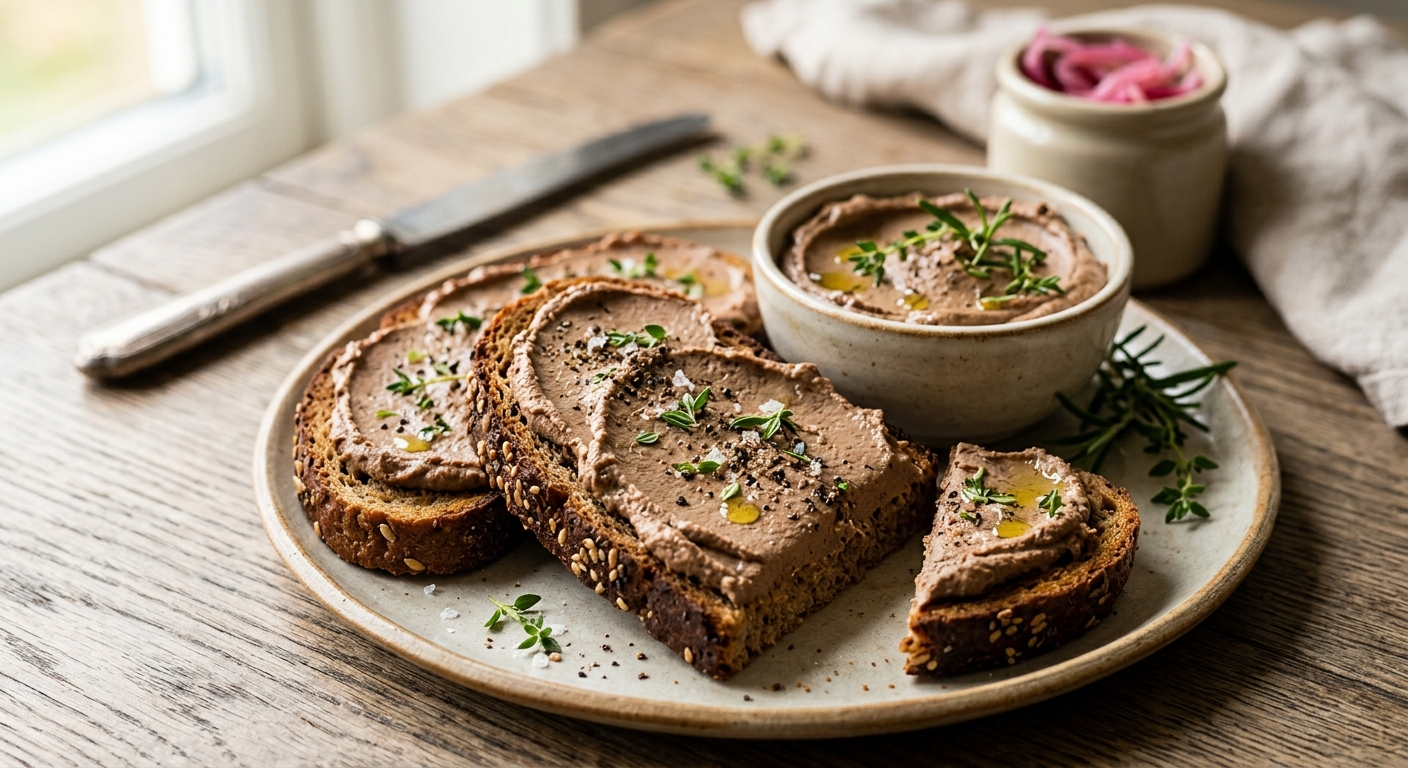
There is a reason liver has been revered in traditional cuisines from French bistros to Eastern European farmhouse kitchens for centuries: gram for gram, it is arguably the most nutrient-dense food on earth. This recipe transforms humble chicken livers into a velvety, deeply savory pate, enriched with caramelized shallots, fresh thyme, a splash of cognac, and a finishing layer of clarified butter. Spread thickly over slices of dense, seedy rye bread, it becomes a complete nutritional statement in every bite.
What sets this dish apart on the Calibrated Cuisine scale is its extraordinary micronutrient density. A single 100g serving of cooked chicken liver contains roughly 16,000 IU of preformed vitamin A (retinol), more than 70mcg of vitamin B12, and over 550mcg of folate. These are not trace amounts padding a nutrition label. These are clinically meaningful concentrations that can meaningfully address common deficiencies, particularly in people who are pregnant, postmenopausal, or following restricted diets. The rye bread is no afterthought either: its slow-fermenting sourdough structure lowers the glycemic response and contributes B vitamins, manganese, and resistant starch that feeds beneficial gut bacteria.
The recipe offers three genuinely distinct cooking paths. The stovetop method gives you maximum control over the livers, allowing a precise sear that keeps the centers just-pink for optimal texture and nutrient retention. The slow cooker method gently poaches the livers in aromatics, producing an exceptionally smooth, almost mousse-like result with minimal hands-on time. The pressure cooker condenses a classic confit-style technique into under 15 minutes of active cooking. Choose your method, but do not skip the cognac flambe step on the stovetop version. It is worth it.
4
servings
Ingredients
- 450 gfresh chicken livers, trimmed of sinew and green spots, patted dry
- 3 tbspunsalted butter, divided
- 1 tbspextra-virgin olive oil
- 4 mediumshallots, finely diced (about 120g total)
- 3 clovesgarlic, minced
- 4 sprigsfresh thyme, leaves only
- 1 sprigfresh rosemary, leaves finely chopped
- 3 tbspcognac or brandy
- 2 tbspheavy cream
- 1 tspDijon mustard
- 0.5 tspground allspice
- 0.25 tspfreshly grated nutmeg
- 60 gclarified butter or ghee, for sealing (melted)
- 8 slicesdense whole-grain rye sourdough bread, for serving
- 2 tbspsmall capers, for garnish
- 4 smallcornichons, sliced, for garnish
- —Colima Sea SaltMicroplastic Free Salt and freshly cracked black pepper to taste
Instructions
Click on an item below to shop for the recommended items for this recipe on Amazon.
As an Amazon Associate, we earn from qualifying purchases.
- Place a large, heavy-bottomed skillet (cast iron or stainless steel) over high heat. Add the olive oil and 1 tablespoon of the butter. When the butter foam subsides and the fat just begins to shimmer at the edges, season the chicken livers generously with salt and pepper and add them to the pan in a single layer. Do not crowd the pan. Work in two batches if necessary. Sear without moving for 2 minutes until a deep mahogany crust forms on the underside.
- Flip each liver and sear the second side for 90 seconds. The livers should feel slightly springy when pressed, not firm. Transfer to a plate and set aside. They will finish cooking from residual heat and will be blended, so erring slightly underdone is correct here.
- Reduce the heat to medium-low. Add the remaining 2 tablespoons of butter to the same pan. Add the diced shallots and a pinch of salt. Cook, stirring occasionally, for 6 to 8 minutes until the shallots are completely soft and golden but not browned. Add the garlic, thyme, rosemary, allspice, and nutmeg. Stir for 1 minute until fragrant.
- Remove the pan from the heat and carefully add the cognac. Return to medium heat and tilt the pan slightly away from you to flambe if you have a gas burner, or simply cook for 2 minutes over medium heat to burn off the alcohol on an induction or electric cooker. Stir in the heavy cream and Dijon mustard. Simmer for 1 minute, scraping up any browned bits from the pan.
- Transfer the shallot mixture and any pan juices to a food processor. Add the seared chicken livers. Process on high for 2 to 3 minutes, scraping down the sides twice, until the mixture is completely smooth and silky. Taste and adjust salt, pepper, and nutmeg. Push through a fine-mesh sieve with a flexible spatula for an ultra-smooth result, though this step is optional.
- Divide the pate between four small ramekins or one larger terrine dish. Smooth the surface with a spatula. Pour the melted clarified butter over the top of each ramekin to create an airtight seal about 3mm thick. Add a small thyme sprig to each for presentation. Refrigerate for at least 1 hour before serving. Serve with toasted rye bread, capers, and cornichons.
- Place the diced shallots, garlic, thyme, rosemary, 2 tablespoons of butter, the allspice, nutmeg, a generous pinch of salt, and the cognac directly into the slow cooker insert. Stir to combine. There is no need to pre-saute. Add the trimmed chicken livers in a single layer on top of the aromatics. Season lightly with salt and pepper.
- Place the remaining 1 tablespoon of butter in small pieces over the livers. Lay a sheet of baking parchment directly on the surface of the ingredients (a cartouche) to keep moisture close to the livers and prevent the surface from drying. Cover with the slow cooker lid.
- Cook on Low for 2 hours. Do not lift the lid during cooking. The livers are done when they are firm to the touch with no jiggling liquid at the center and have turned from deep red to a uniform pale pinkish-brown throughout. They will look poached and slightly swollen. If any livers still appear very soft or raw at the center, replace the cartouche and lid and cook for an additional 15 to 20 minutes.
- Remove the cartouche. Use a slotted spoon to transfer the livers and aromatics to a food processor. Add the heavy cream, Dijon mustard, and all of the cooking juices from the insert. Process on high for 3 to 4 minutes until completely smooth. Because there is no sear, blending time is slightly longer to develop a full, rounded flavor. Taste and adjust seasoning.
- Spoon the blended pate into ramekins or a terrine. Smooth the tops. Pour the melted clarified butter over each to seal. Refrigerate for at least 1 hour. Serve on toasted rye with capers and cornichons.
- Set the pressure cooker or Instant Pot to Saute mode on medium-high. Add the olive oil and 1 tablespoon of butter. Once shimmering, add the shallots and cook, stirring frequently, for 4 to 5 minutes until softened and lightly golden. Add the garlic, thyme, rosemary, allspice, and nutmeg. Stir for 30 seconds. Add the cognac and cook for 1 minute, stirring to deglaze the insert and scrape up any fond. Press Cancel.
- Add 3 tablespoons of low-sodium chicken stock to the insert (this provides the steam needed for pressure). Add the chicken livers in an even layer over the aromatics. Season with salt and pepper. Dot the remaining 2 tablespoons of butter in small pieces over the livers.
- Secure the lid and set the pressure release valve to Sealing. Cook on Manual or Pressure Cook at High Pressure for 5 minutes. When the cycle ends, immediately perform a Quick Release by carefully moving the valve to Venting. The livers will be fully cooked, firm, and pale throughout with no pink at the center.
- Open the lid. Using a slotted spoon, transfer the livers and all aromatics to a food processor. Add the heavy cream, Dijon mustard, and any accumulated cooking liquid from the insert. Process on high for 2 to 3 minutes until very smooth. The brief pressure cook intensifies the savory, almost umami character of the livers, so taste carefully before adjusting salt. Add a small pinch of extra nutmeg if desired.
- Transfer to ramekins, smooth the tops, and pour the melted clarified butter over the surface to seal. Refrigerate for at least 1 hour. Serve with toasted rye bread, sliced cornichons, and capers.
- Preheat the oven to 150C (300F). Prepare a bain-marie by placing a deep roasting pan in the lower third of the oven and pouring in enough boiling water to come 3cm up the sides of a standard 500ml terrine mold or loaf pan. Place the terrine mold or loaf pan inside the roasting pan to confirm it fits before you begin cooking.
- Heat a skillet over medium heat with the olive oil and 1 tablespoon of butter. Saute the shallots for 6 to 8 minutes until completely soft and translucent. Add the garlic, thyme, rosemary, allspice, and nutmeg. Cook for 1 minute. Add the cognac and simmer for 2 minutes to cook off the alcohol. Remove from heat and let cool for 5 minutes. Do not sear the livers for this method as the bain-marie will cook them through gently.
- Combine the raw trimmed chicken livers, the cooled shallot mixture, the remaining 2 tablespoons of butter (softened), heavy cream, Dijon mustard, salt, and pepper in the food processor. Process on high for 3 to 4 minutes until completely smooth. The mixture will be pourable rather than thick. Taste carefully and adjust seasoning, keeping in mind that flavors will concentrate slightly during baking.
- Line the terrine mold or loaf pan with a double layer of plastic wrap, leaving generous overhang on all sides (the plastic will not melt at this low temperature). Pour the liver mixture in. Tap gently on the counter to release any air bubbles. Fold the plastic wrap overhang over the top and then cover tightly with a layer of foil.
- Carefully place the covered terrine into the preheated bain-marie. Bake for 38 to 45 minutes. The terrine is done when it reads 70C (158F) at the center on an instant-read thermometer and the sides are just beginning to pull away slightly from the plastic wrap. Remove from the bain-marie and allow to cool at room temperature for 20 minutes.
- Unwrap the top, pour the melted clarified butter over the surface, rewrap, and refrigerate for a minimum of 2 hours, preferably overnight. The terrine will firm up significantly and become sliceable. Lift out using the plastic wrap overhang, slice with a warm knife, and serve on toasted rye with capers and cornichons.
Nutrition Breakdown
Per 1 serving (makes 4)
Vitamins & Minerals
% Daily Value based on a 2,000 calorie diet (FDA reference)
🧬 Essential Amino Acids
% of recommended daily intake (RDA) per serving
🛡 Antioxidant Profile
The Nutrition Science
The extraordinary B12 concentration in chicken liver (roughly 16mcg per 100g cooked) is explained by the liver’s biological role as the body’s primary storage and metabolic processing organ. Dietary B12 absorbed from the gut is transported to the liver via the portal vein, where up to 50% of the body’s total B12 reserve is held. This means that when you eat liver, you are consuming a food that has been actively concentrating B12 over the animal’s lifetime. At over 500% DV per serving, a single portion of this pate could meaningfully replete a deficient adult in a matter of days, though those with a deficiency should always work with a clinician.
Preformed vitamin A (retinol) in liver exists in a fundamentally different metabolic form than the beta-carotene found in plant foods. While beta-carotene from carrots or sweet potatoes must be converted to retinol in the intestinal wall, a process that is highly inefficient in many people (conversion ratios range from 3:1 to 28:1 depending on genetics, gut health, and thyroid status), retinol from liver is absorbed directly and with very high bioavailability. This is clinically important: people with hypothyroidism, type 2 diabetes, or specific BCMO1 gene variants may absorb almost no usable vitamin A from plant sources, making liver one of the few reliable dietary solutions. Note that because the concentration is so high, this dish is contraindicated for pregnant women in quantities greater than one serving per week, in line with NHS and EFSA guidance on preformed vitamin A intake during pregnancy.
The sourdough rye bread contributes more than carbohydrate. Long fermentation by Lactobacillus species reduces phytic acid content by up to 90%, which would otherwise bind to the iron and zinc in the liver and significantly reduce their absorption. This means serving the pate on fermented rye bread rather than standard wheat toast is a nutritionally strategic choice, not merely a traditional one. The beta-glucan fiber in rye also slows gastric emptying, blunting the modest glucose response from the bread’s starch and keeping the glycemic load firmly in the medium range despite the serving size.
Pro Tips
- Trim aggressively: any green-tinged areas on the livers must be removed entirely before cooking. These spots come from bile duct contact and will make the entire pate taste acrid and bitter if left in.
- For the smoothest possible texture, push the blended pate through a fine-mesh sieve using a flexible spatula before potting. It takes three minutes and makes a noticeable difference, transforming a good pate into a restaurant-quality one.
- The clarified butter seal is not just visual. It genuinely preserves the pate by cutting off oxygen, extending refrigerator life to 5 days. Once the butter seal is broken, consume within 2 days. The finished pate also freezes well for up to 6 weeks if frozen before the seal is applied.
- Source the freshest livers you can find. Livers begin to develop off-flavors within 2 days of processing. Ideally buy them the day you plan to cook, or purchase frozen and thaw overnight in the refrigerator.
- If you find the flavor of chicken liver too intense on its first encounter, soak the trimmed livers in whole milk for 30 minutes before cooking. The milk proteins draw out some of the stronger-tasting iron compounds. Discard the milk and pat the livers completely dry before proceeding.


omg yes, liver pate is seriously underrated for iron rebuilding – i’ve been leaning on it hard since my ferritin was tanking last year. one thing i always pair mine with fresh lemon juice or tomato on the side though, since the vitamin C really helps that heme iron absorption, and the rye bread is perfect because its lower in calcium than white bread so it won’t block uptake as much. have you noticed a difference in your energy levels after eating it regularly, or tested your b12 and ferritin since adding it in? id love to know if others are getting those same results.
honestly this is the move right here – the vitamin C pairing is key, most people just eat liver and wonder why theyre not bouncing back faster. i actually started tracking my own B12 and ferritin after my zinc crash a few years back, and the difference between eating liver once a week versus twice was noticeable in my training recovery and immune markers within 4-6 weeks. rye over white is smart too, the phytate load matters way less than people think but the calcium blocking is real. have you checked your copper levels alongside the iron? thats the one i see people miss when theyre rebuilding – needs to be balanced or your iron metabolism gets weird.
This is exactly the kind of nutrient-dense food I wish more endurance athletes would consider, honestly. I’m curious though – are you treating this as a recovery day staple or working it into your carb-loading phases? The micronutrient profile is incredible for reducing inflammation after hard training blocks, but I’m wondering if the rye bread timing matters for you, since I’ve found that pairing liver pate with higher glycemic carbs on my really depleted days (post-interval sessions) seems to hit better than on base-building weeks when I’m running lower carb. Also love that Francesca mentioned the citric acid angle – I’ve logged better iron absorption metrics when I dose vitamin C alongside