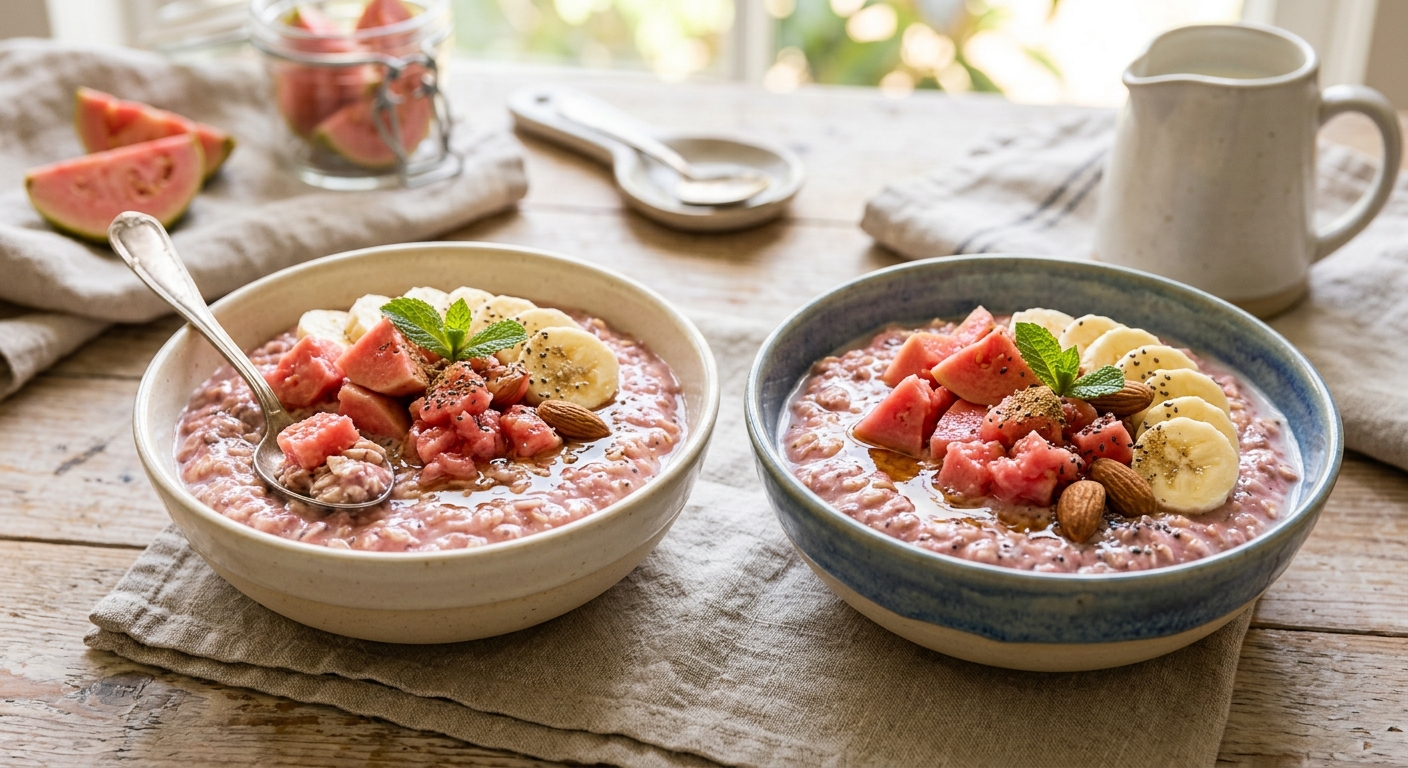
Most people reach for an orange when they think Vitamin C, but guava quietly outperforms every common fruit on the shelf. A single 100g serving of pink guava delivers roughly 228mg of Vitamin C, nearly 2.5 times what you find in an equivalent weight of orange. When you build an entire breakfast around this tropical powerhouse, pairing it with rolled oats for sustained energy, chia seeds for omega-3 fatty acids, and coconut milk for medium-chain triglycerides, you get a meal that is as strategically nutritious as it is genuinely craveable. This recipe was developed to hit that precise sweet spot between laboratory precision and real-world deliciousness.
Overnight oats have earned their place in the meal-prep canon for good reason. The extended soak time allows rolled oats to undergo partial hydrolysis, breaking down some of the starches and reducing the effective glycemic load compared to hot-cooked oats made quickly. The beta-glucan in oats also forms a more viscous gel during a long cold soak, which research published in the European Journal of Clinical Nutrition associates with greater LDL cholesterol reduction and improved satiety hormones. By introducing guava at multiple stages of this recipe, both as a base puree folded into the oat mixture and as a fresh topping added at serving, you preserve the heat-sensitive Vitamin C content that would otherwise degrade during prolonged cooking.
The Calibrated Cuisine approach to this recipe goes further than just throwing fruit into oats. Every ingredient is chosen to complement the nutritional profile: chia seeds provide ALA omega-3s and additional soluble fiber to extend the beta-glucan effect, a pinch of black pepper activates piperine which may enhance absorption of fat-soluble carotenoids, and a small amount of raw honey contributes trace enzymes and prebiotic oligosaccharides. The result is a breakfast bowl where every spoonful is working hard for you, long before lunch.
4
servings
Ingredients
- 320 grolled oats (old-fashioned, not instant)
- 400 gfresh pink guava, peeled and roughly chopped (about 4 medium guavas)
- 400 mlfull-fat coconut milk, well shaken
- 480 mlunsweetened almond milk (or oat milk)
- 60 gchia seeds
- 60 graw honey or pure maple syrup
- 1 tsppure vanilla extract
- 0.5 tspground cardamom
- 0.25 tspfreshly cracked black pepper
- 200 gfresh guava slices, for serving (about 2 medium guavas)
- 40 gtoasted unsweetened coconut flakes, for serving
- 30 graw pumpkin seeds (pepitas), for serving
- —Colima Sea SaltMicroplastic Free Salt, one small pinch
Instructions
Click on an item below to shop for the recommended items for this recipe on Amazon.
As an Amazon Associate, we earn from qualifying purchases.
- Place the roughly chopped guava in a medium saucepan over medium heat with 60ml of the almond milk. Cook, stirring occasionally, for 4 to 5 minutes until the guava softens completely and begins to break down. Remove from heat and let cool for 5 minutes. Transfer to a blender and blitz until completely smooth. Pass through a fine-mesh sieve using a spatula to remove seeds and any fibrous skin, yielding approximately 280ml of smooth guava puree. Set aside.
- In a large mixing bowl, combine the rolled oats and chia seeds. Stir together well so the chia seeds are evenly distributed throughout the oats rather than clumping at the bottom, as this prevents uneven gel formation during the soak.
- Pour the remaining almond milk and the coconut milk over the oat and chia mixture. Add the honey, vanilla extract, cardamom, black pepper, and pinch of sea salt. Stir vigorously for 60 seconds to ensure the honey is fully dissolved and the spices are evenly distributed.
- Add the warm (not hot) guava puree to the bowl and fold it through the oat mixture using a wide spatula with slow, deliberate strokes. You want ribbons of guava puree marbled through the oats rather than a fully homogeneous mixture, as this creates pockets of concentrated flavor.
- Divide the mixture evenly between 4 airtight jars or containers (approximately 300ml capacity each). Press a piece of plastic wrap or a lid directly against the surface to prevent oxidation of the guava, which would cause browning. Refrigerate for a minimum of 6 hours, ideally overnight. When ready to serve, stir each jar, top with fresh guava slices, toasted coconut flakes, and pumpkin seeds.
- Blend the fresh guava with 120ml of the almond milk in a blender until completely smooth. Do not sieve the puree for this method as the long cook time will fully soften any fibrous bits, and retaining the solids adds extra dietary fiber to the final dish. Set the puree aside.
- Lightly grease the slow cooker insert with a neutral oil or coconut oil spray. This critical step prevents the oats from sticking and scorching on the sides during the long cook, which would impart a bitter flavor.
- Add the rolled oats, chia seeds, coconut milk, remaining almond milk, honey, vanilla extract, cardamom, black pepper, and sea salt directly to the greased slow cooker insert. Stir thoroughly to combine, ensuring the honey is dissolved into the liquids before the oats absorb everything.
- Pour the guava puree over the oat mixture and stir once more to roughly incorporate. Do not over-stir: a loose swirl is fine. Place the lid on the slow cooker and cook on Low for 6 to 7 hours (overnight is ideal). Do not cook on High, as the higher temperature will cause the oats to become gluey and the coconut milk to separate.
- In the morning, remove the lid and stir the oats from the bottom up. The mixture will have thickened considerably. If it is thicker than you prefer, stir in warm water or additional almond milk, one tablespoon at a time, until you reach your desired consistency. Taste and adjust sweetness. Serve immediately in bowls topped generously with fresh guava slices, toasted coconut flakes, and pumpkin seeds, adding the fresh fruit only now to protect its Vitamin C content.
- Blend the fresh guava with 120ml of the almond milk until completely smooth. Sieve if desired for a silkier texture. Set aside.
- Pour 240ml of cold water into the base of your Instant Pot or electric pressure cooker. Place the trivet inside. In a separate stainless steel or oven-safe bowl that fits inside your cooker, combine the rolled oats, chia seeds, coconut milk, remaining almond milk (360ml), honey, vanilla extract, cardamom, black pepper, and sea salt. Stir well to dissolve the honey. Stir the guava puree through the oat mixture and lower the bowl onto the trivet using a foil sling. This pot-in-pot technique prevents the starchy oats from triggering the burn warning on the base of the insert.
- Seal the pressure cooker lid and set the steam release valve to Sealing. Select Manual or Pressure Cook mode and set to 3 minutes at High Pressure. The pot will take approximately 10 minutes to come up to pressure before the cook timer begins.
- When the cook cycle ends, allow the pressure to release naturally for 10 minutes (do not touch the valve). After 10 minutes, carefully turn the steam release valve to Venting to release any remaining pressure, then open the lid away from you.
- Carefully lift the inner bowl out using oven mitts. Stir the oats well, scraping the bottom and sides of the bowl. The mixture will thicken further as it cools slightly. If the oats are thicker than preferred, stir in additional almond milk to loosen. Spoon into serving bowls immediately and top with fresh guava slices, toasted coconut flakes, and pumpkin seeds. Serve hot.
Nutrition Breakdown
Per 1 serving (makes 4)
Vitamins & Minerals
% Daily Value based on a 2,000 calorie diet (FDA reference)
🧬 Essential Amino Acids
% of recommended daily intake (RDA) per serving
🛡 Antioxidant Profile
The Nutrition Science
The headline nutrient here, Vitamin C, does far more than most people realize. Beyond its well-known immune-supporting role, ascorbic acid is a required cofactor for collagen synthesis, meaning adequate intake directly affects skin integrity, joint cartilage repair, and wound healing. It also dramatically enhances non-heme iron absorption from plant sources. The iron in the oats and pumpkin seeds in this recipe is non-heme iron, which on its own has an absorption rate of only 2 to 20%. The presence of 190mg of Vitamin C in the same meal can increase that absorption rate by up to 300%, effectively tripling the functional iron you absorb from this bowl. This is a textbook example of food synergy, where two nutrients working together produce an outcome neither could achieve alone.
Pink guava’s lycopene content deserves special attention. With approximately 5.4mg per serving in this recipe, this single breakfast bowl provides more lycopene than a medium-sized raw tomato. Lycopene is a carotenoid that preferentially accumulates in the prostate, skin, and liver, where it quenches singlet oxygen radicals with an efficiency roughly twice that of beta-carotene. The fat content from coconut milk in this recipe is not merely for creaminess: dietary fat is required for the absorption of all fat-soluble carotenoids including lycopene and beta-carotene, as they are packaged into chylomicrons in the intestinal wall and require micellar solubilization by bile acids, a process that depends on the presence of lipids in the digestive tract.
The beta-glucan fiber in rolled oats is one of the most rigorously studied dietary fibers in cardiovascular nutrition. At doses of 3g per day, the FDA permits a health claim linking oat beta-glucan to reduced risk of coronary heart disease. This recipe delivers approximately 2.4g of beta-glucan from the 80g oat serving per person, close to that threshold in a single meal. Beta-glucan works by forming a viscous gel in the small intestine that traps bile acids, forcing the liver to synthesize new bile from circulating LDL cholesterol, thus lowering serum LDL. The overnight soak used in the stovetop method enhances the solubility of beta-glucan compared to dry oats, potentially amplifying this effect further.
Pro Tips
- Choose pink-fleshed guavas over white-fleshed varieties whenever possible. Pink guava contains 8 to 10 times more lycopene and significantly higher beta-carotene than white guava, making it the nutritionally superior choice for this recipe.
- If fresh guava is unavailable, frozen guava pulp (thawed) is an excellent substitute and often more affordable. Avoid guava juice or nectar, as pasteurization and filtration remove most of the fiber and degrade a significant portion of the heat-sensitive Vitamin C.
- Do not skip sieving the guava puree for the stovetop and pressure cooker cold-soak versions. Guava seeds are hard enough to be unpleasant in a chilled oat texture, and the skins can introduce a slightly bitter note that overwhelms the delicate floral sweetness of the fruit.
Tammy, you’re touching on something clinically important here – the overnight soak actually preserves more bioavailable iron compared to cooked oats, and yeah, that vitamin C synergy is real and measurable. One thing worth noting though: if you’re managing thyroid health, the raw oats themselves contain minimal goitrogens compared to cruciferous veggies, so the soak method is your friend. I’ve seen too many patients unnecessarily restrict foods out of thyroid anxiety when the actual evidence says this preparation is solid. Guava is doing heavy lifting here for both absorption and prevention.
Oh this sounds amazing, and I love that you’re highlighting vitamin C since it actually helps with iron absorption from those oats too! Quick question though, since I’m always thinking about thyroid health, how does the cooking method (or lack thereof with overnight oats) affect the goitrogenic compounds in raw oats? I know roasting reduces them, but I’m curious if soaking overnight does anything similar. Either way, this is such a fun way to get more nutrients in, and I’m definitely trying this recipe this week!
oh dude this recipe is calling out to me for one reason – have you considered adding some dried shiitake or reishi to this overnight oats situation?? like i know it sounds wild but hear me out, the umami depth from shiitake actually complements tropical fruit really well and you’re already getting that vitamin c boost which synergizes beautifully with the beta-glucans in mushrooms for immune support. plus reishi has these adaptagenic compounds that could balance out the natural sugars from the guava, and the whole thing becomes this whole-foods functional powerhouse. tammy makes such a good point about iron absorption too – the vitamin c is def doing heavy lifting there!