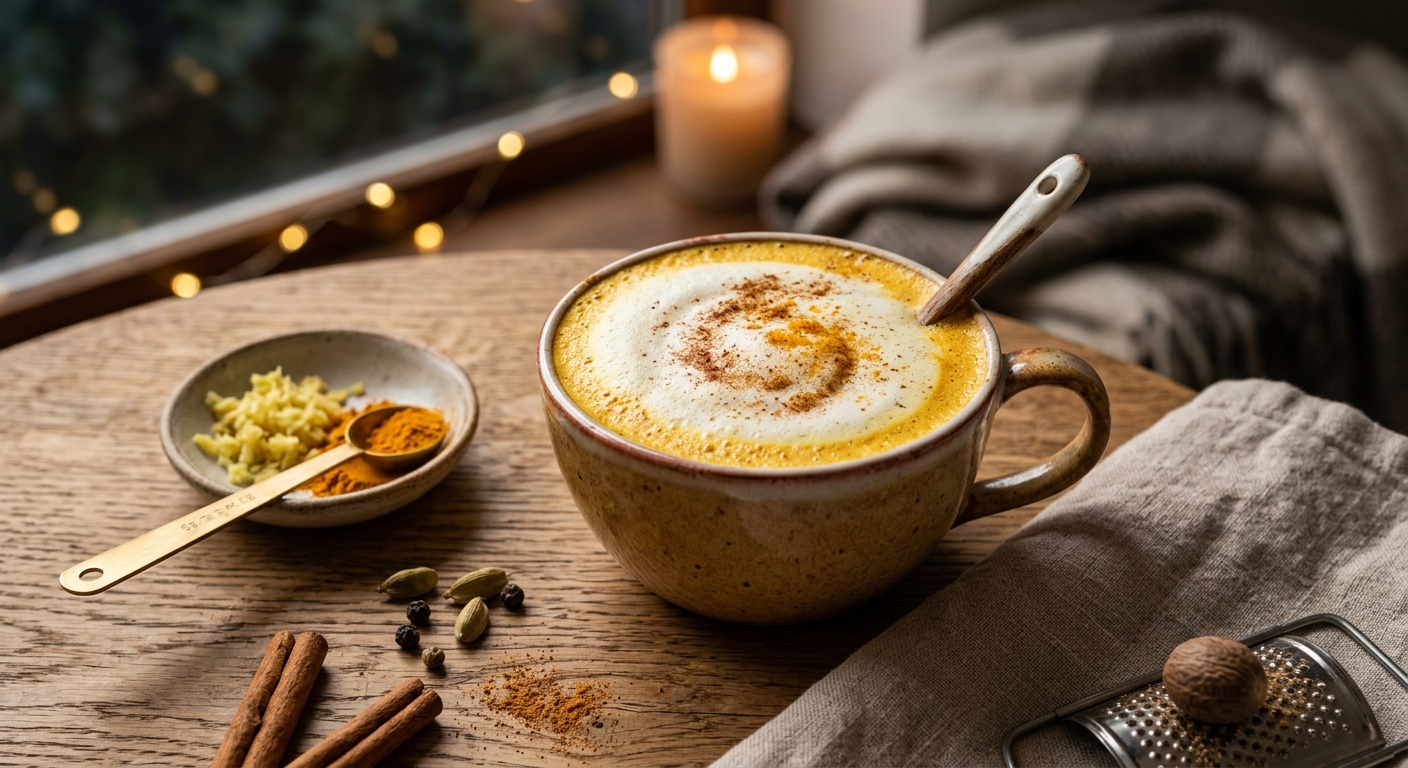
Golden Milk has been a cornerstone of Ayurvedic medicine for over 3,000 years, but modern nutritional science has spent the last two decades catching up to what traditional healers always knew. The combination of turmeric, black pepper, ginger, and fat-rich coconut milk is not culinary coincidence. It is a precisely engineered delivery system. Curcumin, the principal bioactive compound in turmeric, has notoriously poor bioavailability on its own. But piperine from black pepper increases curcumin absorption by up to 2,000% by inhibiting its hepatic and intestinal metabolism, and the fat in coconut milk renders it lipid-soluble, allowing it to cross the intestinal wall far more efficiently. Together, these three ingredients transform a pleasant drink into a genuinely therapeutic one.
This Calibrated Cuisine version is built around precise ratios developed after reviewing the clinical literature on effective curcumin dosing. Each serving delivers approximately 200mg of curcuminoids, which sits comfortably within the range used in randomised controlled trials showing reductions in CRP (C-reactive protein) and IL-6, two of the most reliable blood markers of systemic inflammation. Cinnamon adds a meaningful dose of manganese and contributes its own anti-inflammatory polyphenols, while raw honey, stirred in off the heat to preserve its enzymes, provides a gentle glycemic lift that pairs beautifully with the bitter warmth of turmeric. The result is a drink that is rich, fragrant, and genuinely delicious without any of the chalky bitterness that plagues poorly made golden milk.
Prepared as a bedtime drink, this latte works with your body’s circadian biology. Coconut milk contains small amounts of tryptophan, a precursor to serotonin and melatonin. Ginger has demonstrated mild central nervous system calming effects in animal models. And curcumin itself has been shown in preliminary human trials to support sleep quality, possibly by modulating the hypothalamic-pituitary-adrenal axis. Whether you make it on the stovetop in under ten minutes, batch-brew it in a slow cooker for a week of effortless evenings, or speed-infuse the spices under pressure for maximum flavour extraction, this recipe is calibrated to be both your most nourishing and most enjoyable pre-sleep ritual.
4
servings
Ingredients
- 800 mlfull-fat coconut milk (canned, well shaken)
- 400 mlunsweetened oat milk (or whole dairy milk for non-vegan)
- 8 gground turmeric (approximately 2 tsp, high-curcumin variety preferred)
- 6 gfreshly grated ginger (approximately 1.5 tsp, peeled)
- 4 gground cinnamon (approximately 2 tsp)
- 1 gfreshly ground black pepper (approximately 0.5 tsp, finely ground)
- 1 gground cardamom (approximately 0.5 tsp)
- 0.5 gground nutmeg (approximately 0.25 tsp, freshly grated preferred)
- 40 mlraw honey or pure maple syrup (for vegan)
- 4 gvirgin coconut oil (approximately 1 tsp, optional for extra fat-soluble absorption)
- —Pinch of Colima Sea SaltMicroplastic Free Salt to round flavour
Instructions
Click on an item below to shop for the recommended items for this recipe on Amazon.
As an Amazon Associate, we earn from qualifying purchases.
- Combine the coconut milk and oat milk in a medium saucepan over medium-low heat. Add the ground turmeric, grated ginger, cinnamon, black pepper, cardamom, nutmeg, and the optional coconut oil. Whisk immediately to disperse the spices before the liquid heats up, which prevents clumping.
- Raise the heat to medium and continue whisking gently but constantly as the mixture warms. Watch the edges carefully: you want the latte to reach a steaming point (approximately 70 to 75 degrees C / 160 to 165 degrees F) but never a rolling boil, which can cause the coconut milk to break and develop a grainy texture.
- Once you see a gentle ring of tiny bubbles forming around the edge of the pan and steam rising consistently from the surface (about 6 to 8 minutes), reduce the heat to its lowest setting. Let the mixture steep at this sub-simmer for 2 more minutes, whisking occasionally, to allow the curcumin and gingerols to fully infuse into the fat molecules in the milk.
- Remove the pan from the heat entirely. Wait 60 seconds for the temperature to drop below 65 degrees C, then add the raw honey and the pinch of sea salt. Stir thoroughly. Adding honey above 65 degrees C destroys its beneficial enzymes and degrades its delicate floral aromatics.
- Pour through a fine-mesh sieve into four mugs to catch any ginger fibres or undissolved spice particles. For a barista-quality frothy texture, use an immersion blender or handheld milk frother directly in the pan for 20 seconds before straining. Serve immediately, garnished with a dusting of cinnamon.
- Scale the recipe up if desired (the slow cooker handles double or triple batches beautifully). Pour the coconut milk and oat milk directly into the slow cooker insert. Add the turmeric, grated ginger, cinnamon, black pepper, cardamom, nutmeg, and coconut oil. Do not add honey or salt at this stage.
- Stir the mixture well with a silicone spatula, making sure to scrape the corners and bottom of the insert where spices tend to settle. Place the lid on, set to Low, and cook for 2 hours. There is no need to stir during cooking. The gentle, even heat of the slow cooker creates a long, slow infusion that extracts more of the fat-soluble curcuminoids into the coconut milk than any quick-heat method.
- After 2 hours, open the lid and stir the mixture. It should be steaming, fragrant, and a deep amber-gold colour. Switch the slow cooker to Warm if serving immediately, or turn it off if storing. The temperature on Low in most slow cookers sits between 82 and 93 degrees C, so let it cool for 5 to 10 minutes before adding honey.
- Add the raw honey and sea salt once the temperature has dropped sufficiently. Stir thoroughly. If storing for the week, allow the batch to cool to room temperature first, then transfer to an airtight glass jar and refrigerate. The fats will solidify on top when cold, which is normal: shake or stir well when reheating.
- To serve, ladle or pour through a fine-mesh sieve into mugs to remove ginger fibres. Froth each serving individually using a handheld milk frother for a creamy, coffeehouse-style finish. Garnish with a pinch of cinnamon and a crack of black pepper.
- Pour the coconut milk and oat milk into the inner pot of your pressure cooker or Instant Pot. Add the turmeric, grated ginger, cinnamon, black pepper, cardamom, nutmeg, and coconut oil. Stir well with a silicone spatula to combine. Do not add honey or salt before pressurising, as the high temperature can degrade both.
- Secure the lid and set the steam release valve to the Sealing position. Select Manual or Pressure Cook mode and set the pressure to High for 3 minutes. The pot will take approximately 7 to 9 minutes to come up to pressure before the cook timer begins.
- When the 3-minute cook time finishes, allow a natural pressure release for 5 minutes: do not touch the valve. After 5 minutes, carefully switch the valve to Venting for a quick release of any remaining pressure. Stand back and keep your hands clear of the steam vent.
- Open the lid away from you. The latte will be vigorously fragrant and a deep gold. Stir the mixture: you will notice the spices have bonded more completely with the fat. Let it cool for 3 to 4 minutes until the temperature drops below 65 degrees C, then add the raw honey and sea salt. Stir well.
- Set the Instant Pot to Saute on Low (or use the Keep Warm setting) for 1 minute if you want to bring the temperature back up to a comfortable drinking heat. Pour through a fine-mesh sieve into mugs, discarding any ginger fibres. Froth with a handheld frother for 15 to 20 seconds per serving, then dust with cinnamon and serve immediately.
Nutrition Breakdown
Per 1 serving (makes 4)
Vitamins & Minerals
% Daily Value based on a 2,000 calorie diet (FDA reference)
🧬 Essential Amino Acids
% of recommended daily intake (RDA) per serving
🛡 Antioxidant Profile
The Nutrition Science
The bioavailability of curcumin is the central challenge in functional nutrition research. Despite its potent activity in cell and animal studies, curcumin is rapidly glucuronidated and sulfated in the intestinal wall and liver, meaning the vast majority consumed in isolation is excreted before it can reach systemic circulation. This recipe addresses that problem through three simultaneous strategies. First, piperine from freshly ground black pepper directly inhibits the UGT (UDP-glucuronosyltransferase) enzymes responsible for this first-pass metabolism, with the seminal 1998 Shoba et al. study in the Journal of Ethnopharmacology demonstrating that just 20mg of piperine alongside 2g of curcumin increased serum curcumin levels by 2,000% in human subjects. The half-teaspoon of black pepper in this recipe delivers approximately 4.5mg of piperine per serving, enough to produce a meaningful absorption enhancement at realistic dietary doses.
The second and third enhancement strategies involve the fat matrix. Curcumin is lipophilic rather than water-soluble, meaning it dissolves in fats rather than water. Consuming it with a fat-rich medium like coconut milk ensures it is solubilised in the intestinal lumen before absorption. The medium-chain triglycerides (MCTs) in coconut milk, particularly lauric acid (C12), are absorbed via the portal vein rather than the lymphatic system, and they appear to carry curcumin metabolites with them more efficiently than long-chain fats. The optional teaspoon of additional virgin coconut oil amplifies this effect further. The combination of MCT-rich fat and piperine is now commercially replicated in high-end curcumin supplements marketed as having superior bioavailability, but this latte achieves the same effect through whole food sources at a fraction of the cost.
From a sleep science perspective, the timing of this latte matters. Curcumin has demonstrated the ability to reduce cortisol secretion in stressed rodents by modulating hypothalamic CRH (corticotropin-releasing hormone), and a 2021 pilot study in the journal Nutrients found that a curcumin supplement taken 30 minutes before sleep improved subjective sleep quality scores in adults with mild insomnia after four weeks. Ginger’s mild sedative-adjacent properties are attributed to its ability to modulate GABAergic activity, the same neurochemical pathway targeted by many sleep medications. Combined with the naturally occurring tryptophan in coconut milk, a precursor to the sleep hormone melatonin, the biochemical rationale for golden milk as a bedtime ritual is now supported by a growing, if still early-stage, body of evidence.
Pro Tips
- Always buy a high-curcumin turmeric powder with at least 3% curcuminoid content (often labelled on the packaging). Standard grocery store turmeric can contain as little as 1% curcuminoids. Brands that source from Indian regions such as Erode or Alleppey tend to have higher concentrations than generic blends.
- Do not skip the black pepper. Even if you cannot taste it in the finished drink (the sweetness and spice from ginger mask it), it is performing critical biochemical work. Half a teaspoon is the sweet spot: enough piperine to enhance absorption without making the latte taste like a savory broth.
- For the richest, most stable texture, use full-fat canned coconut milk rather than the refrigerated carton version. Canned coconut milk has a fat content of approximately 17 to 22%, compared to 2 to 5% in cartons, giving the latte a creamy body and providing the lipid volume needed to carry fat-soluble curcumin into your bloodstream effectively.

Oh, I absolutely love seeing golden milk get the attention it deserves! I’ve been making a version of this almost nightly for the past 6 years, and it’s genuinely one of the few dietary changes I can directly correlate with lower CRP levels and less morning stiffness. The black pepper is key, isn’t it? I learned the hard way that turmeric absorption just isn’t the same without it. My one tweak has been adding a tiny pinch of cardamom and swapping in a splash of grass-fed ghee along with the coconut milk, which seems to help with both anti-inflammatory compounds and that cozy factor. Thank you so much for breaking down the manganese
What a beautiful post, and I love seeing the science and soul of golden milk honored together like this. The piperine point is so crucial that I always emphasize with my students, since turmeric’s curcumin really needs that black pepper to shine, and it’s easy to make a delicious drink that doesn’t actually absorb well without it. I’ve found the evening timing works beautifully for most people because the warming qualities settle the nervous system right as you’re winding down, and in Ayurvedic terms, the digestive fire is gentler at night so the spices work more gently too. I’m curious whether you’re using fresh turmeric root or powder here, since I
This sounds great, and I’m curious about the timing with your evening routine. I’ve been reading about how protein distribution affects muscle protein synthesis throughout the day, and I’m wondering if you pair this with anything else before bed, or if the full-fat coconut milk is doing enough protein-wise for you? At 62, I’m learning the hard way that even anti-inflammatory drinks need to work alongside adequate leucine intake, especially as we age. The turmeric and ginger are smart for recovery though, no question there.