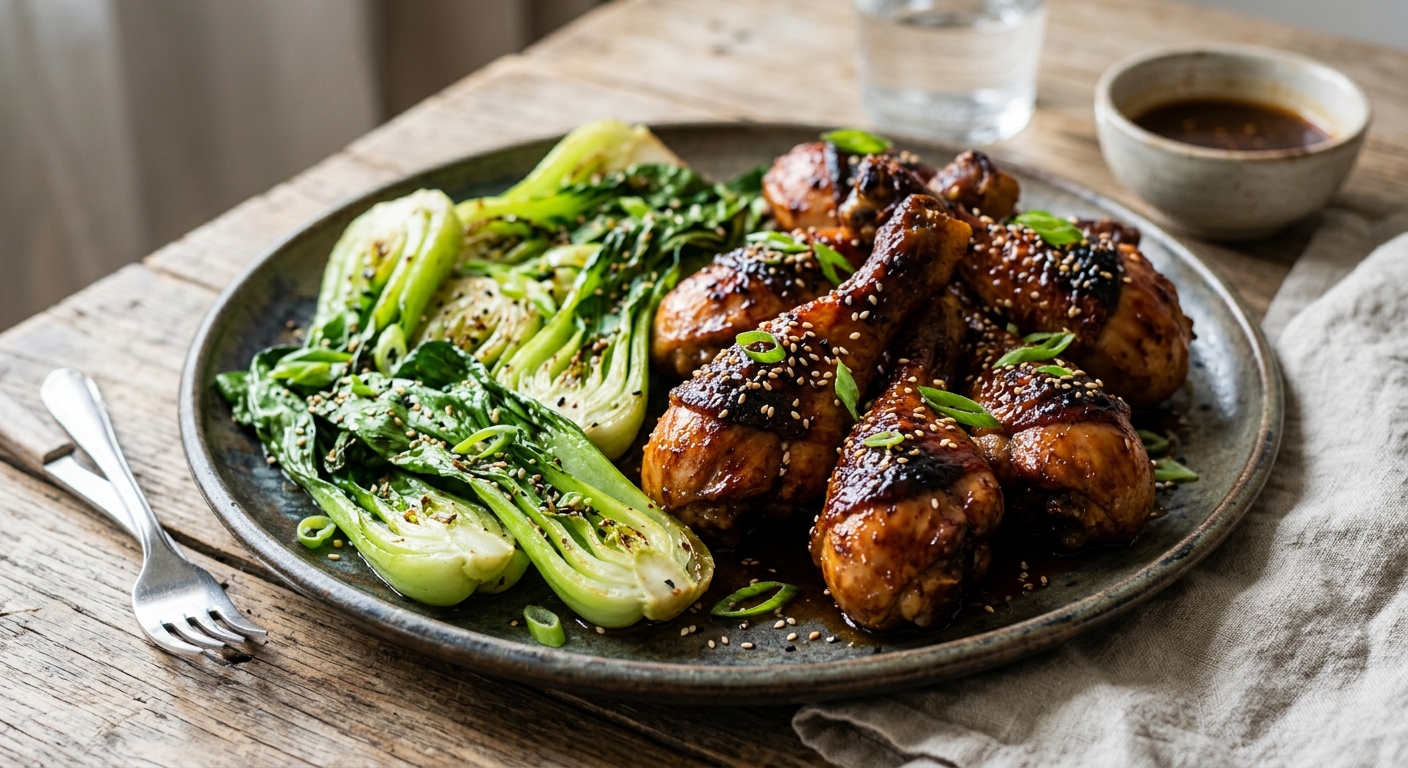
Honey-soy chicken is one of those rare combinations where deeply savory umami, floral sweetness, and aromatic garlic-ginger complexity all arrive at once. These drumsticks develop a glossy, caramelized lacquer that clings to every surface, while the bok choy stays crisp-tender and perfumed with toasted sesame. It is the kind of meal that feels indulgent but is quietly doing serious nutritional work behind the scenes.
What makes this dish a nutritional standout is the combination of high-quality animal protein from the drumsticks and the remarkable micronutrient density of bok choy. Chicken drumsticks are one of the most cost-effective sources of complete protein, selenium, phosphorus, and B vitamins available. Bok choy, meanwhile, is a cruciferous powerhouse, delivering vitamin K, vitamin C, folate, and a suite of glucosinolate antioxidants that support detoxification pathways in the liver. Together, they create a plate that genuinely moves the needle on your daily nutritional targets.
At Calibrated Cuisine, we have engineered the marinade ratio to balance sodium load while maximizing the Maillard browning that makes this dish so deeply flavorful. The honey is not just for sweetness, it provides fructose and glucose molecules that accelerate surface caramelization at lower temperatures than sucrose alone, meaning you get that lacquered glaze without burning the garlic. Whether you choose the stovetop, oven, slow cooker, or pressure cooker method, each approach has been calibrated for optimal texture and maximum nutrient retention.
4
servings
Ingredients
- 1200 gchicken drumsticks (about 8 drumsticks), skin-on
- 500 gbaby bok choy, halved lengthwise
- 60 mllow-sodium soy sauce
- 3 tbspraw honey
- 2 tbsptoasted sesame oil
- 1 tbsprice wine vinegar
- 4 clovesgarlic, minced
- 2 tspfresh ginger, finely grated
- 1 tbspcornstarch
- 2 tbspwater
- 1 tbspAvocado Oil100% Pure Avocado Oil (such as avocado or grapeseed oil)
- 2 tbspsesame seeds, toasted
- 3 stalksspring onions, thinly sliced
- —Colima Sea SaltMicroplastic Free Salt and white pepper to taste
Instructions
Click on an item below to shop for the recommended items for this recipe on Amazon.
As an Amazon Associate, we earn from qualifying purchases.
- Whisk together the soy sauce, honey, rice wine vinegar, minced garlic, and grated ginger in a bowl. Reserve 3 tablespoons of this marinade in a separate small bowl for finishing. Pat the drumsticks completely dry with paper towels and season lightly with white pepper. Place drumsticks in the remaining marinade and turn to coat. Allow to marinate at room temperature for 15 minutes while you prepare the bok choy.
- Heat the neutral oil in a large, heavy-bottomed skillet or braising pan over medium-high heat until shimmering. Lift the drumsticks from the marinade, letting any excess drip off, and lay them in the pan skin-side down. Do not crowd: work in two batches if necessary. Sear undisturbed for 5 to 6 minutes until the skin is deeply golden and releases naturally from the pan.
- Turn the drumsticks and sear the other side for 3 minutes. Pour the remaining marinade from the bowl into the pan, reduce the heat to medium-low, and cover with a lid. Braise the drumsticks for 18 to 20 minutes, turning every 6 minutes, until the internal temperature reads 82 degrees C (180 degrees F) on an instant-read thermometer and the juices run clear.
- While the drumsticks finish cooking, mix the cornstarch with 2 tablespoons of water in a small bowl to form a slurry. Remove the drumsticks to a plate. Increase the heat to medium-high and pour the cornstarch slurry into the pan juices, whisking constantly for 60 to 90 seconds until the sauce thickens to a glossy glaze. Spoon the glaze over the drumsticks and tent loosely with foil.
- Wipe out any dark residue from the pan and return it to high heat. Add 1 teaspoon of sesame oil and place the bok choy cut-side down in a single layer. Sear for 2 minutes without moving until charred at the edges. Add the reserved 3 tablespoons of marinade and toss vigorously for 1 to 2 minutes until the bok choy is just wilted but still has a firm bite. Plate the bok choy, nestle the glazed drumsticks on top, drizzle with remaining sesame oil, and finish with toasted sesame seeds and sliced spring onions.
- Combine the soy sauce, honey, rice wine vinegar, garlic, and ginger directly in the slow cooker insert and stir to dissolve the honey. There is no need to marinate separately. Season the drumsticks with white pepper and add them to the slow cooker, turning each piece to coat thoroughly in the sauce. Arrange them in as even a layer as possible, larger pieces on the outside where heat is greatest.
- Cover and cook on Low for 5 to 6 hours or High for 3 hours, until the meat is completely tender and beginning to pull away from the bone. The internal temperature should reach at least 82 degrees C (180 degrees F). Do not lift the lid during the first 2 hours, as this releases trapped steam and significantly extends cooking time.
- About 15 minutes before serving, preheat your oven broiler to high and line a baking sheet with foil. Carefully transfer the drumsticks from the slow cooker to the prepared baking sheet. Ladle the cooking juices from the slow cooker insert into a small saucepan over medium-high heat. Whisk in the cornstarch slurry (1 tablespoon cornstarch mixed with 2 tablespoons water) and cook for 2 minutes until the sauce reduces to a thick, glossy glaze.
- Brush the drumsticks generously with the reduced glaze and broil 15 cm from the element for 3 to 4 minutes, watching carefully, until the skin is blistered and caramelized. Brush once more with glaze halfway through broiling.
- While the drumsticks broil, heat 1 teaspoon sesame oil in a skillet over high heat. Add the bok choy cut-side down and cook for 2 minutes until charred. Add the reserved 3 tablespoons of marinade (set aside before adding drumsticks to slow cooker), toss for 1 to 2 minutes until just tender. Plate the bok choy, arrange the broiled drumsticks on top, drizzle with remaining sesame oil, and garnish with sesame seeds and spring onions.
- Set your Instant Pot or electric pressure cooker to Saute on High. Add the neutral oil and heat until shimmering. Pat the drumsticks dry and season with white pepper. Working in two batches, sear the drumsticks for 3 minutes per side until golden brown. Remove and set aside. This step builds the flavor base that the sealed environment will then deepen and concentrate.
- Pour the soy sauce, honey, rice wine vinegar, garlic, and ginger into the pot and use a wooden spoon or silicone spatula to scrape up any browned bits from the bottom. This is critical: any stuck residue will trigger a burn warning during pressurization. Stir until the honey is fully dissolved in the liquid.
- Return all drumsticks to the pot, nestling them in the sauce. Secure the lid and set the valve to Sealing. Cook on Manual High Pressure for 12 minutes. The pot will take approximately 8 to 10 minutes to come up to pressure before the 12-minute countdown begins.
- Once cooking is complete, perform a quick release by carefully turning the valve to Venting. When the float pin drops, open the lid. Transfer the drumsticks to a plate. Set the pot back to Saute on High. Whisk the cornstarch slurry (1 tablespoon cornstarch, 2 tablespoons water) into the remaining liquid and stir continuously for 2 to 3 minutes until the sauce reduces to a thick, glossy glaze. Spoon the glaze over the drumsticks and turn to coat.
- Cancel Saute. Add 1 teaspoon sesame oil and the bok choy directly to the warm pot. Toss the bok choy in the residual heat and sauce for 60 to 90 seconds until just wilted but still bright green. The carryover heat in the pot is perfectly calibrated for this delicate vegetable. Plate immediately, topping with glazed drumsticks, sesame seeds, and sliced spring onions.
- Combine the soy sauce, honey, rice wine vinegar, garlic, and ginger in a bowl or zip-lock bag. Add the drumsticks, turn to coat thoroughly, and marinate in the refrigerator for a minimum of 30 minutes, or up to 12 hours for deeper flavor penetration. Remove from the fridge 20 minutes before roasting to allow even cooking. Preheat the oven to 220 degrees C (425 degrees F) with a rack set in the upper third.
- Set a wire rack inside a rimmed baking sheet lined with foil. Lift the drumsticks from the marinade, allowing excess to drip off, and arrange them on the rack with space between each piece. Pour the remaining marinade into a small saucepan. Roast the drumsticks for 20 minutes.
- While the drumsticks roast, bring the reserved marinade to a simmer over medium heat and whisk in the cornstarch slurry. Cook for 2 minutes until thickened to a brushable glaze consistency. Remove from heat.
- After the first 20 minutes, brush the drumsticks generously with the reduced glaze. Return to the oven and roast for a further 20 to 25 minutes, glazing once more at the 15-minute mark, until the skin is deeply lacquered and the internal temperature reads 82 degrees C (180 degrees F). For extra char, switch the oven to broil for the final 2 to 3 minutes.
- Remove the drumsticks from the oven and rest for 5 minutes. While they rest, toss the halved bok choy in 1 tablespoon sesame oil and arrange cut-side up on a separate baking sheet. Slide into the oven (still at broil) for 3 to 4 minutes until the edges are lightly charred and the stems are just tender. Alternatively, cook the bok choy in a hot skillet as described in the stovetop method. Arrange on a platter, top with drumsticks, and finish with sesame seeds and spring onions.
Nutrition Breakdown
Per 1 serving (makes 4)
Vitamins & Minerals
% Daily Value based on a 2,000 calorie diet (FDA reference)
🧬 Essential Amino Acids
% of recommended daily intake (RDA) per serving
🛡 Antioxidant Profile
The Nutrition Science
Selenium is the nutritional story of this dish, and chicken is one of its most bioavailable dietary sources. Selenium in animal tissue exists predominantly as selenomethionine and selenocysteine, organic forms that are absorbed at 80 to 90 percent efficiency compared to roughly 50 percent for inorganic selenate found in supplements. Selenocysteine is the active form incorporated directly into glutathione peroxidase, the enzyme that neutralizes hydrogen peroxide and lipid hydroperoxides inside cells. A single serving of this recipe provides 65 percent of the daily value, making it one of the most efficient single-meal selenium deliveries possible from whole food.
Bok choy contributes a cruciferous antioxidant profile that is genuinely distinct from leafy greens like spinach or kale. Its glucosinolates, primarily sinigrin and glucobrassicin, are enzymatically converted to isothiocyanates when the vegetable is chewed or chopped. These compounds activate the Nrf2 transcription factor pathway, which upregulates the body’s own antioxidant gene expression, effectively boosting internal defenses rather than simply supplying antioxidants directly. The high-heat sear used in this recipe preserves a meaningful proportion of glucosinolates because the brief cooking time does not fully denature myrosinase, the enzyme responsible for their conversion. Vitamin C in bok choy also acts synergistically with selenium, regenerating oxidized glutathione back to its active reduced form.
The honey-soy marinade has a functional role beyond flavor. The reducing sugars in honey (glucose and fructose) participate in the Maillard reaction at temperatures above 140 degrees C, producing hundreds of flavor-active melanoidins that also carry mild antioxidant activity. Soy sauce contributes glutamate, which amplifies the perception of savoriness (umami) at concentrations too low to taste independently. Ginger contains gingerols and shogaols, pungent phenolic ketones with well-documented anti-inflammatory and anti-nausea properties, adding a further layer of functional benefit to what is already a nutritionally dense meal.
Pro Tips
- For maximum glaze adhesion, score the skin of each drumstick with two shallow diagonal cuts before marinating. This creates more surface area for the honey-soy lacquer to grip and also allows the marinade to penetrate deeper into the meat.
- Do not use dark sesame oil for cooking at high heat; it has a low smoke point and turns bitter. Use it only as a finishing oil drizzled over the plated dish for maximum aroma and to preserve its heat-sensitive lignan antioxidants (sesamin and sesamolin).
- Bok choy cooks in under 3 minutes at high heat. Have everything else plated and ready before you add it to the pan. Overcooked bok choy loses its bright color and crisp texture, and prolonged heat above 85 degrees C begins to degrade its water-soluble vitamin C content significantly.
Love that you’re tracking your inflammatory markers with CRP, Irene, that’s real data-driven eating! One quick sourcing note on the honey-soy combo though: conventional soy sauce often carries pesticide residues and sometimes hidden MSG, so I’d definitely grab organic tamari or coconut aminos if you haven’t already. For your ginger-turmeric swap, you could do a miso-ginger glaze (use red or chickpea miso for deeper umami) with fresh turmeric and a touch of maple syrup instead, which tends to have a more moderate glycemic impact than honey while still getting you that selenium from the chicken.
What a thoughtful suggestion about the tamari and coconut aminos, Klara! I’ve been teaching my cooking class students the same thing for years now, and I always say that switching to organic tamari is one of those functional swaps that actually makes the dish taste *better*, not just healthier. Your miso-ginger-turmeric glaze idea is absolutely brilliant – I’m actually planning to test a similar version with red miso next week for class since my students have been asking about lower glycemic options. The maple syrup swap is so smart too, and you’re right that it caramelizes beautifully on drumsticks without that sharp sugar spike you get from honey. Thanks for
ngl this selenium angle really speaks to me – after my heart attack five years ago my cardiologist flagged my levels and ive been obsessed with getting them up through food rather than supplements when i can. ive been making something similar in my slow cooker with bone broth instead of the glaze, adds collagen for artery health too, and the bok choy is perfect for the vitamin k your body needs for calcium regulation. thanks for tracking the micronutrient density like this, its exactly the kind of evidence-based approach that got my hdl numbers back where they needed to be.
This looks wonderful, but I have to ask – do you have any suggestions for swapping the honey-soy glaze for something with turmeric or ginger? I’ve found that the inflammatory response from refined sugars really spikes my CRP levels, even with honey, so I’ve been experimenting with ginger-miso glazes instead. The selenium and bok choy are exactly what I need though, and I love that you’re highlighting the vitamin K since I’ve noticed it helps with my joint mobility when I get enough of it!
oh this is such a smart swap and i love that youre tracking your actual inflammatory markers – ginger miso glaze sounds amazing and honestly miso is where its at for gut health too since its full of beneficial bacteria if you use unpasteurized! ive found that fermented condiments like miso and tamari are way gentler on my system than straight honey, plus the fermentation actually increases the bioavailability of minerals like that selenium youre after. if youre into experimenting, have you ever tried adding a splash of your own homemade ginger-turmeric ferment to the glaze? i make batches of ginger bugs that work beautifully as a base and the pr
Oh Kirsten, you’ve just given me the most wonderful idea for next month’s class! I’ve been teaching my students about fermented condiments for years, but I love how you’re connecting the dots between fermentation and mineral bioavailability, especially for selenium, because that’s exactly the kind of practical nutrition science that gets people excited about cooking differently. Your ginger bug suggestion is brilliant, and I’m absolutely going to experiment with that as a glaze base before I teach it, since homemade ferments give you so much more control than store-bought, and the flavor complexity would be a real upgrade from the traditional honey-soy approach I used to rely on.